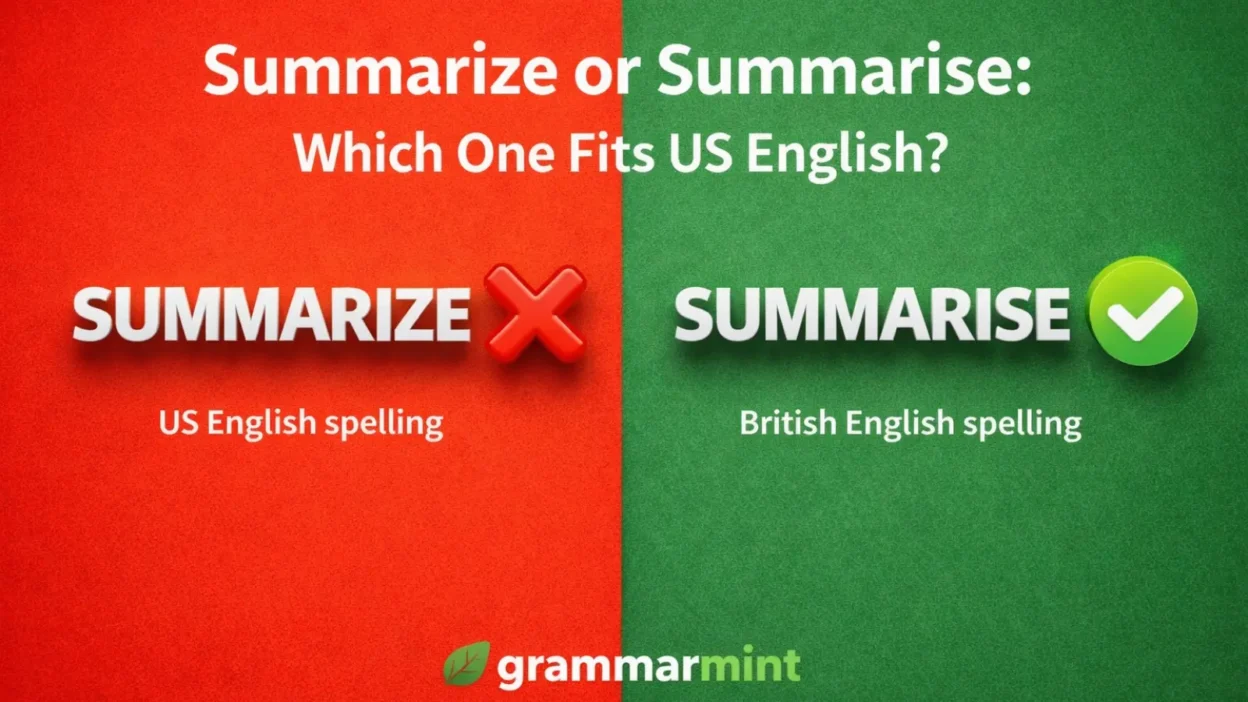
If you write for US readers, the Summarize or Summarise question comes up more often than it should. It shows up in school papers, business writing, editing, product copy, and even quick email recaps. American English usually wants summarize, while British English often prefers summarise. Still, the choice is not about intelligence or meaning. It is about regional spelling, style guide fit, academic writing, business writing, and your global audience. Oxford, Cambridge, and Merriam-Webster all reflect the same broad split. So this guide will help you choose the right form, avoid mixed spelling, and write with more confidence.
Quick Answer
Summarize or summarise: both are correct. Use summarize for US English, and use summarise for UK-focused writing. If your audience is mixed, choose one style early and keep it consistent.
TL;DR
• Summarize is standard in US English
• Summarise is common in UK English
• Both forms mean exactly the same thing
• Audience matters more than personal habit
• Don’t mix both spellings in one document
• In US writing, choose summarize
Summarize Vs Summarise
This is the core difference. The meaning stays the same, but the expected spelling changes with the audience.
• Same meaning, different regional spelling
• US spelling favors summarize
• UK spelling often favors summarise
• Both forms share one pronunciation
• Both forms work as verbs
• Neither changes sentence meaning
• The difference is visual only
• Audience decides the better choice
• Consistency matters more than preference
• Mixed pages look less polished
• Search results show both variants
• Editors notice the choice quickly
Which Is Correct
People often assume one form must be wrong. In practice, both are correct when they match the writing style around them.
• Both are correct in context
• Correct spelling depends on region
• Regional choice beats blanket rules
• US schools prefer summarize
• UK house styles often prefer summarise
• Some British publishers allow summarize
• American editors rarely want summarise
• Neither form is slang
• Neither form sounds smarter
• One letter changes nothing semantic
• The wrong move is mixing systems
• Pick one and stay with it
Summarize In American English
For a USA audience, this is the easy part. Summarize is the safe, standard choice almost every time.
• American English defaults to summarize
• US audience expects the z form
• US dictionaries list summarize first
• US classrooms teach the z spelling
• US business writing favors summarize
• American apps often use summarize
• Résumés read naturally with summarize
• Newsletters usually keep the z
• Corporate style sheets choose summarize
• Spellcheck in US mode agrees
• Summarise can look imported here
• Use summarize across US pages
Summarise In British English
British usage often leans the other way. That said, British English is a little more flexible than many writers expect.
• British English often prefers summarise
• Commonwealth usage often leans that way
• UK school materials use summarise often
• British reports may keep the s
• UK readers usually recognize both
• Summarise feels natural in British prose
• The meaning stays identical
• It pairs with summarised and summarising
• Many UK sites still choose -ise
• Australian editors may prefer it
• New Zealand usage often follows
• Canadian house style can vary
Can You Use Summarize In UK Writing
Yes, you can. However, the better answer is to check the local style before you submit or publish.
• Oxford style sometimes accepts -ize
• -ize ending isn’t always American there
• Many UK readers understand summarize
• Academic departments may allow either
• Newsrooms may have house preferences
• Check the publisher before submitting
• Match the document’s existing style
• One accepted choice beats mixing
• Formal UK copy may prefer summarise
• Student work should follow instructions
• Global brands often pick one standard
• When unsure, review local examples
Can You Use Summarise In US Writing
It is still understandable in the US. Even so, it usually looks off to American readers and editors.
• US editors usually expect summarize
• American reader may notice summarise
• Summarise can feel inconsistent in US copy
• It may trigger spellcheck warnings
• It can distract from the message
• Still, the meaning remains clear
• Imported quotes may keep summarise
• Brand names may preserve house style
• Fiction can reflect a UK voice
• Scholarly citations keep original spelling
• Most US webpages should avoid it
• Switch to summarize for local clarity
Why -ize And -ise Both Exist
This spelling split did not appear out of nowhere. It grew from older language history, dictionary choices, and publishing habits.
• Spelling history shaped both endings
• Greek-root tradition supports many -ize forms
• British house styles split over time
• American usage settled on -ize
• British usage kept both options alive
• Publishers normalized different preferences
• Schools reinforced local conventions
• Dictionaries now record the split
• Pronunciation did not cause the change
• Meaning never split into two verbs
• The pattern appears in related words
• Organize and organise show it too
Summary Vs Summarize
This is a basic but useful distinction. One word names the short version, and the other names the action.
• Summary is the noun
• Verb form is summarize or summarise
• Write a summary after reading
• Summarize the chapter before class
• Summary names the short version
• Summarize names the action
• Don’t swap noun and verb roles
• A summary can be one paragraph
• You summarize when you condense
• The pair shares one word family
• Summaries can be spoken too
• Good grammar keeps them separate
Summarizing Vs Paraphrasing
These are related skills, but they are not the same. A summary compresses broadly, while a paraphrase restates more closely.
• Paraphrasing rewrites specific points
• Main points drive a summary
• Summaries cut much more detail
• Paraphrases stay closer in length
• Summaries cover bigger chunks
• Paraphrases can track one paragraph
• Summaries can cover whole chapters
• Both should preserve meaning
• Both still need fair attribution
• Summary favors overview over detail
• Paraphrase favors restated precision
• Use the right tool deliberately
Summarize In Academic Writing
School and college writing make this question more visible. You need the right spelling, but you also need a sharp method.
• Academic writing values accuracy first
• Concise overview beats extra detail
• Summarize the thesis, not everything
• Keep the author’s point intact
• Use neutral reporting language
• Don’t slip opinions into summary
• Follow your school’s spelling style
• Match citation rules carefully
• Topic sentences strengthen summaries
• Word limits matter in class
• One clear paragraph often works
• Proofread for copied wording
Summarize In Professional Writing
Workplace writing rewards brevity with purpose. A strong summary helps busy readers act faster.
• Business writing rewards direct wording
• Executive summary highlights key outcomes
• Summarize decisions before background details
• Lead with results and next steps
• Keep numbers brief and exact
• Avoid long scene-setting paragraphs
• Busy readers want essentials fast
• Bullets improve quick scanning
• Match company spelling conventions
• Client-facing copy needs consistency
• Reports should end with a recap
• Clarity beats flourish every time
Summarize In Emails, Reports, And Notes
This is where the word earns its keep. Clear recap writing saves time, reduces confusion, and keeps teams aligned.
• Email recap keeps teams aligned
• Meeting notes need the essentials
• Start with the main takeaway
• Then list decisions and actions
• Add deadlines only when needed
• Keep names tied to tasks
• Short summaries reduce confusion later
• Subject lines can signal a recap
• Weekly reports benefit from condensation
• Project notes need simple wording
• Internal memos should stay scan-friendly
• End with the next step
Summarize In Apps, Menus, And Buttons
Product copy needs to feel natural to the user. Because of that, language settings matter more than personal preference.
• Interface text should stay familiar
• Product copy follows locale settings
• US products usually show summarize
• UK products may show summarise
• Buttons need the shortest clear label
• Menus should match platform language
• Inconsistent screens feel unfinished
• Tooltips can carry extra detail
• Global apps may localize both
• Help centers should mirror the UI
• Search boxes can accept either
• Localization beats one-size-fits-all copy
Real Sentence Examples
Examples make the choice easier. These lines show how each spelling sounds in normal writing.
• Please summarize the report before lunch
• Can you summarize yesterday’s client call
• The article summarizes the court’s ruling
• I’ll summarize the budget changes now
• She summarized the chapter in class
• Please summarise the findings for Friday
• He summarised the lecture in two lines
• The memo summarises the main risks
• Could you summarise the proposal briefly
• Our editor wants a summary first
• To summarize, the plan stays on track
• To summarise, the team chose option B
Common Mistakes To Avoid
Most errors here are not about vocabulary. They happen because writers drift between styles or confuse related forms.
• Mixed spelling weakens polished writing
• Style drift happens during revision
• Mistake: switching forms mid-page. Fix: choose one
• Mistake: copying a variant blindly. Fix: localize prose
• Mistake: using summary as a verb. Fix: summarize
• Mistake: overloading detail. Fix: keep essentials
• Mistake: adding opinions. Fix: stay neutral
• Mistake: padding sentences. Fix: cut filler
• Mistake: ignoring house style. Fix: check it
• Mistake: trusting spellcheck alone. Fix: set locale
• Mistake: forcing UK spelling for US readers
• Mistake: thinking both forms are wrong
How To Choose The Right Spelling Every Time
The best choice is usually obvious once you ask who will read the piece. So start with audience, then lock the style.
• Audience first solves most cases
• Brand voice should stay steady
• Use summarize for US-facing content
• Use summarise for UK-led documents
• Check your dictionary setting first
• Match nearby spellings carefully
• Review headings, captions, and buttons
• Keep templates locked to one style
• Follow client or teacher instructions
• Preserve quoted source spelling exactly
• When global, pick one standard early
• Final proofreading catches drift fast
FAQs
Which is correct, summarize or summarise?
Both are correct. Use summarize for US English and summarise for UK-focused writing.
Is summarize American English?
Yes. In modern US writing, summarize is the standard spelling you should usually choose.
Is summarise British English?
Yes, it is a common British spelling. However, some British styles also accept summarize, so context still matters.
Can summarize be used in British writing?
Yes, sometimes. Still, many UK readers and house styles will prefer summarise, so consistency matters.
Why do some writers use -ize instead of -ise?
Because English spelling traditions split over time. American English settled strongly on -ize, while British usage kept both forms in circulation.
What’s the difference between summarizing and paraphrasing?
Summarizing reduces a longer source to its main ideas. Paraphrasing restates a smaller part more closely in your own words.
Conclusion
Summarize or Summarise is not a trap once you know the audience.
Use summarize for US English, use summarise for UK-style copy, and keep your choice steady from start to finish.
That one small decision makes your writing look cleaner, clearer, and more intentional.