
You may see “main character” in books, movies, TV shows, classrooms, reviews, and social media posts. The phrase can describe the most important person in a story. It can also describe someone who acts like life is centered on them.
Knowing the difference matters because the tone changes by context. In a literature class, it is usually neutral. Online, it may sound playful, admiring, sarcastic, or critical.
This guide explains the plain meaning, slang meaning, pronunciation, part of speech, examples, related terms, and common mistakes. It also shows when the phrase sounds natural and when it sounds too dramatic.
Quick Answer
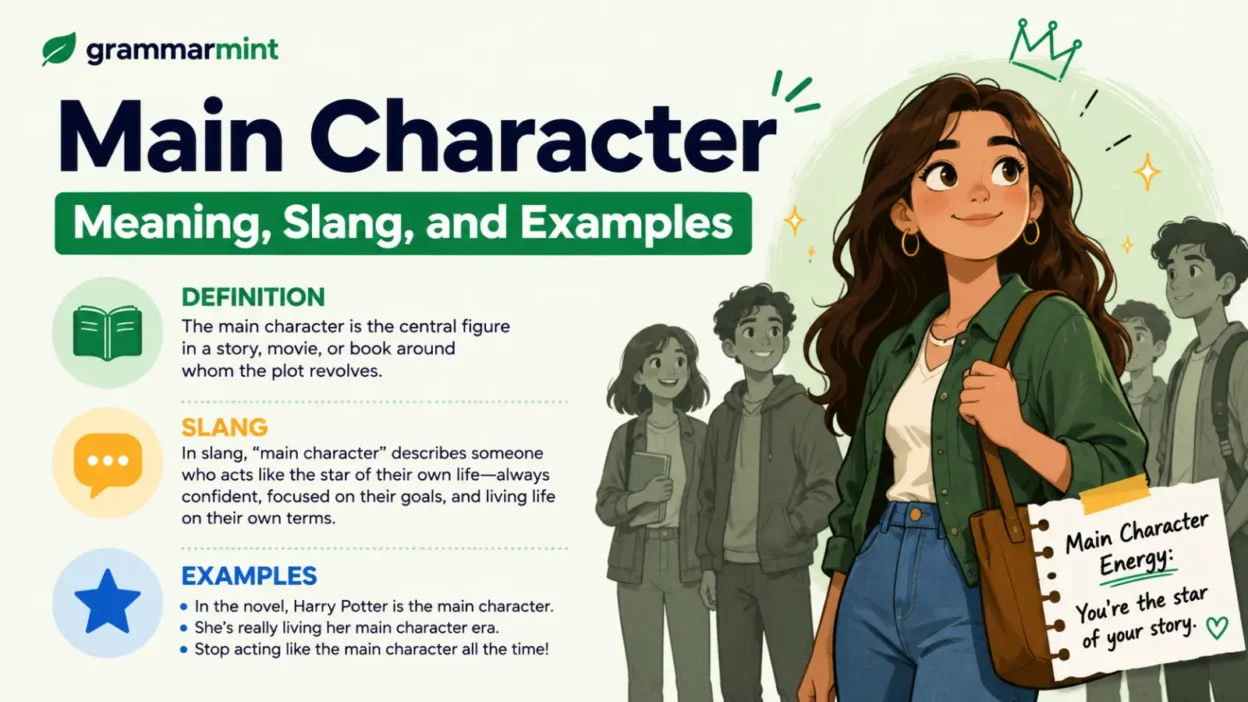
Main character meaning refers to the most important character in a story, movie, show, or game. In slang, it can describe someone who seems confident, noticeable, or overly focused on themselves.
TL;DR
• A main character is the central figure.
• It is usually a noun phrase.
• In stories, it often means protagonist.
• In slang, tone depends on context.
• It can be praise or criticism.
• “Main character syndrome” is not medical.
What Main Character Means in English
A main character is the character who matters most in a story. The plot often follows this person closely. Their choices, problems, and growth shape the story.
In plain English, “main character” means the central person, animal, or figure in a book, movie, show, play, or game.
Examples:
• The main character in the novel moves to Chicago.
• The movie’s main character learns to trust her team.
• The game lets you choose your main character.
• The main character changes after losing his job.
The phrase can also describe real life. In that use, it means the most important person or thing in a situation.
Example:
• At the family reunion, Grandma was the main character.
That sentence means everyone’s attention centered on Grandma.
Main Character Meaning in Slang
In slang, “main character” means someone who acts or feels like the star of their own life. It often appears in phrases like “main character energy.”
This use is common on social media. It can be positive, negative, or teasing.
Positive meaning:
• She wore the red coat and had main character energy.
• He finally quit that job and chose himself. Main character move.
Negative meaning:
• Stop acting like the main character in every group project.
• He made the whole party about himself.
Playful meaning:
• I bought coffee, walked in the rain, and felt like the main character.
The key is tone. If the speaker admires the confidence, it is praise. If the speaker sees selfishness, it is criticism.
Pronunciation and Part of Speech
“Main character” is pronounced:
• main KAIR-ik-ter
• /ˌmeɪn ˈker.ək.tɚ/
The phrase has two words. “Main” describes which character. “Character” names the person or figure.
Part of speech:
• Main character is a noun phrase.
• It can be singular or plural.
• The plural form is main characters.
Examples:
• The main character is brave.
• The main characters are siblings.
Do not write it as one word. “Maincharacter” is not standard.
Main Character in Stories
In stories, the main character is usually the person readers or viewers follow most closely. This character often faces the central problem.
The main character may be kind, selfish, funny, scared, brave, or flawed. A main character does not have to be perfect.
Examples:
• In a mystery, the main character may solve the case.
• In a romance, the main character may learn to trust love.
• In a drama, the main character may face a hard choice.
A main character is often the protagonist. However, writers sometimes treat the two terms differently.
A protagonist usually drives the main action. A main character is the person the story centers on. In many simple stories, they are the same person.
Main Character in Everyday Speech
People also use “main character” outside stories. In everyday speech, it can describe someone who stands out.
This use often appears in casual talk, texting, captions, and memes.
Examples:
• She walked into graduation like the main character.
• This song makes me feel like the main character.
• He thinks he is the main character at work.
• That outfit is giving main character.
At work or school, be careful. The phrase may sound too casual. Use “central person,” “key person,” or “lead figure” in formal writing.
Better formal example:
• Maria was the key person in the project.
Casual version:
• Maria was the main character of that project.
Main Character Energy and Main Character Syndrome
“Main character energy” means strong confidence or noticeable presence. It can describe someone who seems bold, stylish, focused, or self-assured.
Example:
• She gave her speech with main character energy.
That sentence usually sounds positive.
“Main character syndrome” is more negative. This describes behavior where someone treats life like a story centered only on them.
The phrase is not a medical diagnosis. Instead, it is an informal way to talk about attitude and behavior.
| Context | Best Choice | Why |
|---|---|---|
| Story discussion | main character | Clear and neutral |
| Complimenting confidence | main character energy | Sounds modern and positive |
| Criticizing self-focus | main character syndrome | Shows excessive self-importance |
| Formal writing | central figure | More professional |
Use “main character syndrome” carefully. It can sound harsh.
How to Use Main Character Correctly
Use “main character” when you mean the central figure in a story. Use it in slang when the tone is casual and clear.
Good story examples:
• The main character wants to find her brother.
• The main character changes by the final chapter.
• The show has two main characters.
Good slang examples:
• I felt like the main character on my first day in New York.
• He has main character energy when he performs.
• She is not rude. She is just confident.
Use context to avoid confusion.
Weak sentence:
• The main character of the meeting was the budget.
Better sentence:
• The budget was the main focus of the meeting.
A budget is not a character. “Main focus” fits better.
Synonyms, Antonyms, and Related Terms
The best synonym depends on context.
Close synonyms:
• protagonist: the leading character in a story
• lead: the main role in a movie, show, or play
• central character: a clear, formal option
• leading character: a common story term
• key figure: useful for real-life situations
Possible antonyms:
• side character: a less central character
• supporting character: a character who helps the main story
• background character: a minor figure with little focus
• extra: a small role, often in film or TV
Related terms:
• hero: a good or admired lead character
• villain: an evil or harmful character
• narrator: the voice telling the story
• antagonist: the force or person opposing the protagonist
Do not use “hero” as an exact synonym. A main character can be a villain.
Common Mistakes and Clear Examples
Mistake 1: Thinking every main character is a hero.
Wrong:
• The main character is always the good person.
Better:
• The main character is the central person, good or bad.
Mistake 2: Using “main character syndrome” too seriously.
Wrong:
• She has a disease called main character syndrome.
Better:
• People jokingly say she has main character syndrome.
Mistake 3: Using slang in formal writing.
Too casual:
• The speaker had main character energy.
More formal:
• The speaker had strong presence and confidence.
Mistake 4: Confusing “main character” with “main idea.”
Wrong:
• The main character of the paragraph is climate change.
Better:
• The main idea of the paragraph is climate change.
Mini Quiz
Choose the best answer.
- What is a main character in a story?
A. The central character
B. A random background person - Is “main character energy” always negative?
A. Yes
B. No - Which is more formal?
A. Main character energy
B. Strong presence - Can a villain be the main character?
A. Yes
B. No - What is the plural of main character?
A. Main characters
B. Mains character
Answer key:
- A
- B
- B
- A
- A
FAQs
What Does Main Character Mean?
“Main character” means the central character in a story, movie, show, play, or game. The story usually follows this character most closely.
In slang, it can mean someone who acts like life centers on them. The tone depends on the sentence.
What Does Main Character Mean in Slang?
In slang, “main character” describes someone who seems like the star of their own life. In slang, the phrase can suggest confidence, style, attention, or self-focus.
Sometimes it works as a compliment or a joke. In other cases, it may sound critical if someone seems selfish.
What Is Main Character Energy?
“Main character energy” means confident, noticeable, or bold behavior. It often suggests someone is showing up with strong presence.
People use it in captions, comments, and casual speech. It usually sounds playful or admiring.
Is Main Character Energy a Compliment?
The phrase can be complimentary when it praises someone’s confidence, style, or bold mood.
It can also sound sarcastic when the person seems overly self-important. If someone is being selfish, the phrase may sound critical.
What Is Main Character Syndrome?
“Main character syndrome” is an informal phrase. It describes acting as if everyone else is only part of your story.
It is not a medical diagnosis. Use it carefully because it can sound judgmental.
Is a Main Character the Same as a Protagonist?
In many stories, yes. The main character and protagonist are often the same person.
In some writing discussions, they can differ. The protagonist drives the main action, while the main character receives the central focus.
Can the Main Character Be a Villain?
Yes. A main character can be good, bad, or morally mixed.
The phrase describes story importance. It does not always describe moral goodness.
Conclusion
Main character meaning depends on context. In stories, it means the central character. In slang, it can mean confidence, attention, or self-focus.
Use the phrase when the central role is clear. For formal writing, choose “central character” or “key figure” when needed.