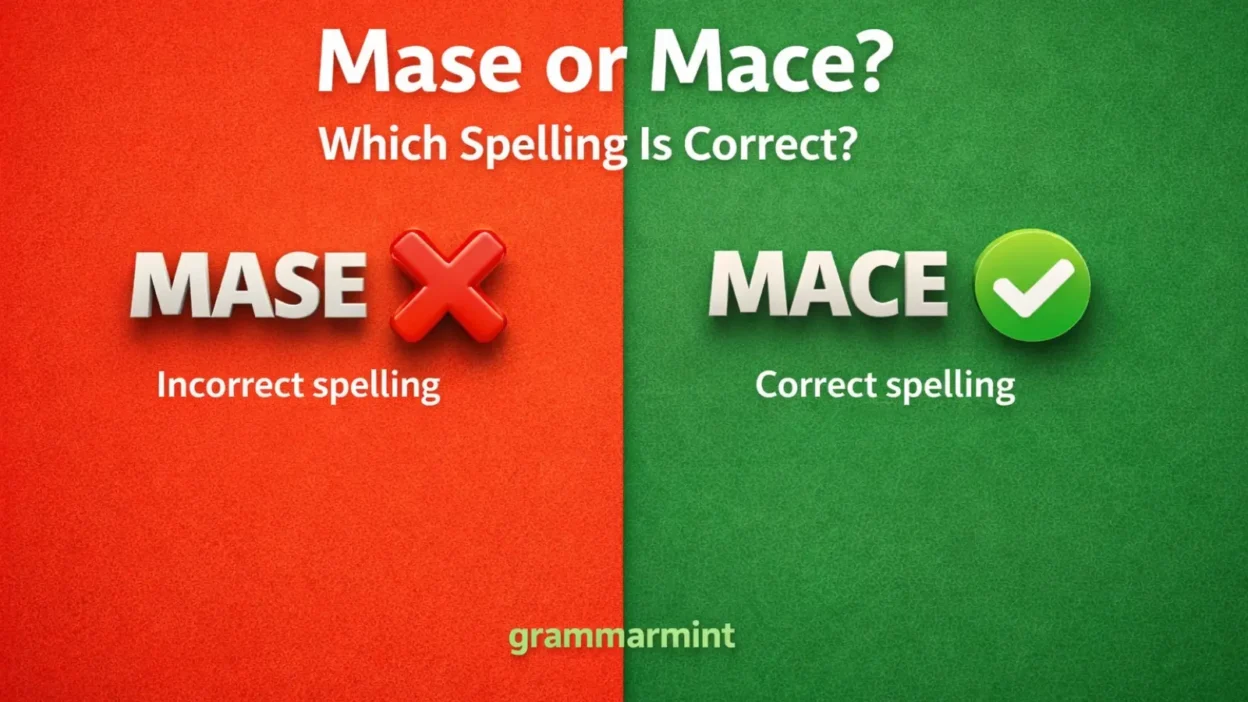
If you’re writing for school, work, or everyday life, the choice between Mase or Mace can trip you up fast. These two spellings sound the same, yet they point to very different things: a spice, pepper spray, a medieval weapon, a proper noun, and a common spelling mistake. You might see the word near nutmeg, Mace Brand, history writing, or a person’s name, which is why the confusion sticks. This guide clears up the right spelling, the rare exception, the sound pattern, and the easiest way to choose the right form every time.
Quick Answer
Mase or Mace? In standard American English, mace is the correct spelling for the spice, the weapon, and the common spray term. Mase is usually a name or a rare niche form, not the word most writers need.
TL;DR
• Use mace for the normal English word.
• Use Mase mainly as a name.
• This is not a US-UK split.
• Context decides the exact meaning.
• Spray wording adds a brand twist.
• Proofreading fixes this fast.
Mace Meaning
Here, the key ideas are spice, common noun, and usage. In plain English, mace is the standard spelling, but its meaning changes with context.
• Standard spelling in everyday English.
• Names a spice from nutmeg.
• Can name a heavy medieval club.
• Also names ceremonial staffs.
• Often refers to defense spray casually.
• Usually works as a noun.
• Context chooses the exact sense.
• Cooking uses stay lowercase.
• History uses stay lowercase too.
• Ceremony uses stay lowercase too.
• Brand references may be capitalized.
• One letter changes the meaning.
Mase Meaning
This section centers on proper noun, rare form, and technical verb. In modern writing, Mase is not the spelling most people want.
• Usually appears as a personal name.
• Often takes a capital letter.
• Rare in standard daily writing.
• Not the normal spice spelling.
• Not the common weapon spelling.
• Not the everyday spray spelling.
• May appear in stage names.
• Can show up in surnames.
• A niche technical verb exists.
• Obsolete forms appear in older texts.
• Modern usage stays very limited.
• Most writers never need it.
Mace In Cooking
In food writing, think nutmeg, aril, and baking spice. This is one of the clearest meanings of mace, so it is a good anchor for remembering the correct spelling.
• Comes from the nutmeg covering.
• Has a warm, fragrant flavor.
• Common in baking and sauces.
• Often used in small amounts.
• Pairs well with cream dishes.
• Shows up in holiday recipes.
• Works in savory dishes too.
• Ground mace is easiest to find.
• The spice stays lowercase.
• It is not spelled mase.
• Recipe context makes meaning obvious.
• Nutmeg clues usually settle it.
Mace As Pepper Spray
Now the useful terms are defense spray, brand name, and lowercase. Everyday speech often uses mace for spray, even when the exact product name differs.
• Many people say mace for spray.
• Everyday wording can be loose.
• Brand wording can be stricter.
• Lowercase fits generic casual use.
• Capital letters signal a brand.
• News wording varies by context.
• Product wording may be more exact.
• Legal writing prefers precise naming.
• Casual speech often shortens terms.
• The sound stays the same.
• The spelling still uses c.
• Mase spray looks incorrect.
Mace Vs Pepper Spray
The big ideas here are trademark, generic term, and product wording. This is where many pages get fuzzy, so clear wording helps.
• Mace can be a brand.
• Pepper spray is the generic product.
• Not every pepper spray is Mace.
• Casual speakers mix them freely.
• Formal writing should be more precise.
• Brand style can affect capitalization.
• Product labels may say pepper spray.
• Everyday speech may just say mace.
• The meanings overlap in conversation.
• The terms are not perfect twins.
• Precision matters in careful writing.
• Spelling never changes to mase.
Mace As A Weapon
Here, the useful anchors are medieval club, flanged head, and armor. This sense is older, but it still appears in history, fantasy, and gaming writing.
• A mace is a weapon.
• It is a heavy striking club.
• Some versions have flanged heads.
• Some versions have spikes.
• It appears in medieval history.
• It shows up in fantasy stories.
• Games use the term often.
• The word is always mace.
• Weapon context removes doubt quickly.
• Armor writing often includes it.
• It is not related to names.
• This sense stays lowercase normally.
Mace As A Ceremonial Staff
The central terms here are parliament, university, and authority. In civic or academic settings, mace often means an ornamental staff that represents office or power.
• Ceremonial maces symbolize authority.
• They appear in parliaments and universities.
• Processions often include one.
• The object is decorative, not practical.
• It comes from the weapon sense.
• Formal events keep the older term.
• Academic traditions still use it.
• Civic rituals may feature it.
• The spelling remains unchanged.
• Staff-of-office meaning is still current.
• Context sounds official and formal.
• Readers rarely confuse this with Mase.
How To Spell Mace Spray
This section focuses on spelling, self-defense term, and capitalization. When the topic is spray, the safe writing rule is simple.
• Write mace spray, not mase spray.
• Use lowercase in generic phrasing.
• Use uppercase for brand styling.
• Copy product labels when accuracy matters.
• Keep the c in normal writing.
• Don’t spell by sound alone.
• Homophones often fool fast typists.
• Proofread the word after drafting.
• Product context helps confirm spelling.
• Brand context affects the capital letter.
• Everyday notes can stay simpler.
• The wrong vowel won’t fix it.
Is Mase A Word
The useful markers here are obsolete, niche, and dictionary trace. The honest answer is yes, but almost never in the way ordinary writers mean.
• Rarely, yes, mase appears.
• It is not a common choice.
• Some dictionaries show niche senses.
• Older texts may carry variants.
• Technical language can revive odd forms.
• Everyday editors still avoid it.
• Most people never encounter it.
• It does not replace mace.
• It does not help recipes.
• It does not fit weapon history.
• It does not fix spray wording.
• Usual writing still favors mace.
Is Mase Ever Correct
Here, think name, context, and exception. The answer is yes, but only in limited situations.
• Correct when it is someone’s name.
• Correct in stage-name references.
• Correct in some surname uses.
• Correct in rare niche dictionary cases.
• Correct in quoted historical spellings.
• Incorrect for the spice meaning.
• Incorrect for the club meaning.
• Incorrect for generic spray wording.
• Context makes the exception obvious.
• Capitalization often gives the clue.
• Lowercase mase looks suspicious today.
• Most corrections should change it.
Why Mace And Mase Sound The Same
The key ideas are homophone, pronunciation, and long A. Because they sound alike, your ear cannot solve this problem by itself.
• Both are pronounced the same.
• Each uses the long A sound.
• They rhyme with face.
• Sound alone cannot guide spelling.
• Context must do the work.
• Fast typing increases the mix-up.
• Spellcheck may miss name confusion.
• Your brain follows sound first.
• Proofreading must follow meaning next.
• This is a classic homophone trap.
• Short words create sneaky mistakes.
• One letter carries the difference.
Mace In A Sentence
Now use examples, context clue, and sentence pattern. Real sentences make the distinction much easier to remember.
• She added mace to the soup.
• The knight raised a heavy mace.
• The silver mace led the procession.
• He carried mace for protection.
• The recipe called for ground mace.
• The museum displayed an iron mace.
• Their ceremony began with the mace.
• Mase released a new song.
• I met a student named Mase.
• That email should say mace, not mase.
• Context fixed the typo instantly.
• Meaning decides the right sentence.
Mace Pronunciation
In this sound guide, keep rhymes with face, one syllable, and stress in mind. The pronunciation is simple, which is partly why the spelling error happens so often.
• Say it like mays.
• It rhymes with face.
• It rhymes with lace.
• It is one syllable.
• The word carries one beat.
• There is no hidden vowel.
• The ending sounds like -ace.
• Pronunciation does not reveal the c.
• Sound alone invites spelling slips.
• Name use sounds identical too.
• Reading aloud won’t solve meaning.
• Visual checking still matters most.
Mace Vs Maze
This nearby confusion uses maze, spelling slip, and lookalike. While it is a different issue, it shows how one small letter can send the reader somewhere else.
• Maze means a puzzle path.
• Mace means a different thing.
• The words are not synonyms.
• Only one letter changes shape.
• The sounds are close enough.
• Typists can swap them accidentally.
• Context exposes the mistake fast.
• History writing wants mace.
• Puzzle writing wants maze.
• Recipe writing never wants maze.
• Name writing rarely wants either.
• A quick reread catches this.
Mase As A Name
This section uses capitalization, first name, and stage name. When Mase is a name, it stops being a spelling error and becomes a proper noun.
• Capitalize Mase when it’s a name.
• Names follow different rules.
• Stage names count as names.
• First-name context makes it clear.
• Surname context can help too.
• A name does not become spice.
• A name does not become weapon.
• A name does not become spray.
• Capital letters guide the reader.
• Lowercase usually removes that clue.
• Sentence context should confirm identity.
• Proper nouns create the exception.
Memory Tricks For Mace Or Mase
Use memory hook, object word, and name clue here. Once you connect the spelling to the meaning, the mistake becomes much easier to avoid.
• Mace has a c for common word.
• Mace names concrete objects and uses.
• Mase looks more like a name.
• Think mace with cooking cards.
• Think mace with castle combat.
• Think mace with ceremony halls.
• Think Mase on a badge.
• Object meanings usually take mace.
• Person meanings may take Mase.
• Ask, “Thing or name?” first.
• Then choose the spelling fast.
• One quick check prevents embarrassment.
FAQs
What is the difference between mace and mase?
Mace is the standard English spelling for the spice, the weapon, and the common spray term. Mase is usually a name or a rare niche form, so it is not the spelling most writers want.
Is “mase” ever correct?
Yes, but only in limited contexts. It can be correct as a name, and rare dictionary traces exist, but it is not the normal spelling for the common word.
What is “mace” in cooking?
In cooking, mace is a spice that comes from the outer covering of nutmeg. It has a warm, aromatic flavor and often appears in baking, sauces, and seasonal dishes.
Does “mace” mean pepper spray?
In everyday speech, many people use mace to mean pepper spray. Still, product wording can be more exact, and Mace can also refer to a brand name rather than the whole category.
How do you use “mace” in a sentence?
You can write, “She added mace to the sauce,” or “The guard carried a mace in the parade.” The context tells the reader whether you mean spice, weapon, ceremonial staff, or spray.
Which spelling is preferred in American English?
American English prefers mace for the ordinary word. Mase is not an American variant of the same term, so this is not a real US-versus-UK spelling split.
Conclusion
When you’re choosing Mase or Mace, the safe default is simple: use mace unless you truly mean a name or a rare exception.
Check the context, read the sentence once more, and the right spelling usually becomes obvious.