
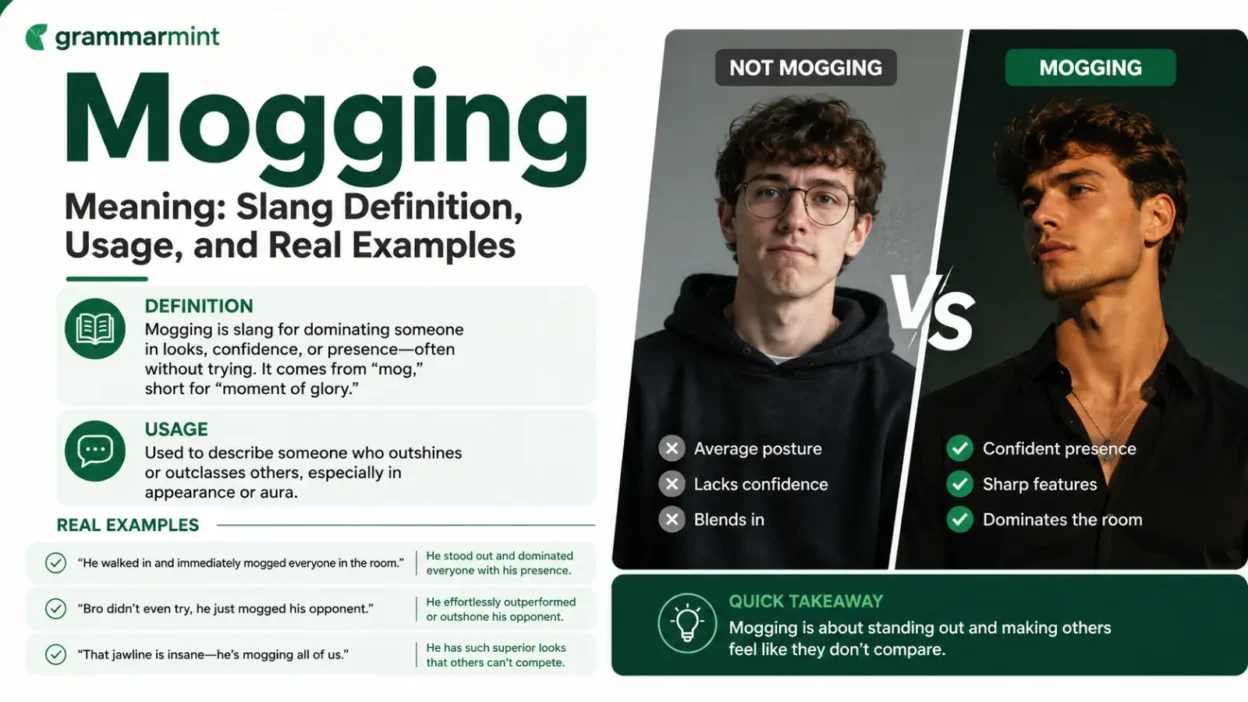
You may see mogging in TikTok comments, gym videos, livestream clips, and teen slang posts. Someone may say a tall guy is “mogging” the room. Another person may say a gamer “mogged” everyone in a match. In many cases, the word points to comparison. It usually means one person looks better, performs better, or seems more dominant.
The word matters because it is not always harmless. It can mean outclassing someone in a joking way. Yet it can also sound rude, competitive, or appearance-obsessed. Some people use it as praise. Others use it to make someone feel small. This guide explains the meaning in plain English. It also covers slang use, pronunciation, word forms, examples, origin, related terms, and safer usage notes.
Quick Answer
Mogging meaning: mogging is slang for outclassing, outshining, or dominating someone in comparison. It often refers to looks, body, style, confidence, or performance.
TL;DR
• Mogging means outclassing someone.
• It is informal internet slang.
• It often relates to appearance.
• It can be playful or rude.
• “Mog” is the base verb.
• Avoid it in formal writing.
What Does Mogging Mean?
Mogging means making someone else look weaker, smaller, less attractive, or less impressive by comparison. The idea is not just being good. It is being so good that another person seems outclassed.
In plain English, mogging means “showing someone up.” It can describe looks, fitness, style, confidence, skill, or status.
Examples:
• He is mogging everyone at the gym.
• Her outfit mogged the whole room.
• That player mogged the other team.
• His confidence was mogging everyone on stage.
The meaning depends on context. It may sound funny among friends. It may sound mean when used to judge someone’s body or face.
Mogging Meaning In Slang And Common Contexts
In slang, mogging usually appears in online comments. People use it when comparing one person with another. The comparison is often direct, visual, and exaggerated.
Common contexts include:
• Gym videos
• Fashion posts
• Beauty comments
• Livestream clips
• Gaming highlights
• Teen slang posts
• Meme captions
Appearance-based comments often use mogging to mean someone looks more attractive. In gaming or sports, it can mean someone performed much better. Style posts may use it when one outfit clearly outshines another.
| Context | Best Choice | Why |
|---|---|---|
| Friend joking about an outfit | “You mogged us today.” | Playful praise |
| Formal work email | “You performed very well.” | More professional |
| Comment about someone’s body | Avoid “mogging” | It may sound judgmental |
| Gaming highlight | “He mogged the lobby.” | Common casual use |
Use the word only when the setting is casual. Even then, make sure it does not insult someone.
Pronunciation, Part Of Speech, And Word Forms
Mogging is usually pronounced “MAW-ging.” It sounds close to “logging” for many American speakers. Do not pronounce it like “moe-ging.”
The base word is “mog.” In modern slang, “mog” works as a verb. It means to outclass or outshine someone.
Common word forms:
• mog: base verb
• mogs: present form
• mogged: past tense
• mogging: action or ongoing form
• mogger: person doing the mogging
• moggee: person being outclassed
Examples:
• He mogs everyone in photos.
• She mogged the room with that jacket.
• They are mogging the other team.
• The mogger got all the attention.
“Mogging” can also work like a noun. In that use, it names the act itself.
Example:
• The whole comment section talked about the mogging.
How To Use Mogging In A Sentence
Use mogging when the tone is casual and internet-style. It works best in comments, captions, jokes, and informal chats. It does not fit serious school, work, or business writing.
Natural examples:
• His new haircut is mogging everyone.
• She walked in and mogged the group photo.
• That team mogged us in the final round.
• He got mogged by his younger brother.
• This suit is mogging my old one.
• Their stage presence mogged the opener.
You can also use “mogged” when the comparison already happened.
Example:
• I thought my outfit was good, but Maya mogged me.
The sentence sounds casual and slightly dramatic. That is part of the slang effect.
Tone, Context, And When Not To Use It
Mogging can sound playful when friends use it lightly. It can also sound harsh because it ranks people. That is why the word needs care.
Use it when:
• The tone is joking.
• Everyone understands the slang.
• The comment is not cruel.
• The comparison is about performance or style.
Do not use it when:
• You are judging someone’s body.
• The person may feel embarrassed.
• You are writing formally.
• The comment sounds like bullying.
Better choices include “outperformed,” “stood out,” “looked great,” or “won the moment.” These words are clearer and kinder in many settings.
Origin And History
The slang “mogging” is commonly traced to AMOG, meaning “alpha male of the group.” It came from online spaces focused on male status, dating, and dominance. Because of that history, the word can carry a competitive tone.
Over time, the meaning spread into wider internet slang. Today, many people use it more loosely. It may describe looks, style, confidence, fitness, gaming, or social presence.
Still, its history matters. The word can sound funny in memes, but it can also support unhealthy comparison. Use it with that background in mind.
Related Terms, Synonyms, And Antonyms
Mogging is connected to several internet slang terms. Some are playful. Others can sound judgmental or extreme.
Related terms:
• mog: to outclass someone
• mogged: outclassed or shown up
• looksmaxxing: trying to improve physical appearance
• frame-mogging: outclassing someone through body frame
• hair-mogging: outclassing someone through hairstyle
• aura: a person’s vibe or presence
• rizz: charm or flirting confidence
Close synonyms depend on context.
Useful synonyms:
• outclassing
• outshining
• outperforming
• showing up
• dominating
• upstaging
There is no perfect single-word antonym. Close opposite phrases include “getting mogged,” “being outclassed,” and “being upstaged.”
Common Mistakes
Mistake: Using mogging in formal writing.
Correction: Use “outperformed” or “outclassed.”
Mistake: Thinking mogging only means beauty.
Correction: It can also mean skill, style, size, or confidence.
Mistake: Using it to insult someone’s body.
Correction: Avoid body-based comparisons.
Mistake: Spelling it “moging.”
Correction: The common spelling is “mogging.”
Mistake: Treating it as always positive.
Correction: It can be praise, teasing, or an insult.
Mistake: Saying “moe-ging.”
Correction: Say “MAW-ging.”
Mini Quiz
- What does mogging usually mean?
- Is mogging formal or informal?
- Which is better in a work email: “mogged” or “outperformed”?
- What is the past tense of mog?
- Why can mogging sound rude?
Answer key:
- Outclassing or outshining someone.
- Informal.
- Outperformed.
- Mogged.
- It can rank people by looks or status.
FAQs
What does mogging mean?
Mogging means outclassing, outshining, or dominating someone by comparison. It often refers to looks, style, size, confidence, or performance. The word is informal slang.
What does mog mean in slang?
“Mog” means to outclass or show someone up. It is the base verb behind “mogging” and “mogged.” People often use it in online comments.
Is mogging a compliment?
It can be a compliment in casual slang. For example, “You mogged everyone” can mean “You looked amazing.” However, it can also sound like an insult toward others.
What does mogged mean?
“Mogged” is the past tense of “mog.” It means someone was outclassed or shown up. Example: “He got mogged in the group photo.”
Is mogging related to looksmaxxing?
Yes, it is often connected with looks-focused internet culture. In that context, it means outclassing someone in appearance. However, people also use it for style, gaming, and performance.
Where did mogging come from?
Mogging is commonly linked to AMOG, short for “alpha male of the group.” Its full history is messy and tied to online status culture. Today, its use is broader and often more joking.
Should I use mogging in everyday English?
Use it only in casual settings where people know the slang. Avoid it in formal writing, school assignments, work emails, or sensitive comments. Clearer words are often better.
Conclusion
Mogging meaning is simple: it means outclassing or outshining someone. The tricky part is tone.
Use it carefully in casual slang. When respect matters, choose a clearer and kinder word.
[…] the clear rule, the history behind both forms, and how to choose confidently. You’ll also see real examples from texting, work emails, and medical […]