You may see standing on business in texts, captions, songs, memes, short videos, or casual conversations. Someone might say, “I’m standing on business,” after keeping a boundary. Another person might use it after finishing a hard task.
The phrase matters because it does not always mean real business. In modern slang, it usually means handling your responsibilities, keeping your word, or refusing to back down. It can sound confident, serious, funny, or dramatic, depending on context.
This guide explains the phrase in plain English. You will learn what it means, how to use it, when to avoid it, and how it appears in everyday American English.
Quick Answer
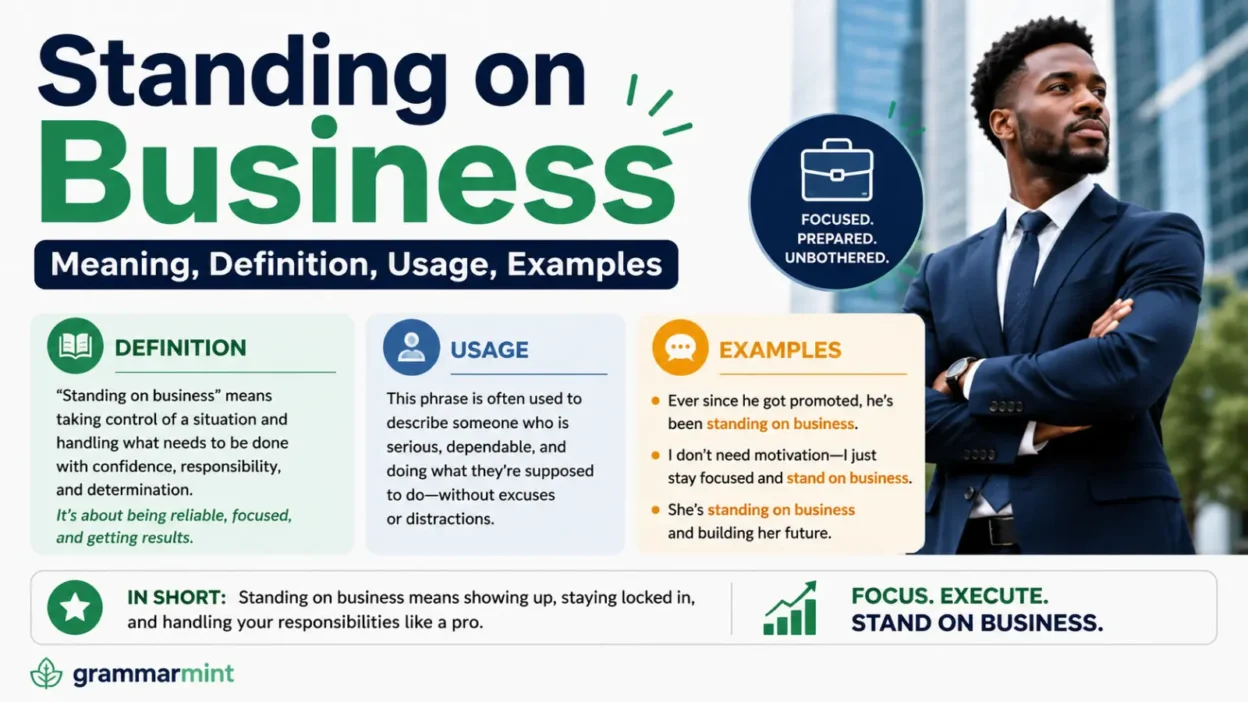
Standing on business meaning: handling your responsibilities, keeping your word, and standing firm on what you said or believe.
It is informal slang. Use it when someone follows through and does not fold under pressure.
TL;DR
• It means handling what matters.
• It is informal slang.
• It can mean standing firm.
• It often shows confidence.
• Avoid it in formal writing.
What Standing on Business Means in Plain English
Standing on business means doing what you said you would do. It also means taking care of your responsibilities without excuses.
The “business” in the phrase can mean your duties, values, goals, or boundaries. It does not always mean a company or job.
Simple meaning:
• You keep your word.
• You handle your responsibilities.
• You do not back down easily.
• You act instead of only talking.
Example:
“I told them I would finish the project, and I did. I was standing on business.”
Here, the speaker means they followed through.
Meaning in Slang and Modern English
In slang, standing on business often means being serious about your words and actions. It can also mean standing firm in a conflict, decision, or personal boundary.
People use it in a serious way:
“She said she would stop answering late-night texts, and she did. She’s standing on business.”
They also use it in a joking way:
“I deleted the food app to save money. I’m standing on business.”
In modern English, the phrase often carries pride. It says, “I meant what I said.”
However, it is still casual. It works best in friendly speech, captions, comments, and informal messages.
Pronunciation and Part of Speech
Pronunciation: STAN-ding on BIZ-niss
The stress is strongest on stand and biz. Say it smoothly as one phrase.
Part of speech: phrase
It is built from the verb phrase stand on business. In standing on business, “standing” is the present participle form.
Common forms:
• I stand on business.
• She stands on business.
• We are standing on business.
• He stood on business.
The phrase works like an action. It tells what someone is doing or choosing to do.
How to Use Standing on Business Correctly
Use standing on business when someone acts with follow-through. The action should show discipline, responsibility, or firmness.
Good sentence examples:
• “I paid my bills first. I’m standing on business.”
• “She set a deadline and kept it.”
• “He apologized and fixed the mistake.”
• “They promised better service, then delivered.”
You can also use it after a decision:
“I’m not arguing anymore. I’m standing on business.”
That means the speaker is staying firm.
Small comparison table:
| Context | Best Choice | Why |
|---|---|---|
| Casual text | standing on business | Sounds natural and current |
| Formal email | following through | Sounds professional |
| Personal boundary | standing firm | Clear and respectful |
| Work report | meeting commitments | Fits formal tone |
The phrase is strongest when the action matches the words.
Common Contexts and Examples
You will often see this phrase in social media captions. It can make a simple action sound bold or funny.
Caption examples:
• “Finished the work before the deadline. Standing on business.”
• “Blocked distractions all week.”
• “Saved money instead of ordering out.”
In relationships, it often means keeping a boundary.
Example:
“I told him I needed respect. Now I’m standing on business.”
In school or work, it can mean taking responsibility.
Example:
“She missed one deadline, then created a better plan. Now she’s standing on business.”
In arguments, it can mean not changing your position.
Example:
“I said what I said, and I can explain why.”
Use this tone carefully. It can sound confident, but it can also sound stubborn.
When Not to Use Standing on Business
Do not use standing on business in formal writing. It may sound too casual for reports, applications, or official emails.
Avoid it here:
• job applications
• academic essays
• business proposals
• legal documents
• formal apologies
Instead, choose clearer wording.
Better formal choices:
• “I followed through.”
• “I kept my commitment.”
• “I maintained my position.”
• “I handled the matter responsibly.”
Also avoid it when the listener may not know slang. A simple phrase will be easier to understand.
Related Terms, Synonyms, Antonyms, and Origin
Related terms include:
• stand on business
• standing on biz
• stand firm
• stand your ground
• practice what you preach
• walk the talk
• handle your business
Close synonyms:
• follow through
• keep your word
• take responsibility
• stay firm
• back up your claims
There is no perfect one-word synonym. The phrase combines action, confidence, and responsibility.
Useful opposites:
• fold
• back down
• make excuses
• avoid responsibility
• go back on your word
The exact origin is not fully proven. The phrase is commonly linked with Black American speech and became more visible through music, internet comedy, and social media in the 2020s.
Because the origin is not fully settled, avoid saying one person invented it.
Common Mistakes
Mistake 1: Thinking it only means real business
Wrong: “He opened a store, so he is standing on business.”
Better: “He kept his promise and handled the issue.”
The phrase can involve work, but it is not only about companies.
Mistake 2: Using it in formal writing
Too casual: “Our team is standing on business this quarter.”
Better: “Our team is committed to meeting its goals.”
The second sentence sounds clearer in a professional setting.
Mistake 3: Using it for empty talk
Weak: “I’m standing on business,” but nothing changes.
Better: Use the phrase when action supports the claim.
Mistake 4: Overusing it
If every small action is “standing on business,” the phrase loses power. Save it for moments with real follow-through.
Mini Quiz
Choose the best answer.
- What does standing on business usually mean?
A. Owning a company
B. Handling responsibilities and keeping your word
C. Standing inside an office - Which sentence uses it naturally?
A. “The chair is standing on business.”
B. “I kept my boundary, so I’m standing on business.”
C. “The store sells business stands.” - Is the phrase formal?
A. Yes
B. No - Which phrase is closest in meaning?
A. follow through
B. fall asleep
C. change the topic
Answer key:
- B
- B
- B
- A
FAQs
What does standing on business mean?
It means handling your responsibilities and keeping your word. It can also mean standing firm on a decision or boundary.
The phrase is casual slang. It is common in texts, captions, videos, and everyday speech.
What does standing on business mean on TikTok?
On TikTok, it usually means not folding under pressure. It can also mean acting serious about your goals, standards, or boundaries.
Many users say it in a funny or dramatic way. Still, the basic idea is follow-through.
Is standing on business slang?
Yes, it is slang. It is informal and modern in tone.
It is best for casual speech, social posts, and friendly messages. Avoid it in formal writing.
What does standing on business mean in a relationship?
In a relationship, it often means keeping a boundary. It can also mean refusing to accept disrespect or mixed signals.
Example: “I said I needed honesty, and I’m standing on business.”
Does standing on business mean taking care of business?
They overlap, but they are not exactly the same. Taking care of business means getting things done.
Standing on business adds firmness. It suggests you mean what you say.
Can I say standing on biz?
Yes, standing on biz is a shorter slang form. It is even more casual.
Use it in texts or captions only. It may confuse people outside online slang.
Where did standing on business come from?
The exact origin is unclear. It is commonly connected with Black American speech and later spread through music, comedy, and social media.
A safe explanation is that the phrase became widely known online in the 2020s.
Conclusion
Standing on business meaning is simple: keep your word, handle your responsibilities, and stand firm when it matters.
Use it in casual settings where slang fits. For formal writing, choose clearer words like “follow through” or “keep my commitment.”