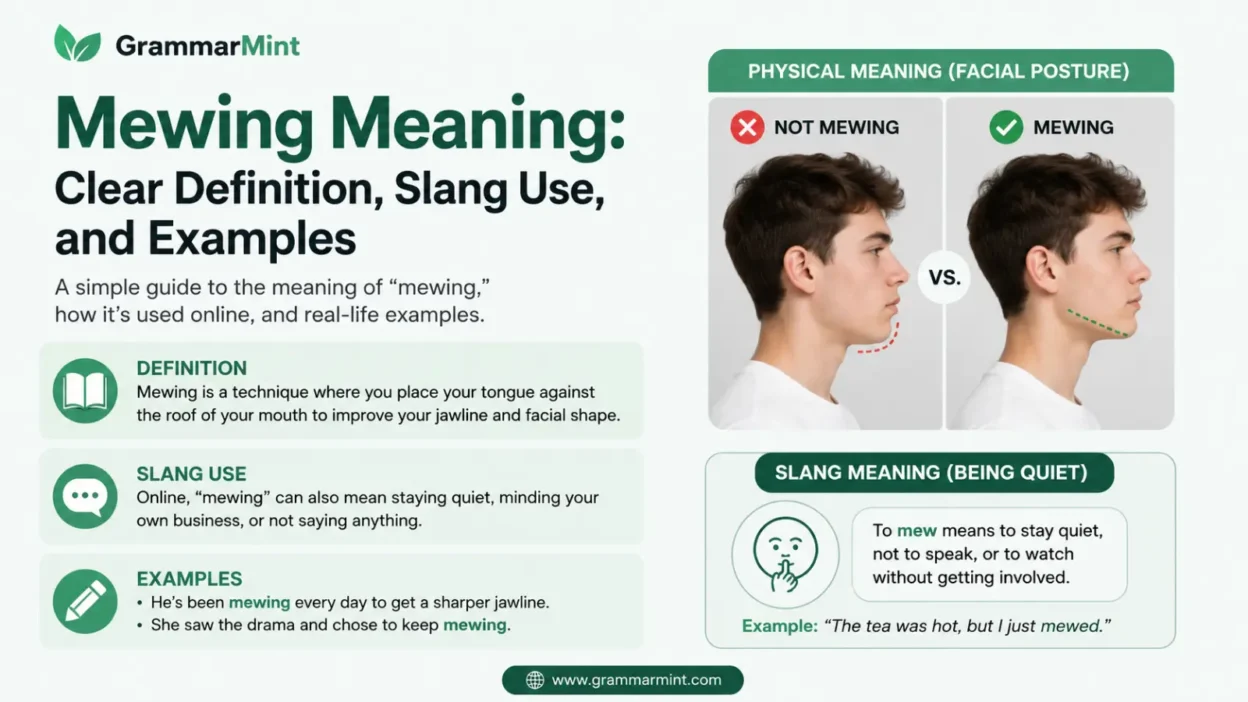
You may see mewing in TikTok videos, teen slang posts, health articles, memes, or classroom stories. The word often appears near jawline tips, face-shape talk, and jokes about staying silent.
The term matters because it has more than one modern use. In its main sense, mewing means placing the tongue against the roof of the mouth. People do this because they believe it may improve their jawline. In slang, it can also describe a gesture that means someone is too busy “mewing” to talk.
This guide explains the meaning in plain English. It also covers slang use, pronunciation, part of speech, examples, mistakes, and related terms.
Quick Answer
Mewing meaning: mewing is the practice of placing your tongue against the roof of your mouth. In slang, it can also mean a silent gesture used to avoid talking.
TL;DR
• Mewing is informal modern slang.
• It means tongue posture for jawline appearance.
• It is pronounced MYOO-ing.
• Teens may use it as a silent gesture.
• It should not replace dental care.
• Use it mainly in casual contexts.
What Does Mewing Mean?
Mewing means resting the tongue against the roof of the mouth. People usually connect it with jawline appearance.
In plain English, it is a tongue-posture practice. The person keeps the mouth closed and places the tongue upward.
Many people discuss mewing as a beauty trend. They may say it helps the jaw look sharper. However, that claim should be treated carefully.
Here is the simplest definition:
• Mewing means pressing or resting the tongue on the roof of the mouth.
• The goal is usually a more defined jawline.
• The word is informal in most modern use.
Example:
“She watched a video about mewing and jawline posture.”
Mewing Meaning in Slang
In slang, mewing can mean the same tongue-posture practice. It can also describe a silent gesture.
Some teens use the gesture to mean, “I cannot talk right now.” The joke is that they are busy mewing.
The gesture often includes two moves. A person may place one finger near the lips. Then they may trace the jawline with another finger.
This use is casual and playful. In a classroom or serious setting, it can seem rude.
Examples:
• “He did the mewing gesture instead of answering.”
• “My younger cousin keeps saying he is mewing.”
• “The joke was funny online, but not during class.”
Pronunciation and Part of Speech
Mewing is pronounced MYOO-ing. It rhymes with chewing.
The word has two main grammar roles. Most often, it works as a noun or gerund.
As a noun:
“Mewing became popular online.”
As a gerund:
“She is trying mewing for her jawline.”
It can also work as the -ing form of the verb mew. In older English, mewing can mean making a soft cat-like sound.
That older meaning is different. In modern slang, mewing usually means tongue posture.
How Mewing Works in Plain English
The basic idea is simple. A person rests the tongue against the roof of the mouth.
People often describe the position like this:
• Lips closed
• Tongue flat against the palate
• Teeth relaxed or lightly touching
• Breathing through the nose
This does not mean clenching the jaw. It also does not mean pushing hard with the tongue.
The word describes the practice, not a proven result. That difference matters.
Common mistake:
Incorrect: “Mewing will fix your jawline fast.”
Correct: “Mewing is a tongue-posture trend linked to jawline appearance.”
Does Mewing Actually Change Your Jawline?
Many people try mewing because they want a sharper jawline. The word is now tied to beauty and face-shape talk.
Still, the meaning is not the same as proof. A trend can be popular without being proven.
Adults should be especially careful with big claims. Bone structure does not change easily.
Mewing may make someone more aware of tongue posture. It may also affect how the jaw looks in a photo. That is not the same as reshaping the face.
Better wording:
“Mewing is said to help jawline appearance.”
Not: “Mewing definitely changes your face.”
If someone has jaw pain, bite problems, or dental concerns, they should ask a qualified professional.
When to Use Mewing
Use mewing when you mean the modern tongue-posture trend. It fits casual writing, social posts, and slang explanations.
You can also use it in health or parenting content. In those cases, keep the wording careful.
| Context | Best Choice | Why |
|---|---|---|
| TikTok slang | mewing | It matches modern casual use. |
| Dental discussion | tongue posture | It sounds clearer and more formal. |
| Classroom behavior | mewing gesture | It explains the silent action. |
| Medical concern | professional evaluation | It avoids unsafe advice. |
Good uses:
• “Mewing is popular in jawline videos.”
• “The teacher noticed students using the mewing gesture.”
• “The article explains mewing without promising results.”
Common Mistakes and Examples
The biggest mistake is treating mewing as a guaranteed fix. It is better to call it a trend or practice.
Another mistake is confusing it with meowing. Mewing can mean a soft animal sound, but that is not the slang meaning.
Common mistake:
Incorrect: “Mewing is the same as meowing.”
Correct: “Mewing can mean a cat-like sound, but slang mewing means tongue posture.”
More examples:
• “Mewing videos are common on social media.”
• “He said he was mewing as a joke.”
• “Mewing is not a formal medical treatment.”
• “The meme showed a student doing the mewing gesture.”
• “She asked what mewing means after seeing it online.”
Related Terms, Synonyms, and Antonyms
Mewing does not have many exact synonyms. The closest phrase is tongue posture.
Close related terms:
• Tongue posture: the position of the tongue at rest
• Jawline: the lower outline of the face
• Mew: to make a soft cat-like sound
• Mewer: a person who practices mewing
• Looksmaxxing: slang for trying to improve appearance
There is no strong direct antonym for mewing. You could say mouth breathing or poor tongue posture in some contexts. However, those are not exact opposites.
Use related terms only when they truly fit. Do not replace mewing with a broad word like exercise every time.
Mini Quiz
Choose the best answer.
- What does mewing usually mean today?
A. Running fast
B. Tongue posture
C. Loud singing - How do you pronounce mewing?
A. MEE-wing
B. MYOO-ing
C. MAY-wing - Which sentence is best?
A. “Mewing always changes your face.”
B. “Mewing is a tongue-posture trend.”
C. “Mewing means brushing teeth.” - What can the mewing gesture mean in slang?
A. “I cannot talk right now.”
B. “I am hungry.”
C. “I lost my phone.”
Answer key:
- B
- B
- B
- A
FAQs
What does mewing mean?
Mewing means placing the tongue against the roof of the mouth. People usually connect it with jawline appearance. In slang, it can also mean a silent gesture used to avoid talking.
What does mewing mean in slang?
In slang, mewing can mean tongue posture done for a sharper jawline. It can also mean a gesture that says, “I cannot talk right now.” This use is common in teen and meme contexts.
What is mewing on TikTok?
On TikTok, mewing often appears in jawline videos, beauty jokes, and teen slang. Some videos show the tongue-posture practice. Others use it as a meme or silent classroom gesture.
Why are kids mewing in class?
Some students use the mewing gesture as a joke. It can mean they are “too busy mewing” to answer. In school, this can seem dismissive or disrespectful.
Does mewing actually work?
Mewing is popular, but strong results are not proven. It may make someone more aware of tongue posture. It should not be treated as a sure way to reshape the face.
Is mewing safe?
Gentle natural tongue posture is usually not the issue. Forcing the tongue or jaw into a hard position can cause problems. Anyone with pain or bite issues should seek professional care.
Is mewing a real word?
Yes, mewing is a real word. It can mean making a soft mew sound. In modern slang, it usually means a tongue-posture practice linked to jawline appearance.
Conclusion
Mewing meaning is simple once you know the context. It usually means a tongue-posture trend linked to jawline appearance.
In slang, it can also describe a silent gesture. Use the word carefully, and avoid promising results.