You may see LOL in texts, comments, group chats, gaming messages, and social posts. It often appears after a joke, funny photo, awkward story, or playful remark. The letters originally represent “laughing out loud,” but modern use is wider.
People now use LOL to show amusement, soften a statement, or keep a message friendly. Sometimes it signals only a smile, not real laughter. Its meaning can also change through context, capitalization, and placement.
Understanding LOL helps you read tone more accurately. It also prevents confusion in serious, formal, or sensitive conversations. This guide clearly explains its definition, pronunciation, grammar roles, common uses, examples, history, and related expressions. You will also learn when LOL fits and when another response works better.
Quick Answer
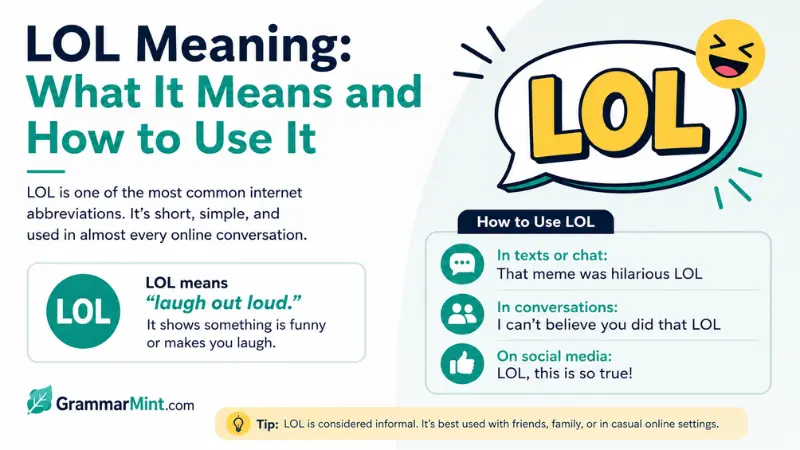
LOL meaning is usually “laughing out loud” or “laugh out loud.” People use it informally to show amusement, friendliness, irony, or a light tone.
TL;DR
• LOL usually means “laughing out loud.”
• It belongs mainly in informal communication.
• It may show a smile, not actual laughter.
• Lowercase lol often feels softer or more casual.
• Context matters more than capitalization alone.
• Avoid it in serious or formal messages.
What Does LOL Mean?
LOL is a common abbreviation for “laughing out loud.” It tells another person that something seems funny or amusing.
The expression does not always describe real, audible laughter. A person may type LOL after smiling, noticing humor, or appreciating a joke.
Consider this exchange:
“Dad tried to unlock the wrong car again.”
“LOL, that sounds exactly like him.”
The reply shows amusement and shared understanding. It does not prove the sender actually laughed aloud.
LOL can also mark a sentence as playful:
“I finished the whole pizza by myself, LOL.”
Here, the sender may feel amused, embarrassed, or slightly proud. LOL guides the reader toward a light interpretation.
In modern messaging, LOL may also soften a direct statement:
“You forgot your coffee again, lol.”
Without lol, the message could feel critical. With it, the comment sounds more teasing and friendly.
How LOL Works in Texts and Online Messages
LOL often carries emotional information that facial expressions normally provide. Text alone can sound colder than the speaker intends.
A writer may add lol to show warmth, amusement, or a relaxed attitude. It can also reduce tension after an awkward admission.
“I sent the file to the wrong person, lol.”
The mistake is real, but the sender presents it lightly. The message may suggest embarrassment rather than laughter.
LOL commonly serves four functions:
• It reacts to something funny.
• It marks a statement as a joke.
• It softens criticism or correction.
• It keeps a conversation casual.
Placement can affect the message slightly. At the beginning of a message, LOL often works as an immediate reaction.
“LOL, I cannot believe that happened.”
When placed at the end, it usually changes the tone of the whole sentence.
“I cannot believe that happened, lol.”
Both versions show amusement. The second can feel quieter, drier, or more self-aware.
People also send LOL alone. A one-word reply may acknowledge a joke without continuing the conversation. Depending on the relationship, it can feel friendly, brief, or uninterested.
Pronunciation, Capitalization, and Grammar
In speech, many Americans pronounce LOL as “el-oh-el.” Some pronounce it like the word “loll.”
The letter-by-letter form is clearer for learners. Both forms may appear in casual speech, though written use remains more common.
LOL and lol have the same basic meaning. Capitalization may suggest intensity, but there is no fixed rule.
Capitalized “LOL!” can suggest a stronger reaction.
By contrast, lowercase “lol” often feels mild, casual, dry, or slightly awkward.
At the start of a sentence, “Lol” may also appear with an initial capital letter. Phones sometimes capitalize it automatically.
Grammatically, LOL can work in several ways. It often functions as an abbreviation or an exclamation.
As an exclamation, it expresses a reaction:
“LOL! That video was perfect.”
It can also work like a conversation marker:
“I guess I need another alarm, lol.”
In very informal English, people sometimes use LOL as a verb:
“I LOLed when I saw the photo.”
“I was LOLing during the whole story.”
These verb forms are understandable but highly casual. They do not belong in formal school or workplace writing.
LOL is not normally an adjective or adverb. Its main job is expressing reaction or guiding tone.
Common Contexts and Examples
The exact message depends on the surrounding words and relationship. These examples show common uses.
Genuine Amusement
“That dog just stole my sandwich.”
“LOL, I wish I had seen that.”
The reply says the event seems genuinely funny.
A Mild Smile
“I wore two different socks today, lol.”
The sender may only find the mistake slightly amusing.
Friendly Teasing
“You would choose the longest checkout line, LOL.”
LOL shows that the comment is playful, not harsh.
Embarrassment
“I waved back, but she was greeting someone else, lol.”
The sender uses humor to manage an awkward moment.
Sarcasm
“Great, another meeting that could have been a message, lol.”
The speaker does not truly think the meeting is great. LOL supports the sarcastic tone.
Softening a Request
“Can you send that photo again? I deleted it, lol.”
The request feels less demanding because the sender admits the mistake lightly.
Acknowledging a Joke
“You should charge admission for that dance move.”
“lol”
The reply shows recognition, though it may feel less enthusiastic than “LOL!”
Spoken Use
“I opened the empty box and literally said, ‘LOL.’”
Some people say the letters aloud for comic effect. This is still very informal.
When to Use LOL
LOL works best when the relationship and setting are relaxed. It is common among friends, relatives, classmates, and familiar coworkers.
Use it when you want to show light amusement. It also works when a plain sentence might sound too serious.
| Context | Best Choice | Why |
| Friend sends a funny video | LOL or lol | Both show amusement |
| Casual group chat | lol | It keeps the tone relaxed |
| Serious apology | Direct words | LOL may weaken sincerity |
| Formal work message | Clear sentence | Slang may seem unprofessional |
Match the other person’s communication style when possible. Someone who never uses slang may prefer “That was funny” or “That made me laugh.”
You can also choose a more specific response:
• “That was hilarious.”
• “You made me laugh.”
• “That is so funny.”
• “I am smiling at this.”
• “I cannot stop laughing.”
These replies carry clearer emotional meaning. They are useful when LOL feels too vague.
When Not to Use LOL
Avoid LOL when the topic requires seriousness, sympathy, or precise wording. It can make an important message sound careless.
Do not add it to condolences:
Incorrect: “I am sorry about your loss, lol.”
Correct: “I am very sorry about your loss.”
Avoid it during serious apologies:
Weak: “Sorry I missed your presentation, lol.”
Better: “I am sorry I missed your presentation.”
LOL can also weaken a firm boundary:
Unclear: “Please stop sharing my photos, lol.”
Clear: “Please stop sharing my photos.”
Be careful with sarcasm. The reader may not recognize your intended tone.
“You did a great job, lol.”
This could sound mocking or insulting. Use direct praise when you mean it sincerely.
Formal reports, applications, academic assignments, and official messages usually require standard wording. Save LOL for casual communication unless the setting clearly welcomes slang.
Origin and How Its Use Changed
LOL developed during early digital communication in the 1980s. People needed short ways to show reactions in typed conversations.
The exact first use is uncertain. Written records from the late 1980s show LOL meaning “laughing out loud.”
The expression spread through online forums, chat rooms, email, and text messaging. Social media later made it familiar across age groups.
Its function also expanded. At first, LOL mainly reported laughter or marked a joke.
Today, it can show friendliness, mild amusement, embarrassment, irony, or social connection. It may act more like a smile or soft voice than a literal statement.
LOL is now established informal English. However, it remains closely linked with casual digital communication.
Related Terms and Common Confusions
LOL belongs to a larger group of laughter expressions. Each one can suggest a different level or style of amusement.
• Haha: Direct written laughter; often warmer than lol.
• LMAO: A stronger, more expressive reaction; mildly vulgar.
• ROFL: “Rolling on the floor laughing”; dramatic and playful.
• Hehe: Quiet, mischievous, or slightly awkward laughter.
• 😂: A laughing emoji that can replace or strengthen LOL.
• IJBOL: “I just burst out laughing”; a newer emphatic reaction.
These expressions are related, but they are not exact synonyms. Tone varies by person, age group, platform, and relationship.
LOL has no clear antonym. “Not funny” expresses the opposite judgment, but it does not serve the same conversational function.
Do not confuse LOL with LoL in gaming discussions. LoL often refers to the game League of Legends.
Another confusion is “lots of love.” Some people have used LOL that way, especially in personal notes.
Today, “laughing out loud” is the expected meaning in most texts. Write “lots of love” fully when warmth must be clear.
Mini Quiz
Choose the best answer.
1. What does LOL usually mean?
a) Lots of luck
b) Laughing out loud
c) Leave online later
2. Which message uses LOL naturally?
a) “That puppy fell asleep in my shoe, LOL.”
b) “Your payment is overdue, LOL.”
c) “I am sorry for your loss, LOL.”
3. What can lowercase lol sometimes show?
a) A mild or casual reaction
b) A formal instruction
c) A medical warning
4. Which setting usually requires avoiding LOL?
a) A friend’s group chat
b) A funny family text
c) A formal job application
Answer key: 1-b, 2-a, 3-a, 4-c.
FAQs
What Does LOL Stand For?
LOL usually stands for “laughing out loud” or “laugh out loud.” It signals amusement or marks a playful statement.
Does LOL Always Mean Actual Laughter?
No. People often use LOL after smiling or noticing mild humor. It can also soften a message or show friendliness.
Can LOL Mean “Lots of Love”?
It can in rare or older personal usage. However, most readers now understand LOL as “laughing out loud.”
Write “lots of love” fully when the meaning matters.
Is LOL Rude in Texting?
LOL is not rude by itself. It can seem dismissive when someone shares serious feelings or expects a thoughtful reply.
Context and relationship determine the tone.
Should LOL Be Uppercase or Lowercase?
Both forms are standard in casual messages. Uppercase LOL may feel stronger, while lowercase lol often feels softer.
Personal texting habits can matter more than capitalization.
Can You Say LOL Aloud?
Yes. People may say “el-oh-el” or pronounce it like “loll.”
Spoken LOL is casual and often humorous. Many people still use it only in writing.
Conclusion
LOL meaning depends on both the phrase and the surrounding tone. It usually shows amusement, but it can also soften casual messages.
Use it with people who understand your style. Choose clearer words for serious, formal, or sensitive situations.