You may see ate in school, texts, comments, captions, and everyday speech. It is a short word, but it can carry two main meanings.
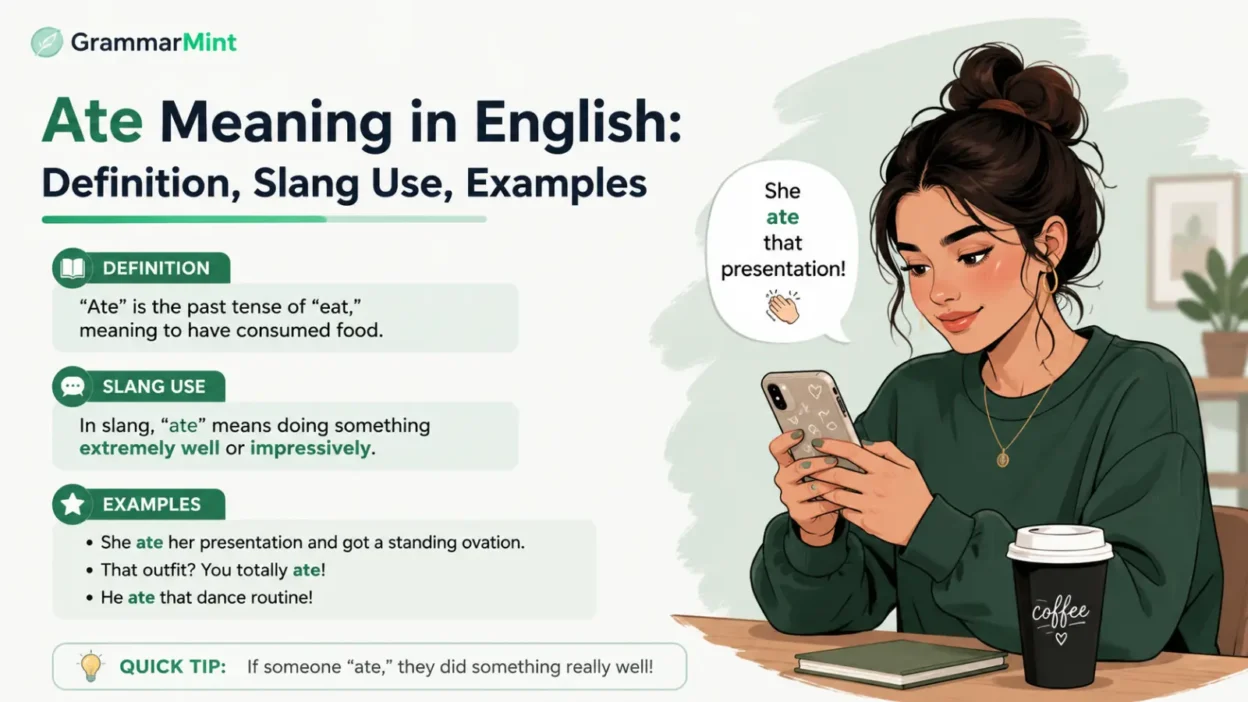
In standard English, ate means someone consumed food in the past. In modern slang, ate can mean someone did something very well. That second use often appears in comments like “she ate” or “you ate.”
This guide explains ate meaning in clear English. You will learn the normal verb meaning, the slang meaning, pronunciation, sentence examples, and common mistakes. You will also learn when ate sounds natural and when another word is better.
Quick Answer
Ate meaning is “consumed food” as the past tense of eat. In slang, ate means someone did something very well or looked impressive.
TL;DR
• Ate is the past tense of eat.
• Say “I ate lunch,” not “I eaten lunch.”
• Say “have eaten,” not “have ate.”
• In slang, “you ate” means “you did great.”
• Ate sounds like “eight” in American English.
• Slang ate is casual, not formal.
What Does Ate Mean In English?
Ate is the simple past tense of eat. It means someone consumed food or had a meal before now.
Use ate when the action is finished. The sentence usually points to a past time, even when the time is not stated.
Examples:
• I ate breakfast before work.
• She ate the last cookie.
• We ate dinner at home.
• They ate pizza after the game.
Ate can also describe something being worn away or used up. This meaning comes from the broader verb eat.
Examples:
• Rust ate through the old pipe.
• The fees ate into our savings.
In most beginner sentences, ate simply means consumed food.
What Does Ate Mean In Slang?
In slang, ate means someone did something extremely well. It is a compliment.
You may see it in comments about fashion, music, sports, dance, makeup, photos, or performances. It often means “nailed it,” “looked amazing,” or “performed perfectly.”
Examples:
• You ate that presentation.
• She ate in that outfit.
• He ate that dance routine.
• They ate and left no crumbs.
The phrase “ate and left no crumbs” adds extra praise. It means the person did so well that nothing was missing.
This slang is informal. It works best in texts, captions, comments, and casual speech.
Do not use slang ate in serious school papers, job emails, or formal reports. In those places, use words like performed well, succeeded, or impressed.
How To Pronounce Ate
In American English, ate is usually pronounced like eight. A simple guide is: AYT.
It has one syllable. The vowel sound is long, like the sound in day.
Examples:
• ate = eight
• I ate = I eight
• She ate lunch = She ayt lunch
Some British speakers may say ate like “et,” rhyming with set. For a US audience, the safest pronunciation is “ayt.”
Do not pronounce it as “at.” That changes the sound and may confuse listeners.
What Part Of Speech Is Ate?
Ate is a verb form. More exactly, it is the simple past tense form of the irregular verb eat.
Eat is irregular because it does not form the past tense with -ed. The correct forms are:
| Verb Form | Correct Word | Example |
|---|---|---|
| Base form | eat | I eat lunch at noon. |
| Simple past | ate | I ate lunch at noon. |
| Past participle | eaten | I have eaten lunch. |
Ate is not usually a noun, adjective, or adverb in everyday English. It works as a verb because it shows an action.
There are other meanings for capitalized Ate or ATE in special fields. Those are not the main meaning people want when they search ate meaning.
How To Use Ate In A Sentence
Use ate when you talk about eating in the past. It fits with past time words like yesterday, last night, earlier, this morning, and after school.
Examples:
• I ate cereal this morning.
• Maya ate lunch at her desk.
• We ate tacos last night.
• The kids ate before practice.
• Someone ate my fries.
You can also ask questions with ate, but the sentence pattern changes. With did, use eat instead of ate.
Correct
• Did you eat dinner?
• What did you have for lunch?
• Have they eaten already?
Incorrect:
• Did you ate dinner?
• What did you ate?
The word did already shows past time. Because of that, the main verb returns to its base form: eat.
Use ate when there is no helping verb like have, has, or had.
Examples:
• I ate too fast.
• We ate before the movie.
• She ate the salad.
Use eaten after have, has, or had.
Examples:
• I have eaten already.
• She has eaten dinner.
• They had eaten before we arrived.
Common mistake:
• Incorrect: I have ate already.
• Correct: I have eaten already.
Another mistake:
• Incorrect: He had ate lunch.
• Correct: He had eaten lunch.
A simple memory trick helps. If you see have, has, or had, choose eaten.
When To Use Ate And When Not To Use It
Use ate in normal past-tense sentences about food. It is clear, common, and correct.
Use slang ate when the setting is casual. It sounds natural in social comments and friendly texts.
| Context | Best Choice | Why |
| Past meal | ate | It shows eating happened before now. |
| Perfect tense | eaten | It follows have, has, or had. |
| Social praise | ate | It means someone did very well. |
| Formal writing | performed well | Slang may sound too casual. |
Use ate here:
• I ate before the meeting.
• She ate the whole sandwich.
• You ate that song.
Avoid ate here:
• I have ate.
• Did you ate?
• The employee ate the quarterly report.
The last example is wrong unless you mean the employee literally consumed paper. For formal praise, say the employee did an excellent job.
Synonyms, Antonyms, And Related Terms
For the standard meaning, ate has close synonyms. These words work when the meaning is about food.
Close synonyms:
• consumed
• swallowed
• had
• dined
• finished
Examples:
• I ate breakfast.
• I had breakfast.
• I consumed a small meal.
For slang ate, the best related phrases are casual compliments.
Related slang and phrases:
• nailed it
• crushed it
• slayed
• killed it
• left no crumbs
These do not always fit formal writing. They work best in casual speech and social comments.
Antonyms depend on the meaning. For food, the opposite may be fasted or skipped a meal. For slang, the opposite may be failed, flopped, or missed.
Examples:
• She ate breakfast.
• She skipped breakfast.
• He ate that performance.
• He missed the mark.
Mini Quiz
Choose the best answer.
- Which sentence is correct?
A. I ate lunch.
B. I eaten lunch. - Which sentence is correct?
A. Have you ate?
B. Have you eaten? - What does “you ate” mean in slang?
A. You did very well.
B. You are hungry. - Which word sounds like ate in American English?
A. eight
B. at - Which sentence is correct?
A. Did you eat breakfast?
B. Did you ate breakfast?
Answer key:
- A
- B
- A
- A
- A
FAQs
What does ate mean?
Ate means consumed food in the past. It is the simple past tense of eat.
Example: “I ate lunch at noon.” The eating happened before now.
What does ate mean in slang?
In slang, ate means someone did something very well. It is a strong casual compliment.
Example: “She ate that performance” means she performed very well.
What does “you ate” mean?
“You ate” means “you did great” in slang. It often praises a look, photo, dance, joke, or performance.
It is casual. Use it with friends or in social comments.
What does “ate and left no crumbs” mean?
“Ate and left no crumbs” means someone did something perfectly. It adds extra praise to “ate.”
Example: “They ate and left no crumbs” means their work or performance was excellent.
Is ate the past tense of eat?
Yes. Ate is the simple past tense of eat.
Use it for finished past actions. Example: “We ate before the concert.”
Is it “have you ate” or “have you eaten”?
The correct form is “have you eaten?” Use eaten after have, has, or had.
Say “Did you eat?” for a simple past question. Do not say “Did you ate?”
How do you pronounce ate?
In American English, ate usually sounds like eight. The simple guide is “ayt.”
Some speakers elsewhere may say it like “et.” For US English, “ayt” is the safest choice.
Conclusion
Ate meaning depends on context. In standard English, ate means consumed food in the past.
In slang, ate means someone did something very well. Check the setting, then choose the meaning that fits.