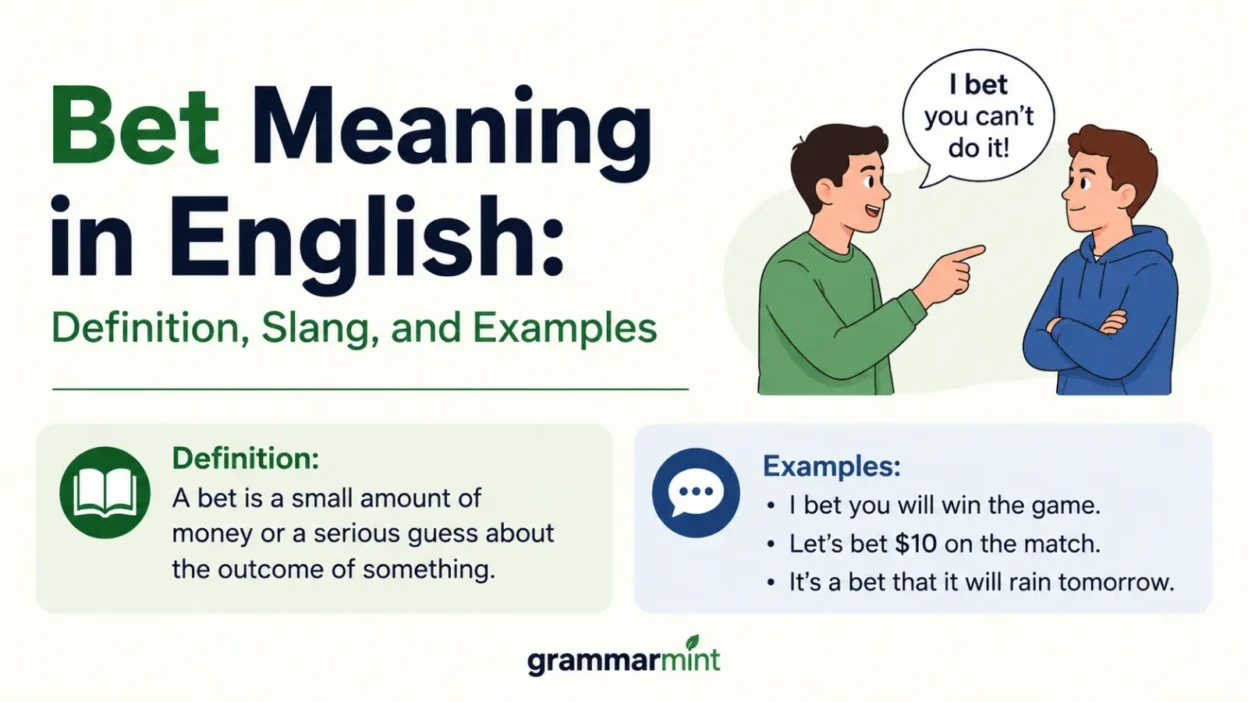
Bet is a small word with several common meanings. You may see it in sports, card games, texting, social media, or casual speech. That can make it confusing for new English learners.
The word can mean a wager, a confident guess, or a casual “okay.” In slang, it often shows agreement or approval. This guide explains bet meaning in plain English. You will learn its standard meaning, slang meaning, grammar role, phrases, and real examples.
Quick Answer
Bet meaning depends on context. As a noun or verb, it means a wager or to risk something. In slang, bet means “okay,” “sure,” “for sure,” or “challenge accepted.”
TL;DR
• Bet can mean a wager.
• Bet can mean to risk money.
• In slang, bet means “okay.”
• It can also accept a challenge.
• It is casual, not formal.
• Pronounce it like “set.”
What Bet Means in Plain English
In standard English, a bet is a risk based on an uncertain result. People often use it when money is involved. For example, someone may place a bet on a game.
Bet can also mean a confident belief. In this use, no money is needed. When someone says, “I bet she is late,” they mean they feel sure.
In slang, bet works as a quick reply. It often means “I agree” or “that works.” It is common in texts and casual talk.
Examples:
• “I placed a small bet on the game.”
• “I bet traffic is bad today.”
• “Meet me at seven?” “Bet.”
Bet as a Noun and Verb
Bet is both a noun and a verb. It is pronounced “bet,” rhyming with “set” and “get.” It has one syllable.
As a noun, bet means the wager itself. It can also mean the choice someone believes will win.
Examples:
• “That was a risky bet.”
• “My bet is that the home team wins.”
• “A safe bet is a choice likely to work.”
As a verb, bet means to risk something. It can also mean to feel sure about something.
Examples:
• “He bet ten dollars on the race.”
• “I bet you forgot your charger.”
• “Do not bet money you cannot afford to lose.”
The past tense is usually bet. Betted also exists, but bet is more common in everyday use.
Bet Meaning in Slang
In slang, bet is an informal reply. It usually means “okay,” “sure,” “for sure,” or “I’m down.” It can show quick agreement.
Example:
Friend: “Let’s grab pizza after class.”
You: “Bet.”
Here, bet means “Sounds good.” It does not mean you are gambling.
Bet can also mean “challenge accepted.” This use sounds confident or playful.
Example:
Friend: “You can’t beat me in this game.”
You: “Bet.”
In some contexts, bet can sound sarcastic. It may mean “yeah, sure” or “I do not believe that.” Tone matters.
Example:
Person: “I’ll clean the whole garage today.”
Reply: “Bet.”
That reply could mean trust or doubt. The speaker’s tone gives the clue.
The exact slang history is not fully clear. It is often linked with Black American English and 1990s youth culture. Still, it is now widely used in casual speech.
How to Use Bet in Texting and Conversation
Use bet when the tone is relaxed. It works best with friends, classmates, siblings, or casual groups. It is short and direct.
Common texting uses:
• Agreement: “Lunch at noon?” “Bet.”
• Confirmation: “I’ll send the file.”
• Agreement: “Lunch at noon?” “Bet.”
• For confirmation: “I’ll send the file.”
Small comparison table:
| Context | Best Choice | Why |
|---|---|---|
| Texting a friend | Bet | Casual and quick |
| Work email | Sounds good | Clear and polite |
| Formal writing | I agree | More professional |
| Game or wager | Bet | Standard meaning |
| Strong guess | I bet | Natural phrase |
Use the full sentence when clarity matters. “That works for me” is safer than “bet” in mixed groups.
Common Phrases with Bet
Bet appears in several everyday phrases. These phrases do not always involve gambling.
I bet
I bet means “I think” or “I am pretty sure.” It sounds casual and natural.
Examples:
• “I bet you are tired after that trip.”
• “I bet she already saw the message.”
• “I bet this restaurant gets crowded.”
You bet
You bet can mean “definitely” or “no problem.” It often sounds friendly.
Examples:
• “Can you help me?” “You bet.”
• “Thanks for the ride.” “You bet.”
• “Will you be there?” “You bet.”
Safe bet
A safe bet is a likely or sensible choice. It does not always involve money.
Examples:
• “Pizza is a safe bet for the party.”
• “It is a safe bet that traffic will be heavy.”
• “For beginners, this app is a safe bet.”
All bets are off
All bets are off means the situation has changed. Old plans or expectations no longer apply.
Examples:
• “If it rains, all bets are off.”
• “Once the deadline moved, all bets were off.”
Wanna bet?
Wanna bet? means “Are you sure?” It can sound playful or challenging.
Example:
• “You think I can’t finish this?” “Wanna bet?”
When Not to Use Bet
Do not use slang bet in formal settings. It may sound too casual or unclear. Some readers may only know the money meaning.
Avoid slang bet in:
• job applications
• business emails
• academic essays
• legal or financial writing
• messages to people you do not know well
Better choices include:
• “Okay.”
• “Sounds good.”
• “I agree.”
• “That works for me.”
• “Understood.”
Also avoid bet if the meaning could be confused with gambling. This matters in serious or professional contexts.
Synonyms and Antonyms for Bet
Synonyms depend on the meaning. A synonym for the money meaning may not fit the slang meaning.
For bet as a noun:
• wager
• stake
• gamble
• risk
For bet as a verb:
• wager
• risk
• gamble
• predict
For slang bet:
• okay
• sure
• agreed
• for sure
• sounds good
Antonyms are limited. For the risk meaning, safer opposites include avoid, refuse, or hold back. For slang agreement, the opposite may be no, disagree, or not really.
Do not replace every bet with wager. Wager sounds more formal. It also does not fit slang replies.
Wrong: “Meet me outside?” “Wager.”
Correct: “Meet me outside?” “Bet.”
Common Mistakes with Bet
A common mistake is reading every bet as gambling. In texts, bet often means agreement. Context decides the meaning.
Wrong: “She said bet, so she must be gambling.”
Correct: “She said bet, so she probably agreed.”
Another mistake is using slang bet in formal writing. It can look too casual.
Wrong: “Bet, I will attend the interview.”
Correct: “I confirm that I will attend the interview.”
Some learners confuse lowercase bet with uppercase BET. Lowercase bet is the word. Uppercase BET often names a brand, network, or abbreviation.
Also, do not overuse bet in every reply. It can sound repetitive. Mix it with “okay,” “sure,” and “sounds good.”
Mini Quiz
Choose the correct meaning of bet in each sentence.
- “I placed a bet on the final score.”
A. agreement
B. wager
C. greeting - “I bet you left your keys at home.”
A. I feel sure
B. I refuse
C. I forgot - “Meet me at six?” “Bet.”
A. no
B. okay
C. maybe never - “You can’t finish that puzzle.” “Bet.”
A. challenge accepted
B. good morning
C. I lost money - “That restaurant is a safe bet.”
A. likely good choice
B. dangerous plan
C. sports ticket
Answer key:
- B
- A
- B
- A
- A
FAQs
What does bet mean?
Bet can mean a wager, a risk, or a confident belief. In slang, it means “okay,” “sure,” or “for sure.” The right meaning depends on context.
What does bet mean in slang?
In slang, bet is a casual way to agree. It can also show approval or accept a challenge. It is common in texts and casual speech.
What does bet mean in texting?
In texting, bet often means “okay” or “sounds good.” If someone writes “Bet” after a plan, they likely agree. It does not usually mean gambling.
Is bet slang for okay?
Yes, bet can be slang for “okay.” It is more casual than okay. Use it with people who understand informal language.
Why do people say bet?
People say bet because it is short and confident. It can confirm a plan quickly. It can also make a reply sound relaxed.
What does you bet mean?
You bet means “definitely,” “of course,” or “no problem.” It is friendly and common in spoken English. It is not the same as slang “bet.”
Can bet be rude?
Bet is not usually rude. Still, tone can change the meaning. A sarcastic “bet” may sound doubtful or dismissive.
Conclusion
Bet meaning changes with context. It can mean a wager, a confident guess, or a casual “okay.”
Use it freely with friends and texts. Choose clearer words in formal writing.