You may see woke in news, social media, comments, school discussions, and everyday arguments. Some people use it to mean aware of unfairness. Others use it as an insult for views they think are too political or too extreme.
That is why woke can confuse English learners. The word has an ordinary grammar meaning and a modern slang meaning. It can sound serious, casual, sarcastic, or critical.
This guide explains the meaning of woke, how to use it, when to avoid it, and how its tone changes by context. You will also see clear examples, related terms, common mistakes, and a short quiz.
Quick Answer
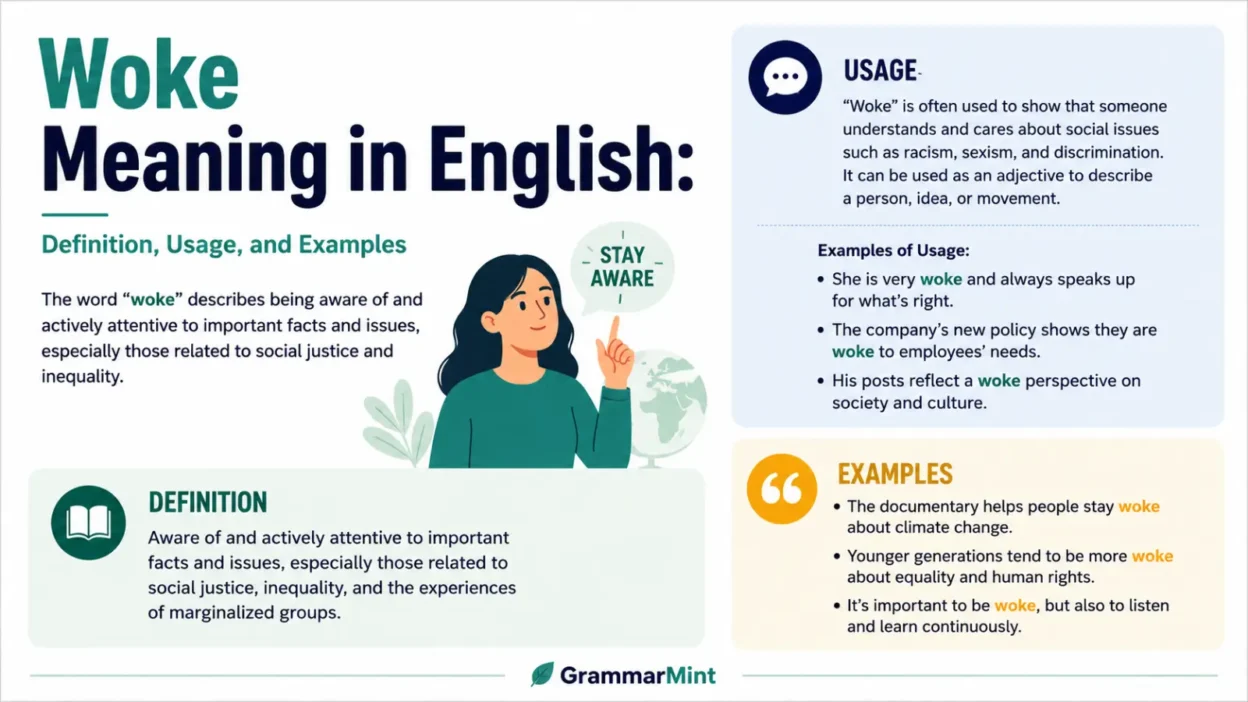
Woke meaning: woke usually means aware of social or political unfairness, especially issues involving racism, inequality, or unequal treatment. It is informal and can sound approving, neutral, sarcastic, or critical.
TL;DR
• Woke often means socially aware.
• It is usually an adjective.
• It can also be past tense of wake.
• The slang use is informal.
• Tone depends heavily on context.
• Use it carefully in formal writing.
What Woke Means in Plain English
In modern English, woke usually describes someone who notices unfair treatment in society. This may include racism, inequality, discrimination, or unfair rules.
A simple definition is: aware of social problems and concerned about fairness.
Examples:
• She tries to stay woke about racial injustice.
• The article discusses woke language in schools.
• Some voters dislike what they call woke politics.
The word is not always neutral. In one sentence, it can praise awareness. In another, it can criticize someone as too political.
Woke as Slang and Everyday English
As slang, woke means alert to unfairness or hidden problems in society. The phrase stay woke means “stay aware” or “do not ignore injustice.”
This slang meaning is common in online comments, culture writing, and political talk. It is less common in careful academic or business writing.
Examples:
• Stay woke and ask who benefits from the rule.
• He thinks every movie with diversity is woke.
• The brand was accused of acting woke for attention.
The last two examples show a critical tone. Many people now use woke to mock ideas they see as too progressive or performative.
Part of Speech and Pronunciation
Woke has two main roles in English.
| Use | Part of Speech | Meaning |
|---|---|---|
| I woke up early. | Verb | Past tense of wake |
| She is woke. | Adjective | Aware of social unfairness |
Pronunciation: wohk
Simple sound guide: it rhymes with joke, broke, and smoke.
Do not pronounce it like walk. The vowel sound is closer to oh.
Examples:
• I woke up at 7 a.m.
• The speaker gave a woke speech.
• They called the campaign woke.
How to Use Woke in a Sentence
Use woke before a noun or after a linking verb like is, seems, or sounds.
Examples:
• That was a woke message.
• She seems woke about workplace bias.
• The show was called woke by critics.
• He used woke as an insult online.
You can also use it in the phrase stay woke.
Example:
• Stay woke when people try to hide the facts.
Be careful with tone. The sentence may sound supportive or dismissive, depending on the speaker.
When to Use Woke and When to Avoid It
Use woke when the topic is informal, cultural, or political. It fits social media, opinion writing, and casual speech.
Avoid it when you need a neutral or formal word. In school essays, reports, or workplace documents, use clearer terms.
| Context | Best Choice | Why |
| Casual talk | woke | Informal and familiar |
| Formal essay | socially aware | Clearer and more neutral |
| News analysis | politically progressive | More specific |
| Criticism | performative | Better for fake concern |
| Basic grammar | woke up | Correct verb phrase |
Better formal choices include:
• socially aware
• politically aware
• conscious of inequality
• concerned about fairness
• attentive to discrimination
Woke vs Awake: The Simple Difference
Awake usually means not sleeping. Woke can also mean the past tense of wake.
Examples:
• I am awake now.
• I woke up early.
The slang meaning is different. It does not mean someone stopped sleeping. It means someone became aware of social problems.
Compare:
• Literal: I woke up at sunrise.
• Slang: She became woke after learning about housing inequality.
Use awake for the present state of not sleeping. Use woke as a past-tense verb or as informal slang.
Origin and History of Woke
The ordinary word woke comes from the verb wake. In grammar, it works as the past tense in sentences like I woke up late.
The slang meaning developed in African American English. It became linked with staying alert to racism, danger, and unfair treatment.
Over time, stay woke spread into wider American culture. By the 2010s, many people used it for awareness of racial and social injustice.
Later, the word also became political. Some people began using woke as a negative label for progressive ideas, public campaigns, or cultural changes.
Because of that history, the word can carry strong feelings. Use it with care, especially in mixed audiences.
Related Terms, Synonyms, and Antonyms
Some related terms appear often near woke.
• stay woke: stay aware of unfairness or hidden problems
• wokeness: the state or quality of being woke
• wokeism: often a critical word for beliefs seen as overly woke
• woke culture: public debate around socially progressive values
Close synonyms depend on context.
Useful synonyms:
• aware
• socially aware
• alert
• conscious
• politically aware
• progressive
These are not perfect matches. Woke carries cultural and political tone that aware does not.
Possible antonyms:
• unaware
• indifferent
• uninformed
• insensitive
Avoid using asleep as the main opposite in serious writing. It works as a metaphor, but it can sound unclear.
Common Mistakes With Woke
One common mistake is using woke when you only mean awake.
Incorrect: I am woke now.
Correct: I am awake now.
Another mistake is using woke in a formal essay without explanation.
Weak: The policy is woke.
Better: The policy focuses on social fairness and equal treatment.
A third mistake is assuming everyone hears the word the same way. Some people hear woke as positive. Others hear it as mocking or political.
A clearer choice often works better.
Unclear: The company released a woke ad.
Clearer: The company released an ad about social inclusion.
Mini Quiz
Choose the best answer.
- In “I woke up late,” what is woke?
A) adjective
B) past tense verb
C) noun - In modern slang, woke usually means:
A) sleepy
B) socially aware
C) very rich - Which sentence is more formal?
A) The speech was woke.
B) The speech focused on social fairness. - Which word sounds closest to woke?
A) walk
B) joke
C) week - Is woke always positive?
A) Yes
B) No
Answer key:
- B
- B
- B
- B
- B
FAQs
What does woke mean?
Woke usually means aware of social or political unfairness. It often refers to issues such as racism, inequality, or discrimination. It is informal and depends heavily on tone.
What does woke mean in slang?
In slang, woke means alert to unfairness or hidden problems in society. The phrase stay woke means to stay aware and not ignore injustice. Today, the word can also be used sarcastically.
Is woke a good or bad word?
It can be either. Some people use woke in a positive way to mean aware and caring. Others use it negatively to mean too political, too sensitive, or fake.
Is woke an adjective or a verb?
It can be both. In I woke up, it is the past tense of wake. In a woke person, it is an adjective.
How do you pronounce woke?
Pronounce woke as wohk. It rhymes with joke, broke, and smoke. Do not pronounce it like walk.
What does stay woke mean?
Stay woke means stay alert, aware, and informed. It is often used about racism, inequality, or unfair treatment. It can sound serious, casual, or political.
What is woke culture?
Woke culture usually refers to public ideas, language, and actions linked with social fairness. Some people use the phrase neutrally. Others use it as criticism.
Conclusion
Woke meaning depends on context. It can mean socially aware, politically progressive, sarcastic, or critical.
Use woke in casual or cultural contexts. For formal writing, choose clearer words like socially aware or concerned about fairness.