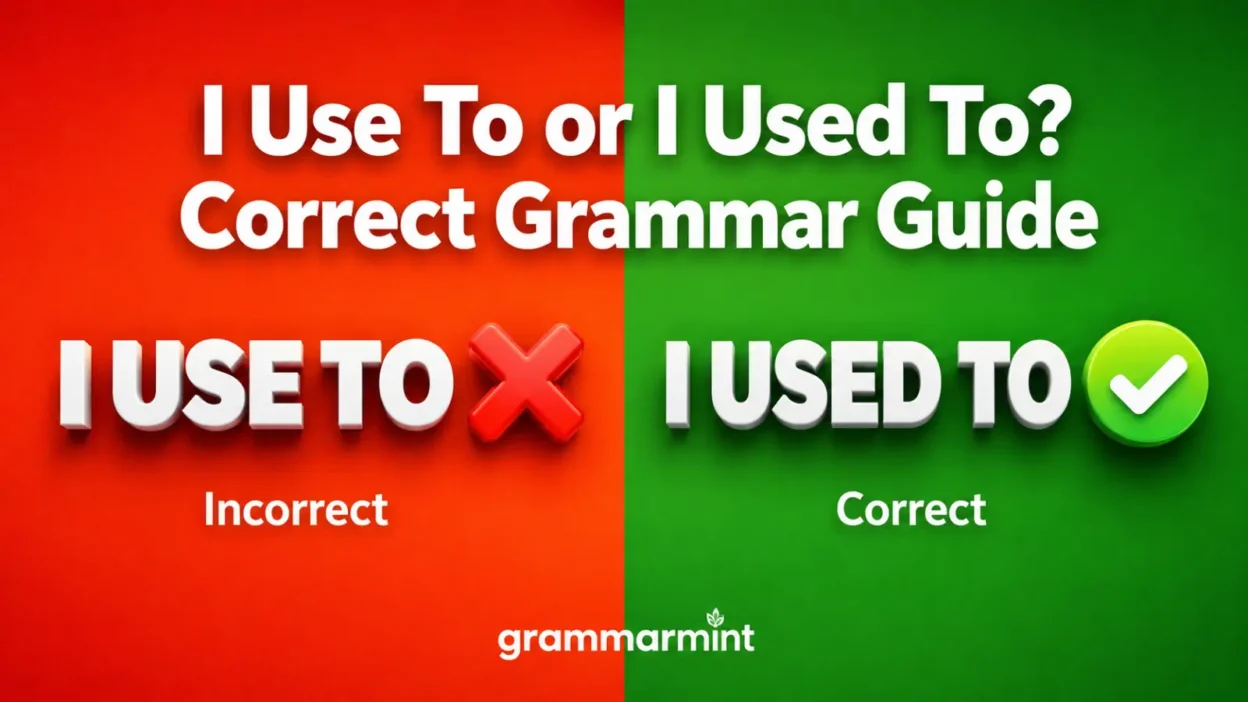
Anyone who writes emails, essays, texts, or social posts can get stuck on this tiny grammar choice. Is it I Use To or I Used To, and why does one sound so much like the other? The answer is simple once you see the pattern. Use “I used to” for a past habit, old routine, former state, repeated action, or something that is no longer true. However, use “use to” after “did,” “didn’t,” or “did not.” This guide explains the rule in plain English, with examples for school, work, conversation, and everyday writing. You’ll also see the difference between “used to,” “be used to,” “get used to,” “would,” and the simple past.
Quick Answer
I used to is correct when you mean a past habit or past state: “I used to play soccer.” Write “use to” only after “did,” “didn’t,” or “did not”: “Did you use to play?”
TL;DR
• Write “I used to,” not “I use to.”
• Use “use to” after “did” or “didn’t.”
• “Used to” means something happened before.
• “I’m used to” means something feels normal.
• Don’t use “used to” for one-time events.
• Read the sentence aloud, then check the helper.
I Used To Or I Use To: Which Is Correct?
“I used to” is the normal choice when you talk about something from the past. It points to a past habit, old fact, or earlier way of life. In regular writing, it is the correct form before another verb.
The phrase sounds confusing because spoken English often hides the “d.” Still, your writing needs that “d” unless “did” appears first.
• I used to ride my bike daily.
• I used to hate early mornings.
• I used to live near Boston.
• I used to drink black coffee.
• I used to play video games nightly.
• I used to work weekends often.
• I used to write in journals.
• I used to call my grandma weekly.
• I used to watch cartoons after school.
• I used to worry about grammar.
• I used to think “use to” was right.
• I used to make that mistake too.
Used To Meaning For Past Habits
“Used to” means something happened before, but it does not happen now. It works well for repeated actions, old routines, and memories. It can also describe something that is no longer true.
You can use it with a past state, like where someone lived or what someone liked. As a result, it is useful for both actions and facts.
• I used to walk home after class.
• She used to read every night.
• They used to eat dinner early.
• We used to visit every summer.
• He used to wear glasses.
• I used to be shy.
• The store used to close at six.
• My dog used to bark constantly.
• Our street used to be quiet.
• I used to like scary movies.
• She used to know everyone there.
• We used to spend Sundays outside.
Use To Meaning After Did Or Didn’t
“Use to” is not usually correct by itself. It becomes correct after auxiliary did, because “did” already shows past time. After “did,” use the base form of the verb.
That pattern works like other past tense sentences. You write “didn’t walk,” not “didn’t walked,” so you write “didn’t use to.”
• Did you use to live here?
• I didn’t use to drive.
• Did she use to sing?
• We did use to talk often.
• He didn’t use to cook.
• Did they use to own horses?
• I did use to believe that.
• You didn’t use to care.
• Did it use to snow more?
• She did not use to travel.
• Didn’t we use to sit there?
• Did your team use to win?
Didn’t Use To Or Didn’t Used To
The safer form is “didn’t use to.” It is the standard negative form for clear American writing. Since did not already carries the past meaning, “used” should become “use.”
Some people say or write “didn’t used to,” especially in casual speech. However, avoid it in formal writing, tests, essays, and business messages.
• I didn’t use to like broccoli.
• She didn’t use to text much.
• We didn’t use to argue.
• He didn’t use to exercise.
• They didn’t use to live nearby.
• I didn’t use to sleep well.
• My brother didn’t use to read.
• Kids didn’t use to have tablets.
• The app didn’t use to crash.
• Our town didn’t use to flood.
• You didn’t use to complain.
• It didn’t use to cost this much.
Did You Use To Or Did You Used To
“Did you use to” is the cleaner question form. The word “did” is the question form marker, so the next verb should be a plain verb. That is why “used” loses the “d.”
This rule is simple once you compare it with “Did you go?” You would not say “Did you went?” because the helper verb already did the tense work.
• Did you use to play piano?
• Did you use to live downtown?
• Did you use to like math?
• Did you use to work nights?
• Did you use to ride horses?
• Did you use to watch baseball?
• Did you use to write poems?
• Did you use to visit often?
• Did you use to eat meat?
• Did you use to know her?
• Did you use to walk there?
• Did you use to study French?
Used To Be Or Use To Be
Use “used to be” for a former state, identity, or situation. It describes a past condition that has changed. For example, “I used to be nervous” means that was true before.
This form often appears with a former role or old description. Since “be” is a state verb, “used to be” is very common.
• I used to be a teacher.
• She used to be my neighbor.
• He used to be nervous.
• This room used to be brighter.
• The mall used to be busy.
• My dad used to be strict.
• I used to be more patient.
• That restaurant used to be cheaper.
• We used to be close friends.
• The office used to be downtown.
• Her hair used to be shorter.
• Winters used to be colder here.
Used To Do Or Use To Do
Write “used to do” when you describe an action from the past. The word after “to” is an infinitive, so keep it simple: do, play, eat, run, study, work. This pattern often shows a repeated action.
However, write “use to do” after “did” or “didn’t.” That keeps your past routine sentence grammatically balanced.
• I used to do my homework early.
• She used to do yoga daily.
• We used to do puzzles together.
• They used to do chores Saturday.
• He used to do odd jobs.
• I didn’t use to do that.
• Did you use to do theater?
• We did use to do drills.
• I used to do laundry weekly.
• She used to do her makeup fast.
• He used to do pushups nightly.
• They used to do volunteer work.
Used To Have Or Use To Have
Use “used to have” for something someone had before. It can show past possession, an old situation, or a past relationship. Usually, the thing is gone or different now.
Use “use to have” only after “did” or “didn’t.” In most normal sentences, “used to have” is the right phrase for a past fact or former state.
• I used to have long hair.
• She used to have two cats.
• We used to have a pool.
• They used to have more time.
• He used to have headaches.
• The house used to have shutters.
• I used to have that phone.
• My car used to have problems.
• Our school used to have uniforms.
• Did you use to have braces?
• I didn’t use to have allergies.
• We did use to have cable.
I Used To Vs I’m Used To
“I used to” looks backward. “I’m used to” means something feels normal now. In that second phrase, “used to” means accustomed to, not past habit.
After “I’m used to,” use a noun or -ing form. It means you are familiar with something through experience. So, “I’m used to waking early” is different from “I used to wake early.”
• I used to wake up late.
• I’m used to waking up early.
• I used to live in Chicago.
• I’m used to cold weather.
• I used to eat fast food.
• I’m used to cooking at home.
• I used to work alone.
• I’m used to team meetings.
• I used to avoid traffic.
• I’m used to long commutes.
• I used to fear public speaking.
• I’m used to speaking publicly.
Be Used To Vs Get Used To
“Be used to” means something already feels normal. “Get used to” means you are becoming comfortable with it. Both connect to becoming accustomed, comfort, and adjustment.
After both phrases, use a noun or -ing form. That means “used to driving” is right, while “used to drive” means something different. A noun phrase also works.
• I’m used to city noise.
• I’m getting used to city noise.
• She is used to working late.
• She is getting used to working late.
• We’re used to the schedule.
• We’re getting used to the schedule.
• He was used to cold mornings.
• He got used to cold mornings.
• I’ll get used to this job.
• They’re used to online classes.
• You’ll get used to driving here.
• My dog got used to visitors.
Used To Vs Would
Both “used to” and “would” can describe old repeated actions. “Would” often sounds more like storytelling. It fits memories, routines, and scenes from the past.
However, “would” usually does not work for past states. Use “used to” for feelings, location, possession, and facts. For repeated actions, either may work.
• I used to visit my aunt.
• I would visit my aunt Sundays.
• We used to play outside.
• We would play until sunset.
• She used to bake bread.
• She would bake every Friday.
• He used to be quiet.
• Do not write “He would be quiet.”
• The town used to feel smaller.
• “Would” does not fit that state.
• I used to own a bike.
• “Would own” sounds wrong there.
Used To Vs Past Simple
Use “used to” for a habit, routine, or state that lasted for a while. Use the simple past for a single event. A clear date or time marker often needs simple past.
For example, “I used to visit Florida” means it happened repeatedly. However, “I visited Florida in 2024” is one completed trip. That difference protects the repeated habit meaning.
• I used to visit Florida.
• I visited Florida last year.
• She used to play tennis.
• She played tennis yesterday.
• We used to eat there weekly.
• We ate there on Friday.
• He used to call often.
• He called at noon.
• I used to study Spanish.
• I studied Spanish in college.
• They used to live nearby.
• They moved nearby in 2023.
Used To In Negative Sentences
Negative sentences with “used to” usually need “didn’t use to.” This form is direct, common, and clear. The phrase didn’t use to works in casual and careful writing.
You can also use never used to for a natural negative. In very formal styles, used not to exists, but it may sound old-fashioned.
• I didn’t use to enjoy running.
• She didn’t use to eat breakfast.
• We didn’t use to lock doors.
• He didn’t use to answer quickly.
• They didn’t use to travel much.
• I never used to drink tea.
• She never used to miss class.
• We never used to fight.
• He never used to smile much.
• The lights didn’t use to flicker.
• This road didn’t use to flood.
• People used not to shop online.
Used To In Questions
Questions with this phrase usually start with “did.” After that, write “use to.” The pattern did use to keeps the verb simple and clear.
You can also add a question word like where, when, why, or how. Then answer with a short answer or a full sentence.
• Did you use to live here?
• Where did you use to work?
• When did you use to run?
• Why did she use to call?
• How did they use to travel?
• Did he use to teach?
• Did we use to meet there?
• Did your parents use to dance?
• Did it use to rain more?
• Yes, I used to live here.
• No, I didn’t use to work.
• She used to call nightly.
Common Mistakes With Used To
The biggest mistake is writing “I use to” when “I used to” is needed. This happens because of pronunciation. The “d” blends into the “t,” so the phrase can sound like “use to.”
The second common spelling mistake is adding “used” after “didn’t.” A quick grammar check is to find “did” first, then choose “use.”
• Wrong: I use to play.
• Right: I used to play.
• Wrong: I didn’t used to play.
• Right: I didn’t use to play.
• Wrong: Did you used to play?
• Right: Did you use to play?
• Wrong: I am used to wake early.
• Right: I am used to waking early.
• Wrong: I used to yesterday.
• Right: I went yesterday.
• Wrong: Get use to it.
• Right: Get used to it.
Used To Examples And Practice Sentences
The best way to learn this phrase is to compare real sentences. These practice sentences use everyday English and show the rule in action. Read each one slowly, then notice whether “did” appears.
For a quick self-check, ask two questions. Is this about the past? Is “did” already in the sentence? Your answer tells you which form to choose.
• I used to walk to school.
• I didn’t use to drive there.
• Did you use to swim?
• She used to sing in church.
• He didn’t use to like onions.
• We used to camp every summer.
• They didn’t use to own pets.
• Did it use to be free?
• My sister used to cut my hair.
• I used to think grammar was hard.
• Did your dad use to coach?
• We never used to miss dinner.
FAQs
Which Is Correct, “I Use To” Or “I Used To”?
“I used to” is correct when you mean something happened in the past but not now. For example, write “I used to play soccer,” not “I use to play soccer.”
Is It “Use To Do” Or “Used To Do”?
Write “used to do” in a normal sentence about a past habit. However, write “use to do” after “did” or “didn’t,” as in “Did you use to do that?”
Is It “Use To Have” Or “Used To Have”?
“Used to have” is correct when you describe something you had before. For example, “I used to have a bike” means you had one in the past.
Is It “Used To Be” Or “Use To Be”?
“Used to be” is correct in regular past-state sentences. Write “She used to be quiet,” but write “Did she use to be quiet?” in a question.
Do You Say “Didn’t Use To” Or “Didn’t Used To”?
“Didn’t use to” is the safer and clearer form. “Didn’t used to” appears in speech, but it is best avoided in careful writing.
Do You Say “Did You Use To” Or “Did You Used To”?
Write “Did you use to” because “did” already shows the past. The verb after “did” should stay in its plain form.
What Is The Difference Between “I Used To” And “I’m Used To”?
“I used to” means something was true in the past. “I’m used to” means something feels normal or familiar now.
Conclusion
The easiest rule is this: write I Use To or I Used To as “I used to” unless “did,” “didn’t,” or “did not” comes first. Then use “use to.”
So, next time you pause, look for “did.” That one word usually gives you the answer.