Someone may call a friend “salty” after a game, argument, or disappointing result. You might also see this word in texts, comments, memes, and group chats. In those situations, it usually has nothing to do with food.
Instead, salty describes a person who feels annoyed, bitter, or resentful. Such feelings often follow a loss, rejection, criticism, or small setback. Understanding the term helps you recognize the speaker’s attitude.
Among friends, salty can sound playful and harmless. However, the same word may dismiss someone’s real feelings. Tone, context, and relationships all affect its meaning.
This guide explains the slang definition, pronunciation, grammar, and natural sentence patterns. You will also learn how it appears in texts, gaming, social media, and everyday speech. Clear examples and a short quiz will help you use it confidently.
Quick Answer and TL;DR
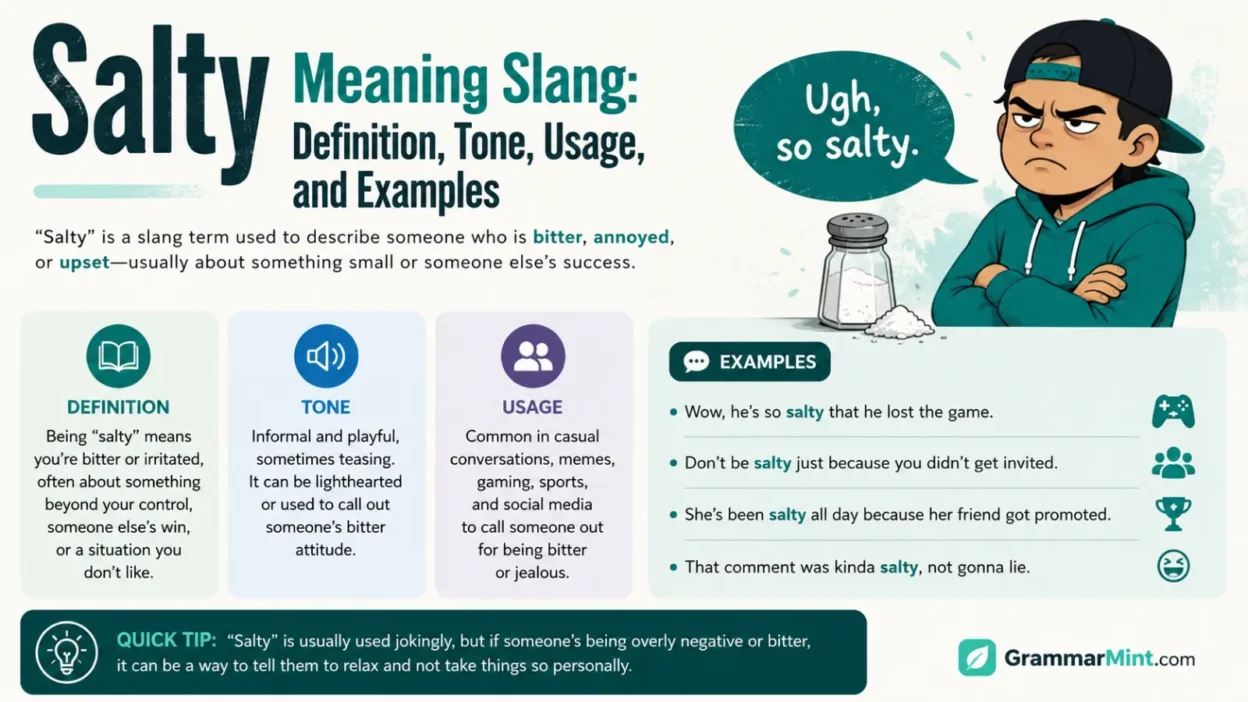
Salty meaning slang usually refers to someone who feels annoyed, bitter, or resentful. Often, it suggests that the person is reacting poorly to a loss, criticism, rejection, or minor problem.
TL;DR
• Usually, salty means annoyed, bitter, or resentful.
• Losses, criticism, and rejection can make someone salty.
• In casual speech, the word often sounds teasing.
• Depending on context, it may also feel insulting.
• Grammatically, salty functions as an adjective.
• Your relationship with the listener affects its tone.
What Does Salty Mean in Slang?
In slang, salty describes someone who remains upset about an unwanted result. A sense of irritation or bitterness usually appears in the person’s behavior.
Someone feeling salty might complain, become defensive, or respond unfriendly. To others, the reaction may seem stronger than the situation deserves.
For example:
• “After his team lost, he became salty.”
• “Nobody chose her idea, so she got salty.”
• “Why are you so salty about one mistake?”
• “Missing the invitation made them feel salty.”
Deep anger is not always involved. More often, the word points to mild or moderate annoyance.
Wounded pride can also cause a salty reaction. Embarrassment, rejection, or criticism may leave someone feeling bitter.
Does Salty Mean Jealous?
Jealousy is not the main definition of salty. Still, jealous feelings can make a person behave that way.
Imagine that your friend receives a promotion. Another coworker responds with bitter comments and an unfriendly attitude. In that situation, people might describe the coworker as salty.
What matters most is the irritated behavior. The word does not explain the exact emotion behind it.
Literal Meaning vs Slang Meaning
Salty carries several meanings in English. Surrounding words and context reveal which meaning applies.
Food-related uses are normally literal. By contrast, emotional uses are informal and often slang.
| Context | Meaning | Example |
|---|---|---|
| Food or drink | Containing or tasting of salt | “The soup is too salty.” |
| Informal slang | Annoyed, bitter, or resentful | “He is salty about losing.” |
| Language or humor | Crude, sharp, or slightly offensive | “The comedian used salty language.” |
“Salty language” does not usually mean angry language. Instead, the phrase refers to crude, vulgar, or provocative speech.
Similarly, a “salty joke” may include adult or offensive content. Looking at the noun after salty helps clarify the intended meaning.
Pronunciation and Part of Speech
In American English, salty is pronounced SAWL-tee. Stress falls on the first syllable.
Grammatically, the word is mainly an adjective. It can describe a person, mood, reaction, taste, or style of language.
Common forms include:
• Salty: “She seems salty.”
• Saltier: “After the second loss, he became saltier.”
• Saltiest: “That was his saltiest response all day.”
• Saltiness: “Everyone noticed her saltiness.”
As slang, salty does not normally function as a verb. Therefore, “He salted after losing” is incorrect for this meaning.
Choose a linking verb instead:
• “After losing, he was salty.”
• “The final result made him salty.”
• “Following the defeat, he acted salty.”
How to Use Salty Naturally
Salty commonly appears after be, get, seem, look, or act. It may also come directly before a noun.
Several sentence patterns sound especially natural in everyday English.
Be Salty About Something
Use salty about to introduce the reason for someone’s annoyance.
• “The schedule change made her salty.”
• “Even now, they are salty about the final score.”
• “Not getting a ticket left me feeling salty.”
Get Salty
The phrase get salty describes someone beginning to feel annoyed.
• “He got salty when I corrected him.”
• “Please don’t get salty over a harmless joke.”
• “Failed plans can make people salty.”
Act or Seem Salty
These patterns describe behavior that looks irritated or bitter.
• “Today, you seem a little salty.”
• “Why is Mark acting so salty?”
• “After the meeting, she looked upset and salty.”
Salty With Someone
Use salty with when irritation is directed toward another person.
• “Why are you being salty with me?”
• “Following the mistake, he became salty with his teammates.”
• “Work stress made her salty with everyone.”
A Salty Reaction or Comment
Salty can also appear before a noun.
• “That response sounded salty.”
• “Another salty comment appeared under the post.”
• “Her attitude made the conversation uncomfortable.”
Salty in Texts, Social Media, and Gaming
Short messages and online conversations often include salty. Depending on the situation, the speaker may be joking or offering light criticism.
A salt-shaker emoji can make the joke more obvious. Even without an emoji, the word carries the same emotional meaning.
In Text Messages
• “Why are you so salty today?”
• “Don’t be salty—we can try again tomorrow.”
• “Because he felt salty, he left the group chat.”
Short texts do not always reveal tone clearly. As a result, playful words may appear rude or unfriendly.
On Social Media
Online users may call a comment salty when it sounds bitter or defensive.
• “That reply seems slightly salty.”
• “After receiving criticism, she posted a bitter response.”
• “Following the announcement, the comment section became salty.”
In Gaming
Gaming communities often use salty after a player loses. Complaining, blaming teammates, or refusing to accept defeat can all seem salty.
• “Losing the match made him salty.”
• “The referee’s call upset the other team.”
• “Start the next round instead of being salty.”
Gaming does not give the word a completely separate definition. Rather, it applies the same emotional meaning to a competitive setting.
Tone: Is Salty Rude or an Insult?
Salty is not a swear word. Even so, it can work as a mild insult.
Close friends may use it playfully after a game or disagreement. In that setting, teasing is often the main purpose.
During a serious conflict, however, the term may dismiss someone’s concerns. Calling a person salty can suggest that their feelings are unreasonable.
Compare these situations:
• Playful: “You’re only salty because I won.”
• Dismissive: “Stop being salty about the unfair treatment.”
Between friends, the first sentence may sound harmless. The second one could minimize a serious complaint.
Avoid using salty during grief, discrimination, workplace disputes, or personal distress. Direct and respectful wording works better in sensitive moments.
Better questions include:
• “Are you upset about what happened?”
• “Would you like to discuss the decision?”
• “Did my comment bother you?”
What Does “Stay Salty” Mean?
“Stay salty” is usually a taunt. Through this phrase, a speaker tells someone to remain upset or continue complaining.
Because it sounds mocking, the expression can easily offend people. Reserve it for playful teasing that everyone clearly understands.
Synonyms, Antonyms, and Related Expressions
No single synonym replaces salty in every situation. Your best choice depends on the cause and strength of the emotion.
Close Synonyms
• Annoyed: Mildly angry or bothered
• Bitter: Holding resentment about an event
• Irritated: Feeling impatient or displeased
• Resentful: Angry about unfair treatment
• Bothered: Emotionally affected or disturbed
• Defensive: Quick to react against criticism
• Sore: Upset after losing or being criticized
In competitive situations, “sore loser” has a similar meaning. That phrase, however, only applies after a loss.
Another informal term is “pressed.” It often suggests that someone cares too much about a minor issue.
Within gaming communities, “tilted” describes frustration that affects a player’s decisions. Although related, it does not match salty in every context.
Antonyms
Salty has no single fixed opposite in slang. Possible contrasts include:
• Calm
• Gracious
• Relaxed
• Unbothered
• Good-natured
• Easygoing
A gracious loser accepts defeat without complaining. Meanwhile, an unbothered person shows little emotional reaction.
Origin and History of Salty
For centuries, the literal word salty has described tastes connected with salt. Later, additional meanings developed through associations with sailors, rough behavior, and strong language.
Historically, sailors were linked with crude speech and tough personalities. Because of that connection, salty could describe language or behavior that seemed sharp, rough, or vulgar.
The angry sense has documented roots in Black American English. Written records place this usage during the 1930s.
One recorded expression was jumping salty. At the time, it described someone suddenly becoming angry.
Gaming and internet communities later spread the modern meaning more widely. Competitive players often applied the word to opponents who reacted badly after losing.
Some people connect salty with tears after disappointment. While that image makes the meaning memorable, it does not explain the word’s full history.
Overall, the exact path between its older and newer meanings remains partly uncertain. For that reason, simple origin stories should be treated carefully.
Common Mistakes and When Not to Use It
Once the context is clear, salty is easy to understand. Nevertheless, several mistakes can make it sound unnatural or insensitive.
Mistake 1: Assuming Salty Always Means Jealous
Jealousy may cause bitterness, but it is not required.
Incorrect idea: Every salty person feels jealous.
Better idea: Many events can leave someone annoyed or resentful.
Mistake 2: Using Salty for Serious Pain
Calling someone salty may minimize strong or justified emotions.
Insensitive: “She is salty because she lost her job.”
Better: “Losing her job left her deeply upset.”
Mistake 3: Forgetting the Linking Verb
Edited standard English usually requires a linking verb.
Less suitable for edited writing: “He salty.”
Standard form: “He is salty.”
In casual speech, some dialects may omit the linking verb. Such grammar is dialect-based and should not be labeled careless.
Mistake 4: Using It in Formal Documents
When salty describes an emotion, it remains informal.
Reports, applications, academic papers, and official complaints need more precise wording. Better choices include annoyed, resentful, irritated, or dissatisfied.
Mistake 5: Confusing Salty With Salty Language
A salty person feels annoyed or resentful. On the other hand, salty language is crude, vulgar, or provocative.
Although the meanings can overlap, they are not identical.
When Not to Use Salty
Avoid the term when:
• Someone is experiencing serious emotional pain.
• Discrimination or unfair treatment is involved.
• Formal language is required.
• The listener may misunderstand playful teasing.
• A direct emotion word would sound clearer.
Salty Examples and Mini Quiz
These examples show how salty appears in modern American English.
Everyday Conversation
• “Because I used the car first, my brother became salty.”
• “After the group changed her plan, she seemed annoyed.”
• “The delay made me salty, but I soon calmed down.”
• “Why are you acting that way with everyone?”
Sports and Gaming
• “After the referee’s decision, the fans became salty.”
• “Because he lost, he quit the match in frustration.”
• “Our opponents posted bitter comments after the game.”
• “There is another round, so don’t get salty.”
School and Work
• “Extra homework left Jordan feeling salty.”
• “Another person received the promotion, which upset her.”
• “His bitter reply made the meeting uncomfortable.”
• “The new seating plan annoyed several students.”
Texts and Social Posts
• “Still salty about last night?”
• “Honestly, that comment sounded unnecessarily bitter.”
• “After posting an angry message, she deleted it.”
• “You won fairly, so ignore the negative replies.”
Mini Quiz
1. What does salty mean here?
“Ben became salty after losing the race.”
A. Hungry
B. Annoyed
C. Tired
2. Which sentence uses the literal meaning?
A. “The fries taste salty.”
B. “She is salty about the result.”
C. “His reply sounded salty.”
3. Which sentence is best for a formal report?
A. “The customer was salty.”
B. “The customer was dissatisfied.”
C. “The customer stayed salty.”
4. What does “stay salty” usually express?
A. A health recommendation
B. A cooking instruction
C. A dismissive taunt
Answer Key
- B — Annoyed
- A — The fries taste salty
- B — The customer was dissatisfied
- C — A dismissive taunt
FAQs
What Does Salty Mean in a Text?
In a text, salty usually means annoyed, bitter, or resentful. Someone may use it after a joke, loss, disagreement, or disappointing result.
Relationship and tone affect how the message sounds. Friends may use it playfully, while strangers can make it feel insulting.
Is Calling Someone Salty an Insult?
Calling someone salty can be a mild insult. Often, the word suggests that the person is overreacting or holding onto resentment.
Among close friends, it may simply be teasing. During a serious disagreement, however, it can sound dismissive.
Why Does Salty Mean Angry?
Older meanings connected salty with sailors, rough behavior, and strong language. During the 1930s, an angry sense also appeared in American usage.
Later, gaming and online communities made the term more common. Its complete historical development remains partly unclear.
Does Salty Mean Jealous?
Not exactly. Salty mainly refers to annoyance, bitterness, or resentment.
Jealousy can cause someone to act salty about another person’s success. Still, it is only one possible cause.
What Does Salty Mean in Gaming?
Within gaming, salty describes a player who reacts badly after losing. Complaints, blame, insults, or rage quitting may all show saltiness.
Angry comments after a match can also be called salty. Depending on the players, the word may sound teasing or hostile.
What Does “Stay Salty” Mean?
“Stay salty” tells someone to keep feeling upset or bitter. Usually, the phrase works as a dismissive or mocking response.
Friends sometimes use it jokingly. During an argument, though, it may make the conflict worse.
Conclusion
Understanding salty meaning slang helps you recognize annoyance, bitterness, and resentment in casual English. The expression works best in relaxed conversations where playful teasing is welcome.
Before using it, consider the situation and the other person’s feelings. Practice by writing one natural sentence with “salty about.”