
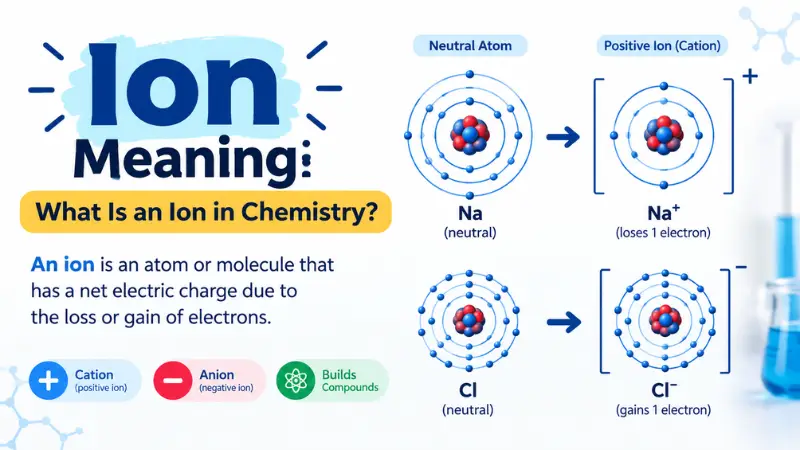
An ion is an atom or group of atoms that has an electrical charge because it has gained or lost electrons. If an atom loses electrons, it becomes a positively charged cation. If it gains electrons, it becomes a negatively charged anion.
Ions are fundamental to chemistry and are involved in many processes, including chemical reactions, electricity, batteries, nerve signals, and the functioning of electrolytes in the human body.
In simple terms:
Ion = an atom or group of atoms with a net electrical charge.
What Does Ion Mean?
The ion meaning in chemistry refers to a particle that carries a positive or negative electrical charge.
Normally, an atom has the same number of protons and electrons, so its overall charge is neutral. However, when the atom gains or loses one or more electrons, the balance changes.
| Particle | What happens to electrons? | Result |
|---|---|---|
| Neutral atom | No net gain or loss | No charge |
| Cation | Loses electrons | Positive charge |
| Anion | Gains electrons | Negative charge |
For example, a sodium atom (Na) has 11 protons and 11 electrons. When it loses one electron, it becomes Na⁺, a positively charged sodium ion.
How Do Ions Form?
Ions generally form when atoms gain or lose electrons.
When an atom loses electrons
Electrons have a negative charge. Therefore, losing electrons leaves an atom with more positive protons than negative electrons.
For example:
Na → Na⁺ + e⁻
A neutral sodium atom loses one electron and becomes a sodium ion with a +1 charge.
When an atom gains electrons
When an atom gains electrons, it has more negative electrons than positive protons.
For example:
Cl + e⁻ → Cl⁻
A chlorine atom gains one electron and becomes a chloride ion with a −1 charge.
This process is called ionization in appropriate contexts, although the exact mechanism can vary depending on the substance and conditions.
What Is a Cation?
A cation is a positively charged ion.
Cations form when atoms or molecules lose electrons.
Common examples include:
- Na⁺ — sodium ion
- K⁺ — potassium ion
- Ca²⁺ — calcium ion
- Mg²⁺ — magnesium ion
- H⁺ — hydrogen ion
Easy way to remember
Cation = positive ion
One common memory trick is to associate the “t” in cation with “+”, although this is only a mnemonic rather than a scientific rule.
What Is an Anion?
An anion is a negatively charged ion.
Anions form when atoms or molecules gain electrons.
Common examples include:
- Cl⁻ — chloride ion
- F⁻ — fluoride ion
- O²⁻ — oxide ion
- S²⁻ — sulfide ion
- OH⁻ — hydroxide ion
Easy way to remember
Anion = negative ion
A simple mnemonic is: anion → “add” electrons → negative charge.
Cation vs. Anion
The main difference between cations and anions is their electrical charge and how they form.
| Feature | Cation | Anion |
|---|---|---|
| Charge | Positive | Negative |
| Electrons | Lost | Gained |
| Example | Na⁺ | Cl⁻ |
| Another example | Ca²⁺ | O²⁻ |
| Commonly formed by | Metals | Nonmetals |
When oppositely charged ions interact, they can form ionic compounds. For example, sodium ions and chloride ions combine to form sodium chloride, commonly known as table salt.
Na⁺ + Cl⁻ → NaCl
Common Examples of Ions
Ions appear throughout chemistry, biology, medicine, and everyday life.
Sodium ion (Na⁺)
Sodium ions are important electrolytes and participate in processes such as nerve signaling and fluid balance.
Potassium ion (K⁺)
Potassium ions play important roles in cellular function, including electrical activity in cells.
Calcium ion (Ca²⁺)
Calcium ions are involved in processes such as muscle contraction, cell signaling, and bone-related biology.
Chloride ion (Cl⁻)
Chloride is a common negatively charged ion and is found in compounds such as sodium chloride.
Hydrogen ion (H⁺)
Hydrogen ions are particularly important in acid-base chemistry. In aqueous chemistry, the concept of hydrogen-ion concentration is closely related to pH.
Hydroxide ion (OH⁻)
Hydroxide ions are important in basic or alkaline solutions.
What Is an Ion in Chemistry?
In chemistry, an ion is a charged species that can participate in chemical reactions and interact with other charged or polar particles.
Ions can be:
- Monatomic ions — made from a single atom, such as Na⁺ or Cl⁻.
- Polyatomic ions — made from multiple atoms bonded together but carrying an overall charge, such as SO₄²⁻ or NO₃⁻.
Examples of polyatomic ions
| Ion | Name | Charge |
|---|---|---|
| OH⁻ | Hydroxide | −1 |
| NO₃⁻ | Nitrate | −1 |
| SO₄²⁻ | Sulfate | −2 |
| CO₃²⁻ | Carbonate | −2 |
| NH₄⁺ | Ammonium | +1 |
The atoms within a polyatomic ion are chemically bonded to one another, but the entire group has a net electrical charge.
Ion vs. Atom: What’s the Difference?
An atom is electrically neutral when it has equal numbers of protons and electrons.
An ion has an electrical charge because its number of electrons is different from its number of protons.
For example:
- Na = neutral sodium atom
- Na⁺ = positively charged sodium ion
The nucleus does not normally change when an ordinary atom becomes an ion. Instead, the number of electrons changes.
Ion vs. Molecule: What’s the Difference?
A molecule consists of two or more atoms chemically bonded together and is not necessarily charged.
An ion, on the other hand, has a net electrical charge.
For example:
- O₂ = neutral oxygen molecule
- H₂O = neutral water molecule
- OH⁻ = charged hydroxide ion
- NH₄⁺ = charged ammonium ion
A species can also be both a molecular species and an ion, as with many polyatomic ions.
Why Are Ions Important?
Ions are important because they are involved in many chemical and physical processes.
1. Chemical reactions
Many reactions involve the transfer or exchange of electrons and the formation of ions.
2. Electricity
Solutions containing mobile ions can conduct electrical current. This is why many electrolyte solutions conduct electricity.
3. Batteries
Batteries rely on chemical reactions involving ions and electron transfer to produce electrical energy.
4. Biology
Charged ions such as sodium, potassium, calcium, and chloride are essential to numerous biological processes.
5. Acids and bases
Hydrogen ions and hydroxide ions are central to many acid-base concepts.
What Are Electrolytes?
An electrolyte is a substance that produces ions when dissolved in water or, in some cases, when molten, allowing the resulting medium to conduct electricity.
Common examples include compounds containing:
- Sodium ions
- Potassium ions
- Calcium ions
- Magnesium ions
- Chloride ions
This is why the word electrolytes often appears in discussions of hydration, sports drinks, and biological fluids.
What Does “Ionization” Mean?
Ionization refers broadly to the process in which an atom or molecule becomes an ion by gaining or losing electrons.
For example, an atom can become positively charged after losing an electron.
However, chemistry uses the term in somewhat different ways depending on the context. For instance, the behavior of an ionic compound dissolving in water is not identical to an electrically neutral molecule becoming ionized.
Understanding the context helps avoid confusing ion formation, ionization, and dissociation.
Ion Meaning in Everyday Language
Outside chemistry, ion generally refers to the scientific concept described above. It is not normally an abbreviation with a separate everyday definition.
However, in texting or informal online communication, “ion” can sometimes appear as a slang spelling or pronunciation of “I don’t.” Its meaning depends heavily on context.
For example:
“Ion know what happened.”
In some informal online contexts, this can mean:
“I don’t know what happened.”
This slang use is different from the scientific meaning of ion.
Ion Meaning: Quick Summary
If you need the definition quickly, remember these points:
- An ion is a charged atom or group of atoms.
- Cations have a positive charge.
- Anions have a negative charge.
- Losing electrons generally produces a positive ion.
- Gaining electrons generally produces a negative ion.
- Ions are important in chemistry, electricity, batteries, biology, and acid-base reactions.
- Na⁺ is a cation, while Cl⁻ is an anion.
- In informal internet slang, “ion” can sometimes mean “I don’t.”
FAQs
An ion is an atom or group of atoms with an electrical charge because it has gained or lost electrons.
An ion can be either positive or negative. A positive ion is called a cation, while a negative ion is called an anion.
Common examples include Na⁺ (sodium), K⁺ (potassium), Ca²⁺ (calcium), and Cl⁻ (chloride).
A neutral atom has equal numbers of protons and electrons. An ion has a net charge because its number of electrons differs from its number of protons.
A cation is a positively charged ion, usually formed when an atom or molecule loses one or more electrons.
An anion is a negatively charged ion, usually formed when an atom or molecule gains one or more electrons.
In some informal online conversations, “ion” is used as slang for “I don’t.” The intended meaning depends on the context.
Ions are involved in chemical reactions, electrical conductivity, batteries, acid-base chemistry, and many biological processes.
Conclusion
The ion meaning is straightforward: an ion is a particle with a net electrical charge. It forms when an atom or group of atoms gains or loses electrons. Cations are positive, while anions are negative.
Understanding ions makes it easier to learn topics such as ionic compounds, electrolytes, acids and bases, chemical reactions, and electricity. If you’re studying chemistry, start by remembering the basic rule: losing electrons produces a positive charge, while gaining electrons produces a negative charge.
Next step: Use the cation-versus-anion distinction to practice identifying the charge and name of common ions such as Na⁺, Mg²⁺, Cl⁻, and O²⁻.
SEO Metadata
Meta title: Ion Meaning: What Is an Ion in Chemistry?
Meta description: Learn the ion meaning, how ions form, cations vs. anions, common examples, and why ions matter in chemistry and everyday life.
URL slug: /ion-meaning/


