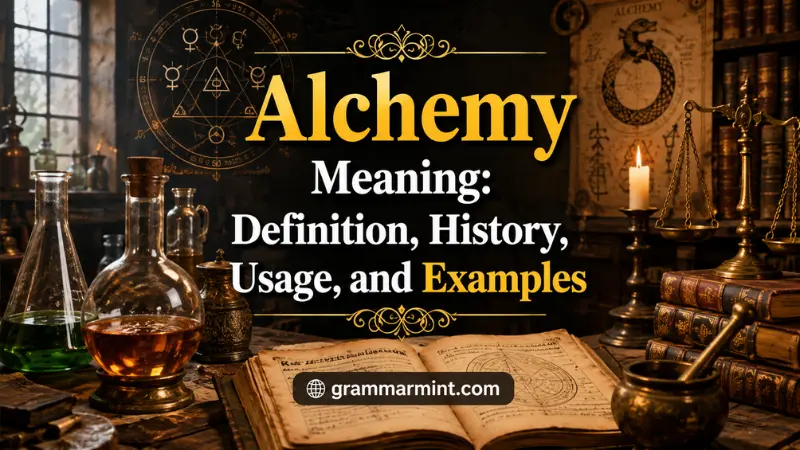
Alchemy appears in history books, fantasy stories, movies, songs, and everyday writing. At first, the word may sound mystical or scientific. Its oldest meaning refers to an early tradition that studied matter and hoped to transform substances.
Many alchemists became famous for seeking ways to turn common metals into gold. Some also searched for powerful medicines or ways to extend life. Today, however, alchemy often has a figurative meaning. It can describe an impressive transformation that seems almost magical.
Understanding the word helps you read both historical and modern English more accurately. It also prevents confusion between alchemy, chemistry, magic, and spiritual ideas. This guide explains the alchemy meaning, pronunciation, grammar, history, modern use, related words, and clear examples today.
Quick Answer
Alchemy meaning usually refers to transforming something ordinary into something valuable or remarkable. Historically, alchemy involved experiments, philosophy, medicine, and attempts to turn base metals into gold.
TL;DR
• Alchemy is mainly a noun.
• Say it as AL-kuh-mee.
• Historically, it involved transforming matter.
• Gold-making was one famous goal.
• Modern use often describes remarkable transformation.
• It is not standard modern slang.
Alchemy Meaning in Plain English
In simple English, alchemy means transformation. The exact meaning depends on whether the context is historical or figurative.
Historically, alchemy was an early study of matter and change. Practitioners experimented with metals, minerals, medicines, and other substances. Their goals could include making gold or finding powerful remedies.
In modern writing, alchemy often means a change that seems unusually skillful or mysterious. The word suggests that ordinary parts became something much better.
For example, a chef may turn basic ingredients into an excellent meal. A writer may turn a simple idea into a moving story. Both changes can be called alchemy.
Pronunciation and Part of Speech
Alchemy is pronounced AL-kuh-mee. The first syllable receives the strongest stress.
The word is mainly used as a noun. In most everyday sentences, it names a process, practice, or remarkable transformation.
Example: “The team found the right alchemy and started winning.”
The related noun alchemist means a person who practices alchemy. The adjective alchemical describes something connected with alchemy.
How Alchemy Is Used Today
Modern English uses alchemy in several common settings. Most figurative uses are positive or admiring.
• Cooking: Simple ingredients become an impressive dish.
• Art: Ordinary materials become something beautiful.
• Music: Different sounds combine into a strong result.
• Business: Limited resources produce surprising value.
• Personal growth: Difficult experiences lead to positive change.
The figurative meaning is usually literary or expressive. It sounds stronger than the plain word transformation.
Alchemy is not a mainstream slang term. Informal speakers may use it creatively, but the core meaning remains transformation.
Historical Meaning, Main Goals, and the Philosopher’s Stone
Historical alchemy combined practical experiments with ideas about nature, matter, medicine, and philosophy. Different traditions developed across several regions and time periods.
One famous goal was transmutation. This meant changing a base metal, such as lead, into a noble metal, especially gold.
Another goal involved powerful medicines. Some alchemists searched for a universal remedy or an elixir linked with longer life.
The philosopher’s stone became a famous alchemical idea in European traditions. It was believed to help produce major transformations, including turning metals into gold.
Alchemy also contributed practical knowledge about substances and laboratory methods. Over time, modern chemistry developed into a separate scientific field.
Figurative Meaning: Transformation That Feels Magical
The figurative meaning is common in modern writing. It describes a change that seems mysterious, impressive, or unexpectedly successful.
You might read, “The director created cinematic alchemy from a small budget.” The sentence describes an unusually strong result.
The word can also describe a special combination. For example, a band may have an alchemy that makes its music feel unique.
This use does not usually claim real magic. Instead, it highlights skill, chemistry, creativity, or a result that feels hard to explain.
Alchemy, Chemistry, and Magic
These words overlap in some contexts, but they are not identical. Choosing the right word keeps your meaning clear.
| Context | Best Choice | Why |
| Modern scientific study of matter | Chemistry | It is the current scientific field. |
| Historical attempts to transform matter | Alchemy | It fits the historical tradition. |
| Supernatural power in fiction | Magic | It directly refers to supernatural effects. |
| Impressive creative transformation | Alchemy | It adds a figurative, expressive tone. |
A common mistake is calling modern chemistry “alchemy.” That wording is inaccurate unless you are speaking figuratively.
Another mistake is treating alchemy as a synonym for magic in every sentence. Historical alchemy also involved experiments and practical work.
Examples of Alchemy in Sentences
These examples show both historical and figurative uses.
• Medieval writers described alchemy as a path to transforming metals.
• The novel follows an alchemist searching for a powerful substance.
• Her cooking turns simple vegetables into pure alchemy.
• The band created a rare alchemy on stage.
• Good editing can perform alchemy on a rough first draft.
• The coach found the right alchemy between young and experienced players.
• The museum exhibit explains the history of alchemy.
• Their creative alchemy turned a small idea into a memorable campaign.
The surrounding words usually reveal the intended meaning. Historical references point toward experiments, metals, medicines, and old traditions.
Modern references usually point toward creativity, teamwork, improvement, or impressive change.
Synonyms, Related Terms, and Common Mistakes
Alchemy has no perfect synonym that works in every context. The best alternative depends on the sentence.
Close words for the figurative sense include transformation, transmutation, magic, and conversion. Magic is stronger and may suggest the supernatural.
Related terms include alchemist, alchemical, philosopher’s stone, elixir, transmutation, and chemistry. These words often appear in historical or fantasy contexts.
Avoid using alchemy when you simply mean change. The word usually suggests unusual, valuable, mysterious, or impressive transformation.
Wrong: “I changed my password through alchemy.”
Better: “I changed my password.”
Natural: “The chef’s alchemy turned leftovers into an elegant dinner.”
Mini Quiz
Choose the best answer.
1. What part of speech is alchemy?
A) Noun
B) Adverb
C) Preposition
2. Which sentence uses alchemy figuratively?
A) “The chef created alchemy with basic ingredients.”
B) “The password expired yesterday.”
C) “The bus arrived at noon.”
3. What was a famous historical goal of alchemy?
A) Building airplanes
B) Turning base metals into gold
C) Measuring ocean depth
4. Is alchemy standard modern slang?
A) Yes
B) No
Answer key: 1-A, 2-A, 3-B, 4-B.
FAQs
What is the simple meaning of alchemy?
Alchemy means transformation. Historically, it referred to practices that tried to change substances and discover valuable remedies.
What does alchemy mean today?
Today, alchemy often describes an impressive change that seems almost magical. It may refer to cooking, art, teamwork, or creativity.
Is alchemy a real science?
Historical alchemy included observation and experiments, but it is not modern chemistry. Chemistry later developed as a separate scientific field.
What does alchemy mean spiritually?
In spiritual writing, alchemy can symbolize inner transformation, purification, or personal growth. That meaning depends on the tradition and context.
Does alchemy mean magic?
Not exactly. Modern figurative use can sound magical, but historical alchemy also involved experiments with physical substances.
What is an alchemist?
An alchemist is someone who practices alchemy. In figurative use, it can describe someone skilled at creating remarkable transformations.
Conclusion
Alchemy meaning depends on context, but transformation connects its main uses. Historically, it concerned matter, metals, medicines, and ambitious experiments.
Today, the word often describes a remarkable change or combination. Check the surrounding context to choose the right meaning.