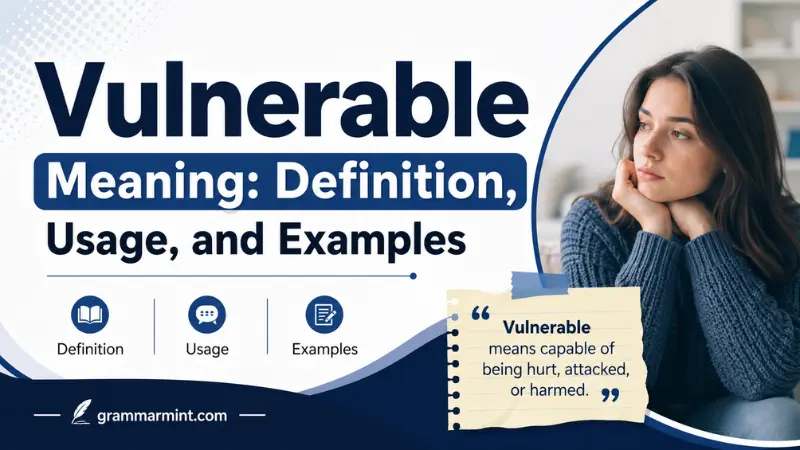
You may hear vulnerable in conversations about feelings, health, safety, relationships, or difficult situations. Understanding vulnerable meaning helps you recognize what kind of risk the speaker describes.
The word can describe a person, animal, business, system, place, or position. In each case, something has a greater chance of being hurt or harmed.
People also use vulnerable when someone opens up emotionally. In that context, the possible harm is rejection, criticism, embarrassment, or emotional pain.
This guide explains the definition, pronunciation, grammar, and common uses. It also shows natural examples and common mistakes.
Quick Answer
Vulnerable meaning is being open to harm, injury, damage, attack, or emotional hurt. Someone vulnerable may also be less protected from a particular danger.
TL;DR
• Vulnerable is mainly an adjective.
• It describes someone or something open to harm.
• Emotional vulnerability involves openness despite possible emotional pain.
• Vulnerable to names a specific danger or influence.
• It is standard English, not ordinary slang.
• Vulnerability is the related noun.
Vulnerable Meaning in Plain English
In simple English, vulnerable means easy to hurt, harm, damage, influence, or attack.
The exact danger depends on the context. The harm may be physical, emotional, financial, social, or another kind.
For example:
• “Young plants are vulnerable to frost.”
The frost can easily damage them.
• “He felt vulnerable after admitting his fear.”
He felt emotionally exposed.
• “The old building is vulnerable during storms.”
A storm could damage it easily.
• “Small businesses may be vulnerable during a sudden downturn.”
Financial problems may affect them strongly.
The word does not always mean harm is happening now. It often means the risk of harm is higher.
Pronunciation and Part of Speech
Vulnerable is pronounced roughly:
VUL-nuh-ruh-buhl
The main stress falls near the beginning. In natural American speech, the middle sounds may become very light.
What part of speech is vulnerable?
Vulnerable is an adjective. It describes a person, animal, place, object, group, or situation.
Examples:
• “The injured bird was vulnerable.”
• “They entered a vulnerable position.”
• “The system remains vulnerable to attack.”
You may also hear the vulnerable. This expression refers to vulnerable people as a group.
Do not normally use vulnerable as a verb. Use another verb such as expose when needed.
Main Meanings and Common Contexts
The central idea stays the same: something lacks complete protection from possible harm.
Physical vulnerability
A person or body part may be easier to injure.
“His injured shoulder remained vulnerable.”
Animals can also become vulnerable when they cannot escape or defend themselves.
Vulnerable to illness
The word often describes a higher risk from disease or infection.
“New seedlings are vulnerable to disease.”
The pattern usually names the danger after to.
Emotional vulnerability
Someone may feel emotionally exposed after sharing personal feelings.
“I felt vulnerable telling her how much the decision affected me.”
Here, the possible harm may involve rejection or judgment.
Vulnerable to criticism or pressure
Arguments, plans, people, and organizations can also be vulnerable.
“The proposal is vulnerable to criticism.”
This does not mean physical injury. It means criticism can affect or weaken the proposal.
Vulnerable groups
The phrase can describe people who face greater risks or need added protection.
The exact reason depends on the situation. Avoid assuming that every member has the same needs.
Is vulnerable slang?
No separate mainstream slang definition is needed for normal American English.
People do use the word casually online. However, its basic meaning remains emotional or practical exposure to harm.
How to Use Vulnerable Correctly
The most useful pattern is:
vulnerable to + danger, problem, influence, or condition
Examples:
• vulnerable to infection
• vulnerable to fraud
• vulnerable to criticism
• vulnerable to pressure
• vulnerable to flooding
• vulnerable to manipulation
You can also use the adjective without to when the danger is already understood.
“She felt vulnerable.”
“The team looked vulnerable.”
“The building remains vulnerable.”
Another common pattern is:
in a vulnerable position
Example:
“Losing its largest customer left the company in a vulnerable position.”
Here is a quick guide:
| Context | Best Choice | Why |
| Risk from a named danger | vulnerable to | Names the specific threat |
| General exposed feeling | vulnerable | No threat must be stated |
| Risky situation | vulnerable position | Describes the overall situation |
| State or quality | vulnerability | A noun is needed |
More everyday examples
“Without sunscreen, my skin is vulnerable to burning.”
“She felt vulnerable asking for help.”
“The broken window left the house vulnerable.”
“The account became vulnerable after the password was shared.”
“His argument was vulnerable to several objections.”
What Vulnerable Means Emotionally and in Relationships
In emotional conversations, vulnerable often means allowing another person to see your true feelings.
You may reveal fear, affection, uncertainty, disappointment, or a personal need. That openness creates some emotional risk.
For example:
“I felt vulnerable telling him that I missed him.”
The speaker is not necessarily physically unsafe. The risk comes from how the other person may respond.
Another example is:
“She was vulnerable enough to admit she needed help.”
Here, vulnerability involves honesty about something difficult.
Does being vulnerable mean being weak?
Not necessarily.
A weak person lacks strength in some way. A vulnerable person is open to a certain kind of harm.
A strong person can still be vulnerable in one situation.
For example, a skilled athlete can have a vulnerable injured knee. A confident person can feel vulnerable during an emotional conversation.
Vulnerability is not the same as oversharing
Being emotionally open does not require sharing every private detail.
Context still matters. People may choose what to share and with whom.
Synonyms, Antonyms, and Related Words
No synonym replaces vulnerable perfectly in every sentence.
Useful synonyms
Susceptible — likely to be affected by something.
“The crop is susceptible to disease.”
Exposed — lacking protection from a danger.
“The coastal homes were exposed to strong winds.”
Unprotected — not adequately protected.
“The files remained unprotected.”
At risk — facing a meaningful possibility of harm.
“Several homes are at risk of flooding.”
Defenseless — unable to defend oneself effectively.
“The young animal appeared defenseless.”
Do not replace vulnerable with weak automatically. Weak often describes low strength rather than exposure to danger.
Useful antonyms
Depending on context, opposites include:
• protected
• secure
• guarded
• resistant
• safe
• invulnerable
Invulnerable is the closest direct opposite. It means unable or very difficult to harm.
Related words
Vulnerability is the main noun.
“Sharing that story required vulnerability.”
It can also mean a weakness or exposed point.
“The inspection revealed a vulnerability in the building.”
Vulnerably is the adverb, though it is less common.
“She spoke vulnerably about her experience.”
Origin and Word Family
Vulnerable entered English from Latin-based forms connected with the idea of a wound.
English has used the word since the early 1600s. Its first meanings focused strongly on being capable of being wounded.
Over time, the idea expanded beyond physical wounds. People could also become vulnerable to criticism, failure, pressure, or emotional pain.
That history helps explain the modern meaning. Something vulnerable can, in some sense, be “wounded.”
The main word family includes:
• vulnerable — adjective
• vulnerability — noun
• vulnerabilities — plural noun
• vulnerably — adverb
• invulnerable — opposite adjective
Common Mistakes With Vulnerable
Mistake 1: Treating vulnerable as an exact synonym for weak
Incorrect idea:
“Vulnerable always means weak.”
Better understanding:
Vulnerability refers to exposure to harm. Weakness refers more directly to limited strength or ability.
Mistake 2: Using the wrong preposition
Less natural:
“The plant is vulnerable from cold weather.”
Better:
“The plant is vulnerable to cold weather.”
Use vulnerable to when naming the danger.
Mistake 3: Assuming vulnerable only describes people
It can describe many things.
“The bridge is vulnerable to flooding.”
“The plan is vulnerable to criticism.”
“The computer is vulnerable to attack.”
Mistake 4: Assuming the word is always emotional
Emotional openness is only one common meaning.
The word also appears in health, safety, business, nature, and everyday situations.
Mistake 5: Assuming emotional vulnerability means sharing everything
A person can be open about one feeling without revealing every private detail.
The meaning centers on emotional exposure, not unlimited disclosure.
Mini Quiz
1. Which sentence uses vulnerable correctly?
A. “The flowers are vulnerable to frost.”
B. “The flowers vulnerable quickly.”
2. What part of speech is vulnerable?
A. Verb
B. Adjective
C. Preposition
3. Which word is closest to vulnerable in “vulnerable to infection”?
A. Susceptible
B. Celebrated
C. Certain
4. Which noun comes from vulnerable?
A. Vulnerability
B. Vulneration
C. Vulnerabling
Answer Key
- A — The flowers can be harmed by frost.
- B — Vulnerable is an adjective.
- A — Susceptible fits this context well.
- A — Vulnerability is the standard noun.
FAQs
What does vulnerable mean in simple words?
It means open to being hurt, harmed, damaged, or affected. The danger can be physical, emotional, social, or practical.
What does it mean when someone is vulnerable?
It may mean the person has less protection from harm. In emotional situations, it can mean openly showing feelings despite possible rejection or judgment.
What is a vulnerable person?
A vulnerable person faces a greater risk of harm in a particular situation. The reason for that risk depends on the context.
Does vulnerable mean weak?
Not exactly. Weakness concerns limited strength, while vulnerability concerns exposure to possible harm.
Someone can be strong yet vulnerable to one specific danger.
What does vulnerable mean in a relationship?
It often means honestly sharing feelings, fears, needs, or hopes. Doing so creates some risk of rejection, misunderstanding, or emotional pain.
What is another word for vulnerable?
Common choices include susceptible, exposed, unprotected, and at risk. The best synonym depends on the sentence.
What is the opposite of vulnerable?
Invulnerable is the closest direct opposite. Depending on context, protected, secure, guarded, or resistant may sound more natural.
Conclusion
Understanding vulnerable meaning becomes easier when you remember the central idea: exposure to possible harm.
Check the context to see whether that harm is physical, emotional, financial, or another kind. Then practice using vulnerable to with a few everyday examples.