You’re here because one tiny vowel can make your writing look unsure. Separate or Seperate is a common question for students, job seekers, teachers, writers, and anyone sending an important email. The answer is simple, but it helps to know why the mistake happens.
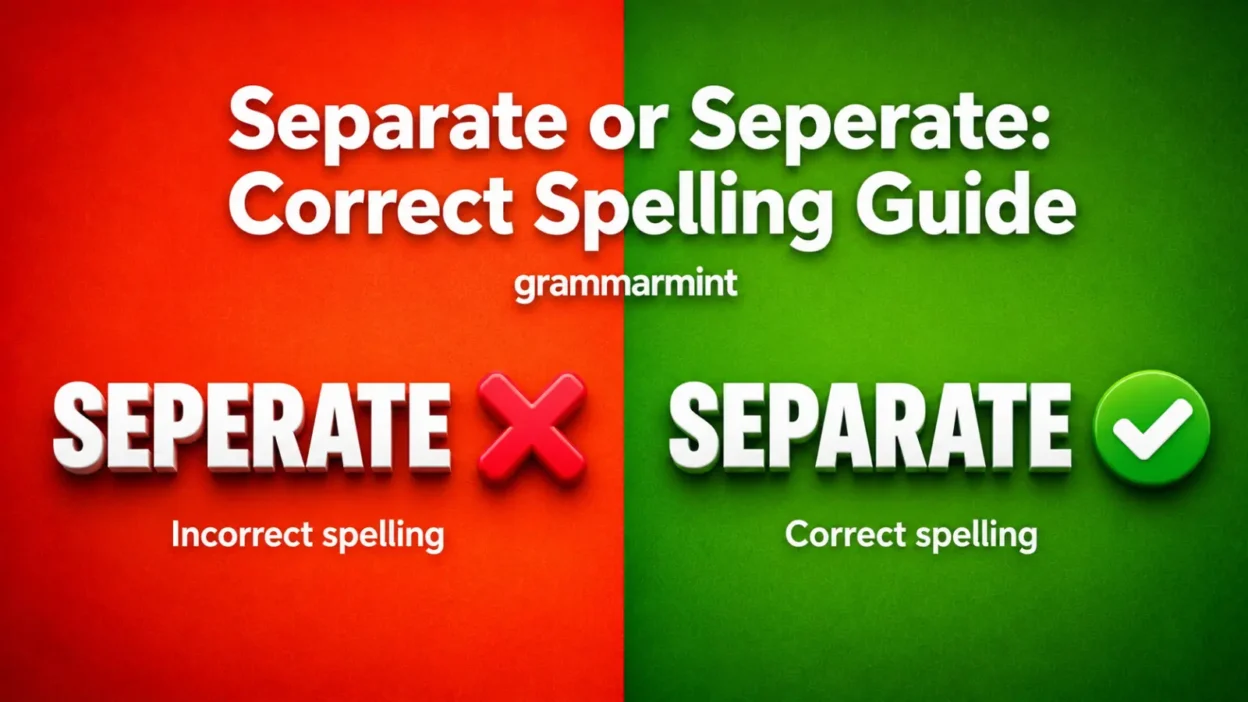
The correct spelling is “separate.” The other spelling is a misspelling. In this guide, you’ll learn the meaning, definition, pronunciation, examples, related forms, and memory tricks. You’ll also see how to use the word in school, work, texting, and everyday writing.
Quick Answer
Separate or seperate is easy to settle: “separate” is correct, and “seperate” is wrong. Use “separate” for the verb, adjective, noun, and related forms.
TL;DR
• “Separate” is always the correct spelling.
• “Seperate” is a spelling mistake.
• The word has two a’s.
• Say it slowly: sep-a-rate.
• “Separation” keeps the same a.
• Use “separate” in formal writing.
Separate Or Seperate
The correct spelling is “separate.” Although common misspelling patterns can feel normal, “seperate” is not the standard English word.
So, when you pause while typing, choose the version with “a” after “p.” That small letter keeps your sentence clean and correct.
• Use “separate” in every normal context.
• Avoid “seperate” in school assignments.
• Choose “separate” for business emails.
• Write “separate” on resumes and forms.
• Use “separate” in text messages too.
• Remember the “a” after the “p.”
• “Seperate” looks common but stays wrong.
• Spell it “separate” before adding endings.
• Use “separate” for people or things.
• Use “separate” for ideas or groups.
• Check it before sending important notes.
• Let spellcheck confirm, not decide.
Separate Vs Seperate
The accepted form is “separate.” The wrong spelling is “seperate,” even if you see it online or in rushed messages.
In standard English, this is not a style choice. It is not like color and colour, where regions differ.
• “Separate” is correct in American English.
• “Separate” is correct in British English.
• “Seperate” is not a regional variant.
• “Seperate” should be edited out.
• “Separate” can describe different items.
• “Separate” can show things moving apart.
• “Seperate” may appear in rough drafts.
• “Seperate” can weaken formal writing.
• “Separate” works in legal wording.
• “Separate” works in school essays.
• “Separate” works in everyday notes.
• One letter makes the full difference.
Seperate Or Separate
If your search starts with “seperate,” you’re not alone. That typing mistake happens because the middle vowel can sound unclear.
Still, the spelling error is easy to fix. Swap the middle “e” for “a,” and the word becomes correct.
• Wrong: “seperate the files today.”
• Correct: “separate the files today.”
• Wrong: “use seperate folders.”
• Correct: “use separate folders.”
• Wrong: “they live in seperate homes.”
• Correct: “they live in separate homes.”
• Wrong: “keep expenses seperate.”
• Correct: “keep expenses separate.”
• Wrong: “a seperate email follows.”
• Correct: “a separate email follows.”
• Wrong: “seperate the colors first.”
• Correct: “separate the colors first.”
How To Spell Separate
To spell it correctly, slow the word down: sep-a-rate. The middle a is the part most people miss.
Once you see the spelling pattern, it becomes easier. Think “sep,” then “a,” then “rate.”
• Break it into three clear parts.
• Say “sep-a-rate” while writing.
• Put “a” after the first “p.”
• Keep two a’s in the word.
• Don’t copy the sound too closely.
• Watch the middle of the word.
• Type it slowly in formal notes.
• Practice it with related forms.
• Use flashcards for quick memory.
• Circle the middle “a” mentally.
• Review it before final drafts.
• Repeat correct spelling until automatic.
Separate Meaning
“Separate” means to set apart, divide, or keep things distinct. It can describe space, groups, choices, ideas, or relationships.
Therefore, the word is useful in many everyday situations. You can separate laundry, separate facts, or keep separate accounts.
• Separate socks from shirts.
• Separate truth from rumor.
• Separate work from personal life.
• Separate students into small groups.
• Separate expenses by category.
• Separate files into labeled folders.
• Separate recycling from regular trash.
• Separate old notes from new notes.
• Separate one issue from another.
• Separate private thoughts from public posts.
• Separate wet items from dry ones.
• Separate strong evidence from guesses.
Separate Definition
As a verb, “separate” means to move or keep apart. As an adjective, it means individual or not joined.
It can also be a noun in clothing, usually as “separates.” However, that use is less common than the verb and adjective.
• Verb: “Please separate the papers.”
• Verb: “They separate cans from bottles.”
• Verb: “The fence separates two yards.”
• Verb: “Clouds separated after sunrise.”
• Adjective: “They need separate rooms.”
• Adjective: “Use a separate password.”
• Adjective: “We made separate plans.”
• Adjective: “Those are separate issues.”
• Noun: “She packed summer separates.”
• Noun use is mostly fashion-related.
• Most writers use verb or adjective.
• Context shows the grammar role.
Separate Pronunciation
The word has two common sounds. As a verb, many Americans say SEP-uh-rate. As an adjective, many say SEP-uh-rit in spoken English.
Because the sounds are close, writers often guess the spelling. However, pronunciation does not change the written “a.”
• Verb sound: “Please separate them.”
• Adjective sound: “Use separate folders.”
• The first syllable gets stress.
• The middle sound can feel weak.
• Weak vowels often cause misspellings.
• Say each syllable while learning.
• Don’t spell only by sound.
• The written form stays “separate.”
• The verb often rhymes with “rate.”
• The adjective sounds shorter.
• Both sounds keep the same spelling.
• Pronunciation explains the confusion.
Separate As A Verb
As an action word, “separate” means to divide, sort, or remove one thing from another. It often describes a task.
You’ll see it in instructions, recipes, cleaning, school, and office work. It is direct, useful, and easy to understand.
• Separate laundry before washing.
• Separate eggs before baking.
• Separate names into groups.
• Separate receipts by month.
• Separate tabs by topic.
• Separate the toys after playtime.
• Separate cans from glass bottles.
• Separate facts from opinions.
• Separate tasks by deadline.
• Separate contacts into lists.
• Separate plants before repotting.
• Separate files before archiving.
Separate As An Adjective
As an adjective, “separate” means individual, not shared, or independent. It describes something that stands apart.
This use is common in daily life. For example, you might have separate calendars, separate rooms, or separate bills.
• They have separate bedrooms.
• We need separate checks.
• Use a separate notebook.
• Keep a separate copy.
• Each child has separate chores.
• They made separate travel plans.
• Use separate bags for liquids.
• Open a separate savings account.
• Save it in a separate folder.
• Take separate cars tonight.
• Keep separate records for taxes.
• These are separate problems.
Separation Or Seperation
The correct noun form is separation. It keeps the same a after the “p,” just like “separate.”
So, “seperation” is wrong. When you learn the base word, the noun becomes much easier.
• Correct: “separation of duties.”
• Wrong: “seperation of duties.”
• Correct: “legal separation papers.”
• Wrong: “legal seperation papers.”
• Correct: “separation between teams.”
• Wrong: “seperation between teams.”
• Correct: “physical separation helped.”
• Wrong: “physical seperation helped.”
• The noun keeps the middle “a.”
• The ending changes, not the root.
• Use “separation” in formal writing.
• Check the noun in long documents.
Separated Or Seperated
The correct past tense is separated. Like the base word, it has two a’s and no middle “e” after “p.”
Meanwhile, “seperated” is incorrect. Fix it by returning to the root word first.
• Correct: “They separated last year.”
• Wrong: “They seperated last year.”
• Correct: “Files were separated.”
• Wrong: “Files were seperated.”
• Correct: “We separated the teams.”
• Wrong: “We seperated the teams.”
• Correct: “The labels separated easily.”
• Wrong: “The labels seperated easily.”
• Add “d” to “separate.”
• Don’t change the root spelling.
• Past tense keeps the middle “a.”
• Proofread relationship-related wording carefully.
Separately Or Seperately
The correct adverb is separately. It comes from separate plus ly, so the middle “a” stays.
Therefore, “seperately” is also wrong. The adverb means “apart” or “not together.”
• Correct: “Pay separately at checkout.”
• Wrong: “Pay seperately at checkout.”
• Correct: “Store them separately.”
• Wrong: “Store them seperately.”
• Correct: “We arrived separately.”
• Wrong: “We arrived seperately.”
• Correct: “Package each item separately.”
• Wrong: “Package each item seperately.”
• Keep the base word unchanged.
• Then add “ly” at the end.
• Use it for actions done apart.
• Watch this form in emails.
Separate Spelling Trick
A good memory trick makes the spelling stick. The classic one is a rat inside “separate”: sep-a-rat-e.
You can also remember separate by hearing “par” in the middle. Both tricks point you back to the needed “a.”
• There is “a rat” in separate.
• Think “sep-a-rate,” not “sep-e-rate.”
• Picture one “a” after “p.”
• Say “a” before “rate.”
• Link “separate” with “apart.”
• Both words suggest distance.
• Write it three times correctly.
• Highlight the “a” while studying.
• Use “separation” as reinforcement.
• Make the correct form familiar.
• Catch the mistake before autocorrect.
• Practice with short real sentences.
Separate Synonyms
Useful synonyms include split, detach, and distinguish. However, each word carries a slightly different feeling.
So, choose the word that matches your sentence. “Separate” is often neutral and flexible.
• Use “split” for breaking into parts.
• Use “divide” for planned sections.
• Use “detach” for removing something attached.
• Use “sort” for categories.
• Use “distinguish” for ideas.
• Use “isolate” for keeping alone.
• Use “partition” for sections or spaces.
• Use “disconnect” for links or systems.
• Use “part” for people moving away.
• Use “segregate” with strong caution.
• Use “classify” for organized groups.
• Use “separate” when unsure.
Separate Sentence Examples
Good example sentences help spelling and meaning click. They also show how “separate” works in formal writing and everyday use.
Use these models when you need a quick sentence. Then, adjust the nouns to match your topic.
• Please separate the signed forms.
• Keep your passwords separate.
• We need a separate invoice.
• The curtain separates both rooms.
• Separate the clean towels first.
• Each team has separate goals.
• She keeps separate work notes.
• Let’s separate facts from feelings.
• The app uses separate profiles.
• They chose separate flights home.
• The teacher separated the class.
• Store raw meat separately.
Separate Vs Divide
Both divide and separate can mean putting things apart. Still, your word choice can change the sentence’s feel.
Use “divide” when you split something into parts. Use “separate” when you keep things apart or show they are not joined.
• Divide the pizza into slices.
• Separate the slices onto plates.
• Divide the budget into categories.
• Separate receipts by category.
• Divide the class into teams.
• Separate noisy groups if needed.
• Divide means create parts.
• Separate means keep apart.
• Divide often feels planned.
• Separate often feels practical.
• Use both words with care.
• Context makes the best choice.
FAQs
Is It Separate Or Seperate?
The correct spelling is “separate.” “Seperate” is a misspelling and should be avoided in every kind of writing.
Is Seperate A Word?
No, “seperate” is not the correct word. People often type it by mistake because the middle vowel can sound unclear.
What Does Separate Mean?
“Separate” means to divide, set apart, or keep things distinct. It can describe people, objects, ideas, places, or groups.
How Do You Spell Separate Correctly?
Spell it s-e-p-a-r-a-t-e. A simple way to remember it is “sep-a-rate,” with an “a” after the “p.”
Is Separate A Verb Or Adjective?
It can be both. As a verb, it means to divide; as an adjective, it means individual or not joined.
Is Seperate British Spelling?
No, it is not British spelling. American and British English both use “separate” as the correct form.
Conclusion
Separate or Seperate has one clear answer: write “separate.” Once you remember the middle “a,” the related forms become easier too.
So, before you send that email, essay, caption, or report, give the word one quick check. Choose “separate,” and your sentence will look polished.