You may see doomposting in social media comments, forums, group chats, and gaming communities. People usually use it when someone keeps predicting failure, disaster, or decline.
The word often carries criticism. It suggests that a person is being too negative or treating the worst outcome as certain.
However, not every warning or complaint is doomposting. A concern may be reasonable when it includes facts, context, and balanced language.
This guide explains the doomposting meaning in plain English. It also covers pronunciation, grammar, common contexts, examples, and related terms.
You will also learn how doomposting differs from doomscrolling. The distinction can help you understand online discussions more accurately.
Quick Answer
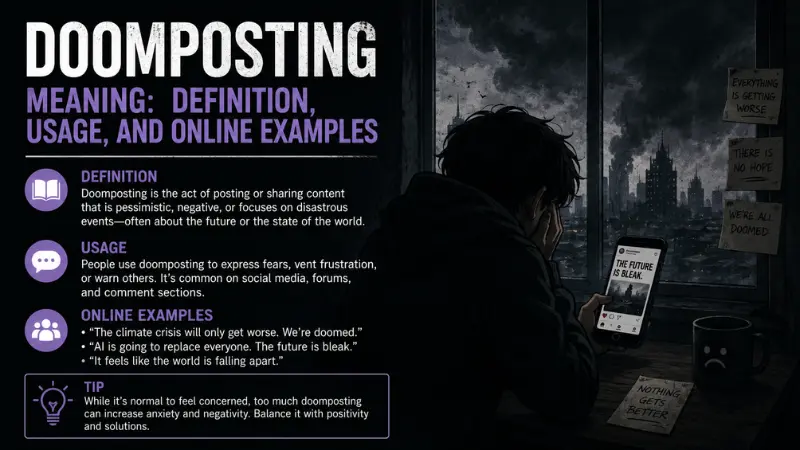
Doomposting meaning: Doomposting is the act of repeatedly sharing exaggerated or highly pessimistic predictions online. It usually presents a bad future outcome as likely or unavoidable.
TL;DR
• Doomposting focuses on negative future outcomes.
• It is informal internet slang.
• Doomposting creates content; doomscrolling consumes it.
• Gaming communities use the term frequently.
• Fair criticism is not automatically doomposting.
Doomposting Meaning in Plain English
Doomposting means posting messages that predict the worst. These messages often make a situation seem hopeless, doomed, or certain to fail.
A doompost may be about the economy, politics, society, technology, or entertainment. It may also concern a specific product, update, team, or game.
The main feature is not simple negativity. Doomposting usually adds exaggeration, certainty, repetition, or a lack of strong evidence.
For example:
“One bad sales report proves this entire industry will disappear next year.”
That statement jumps from one fact to a huge conclusion. The person presents a possible outcome as almost certain.
A more balanced comment would say:
“Sales declined this quarter, so the company may face challenges.”
The second version still expresses concern. However, it avoids treating the worst result as guaranteed.
Dictionaries and online usage sources describe doomposting as informal commentary that magnifies bad outcomes. Community definitions also emphasize unsupported worst-case predictions.
Pronunciation and Part of Speech
Pronounce doomposting as:
DOOM-post-ing
The main stress falls on doom. Each part sounds like the regular words doom and posting.
Doomposting is most often an uncountable noun. It names a type of online behavior.
“The discussion became filled with doomposting.”
It can also be the -ing form of the verb doompost.
“They are doomposting about the new update again.”
The related forms are:
• Doompost: A negative post, or the act of making one.
• Doomposted: The past-tense verb form.
• Doomposter: A person who regularly doomposts.
• Doomposting: The activity or continuing verb form.
These noun and verb roles are recorded in current collaborative dictionary coverage.
Common Contexts and Online Usage
Doomposting appears mainly in informal online communication. It is common in forums, comment sections, social platforms, and group chats.
Politics
Political doomposting predicts total failure, collapse, or permanent defeat.
“This election proves the country will never recover.”
A serious political warning may include evidence and possible responses. A doompost often removes uncertainty and hope.
The economy
Economic doomposting may predict mass unemployment, permanent poverty, or financial collapse.
“Prices rose again, so nobody will ever afford a home.”
The concern behind the statement may be real. The wording turns it into an absolute prediction.
Climate and world events
Some posts treat every disturbing development as proof that disaster is unavoidable.
“This storm confirms that civilization has no future.”
Warnings about real dangers are not automatically doomposting. Context, evidence, and wording still matter.
Entertainment and online communities
Fans may declare that a show, platform, creator, or franchise is “dead” after one unpopular decision.
“The new trailer was weak. This series is finished forever.”
These posts often receive attention because they use dramatic language.
Doomposting in Gaming Communities
Gaming communities use doomposting in a narrower way. It often describes exaggerated negative predictions about unreleased content.
Players may doompost about:
• A character still being tested
• An update that has not launched
• An early balance change
• Falling player numbers
• A delayed release
• A game supposedly becoming “dead”
For example:
“The character lost five percent damage. She is useless now.”
Another example is:
“The update was delayed, so the developers are abandoning the game.”
In these communities, doomposting often involves incomplete information. Players may judge a character before final testing or release.
Current community discussions also separate repetitive negativity from evidence-based analysis. Some moderators require numbers, testing, or detailed reasoning for strongly negative claims.
However, the term can be overused. Some fans call any unfavorable opinion doomposting, even when the criticism is specific and supported.
Doomposting vs Doomscrolling
Doomposting and doomscrolling involve negative online content. However, they describe different actions.
| Context | Best Choice | Why |
|---|---|---|
| Creating pessimistic posts | Doomposting | The person produces negative content |
| Reading bad news repeatedly | Doomscrolling | The person consumes negative content |
| Predicting a game will fail | Doomposting | The person shares a worst-case claim |
| Scrolling through disaster reports | Doomscrolling | The person keeps reading negative news |
Doomposting means creating, sharing, or repeating pessimistic claims.
Doomscrolling means spending excessive time reading upsetting online content. Merriam-Webster defines doomscroll through repeated consumption rather than content creation.
A person may do both.
“He doomscrolled for an hour, then started doomposting in the comments.”
The first action involves reading. The second involves publishing negative predictions.
Doomposting vs Valid Criticism
Negative criticism is not always doomposting. The difference usually involves evidence, scale, certainty, and purpose.
Valid criticism often:
• Identifies a specific problem
• Provides supporting facts
• Recognizes uncertainty
• Suggests a possible improvement
• Allows room for other outcomes
Doomposting often:
• Predicts the worst result
• Uses absolute language
• Repeats the same negative claim
• Ignores evidence against the prediction
• Treats improvement as impossible
Compare these statements:
Valid criticism:
“The update increased loading times on older devices.”
Doomposting:
“This update destroyed the game, and every player will quit.”
The first statement reports a specific concern. The second turns that concern into a sweeping prediction.
You should also consider the speaker’s evidence. A severe warning may be reasonable when reliable facts support it.
Calling every serious concern doomposting can silence useful discussion. Community debates show that users often disagree about where fair criticism ends and exaggeration begins.
Doomposting Examples
Here are natural examples of doomposting in modern English.
As a noun
“The forum was full of doomposting after the announcement.”
“Constant doomposting made the discussion feel hopeless.”
“I left the group because the doomposting never stopped.”
“Some criticism was fair, but much of it became doomposting.”
As a continuing verb
“People are doomposting before the product has even launched.”
“He keeps doomposting about the economy without checking the data.”
“They were doomposting after one disappointing game.”
“Fans started doomposting when the release date changed.”
Using doompost
“That thread reads like a doompost.”
“Do not doompost based on an unconfirmed rumor.”
“She doomposted about the update, then changed her view.”
Using doomposter
“The user gained a reputation as a doomposter.”
“A doomposter may treat every setback as permanent.”
The word normally carries a negative tone. Calling someone a doomposter can sound dismissive or insulting.
Origin and Related Terms
Doomposting combines doom with posting. The structure refers to posting content centered on disaster, decline, or hopeless outcomes.
The exact first use is unclear. A public Urban Dictionary definition appeared on January 27, 2020, but that does not prove the term began then.
As of May 2026, Collins displayed doomposting as a submitted new-word suggestion. The page stated that the word was being monitored for usage evidence.
Related terms include:
Doompost
A single pessimistic post, or a verb meaning to create such content.
Doomposter
A person who produces repeated or exaggerated negative posts.
Doomscrolling
The repeated consumption of upsetting news or social content.
Doomer
A person with deeply pessimistic or fatalistic views about society or the future.
Catastrophizing
A thinking pattern that treats the worst outcome as likely or certain. It is related to doomposting but is not an exact synonym.
Doomerism
A broader outlook based on decline, collapse, or hopelessness.
There is no perfect one-word synonym for doomposting. Close phrases include pessimistic posting, catastrophic posting, and worst-case speculation.
Loose contrasts include constructive criticism, balanced analysis, and solution-focused discussion. These are not exact grammatical antonyms.
Common Mistakes and When Not to Use It
Mistake: Confusing doomposting with doomscrolling
Incorrect:
“I spent two hours doomposting through the news.”
Correct:
“I spent two hours doomscrolling through the news.”
Use doomposting when someone creates or shares the messages.
Mistake: Calling every complaint doomposting
A person can criticize something without predicting disaster.
“The new menu is difficult to navigate.”
That is criticism. It does not claim that the product will fail.
Mistake: Assuming a doompost must be false
A pessimistic prediction can eventually prove correct. The term describes the tone and behavior, not only the final result.
Still, people often use the label when a claim seems exaggerated or unsupported.
Mistake: Using the term in formal documents
Doomposting is informal internet language. Avoid it in contracts, formal reports, and traditional academic writing unless you define it.
A formal replacement might be:
“repeated unsupported predictions of severe negative outcomes”
When not to use doomposting
Do not use the term merely because a topic is upsetting.
Avoid the label when someone is:
• Reporting a verified danger
• Sharing a personal hardship
• Giving evidence-based criticism
• Discussing a serious risk carefully
• Asking for help during a crisis
The label can sound dismissive. Check whether the speaker is exaggerating before using it.
Mini Quiz
1. Which sentence shows doomposting?
A. “The update contains three known bugs.”
B. “Three bugs prove the entire company will collapse.”
2. Which action is doomscrolling?
A. Reading negative news for two hours
B. Posting that society will certainly fail
3. Which sentence is balanced criticism?
A. “The game is dead forever.”
B. “The update caused problems on older systems.”
4. What is a doomposter?
A. Someone who repeatedly posts pessimistic predictions
B. Someone who reads one negative article
Answer Key
- B — It jumps to an extreme conclusion.
- A — Doomscrolling involves consuming negative content.
- B — It identifies a specific problem.
- A — A doomposter creates pessimistic posts.
FAQs
What does doomposting mean in slang?
Doomposting means repeatedly sharing very negative predictions online. The posts often treat failure, disaster, or decline as unavoidable.
Is doomposting the same as doomscrolling?
No. Doomposting creates or shares pessimistic content. Doomscrolling means repeatedly reading upsetting online content.
What does doomposting mean in gaming?
In gaming, it often means predicting that a character, update, or game will fail. These predictions may appear before the final content is released.
Is doomposting always false?
No. A negative prediction can turn out to be correct. However, the label usually suggests exaggeration, weak evidence, or excessive certainty.
Is doomposting the same as criticism?
No. Criticism identifies problems and may offer evidence or solutions. Doomposting usually turns those problems into broad predictions of failure.
How do you use doomposting in a sentence?
You could say, “The discussion changed from useful criticism to constant doomposting.” You could also say, “People are doomposting before the results are available.”
What is a doomposter?
A doomposter is someone who frequently shares pessimistic or catastrophic predictions online. The word usually has a critical tone.
Conclusion
The doomposting meaning centers on repeated, exaggerated predictions of negative outcomes online.
Check the evidence, certainty, and scale before applying the label. Use the term for pessimistic speculation, not every serious concern.