
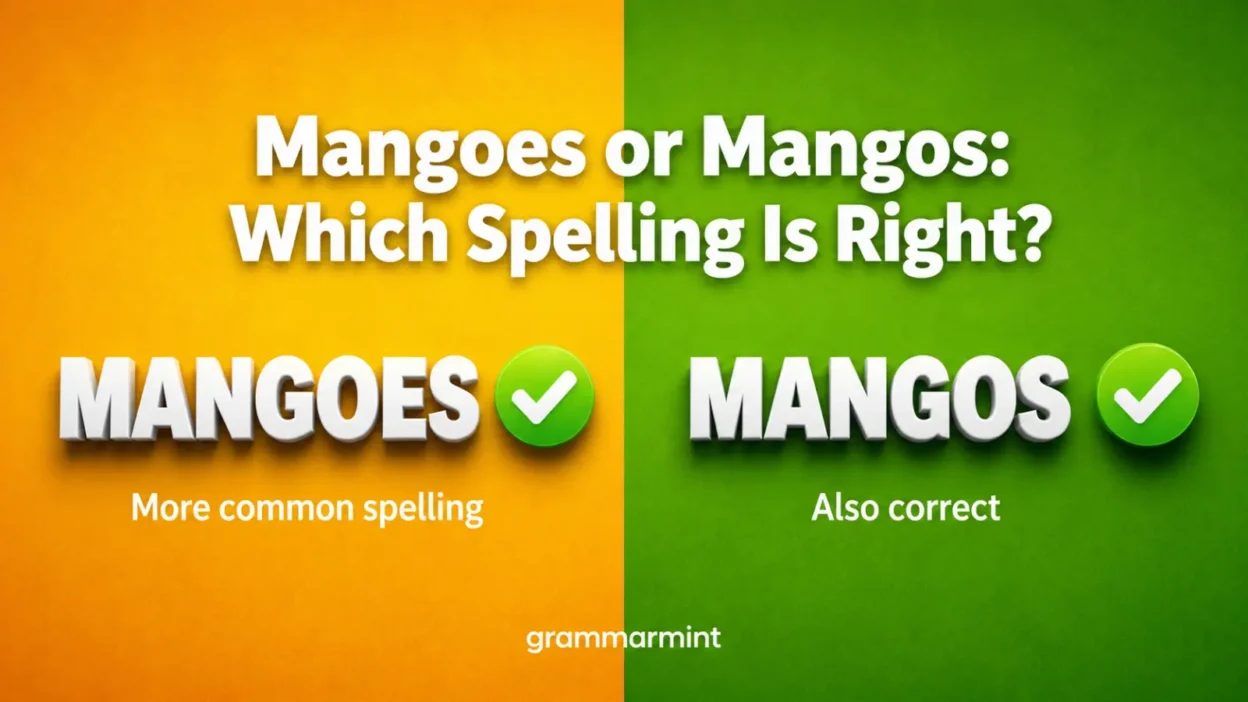
If you’re writing a recipe, school paper, label, or quick text, Mangoes or Mangos can make you pause. Both spellings look familiar, and both show up in real life. Still, readers may expect one over the other.
This guide explains the plural form, correct spelling, grammar rule, American English, British English, formal writing, and everyday examples in plain language. You’ll also see when to pick mangoes, when mangos works, and why consistency matters.
Quick Answer
Mangoes or mangos are both correct plural forms of mango. Use “mangoes” for formal or global writing, and use “mangos” when a casual U.S. style fits.
TL;DR
• Both spellings are correct.
• “Mangoes” is the safer choice.
• “Mangos” is common in casual U.S. use.
• Don’t write “mango’s” for a plural.
• Pick one spelling and stay consistent.
Mangoes Or Mangos
Both spellings are correct, so you’re not making a major mistake. However, each spelling carries a slightly different feel.
For most readers, plural spelling depends on context. “Mangoes” feels like the correct form in polished writing, while “mangos” works as an accepted variant.
• Use mangoes when you want the safest spelling.
• Use mangos when casual style feels natural.
• Choose one spelling for the full piece.
• Avoid switching between both spellings.
• Think about your reader before choosing.
• Mangoes often feels more polished.
• Mangos can feel shorter and cleaner.
• Both forms mean more than one mango.
• Neither spelling changes the fruit’s meaning.
• Dictionaries commonly accept both plural forms.
• Teachers may prefer mangoes in assignments.
• Brands may choose mangos for style.
Plural Of Mango
The plural of mango is “mangoes” or “mangos.” That makes mango a flexible English noun.
Because mango is a singular noun, both plural forms are allowed. As a plural noun, it follows more than one pattern in standard English.
• One mango becomes two mangoes.
• One mango can also become two mangos.
• Mangoes is the more traditional plural.
• Mangos is the shorter accepted plural.
• Both forms are easy to understand.
• The meaning stays exactly the same.
• The choice depends on tone.
• School writing usually favors mangoes.
• Grocery signs may use mangos.
• Recipes can use either spelling.
• Dictionaries list both forms.
• Consistency matters more than personal taste.
Mangoes Vs Mangos
The main difference is not meaning. Instead, the difference is tone, audience, and habit.
A usage difference appears when readers expect a certain style. Because of reader expectation, your writing style should guide the final choice.
• Mangoes feels traditional and widely familiar.
• Mangos feels shorter and more casual.
• Mangoes suits school and work writing.
• Mangos suits signs and friendly copy.
• Mangoes works well for global readers.
• Mangos appears often in U.S. contexts.
• Both spellings sound the same aloud.
• Both refer to the same fruit.
• Mangoes may look more formal.
• Mangos may look more modern.
• Neither choice is automatically wrong.
• Your audience decides the better fit.
Mangos Or Mangoes Which Is Correct
Both are correct, but “mangoes” is the safer default. That’s especially true when you don’t know your reader’s preference.
The right spelling depends on context clues. For most general writing, “mangoes” is the safe choice.
• Choose mangoes for formal writing.
• Choose mangoes for school assignments.
• Choose mangoes for international readers.
• Choose mangos for casual U.S. copy.
• Choose mangos for short product labels.
• Choose mangos if your brand uses it.
• Don’t treat mangos as wrong.
• Don’t treat mangoes as outdated.
• Match the style around your sentence.
• Keep the same form throughout.
• When unsure, use mangoes.
• When editing, check every instance.
Is Mangos Correct
Yes, “mangos” is correct. It is not a misspelling, even though some readers expect “mangoes.”
In American English, “mangos” can fit informal writing and some industry style choices. Still, it may look casual in a school paper.
• Mangos is a valid plural.
• It means more than one mango.
• It often appears in U.S. writing.
• It fits casual notes and posts.
• It works on short signs.
• It can match brand style.
• It may feel less formal.
• It should not be mixed randomly.
• It is not an apostrophe form.
• It is clear in grocery copy.
• It is common in food contexts.
• It still needs consistent use.
Is Mangoes Correct
Yes, “mangoes” is correct. In many cases, it is also the safest spelling to choose.
As the traditional spelling, “mangoes” gives a more formal tone. It also works well for global readers who expect the longer plural.
• Mangoes is widely accepted.
• It works in polished writing.
• It fits school essays well.
• It suits professional messages.
• It is common in dictionaries.
• It looks familiar to many readers.
• It follows the classic -es pattern.
• It pairs naturally with fruit descriptions.
• It works in recipes and articles.
• It avoids sounding too casual.
• It is a strong default choice.
• It should stay consistent throughout.
Mangoes Or Mangos In American English
In the United States, both spellings appear. However, your setting still matters a lot.
For a U.S. audience, “mangos” can feel natural in a casual tone. You may also see it on produce labels and food packaging.
• American readers understand both spellings.
• Mangoes still works in the U.S.
• Mangos can feel more casual.
• Formal U.S. writing often prefers mangoes.
• Grocery stores may use mangos.
• Brands may pick shorter wording.
• Teachers may still mark preferences.
• Recipes can use either form.
• Newspapers may follow house style.
• Labels often value tight wording.
• Consistency keeps the copy clean.
• Mangoes remains the safer fallback.
Mangoes Or Mangos In British English
In British English, “mangoes” is usually the better choice. It looks more familiar in polished UK writing.
For British English, the longer form fits Commonwealth usage. It also helps when writing for international readers.
• Use mangoes for UK readers.
• Mangoes feels more standard globally.
• Mangos may look more American.
• British schools usually prefer mangoes.
• International guides often use mangoes.
• Commonwealth readers expect the longer form.
• Recipes can still be understood either way.
• Formal UK copy should use mangoes.
• Mangoes matches traditional spelling patterns.
• Mangos may feel informal abroad.
• Global audiences need clear choices.
• When unsure worldwide, write mangoes.
Mangoes Or Mangos In Formal Writing
For formal writing, “mangoes” is usually best. It feels polished, familiar, and less likely to distract readers.
In academic writing, professional emails, and reports, consistent spelling matters. The goal is clarity, not showing every possible variant.
• Use mangoes in school papers.
• Use mangoes in professional reports.
• Use mangoes in polished articles.
• Use mangoes in formal emails.
• Avoid casual spelling shifts.
• Don’t switch forms mid-page.
• Follow your teacher’s preference.
• Follow your company’s style.
• Pick clarity over cleverness.
• Edit the plural before publishing.
• Use mangos only with purpose.
• Keep the tone steady.
Mangoes Or Mangos Examples
Examples make the choice easier. You can see how both forms work without changing the sentence’s meaning.
These example sentences show clear meaning in everyday use. The best version depends on tone and setting.
• We bought three ripe mangoes.
• The store sells fresh mangos.
• Mangoes taste sweet in smoothies.
• Cut two mangos for salsa.
• These mangoes are ready today.
• Organic mangos are on sale.
• She packed mangoes for lunch.
• He sliced mangos for dessert.
• The recipe needs diced mangoes.
• The sign says yellow mangos.
• Mangoes grow in warm climates.
• Mangos smell sweet when ripe.
Mangoes Or Mangos Grammar Rule
English words ending in “o” can be tricky. Some add “es,” while others simply add “s.”
Mango has an -o ending, so it can add -es as mangoes. It can also add -s as mangos.
• Mango can take two endings.
• Mangoes follows the -es pattern.
• Mangos follows the -s pattern.
• Both endings are accepted.
• Tomato usually becomes tomatoes.
• Potato usually becomes potatoes.
• Piano usually becomes pianos.
• Photo usually becomes photos.
• English has many exceptions.
• Usage often shapes the rule.
• Dictionaries help confirm both forms.
• Context helps choose the better one.
Words Ending In O Plural
Words ending in “o” don’t all behave alike. That is why mango can feel confusing.
Think of tomatoes, pianos, and loanwords. Each group shows why English plurals are not always neat.
• Tomato becomes tomatoes.
• Potato becomes potatoes.
• Hero becomes heroes.
• Echo becomes echoes.
• Piano becomes pianos.
• Photo becomes photos.
• Radio becomes radios.
• Memo becomes memos.
• Mango can become mangoes.
• Mango can become mangos.
• Some forms depend on history.
• Some forms depend on usage.
Mangoes Or Mangos In Recipes
Recipes can use either spelling. Still, “mangoes” often looks smoother in polished food writing.
For ingredient lists, food writing, and menu copy, pick the form that matches your tone. Then keep it consistent.
• Use mangoes in formal recipes.
• Use mangos in casual recipe cards.
• Write diced mangoes for clarity.
• Write sliced mangos for brevity.
• Keep ingredient wording consistent.
• Match the recipe’s overall tone.
• Avoid changing forms between steps.
• Use mangoes for global readers.
• Use mangos for relaxed branding.
• Menus can choose either form.
• Food blogs often use mangoes.
• Product names may use mangos.
Mangoes Or Mangos On Labels
Labels often follow different rules than essays. Space, brand voice, and design can affect spelling.
On package labels, a team may choose brand voice over textbook tone. “Mangos” can also be a space-saving spelling.
• Labels may use mangos for space.
• Packages may use mangoes for polish.
• Brand style can decide spelling.
• Produce signs often stay brief.
• Short labels need quick reading.
• Formal packaging may prefer mangoes.
• Casual brands may prefer mangos.
• Either form remains understandable.
• Consistency builds brand trust.
• Don’t mix spellings on one label.
• Match nearby product wording.
• Check legal copy carefully.
Mangoes Or Mangos Common Mistakes
Most mistakes come from switching forms or adding apostrophes. Luckily, both problems are easy to fix.
An apostrophe plural like “mango’s” is wrong. Also avoid mixed spellings when checking for grammar mistakes.
• Don’t write mango’s for plural.
• Use apostrophes only for possession.
• Don’t mix mangoes and mangos randomly.
• Don’t assume mangos is wrong.
• Don’t assume mangoes is old-fashioned.
• Don’t copy every store sign.
• Don’t ignore your audience.
• Don’t change spelling between headings.
• Don’t overthink casual texts.
• Don’t use both for variety.
• Don’t let autocorrect decide blindly.
• Don’t skip the final proofread.
Mangoes Or Mangos Quick Practice
Practice helps the spelling feel natural. Try choosing the form that best fits each setting.
These practice sentences build grammar confidence through a quick review. Use “mangoes” when the tone is formal.
• School essay: choose mangoes.
• Casual text: either form works.
• Grocery sign: mangos can work.
• Global article: choose mangoes.
• Brand label: follow brand style.
• Formal email: choose mangoes.
• Recipe blog: mangoes is safe.
• Menu board: either form works.
• Kids’ worksheet: choose mangoes.
• Produce sticker: mangos can fit.
• Research report: choose mangoes.
• Friendly post: pick one form.
FAQs
What Is The Plural Of Mango?
The plural of mango is “mangoes” or “mangos.” Both spellings are correct, but “mangoes” is usually the safer choice for polished writing.
Is It Mangoes Or Mangos?
It can be either mangoes or mangos. Use “mangoes” when you want a more formal or widely accepted spelling, and use “mangos” when a casual style fits.
Is Mangos Correct?
Yes, “mangos” is correct. It appears often in casual U.S. writing, grocery copy, and some food branding.
Is Mangoes Correct?
Yes, “mangoes” is correct. It is the stronger default for school, work, articles, and international readers.
Which Spelling Is More Common?
“Mangoes” is generally the more familiar spelling in standard writing. However, “mangos” is still accepted and easy to understand.
Is Mangos American English?
“Mangos” is often linked with American casual usage. Still, American writers also use “mangoes,” especially in formal contexts.
Can You Use Mango’s As A Plural?
No, “mango’s” is not the plural. Use “mango’s” only when showing possession, as in “the mango’s skin.”
Conclusion
Mangoes or Mangos are both correct, so your best choice depends on audience and tone. When you want the safest spelling, choose “mangoes.”