If you searched for Ya-ll or Y-all, you’re probably trying to write a friendly word without making a tiny spelling mistake. The right answer is simple: y’all is the correct form, while ya’ll, yall, and y-all are usually wrong in polished writing. This guide explains the apostrophe, meaning, grammar, examples, regional use, and safer alternatives in plain English.
Also, y’all is more than a Southern saying. It’s a useful way to address a group in texts, captions, emails, schoolwork, dialogue, and everyday speech. Still, tone matters. So, let’s make the rule easy to remember.
Quick Answer
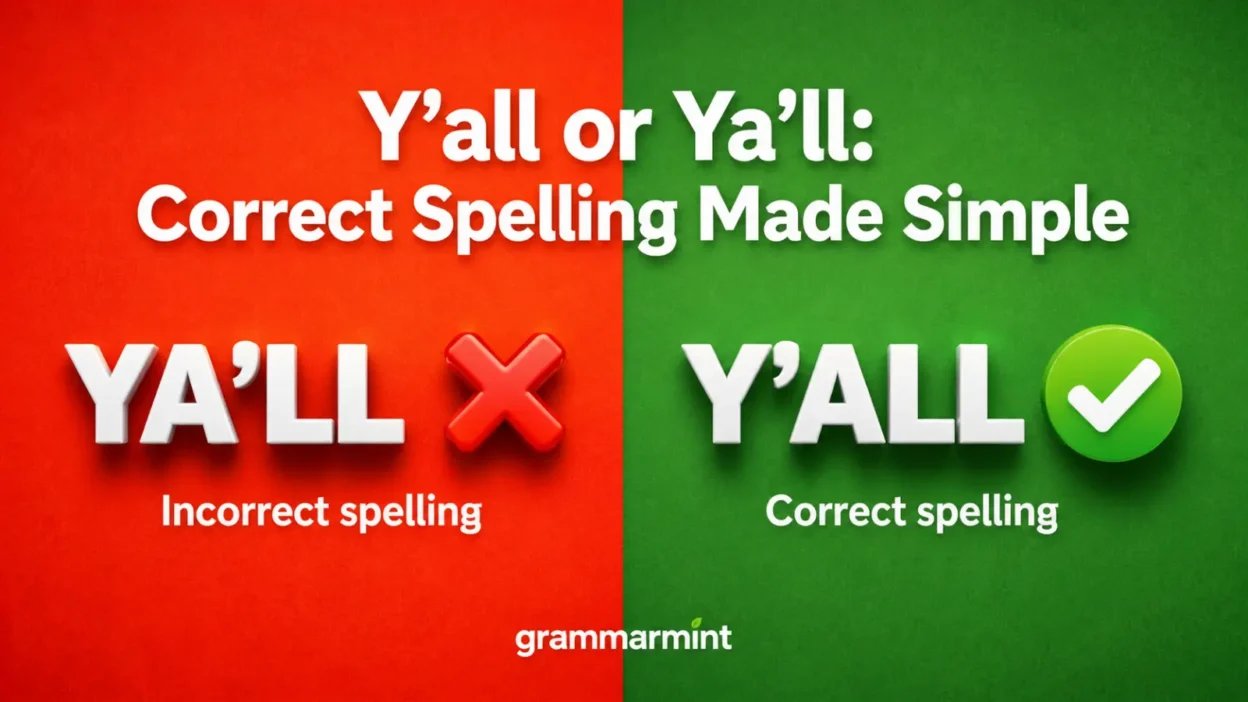
Y’all is the correct spelling because it comes from “you all.” The apostrophe replaces the missing “ou,” so ya’ll and yall are misspellings in standard writing.
TL;DR
• Y’all is the correct spelling.
• Ya’ll puts the mark in the wrong spot.
• Yall is missing the needed apostrophe.
• Use y’all for casual group address.
• Use “you all” in formal settings.
• All y’all adds friendly emphasis.
Ya-ll Or Y-all: The Correct Spelling
The correct spelling is y’all. It joins “you” and “all” into one friendly word. Therefore, the correct spelling places the apostrophe after the y because it stands for missing letters in you all.
• Use y’all when addressing more than one person.
• Avoid ya’ll in edited or careful writing.
• Avoid yall unless copying casual texting.
• Avoid y-all because it looks awkward.
• Think “you all” before choosing the spelling.
• Put the apostrophe after the first letter.
• Write “Y’all” at the start of sentences.
• Write “y’all” in the middle of sentences.
• Use it naturally in casual messages.
• Replace it with “you all” when needed.
• Keep the spelling consistent across your piece.
• Don’t add extra punctuation inside the word.
Yall Or Y’all: Why The Apostrophe Matters
The apostrophe matters because y’all is a contraction. It shows that letters were removed. Without it, yall looks like a typo in most casual writing, even though readers may understand the missing letters.
• Y’all shows that “ou” is missing.
• Yall removes the clue readers expect.
• Apostrophes guide pronunciation and meaning.
• Careful writing needs clear punctuation.
• Text messages may be looser.
• School essays should use y’all carefully.
• Captions look cleaner with y’all.
• Dialogue sounds natural with y’all.
• Brand copy should match audience expectations.
• The apostrophe helps avoid looking careless.
• One small mark changes the whole word.
• When unsure, expand it to “you all.”
Yall, Ya’ll, Or Y’all: Three Spellings Compared
These three spellings sound alike, but they are not equal. Y’all is the standard form in written English. Meanwhile, ya’ll and yall are usually treated as a misspelling.
• Y’all is the form to use.
• Ya’ll puts the apostrophe too late.
• Yall leaves the apostrophe out.
• Y-all uses a strange hyphen.
• Y’all matches normal contraction logic.
• Ya’ll suggests the wrong letters vanished.
• Yall may pass in fast texting.
• Edited work should avoid yall.
• Teachers usually expect y’all.
• Editors usually choose y’all.
• Dictionaries list y’all, not ya’ll.
• Use one spelling across the article.
Ya’ll Vs. Y’all: The Simple Grammar Rule
The grammar rule is simple: an apostrophe goes where letters are missing. Since y’all comes from “you all,” the omitted letters are “ou.” Therefore, your word choice should be y’all.
• Start with the phrase “you all.”
• Remove the “ou” from “you.”
• Keep the y from “you.”
• Keep the word “all.”
• Add the apostrophe after y.
• The result becomes y’all.
• Ya’ll does not follow that pattern.
• Yall ignores the missing letters.
• Y-all adds an unnecessary hyphen.
• Contractions need a clear missing spot.
• This rule works like don’t and can’t.
• Once you see it, it sticks.
How To Spell Y’all Every Time
Here’s the easiest memory trick. To spell y’all, say “you all,” then hide the “ou.” The apostrophe goes after the y, and that easy trick solves the problem fast.
• Write “you all” in your head.
• Cross out only the “ou.”
• Leave the y standing alone.
• Add the apostrophe after y.
• Then attach “all” right away.
• Say it slowly before writing.
• Check that no apostrophe follows a.
• Never write ya’ll by habit.
• Never write yall in polished text.
• Use y’all in dialogue and captions.
• Use “you all” for extra clarity.
• Proofread the apostrophe before publishing.
Y’all Meaning In Plain English
Y’all means “you all.” It is a plural you that speaks to a group. Because it carries an informal tone, it often feels warmer than a plain group address.
• Y’all can mean two people.
• It can also mean many people.
• It often sounds friendly and direct.
• It helps avoid “you guys.”
• It works well in group texts.
• It fits casual greetings.
• It feels natural in speech.
• It can soften a sentence.
• It may sound regional to some readers.
• It should match your audience.
• It is not the same as “they.”
• It points to the people addressed.
Is Y’all A Real Word?
Yes, y’all is a real word. It is a dictionary word and a useful pronoun in regional English and beyond. However, it remains casual, so context still matters.
• Y’all appears in major dictionaries.
• It functions as a pronoun.
• It addresses listeners or readers.
• It is common in American speech.
• It is strongest in the South.
• It also appears outside the South.
• It fills a useful language gap.
• It sounds friendly in many settings.
• It may feel too casual sometimes.
• It belongs in dialogue naturally.
• It can fit relaxed brand voice.
• It is real, not just slang.
Is Y’all Grammatically Correct?
Y’all can be grammatically correct in the right setting. It belongs to informal English, and it has wide accepted usage. Still, formal tone may call for “you all” instead.
• Y’all correctly contracts “you all.”
• It has a clear grammar pattern.
• It works as a group pronoun.
• It is not wrong by itself.
• Tone decides whether it fits.
• Use it freely in casual speech.
• Use it carefully in business writing.
• Avoid it in strict academic work.
• Match the reader’s expectations.
• Dialogue can use y’all naturally.
• Captions can use y’all warmly.
• Formal documents need safer wording.
Why Y’all Is A Contraction
Y’all is a contraction because it joins you + all into one shortened form. The apostrophe mark shows that letters were removed. As a result, the spelling follows a normal English pattern.
• You all becomes y’all.
• Do not becomes don’t.
• Cannot becomes can’t.
• They are becomes they’re.
• We will becomes we’ll.
• Apostrophes show what disappeared.
• Y’all removes “ou” from you.
• The y stays from you.
• The all stays complete.
• The apostrophe bridges the gap.
• That is why y’all works.
• That is why ya’ll fails.
Where The Apostrophe Goes In Y’all
The apostrophe goes after the y. That apostrophe placement marks the exact letter gap where “ou” was removed. Good punctuation makes the word easy to read.
• Correct: y’all are invited.
• Incorrect: ya’ll are invited.
• Incorrect: yall are invited.
• Correct: Are y’all ready?
• Incorrect: Are ya’ll ready?
• The mark follows y, not a.
• The word needs no hyphen.
• The apostrophe is part of spelling.
• Keep it in headlines too.
• Use a curly mark if styled.
• Use a straight mark if plain.
• Either apostrophe style is readable.
Is Y’all Singular Or Plural?
Y’all is mainly a second-person plural word. That means it usually addresses two or more people. However, a single listener can sometimes represent a larger group, like a store or team.
• Use y’all for two people.
• Use y’all for a whole room.
• Use y’all for a friend group.
• Use y’all for a team.
• Use y’all for customers casually.
• Avoid it for one clear person.
• Context may imply a larger group.
• “What do y’all sell?” can address staff.
• “Are y’all open?” can address a business.
• Some regions use it more flexibly.
• Most learners should keep it plural.
• “You” is safer for one person.
Y’all’s And Other Possessive Forms
The possessive form can get messy because speech changes faster than style guides. Y’all’s is common for group ownership, but “your” often reads cleaner. Avoid clunky forms like your all’s in polished writing.
• Y’all’s means belonging to your group.
• It sounds casual and regional.
• “Is this y’all’s table?” sounds natural.
• “Your table” sounds more standard.
• Use y’all’s mainly in dialogue.
• Avoid y’alls’s in clean writing.
• Avoid your all’s in edited text.
• Use “your group’s” for clarity.
• Use “everyone’s” when it fits.
• Possessive y’all can feel playful.
• Formal writing should choose “your.”
• Context decides the best option.
All Y’all Meaning And When To Use It
All y’all means the entire group. It can add friendly emphasis, especially when the speaker wants to include the whole group. It is casual, warm, and often playful.
• All y’all means every one of you.
• It can sound extra friendly.
• It can stress full inclusion.
• It works well in greetings.
• It fits group invitations.
• It can sound playful online.
• It is not needed every time.
• Use it when emphasis helps.
• Avoid it in formal writing.
• It may sound strongly regional.
• “All of you” is more neutral.
• “Everyone” is shorter and cleaner.
Y’all In Southern American English
Y’all is closely tied to Southern American English. Many people also call it Southern slang, though it is more than a catchphrase. Today, it appears widely in American speech.
• Y’all is famous across the South.
• Texas uses it often.
• Georgia uses it often.
• Tennessee uses it often.
• Alabama uses it often.
• The Carolinas use it often.
• It appears outside Southern states too.
• Music and media spread it widely.
• Online speech spreads it faster.
• It can signal warmth and ease.
• Avoid using it as a stereotype.
• Respect the speaker and context.
When To Avoid Y’all In Formal Writing
Y’all may not fit formal writing. In a professional email or academic writing, use a more neutral phrase. However, relaxed workplaces and friendly brands may still use it well.
• Avoid y’all in legal documents.
• Avoid it in academic essays.
• Avoid it in formal reports.
• Avoid it with unknown executives.
• Avoid it when tone feels uncertain.
• Use “you all” for safe clarity.
• Use “everyone” for broad groups.
• Use “team” for coworkers.
• Use “students” for a class.
• Use “guests” for customers.
• Match your setting before sending.
• When in doubt, choose neutral wording.
Better Alternatives To Y’all
Sometimes you all is the best replacement. Other times, everyone or folks sounds smoother. The right choice depends on tone, audience, and how personal you want to sound.
• Use “you all” for clear grammar.
• Use “everyone” for broad groups.
• Use “folks” for friendly tone.
• Use “team” at work.
• Use “friends” for warm messages.
• Use “guests” for hospitality writing.
• Use “readers” in articles.
• Use “students” in class notes.
• Use “customers” in service updates.
• Use “all of you” for emphasis.
• Use “you two” for pairs.
• Use “you” when the group is obvious.
FAQs
Is It Y’all Or Ya’ll?
Y’all is correct. Ya’ll puts the apostrophe in the wrong place because the word comes from “you all.”
What Does Y’all Mean?
Y’all means “you all.” It usually addresses two or more people in a friendly, informal way.
Is Y’all Singular Or Plural?
Y’all is mainly plural. Sometimes one person may represent a wider group, but learners should use it for groups.
Why Is Ya’ll Wrong?
Ya’ll is wrong because the apostrophe should replace the missing “ou” in “you.” That missing spot comes after the y, not after the a.
Is Y’all Grammatically Correct?
Yes, y’all is grammatically correct in informal writing and speech. Still, “you all” is safer in formal settings.
What Does All Y’all Mean?
All y’all means every person in the group. It adds emphasis and often sounds friendly, casual, or regional.
Can Y’all Be Used Outside The South?
Yes, y’all is used outside the South. However, some readers may still hear it as Southern or casual.
Conclusion
Ya-ll or Y-all may look confusing at first, but the answer is easy: write y’all. It is the clean contraction of “you all,” and the apostrophe belongs after the y. When the setting feels formal, choose “you all,” “everyone,” or another clear option.