Effects or Affects can feel tricky because the words sound alike and both deal with change. Still, once you learn the simple rule, the choice gets much easier. This guide explains affect, effect, verb, noun, influence, result, and outcome in plain English.
You’ll see examples for school, work, emails, health, technology, and everyday speech. Also, you’ll learn the exceptions without getting buried in grammar terms. By the end, you’ll know which word fits almost every sentence.
Quick Answer
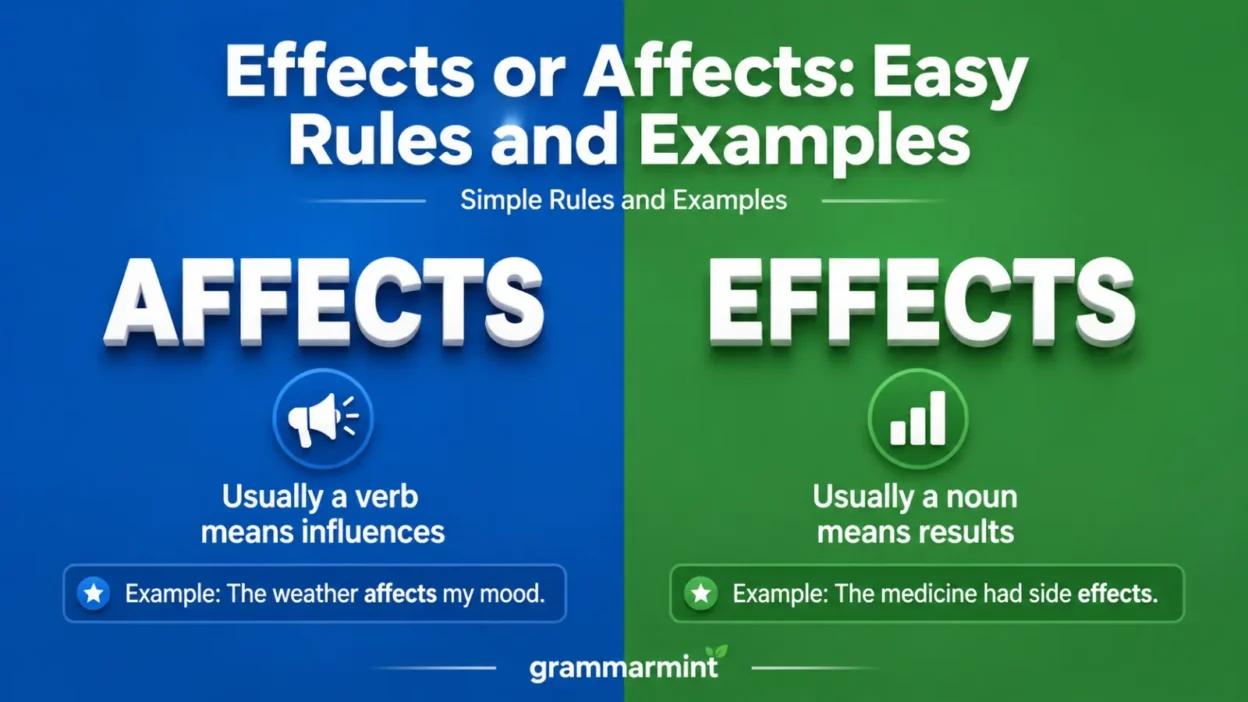
Effects or affects depends on meaning: use “affects” when something influences something else, and use “effects” when you mean results or belongings.
TL;DR
• Affects usually means influences.
• Effects usually means results.
• Affect is usually a verb.
• Effect is usually a noun.
• “Effect change” is a formal exception.
• “Personal effects” means belongings.
Affect Vs. Effect
Affect and effect look almost identical, so the mix-up is normal. However, the basic rule is simple and works most of the time.
Use affect as a verb when something influences something. Use effect as a result when you mean what happened afterward.
• Rain can affect your weekend plans.
• Rain can have a calming effect.
• Stress may affect your sleep.
• Poor sleep has a clear effect.
• Noise can affect your focus.
• Silence often has a peaceful effect.
• A decision can affect many people.
• The effect may appear later.
• Diet can affect your energy.
• Exercise has a lasting effect.
• Technology affects how people work.
• The effect depends on usage.
Effects Vs. Affects
Effects and affects are both correct, but they do different jobs. Therefore, the right choice depends on how the word works in the sentence.
Use effects as a plural noun for multiple results. Use affects as a third-person verb after he, she, it, or a singular subject.
• The medicine caused side effects.
• Weather affects the flight schedule.
• The effects were easy to notice.
• Stress affects memory and focus.
• New rules have several effects.
• Music affects the room’s mood.
• The effects lasted all week.
• Sleep affects school performance.
• Inflation affects family budgets.
• The effects changed over time.
• Exercise affects heart health.
• The policy had mixed effects.
Affect Or Effect
When choosing affect or effect, first ask what the word does. If it shows an action, affect is usually right.
If it names an outcome, effect is usually right. Also, nearby words can give you a helpful grammar clue.
• Choose affect for an action.
• Choose effect for a result.
• Try “influence” as a test.
• Try “result” as another test.
• “The” often points to effect.
• “An” often points to effect.
• “Will” often points to affect.
• “Can” often points to affect.
• “May” often points to affect.
• “Had an” points to effect.
• “Take effect” uses effect.
• “In effect” uses effect.
Difference Between Affect And Effect
The difference is about role, not just spelling. Affect usually shows what does the changing.
Effect usually names the consequence of that change. Meanwhile, both words connect to impact and change.
• Affect means to influence.
• Effect means a result.
• Affect usually needs an object.
• Effect often follows an article.
• Affect shows something happening.
• Effect names what happened.
• Affect answers “what changed it?”
• Effect answers “what resulted?”
• Affect fits before a noun.
• Effect fits after “the.”
• Affect sounds active.
• Effect sounds like an outcome.
Affect Vs. Effect Examples
Examples make the rule easier to remember. So, read each pair slowly and notice the job each word does.
These sentence examples use everyday English. Each one also shows the correct word in a natural context.
• The storm affected our drive.
• The storm had a strong effect.
• Caffeine affects some people quickly.
• Caffeine has a clear effect.
• The speech affected the crowd.
• The speech had a moving effect.
• Screen time affects sleep patterns.
• Screen time has real effects.
• The grade affected her confidence.
• The grade had no lasting effect.
• Training affects team performance.
• Training produces visible effects.
Affects Or Effects In A Sentence
The sentence around the word gives the answer. Therefore, look at the subject first, then check what follows the word.
If the subject is doing something to an object, use affects. If the phrase names a sentence pattern about results, use effects.
• The law affects small businesses.
• Small businesses felt the effects.
• The delay affects our schedule.
• The effects were frustrating.
• Poor lighting affects the photo.
• The effects looked dramatic.
• Salt affects the water’s taste.
• The effects were noticeable.
• His tone affects the message.
• The effects were not intended.
• The update affects older phones.
• The effects vary by model.
Is Affect A Noun Or A Verb?
Affect is usually a verb in everyday writing. That means it often shows action or influence.
Still, affect can be a noun in psychology. In that use, it refers to someone’s visible emotional display, expression, or mood presentation.
• Affect usually means influence.
• It works as an action word.
• “Noise affects learning” is correct.
• “Weather affects traffic” is correct.
• It often needs a direct object.
• The object receives the influence.
• Noun affect is less common.
• Doctors may discuss flat affect.
• Psychology uses affect carefully.
• Everyday writers rarely need it.
• Pronunciation may shift by use.
• When unsure, choose the verb meaning.
Is Effect A Noun Or A Verb?
Effect is usually a noun in everyday writing. It names the thing produced by an action.
However, effect can be a formal verb in special phrases. Most readers mainly need effect as a noun or result word.
• Effect usually means result.
• “The effect was obvious” works.
• “A calming effect” works too.
• It often follows an article.
• Effects can be positive.
• Effects can be negative.
• Side effects use effect.
• Special effects use effect.
• Sound effects use effect.
• “Take effect” is a set phrase.
• Verb effect sounds formal.
• Most sentences need noun effect.
Effect As A Verb
Effect as a verb means to bring something about. Because it sounds formal, you’ll usually see it in legal, business, or academic writing.
The common phrase is effect change. In that phrase, effect means bring about, not simply influence.
• Leaders hope to effect change.
• The plan effected major reform.
• New policy can effect improvement.
• This use sounds formal.
• It does not mean influence.
• It means make happen.
• Avoid it in casual writing.
• Use “create” if unclear.
• Use “bring about” for clarity.
• “Effect change” is correct.
• “Affect change” usually means influence change.
• Context decides the best choice.
Affect As A Noun
Affect as a noun is less common. It usually appears in psychology, medicine, or behavior notes.
Here, affect means outward emotion or visible expression. In everyday writing, though, most people use affect as a verb.
• The patient showed flat affect.
• Her affect seemed unusually calm.
• Clinicians may note restricted affect.
• This noun use is specialized.
• It does not mean result.
• It relates to emotion.
• It may describe facial expression.
• It may describe vocal tone.
• It appears in psychology writing.
• Most emails do not need it.
• Use mood for everyday clarity.
• Use affect carefully as a noun.
Affected Vs. Effected
Affected and effected cause another common mix-up. Thankfully, the same idea still helps.
Affected usually means influenced or changed. Effected means brought about, and it appears mostly in formal past-tense writing.
• The rain affected attendance.
• The policy affected employees.
• The speech affected listeners deeply.
• The team affected the outcome.
• The manager effected a change.
• The law effected reform.
• “Effected” means brought about.
• “Affected” means influenced.
• Affected is far more common.
• Effected sounds more formal.
• Use affected for emotional impact.
• Use effected for completed action.
Cause And Effect
Cause and effect is a helpful memory anchor. The cause is what starts the change, and the effect is what results.
Meanwhile, affect often describes the action between them. So, cause, effect, and relationship can help you choose faster.
• The cause starts the change.
• The effect follows the cause.
• Heat affects ice.
• Melting is the effect.
• Practice affects skill.
• Improvement is the effect.
• Rain affects road safety.
• Slippery roads are one effect.
• Choices affect future options.
• Consequences are later effects.
• Cause asks “why?”
• Effect answers “what happened?”
Personal Effects Meaning
Effects can also mean belongings. You’ll see this use in travel, legal, moving, and official contexts.
The phrase personal effects means belongings, possessions, or personal items. It does not mean emotional results.
• Personal effects means belongings.
• Jewelry can be personal effects.
• Clothing can be personal effects.
• Luggage may contain personal effects.
• Forms may mention personal effects.
• Police reports may use the phrase.
• Estate documents may use it.
• It sounds official.
• It uses effects, not affects.
• “Personal affects” is usually wrong.
• Effects can mean items.
• Context keeps the meaning clear.
Affect Vs. Effect Memory Trick
A good memory trick should be fast. So, use one that works before you hit send.
Remember affect as action and effect as end result. Then use a quick test if the sentence still feels uncertain.
• Affect starts with A.
• Action also starts with A.
• Effect starts with E.
• End result starts with E.
• Replace affect with influence.
• Replace effect with result.
• “The” often signals effect.
• “Will” often signals affect.
• “Can” often signals affect.
• “An” often signals effect.
• Read the sentence aloud.
• Choose the simpler word.
Common Mistakes With Affect And Effect
Most errors happen because the words sound alike. Also, spellcheck may not catch the wrong word.
These common errors often involve the wrong word in a smooth sentence. Good proofreading means checking meaning, not only spelling.
• Wrong: The storm had an affect.
• Right: The storm had an effect.
• Wrong: Stress can effect sleep.
• Right: Stress can affect sleep.
• Wrong: The affects were serious.
• Right: The effects were serious.
• Wrong: Music effects my mood.
• Right: Music affects my mood.
• Wrong: The rule will effect us.
• Right: The rule will affect us.
• Wrong: Personal affects were packed.
• Right: Personal effects were packed.
Affect Vs. Effect Practice
Practice helps the rule stick. First, decide whether the sentence needs an action or a result.
Use this mini quiz like a short worksheet. Then check the answer key in each bullet.
• Weather can affect travel plans.
• The effect was immediate.
• Caffeine affects my focus.
• The effects were mild.
• The rule affects everyone.
• The effects appeared slowly.
• Sleep affects memory.
• The medicine caused side effects.
• The team effected change.
• The patient showed flat affect.
• Her words affected me.
• The final effect was positive.
FAQs
What Is The Difference Between Affect And Effect?
Affect usually means to influence something. Effect usually means the result of that influence.
So, “cold weather affects your health” uses affect. “Cold weather has an effect on your health” uses effect.
Is Affect A Noun Or A Verb?
Affect is usually a verb. It means to influence, change, or make a difference to something.
It can be a noun in psychology. In that case, it describes visible emotion or expression.
Is Effect A Noun Or A Verb?
Effect is usually a noun. It means a result, outcome, or consequence.
It can also be a formal verb. In “effect change,” it means to bring change about.
Can Effect Be Used As A Verb?
Yes, effect can be used as a verb. However, that use is formal and less common.
For example, “The mayor effected reform” means the mayor brought reform about. In everyday writing, “created” may sound clearer.
What Is The Difference Between Effects And Affects?
Effects is usually a plural noun. It means results, outcomes, or sometimes belongings.
Affects is usually a present-tense verb. It means influences or changes something.
How Do You Remember Affect Vs. Effect?
Use A for action and E for end result. Affect is usually the action, while effect is usually the result.
Also, test the sentence with “influence” or “result.” The better replacement usually reveals the answer.
Conclusion
Effects or Affects gets easier once you look at the word’s job. Use affects for influence, and use effects for results or belongings.
Before you publish, send, or submit your writing, read the sentence once more. Then choose the word that matches the meaning.