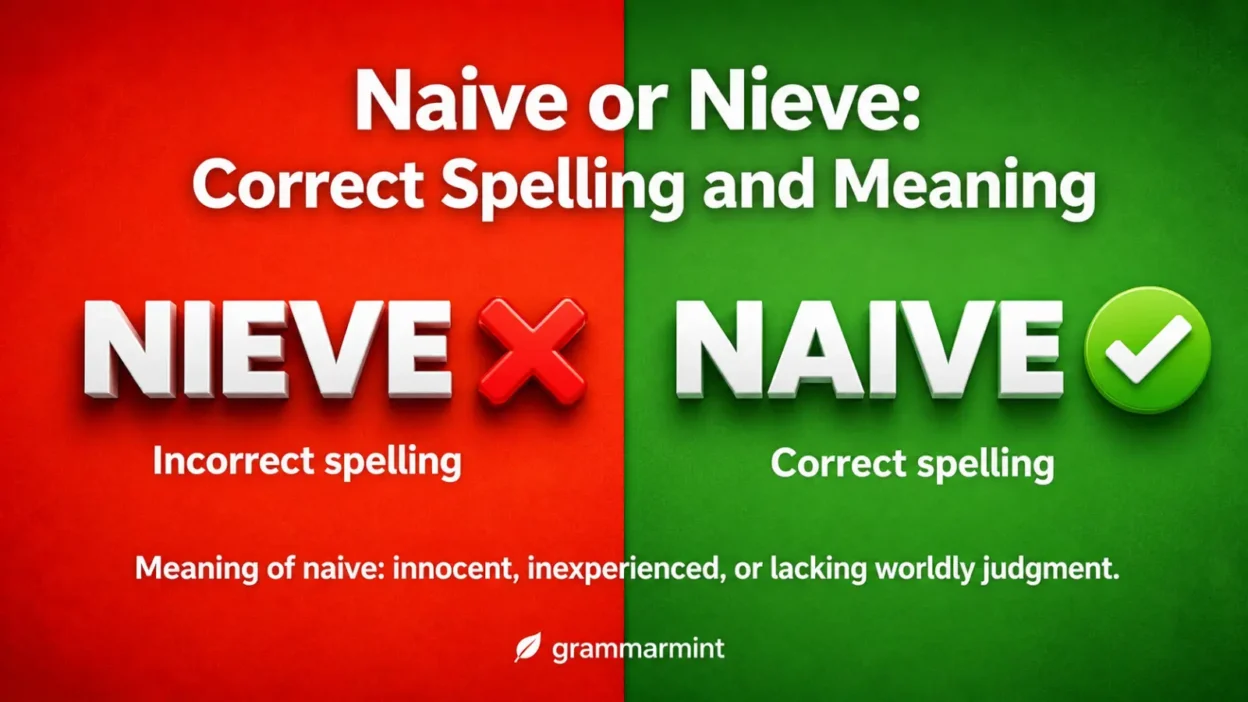
If you’re writing a message, essay, caption, or work email, the naive or nieve choice can make you pause. The correct form is simple, but the spelling feels tricky because naive, nieve, naïve, meaning, pronunciation, misspelling, and Spanish all overlap in confusing ways. You may hear the word clearly, yet still wonder where the vowels go. Also, the accented form “naïve” can make the plain version look incomplete. This guide gives you the direct answer first, then shows how to use the word naturally in American English.
Quick Answer
Naive or nieve is easy to settle: “naive” is the correct English spelling when you mean innocent, inexperienced, or too trusting. “Nieve” is not the right English spelling for that meaning, though it is a Spanish word for snow.
TL;DR
• Use “naive” in English writing.
• “Nieve” means snow in Spanish.
• “Naïve” and “naive” both work.
• Plain “naive” is common in the USA.
• The word can sound mildly negative.
• Check tone before calling someone naive.
Naive Or Nieve
The short answer is direct: choose naive. In English, “nieve” is usually a misspelling, not a style choice. However, it can be a real word in another language.
• Naive is the correct spelling in English.
• Nieve is not the same English word.
• Use naive for an English word meaning inexperienced.
• Use nieve only in Spanish contexts.
• Naive can describe a person’s outlook.
• Nieve can describe snow in Spanish.
• The two words look similar.
• Still, they do not mean the same thing.
• Naive has “ai” after the n.
• Nieve has “ie” after the n.
• That small switch changes everything.
• Therefore, write “naive” in essays.
• Also, use “naive” in emails.
• For captions, plain naive works fine.
• When unsure, remember: naive means trusting.
Naive Meaning
Naive describes someone who lacks experience or expects things to be simpler than they are. Often, it suggests an inexperienced person who is too trusting. Still, the word is not always cruel.
• A naive person may believe people quickly.
• They may miss hidden motives.
• They often expect fair outcomes.
• Their view can seem innocent.
• Sometimes, that innocence feels sweet.
• However, it can also seem careless.
• Naive does not mean unintelligent.
• Instead, it points to limited experience.
• A child may be naturally naive.
• A beginner may sound naive.
• A new employee may make naive assumptions.
• A friend may trust a rumor naively.
• The tone depends on context.
• So, use the word with care.
• When needed, choose a softer synonym.
Naive Definition
A clear definition helps you use the word cleanly. Naive means lacking practical knowledge, especially because of limited life experience. It can also mean simple in style.
• Naive can mean lacking worldly experience.
• It can suggest poor practical awareness.
• It may show a lack of judgment.
• Sometimes, it means artlessly simple.
• It often describes trust without caution.
• It can describe a view or belief.
• It can describe a person.
• It can describe an idea.
• In art, naive can mean intentionally simple.
• In medicine, naive can have technical uses.
• In daily speech, it usually means inexperienced.
• In school writing, define it clearly.
• In work writing, avoid harsh tone.
• In stories, it can reveal character.
• In arguments, it can sound dismissive.
Nieve Meaning
Nieve is not the English adjective you want. In Spanish, “nieve” means snow, so it belongs to a different language. Therefore, it should not replace “naive” in English writing.
• Nieve is a Spanish word.
• It means snow in Spanish.
• It does not mean inexperienced in English.
• It may appear in bilingual writing.
• It may appear in place names.
• It may appear in Spanish lessons.
• It may appear in recipes or travel.
• However, it is wrong for personality.
• “She is nieve” is incorrect English.
• “La nieve” can mean “the snow.”
• Context decides whether nieve belongs.
• For American essays, use naive.
• For English emails, avoid nieve.
• For Spanish sentences, nieve may fit.
• Do not swap the two words.
Is Nieve A Word?
Yes, nieve is a real word, but not the English adjective most people mean. This is why the mistake is sneaky. The spelling exists, yet it usually belongs somewhere else.
• Nieve is real in Spanish.
• It is the wrong spelling for naive.
• It does not describe innocence in English.
• It does not replace naive in essays.
• It can appear in Spanish dictionaries.
• It can appear in bilingual captions.
• It can appear in weather phrases.
• Still, English readers may see an error.
• “Nieve person” looks incorrect.
• “Naive person” looks correct.
• Spell-check may not catch every misuse.
• Autocorrect may even confuse the issue.
• Therefore, check the sentence meaning.
• If it means snow, use nieve.
• If it means inexperienced, use naive.
How To Spell Naive
The correct English spelling is n-a-i-v-e. The key is the vowel order after the first letter. Put “a” before “i,” then finish with “v-e.”
• Spell it n-a-i-v-e.
• The middle is ai, not ie.
• Start with “na,” then add “ive.”
• Do not write “nieve.”
• Do not write “naieve.”
• Do not write “nieave.”
• Say it slowly while typing.
• Think “naive has an a.”
• Link “naive” with “naivety.”
• Notice both keep the “a.”
• Add the final “e.”
• Keep the spelling consistent.
• Use one form per document.
• Prefer plain naive for quick writing.
• Proofread before submitting formal work.
Naive Spelling Rules
Naive feels odd because English spelling has many exceptions. The familiar i before e memory rule does not help here. Instead, learn the word as its own spelling pattern.
• Naive does not follow “i before e.”
• The “ai” spelling is correct.
• This word is an exception.
• The sound may trick your ear.
• The spelling comes through French.
• The final “e” stays present.
• The plain form needs no accent.
• The accented form is also valid.
• Do not rebuild it from sound.
• Memorize the five letters together.
• Write it twice for practice.
• Compare naive with naivety.
• Both words keep the “a.”
• Therefore, “nieve” should stand out.
• Your best rule: naive has “ai.”
Naïve Vs Naive
Both naïve and naive are correct. The first form uses a diaeresis, which is an accent mark over the i. In modern American writing, plain “naive” is usually easier.
• Naïve has two dots over the i.
• Naive drops the dots.
• Both forms mean the same thing.
• Naïve looks more traditional.
• Naive looks simpler on screens.
• American writers often choose naive.
• Some editors still like naïve.
• Use the style your teacher prefers.
• Use the style your publication prefers.
• Do not mix both forms randomly.
• The dots do not change meaning.
• They only guide pronunciation history.
• Plain keyboards make naive convenient.
• For most readers, naive is clear.
• For consistency, pick one form.
Naive Pronunciation
Naive is usually pronounced nah-EEV in American English. It has two syllables, and the second syllable gets the stress. That sound can explain why people guess the wrong spelling.
• Say naive as nah-EEV.
• The stress falls on EEV.
• The word has two syllables.
• The “ai” sounds separated.
• This offers a pronunciation clue.
• The sound may suggest “ie.”
• However, the spelling stays “ai.”
• Do not spell only by sound.
• Practice: nah, then eev.
• Keep the ending crisp.
• Avoid saying it as “nave.”
• Avoid saying it as “nayv.”
• The accented form shows vowel separation.
• Plain naive keeps the same sound.
• Pronunciation helps, but spelling wins.
Naive In A Sentence
The best way to learn the word is through sentence examples. A natural sentence shows context, tone, and meaning at once. Also, it helps you avoid using “nieve” by habit.
• She was naive about online scams.
• His plan sounded naive but sincere.
• I was naive during my first job.
• That is a naive way to negotiate.
• The movie shows a naive young traveler.
• Don’t be naive about hidden fees.
• Her naive trust caused problems later.
• The comment felt naive, not cruel.
• We made naive guesses at first.
• Their offer seemed too naive.
• A naive investor may ignore risk.
• He gave a naive answer in class.
• The team had naive hopes early.
• It’s natural to be naive sometimes.
• Better information can change naive views.
Examples Of Naive
Examples make the meaning easier to feel. In emails, essays, and stories, naive often shows someone trusting too fast. However, the best sentence fits the situation.
• Email: “That assumption may be naive.”
• Essay: “The character begins naive.”
• Story: “Her naive hope fades slowly.”
• Work: “The estimate was naive.”
• School: “A naive reader may agree.”
• Friendship: “He was naive about gossip.”
• Dating: “She trusted his excuse naively.”
• Money: “A naive buyer skips research.”
• Travel: “Tourists can be naive abroad.”
• Safety: “Naive choices increase risk.”
• Politics: “The promise sounded naive.”
• Parenting: “Children are often naive.”
• Business: “Naive pricing hurt profits.”
• Technology: “Naive users reuse passwords.”
• Fiction: “Naive heroes learn through conflict.”
Naive Synonyms
Synonyms help when “naive” sounds too sharp. Depending on tone, use innocent, inexperienced, or trusting. Each word has a slightly different feel.
• Innocent sounds gentler than naive.
• Inexperienced sounds more neutral.
• Trusting sounds warm and kind.
• Unsophisticated can sound formal.
• Gullible sounds more critical.
• Childlike can be positive or negative.
• Sheltered suggests limited exposure.
• Green means new or untested.
• Simple can sound insulting.
• Artless can mean natural and sincere.
• Credulous means too ready to believe.
• Unworldly sounds literary.
• Fresh-faced sounds casual and visual.
• Newcomer-focused language feels kinder.
• Choose the synonym that matches tone.
Naive Vs Innocent
Naive and innocent overlap, but they are not identical. Innocent often means free from blame or harmful intent. Naive usually points to being sheltered or inexperienced.
• Innocent can mean not guilty.
• Naive can mean unaware.
• Innocent often feels softer.
• Naive can carry blame.
• Innocent may describe pure motives.
• Naive may describe weak judgment.
• A child can be innocent.
• An adult can be naive.
• Innocence may be moral.
• Naivety may be practical.
• “Innocent mistake” sounds forgiving.
• “Naive mistake” sounds avoidable.
• Use innocent for kindness.
• Use naive for experience gaps.
• Tone matters more than dictionary labels.
Naive Vs Gullible
Gullible is stronger than naive. A gullible person is easily tricked, while a naive person may simply be too trusting. Therefore, gullible often sounds harsher.
• Gullible means easily fooled.
• Naive means lacking experience.
• Gullible sounds more insulting.
• Naive can sound mild.
• A naive person may learn quickly.
• A gullible person repeats trust mistakes.
• Scammers target gullible people.
• Beginners often make naive choices.
• “Naive” can fit a first mistake.
• “Gullible” fits repeated deception.
• Gullible implies poor skepticism.
• Naive implies limited exposure.
• Use gullible only when needed.
• Use naive for lighter judgment.
• When unsure, choose “inexperienced.”
Naive Person Meaning
A naive person often has a trusting mindset and limited practical judgment. Their behavior may come from youth, inexperience, or hope. Still, they can be smart and capable.
• They believe promises too quickly.
• They expect honesty from everyone.
• They may ignore warning signs.
• They ask simple, direct questions.
• They can seem sincere.
• They may seem overly optimistic.
• They often learn through experience.
• They may avoid conflict.
• They can miss manipulation.
• They may trust charming strangers.
• They sometimes overshare personal details.
• They may accept weak excuses.
• They can grow less naive.
• Experience often builds better judgment.
• Kindness should guide your wording.
British And American Spelling
In both American English and British English, naive is acceptable. The accented form “naïve” also appears in both. In modern writing, plain “naive” is often the easiest choice.
• Americans commonly write naive.
• British writers also use naive.
• Naïve remains correct in both places.
• The meaning does not change.
• The pronunciation does not change.
• The plain form is keyboard-friendly.
• The accented form looks traditional.
• Schools may prefer one style.
• Publishers may set house style.
• Keep your spelling consistent.
• Do not write nieve in either region.
• UK English does not require “nieve.”
• US English does not require “nieve.”
• For a USA audience, use naive.
• For formal consistency, follow the guide.
Common Misspellings Of Naive
The most common mistake is nieve, because the vowel order feels tempting. Other misspellings include naiv and naieve. Fortunately, one quick check catches most errors.
• Nieve is the main mistake.
• Naieve adds an extra vowel.
• Naiv drops the final e.
• Nieave scrambles the middle letters.
• Nave becomes a different word.
• Naïve may lose its dots.
• Plain naive is still correct.
• Watch the “ai” section.
• Keep the final “ve.”
• Search your draft for “nieve.”
• Replace it with naive when needed.
• Check headings and captions too.
• Check image text if included.
• Check social posts before publishing.
• One vowel swap can look careless.
FAQs
Is it naive or nieve?
The correct English spelling is naive. Use it when you mean inexperienced, innocent, or too trusting.
Is nieve a real word?
Yes, but it is a Spanish word meaning snow. It is not the correct English spelling for a trusting or inexperienced person.
What does naive mean?
Naive means lacking experience or practical judgment. It often describes someone who trusts too easily or sees life too simply.
Why does naïve have two dots?
The two dots show that the vowels are pronounced separately. In everyday American writing, you can usually write naive without the dots.
How do you pronounce naive?
Naive is pronounced nah-EEV. The second syllable gets the stress.
Is naive formal or informal?
Naive works in both formal and informal writing. However, it can sound critical, so choose your tone carefully.
Can naive be used in a negative way?
Yes, naive can sound negative when it suggests poor judgment. For a gentler tone, use inexperienced, innocent, or trusting.
Conclusion
Naive or nieve comes down to one simple rule: use naive in English when you mean inexperienced, innocent, or too trusting. If you’re writing for school, work, captions, or everyday messages, plain “naive” is clear and correct. Next, scan your sentence once and make sure the vowels read “ai,” not “ie.