If you’re writing an email, message, or meeting note, the phrase Touchbase or Touch Base can feel weirdly easy to second-guess. The answer matters because correct spelling, business idiom, professional email, check in, follow-up message, and clear context all shape how your writing sounds.
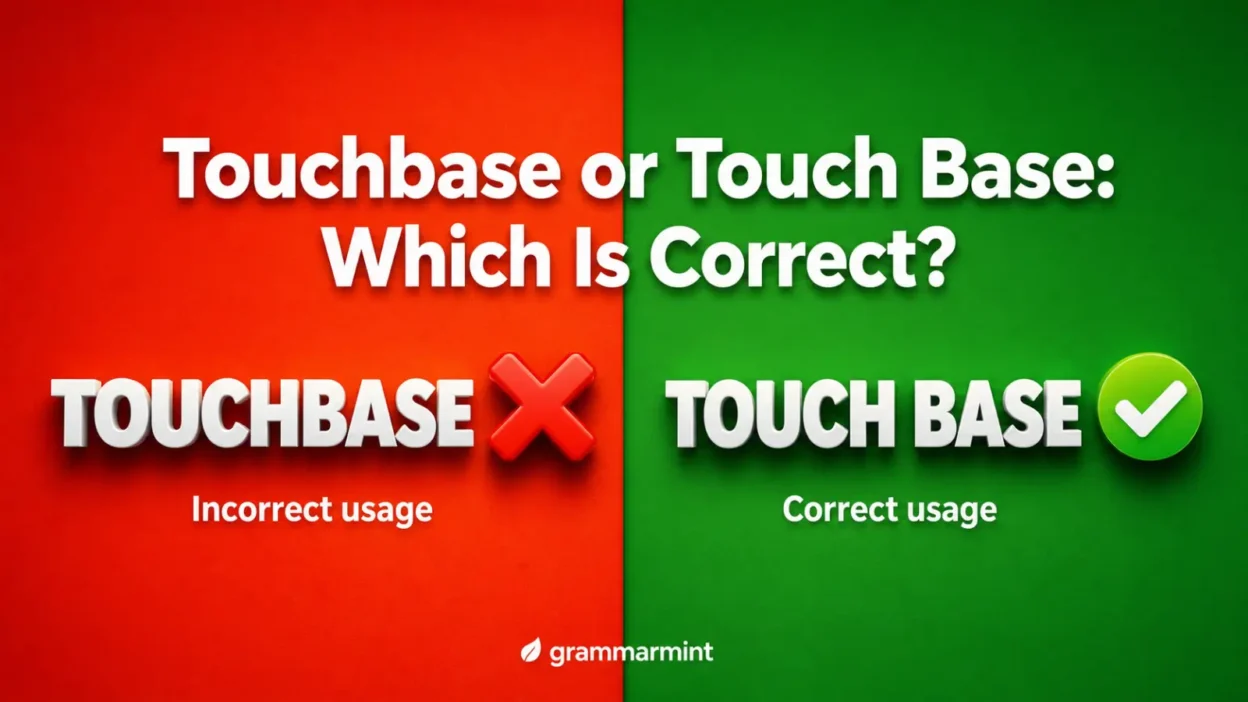
The short rule is simple: use “touch base” as two words. Still, there are a few useful edge cases. For example, “touch-base meeting” can work before a noun, while “touchbase” usually looks too casual or incorrect.
Quick Answer
Touchbase or touch base? Use “touch base” as two words when you mean to briefly contact, check in with, or reconnect with someone.
TL;DR
• “Touch base” is the standard form.
• “Touchbase” usually looks incorrect.
• Use it for brief contact.
• “Touch-base” can modify a noun.
• Clearer alternatives often sound stronger.
• Avoid “touch basis” and “touch bases.”
Touchbase Or Touch Base
The correct choice is “touch base” in most writing. It works as a verb phrase, so the words stay separate.
Use it when you mean a quick check-in. However, don’t combine it into one word in polished writing.
• Use two words for the verb phrase.
• “Touch base” is the correct spelling.
• It’s accepted in standard English.
• Write, “Let’s touch base tomorrow.”
• Don’t write, “Let’s touchbase tomorrow.”
• Keep the words separate in emails.
• Use it for quick work check-ins.
• It fits friendly business messages.
• It can sound vague without details.
• Add a topic after the phrase.
• Add a date when needed.
• Use clearer wording for formal notes.
• Proofread it before sending proposals.
• Remember: base stays singular.
Touch Base Meaning
“Touch base” means to make brief contact with someone. Usually, the goal is to share updates, ask a quick question, or align on next steps.
The phrase often appears at work. Still, it can also fit casual plans with friends or family.
• It means to check in.
• It suggests you’ll briefly connect.
• It’s a common business idiom.
• It doesn’t mean a long meeting.
• It usually means quick contact.
• It can happen by email.
• It can happen by phone.
• It can happen in chat.
• It can happen after silence.
• It often includes a shared topic.
• It works best with purpose.
• It can mean reconnecting politely.
• It can also mean confirming details.
• It’s friendly, not stiff.
Touchbase One Word
“Touchbase” appears online, especially in quick chats. Even so, it is not the safest form for careful writing.
In most cases, the one-word version looks like a typo. Therefore, choose the two-word form unless you’re quoting a brand or product name.
• Avoid the one-word spelling.
• It may pass in informal writing.
• Don’t use it in a professional email.
• It can look rushed.
• It may distract careful readers.
• It weakens polished business writing.
• It’s not the normal verb form.
• Some brands may stylize it.
• Brand names follow brand rules.
• Your sentence should use two words.
• Spell-check may not catch it.
• Grammar tools may vary.
• Editors usually prefer “touch base.”
• When unsure, add the space.
Touch Base In A Sentence
The phrase is easiest to learn through examples. The main trick is to make the sentence clear and specific.
Usually, “touch base” sounds better when you add why or when. Otherwise, the message can feel empty.
• Good example sentence: “Let’s touch base Friday.”
• Use natural wording around it.
• Give readers clear context.
• “Can we touch base after lunch?”
• “I’ll touch base with Nina.”
• “Let’s touch base about pricing.”
• “We should touch base next week.”
• “I touched base with Alex.”
• “She’s touching base with HR.”
• “Please touch base before sending it.”
• “They’ll touch base after the call.”
• “We touched base yesterday morning.”
• “I’ll touch base once I know.”
• “Let’s touch base on the draft.”
Touch Base Email
“Touch base” is common in email because it feels light and polite. Still, a strong email should say what you need.
Instead of using the phrase alone, pair it with a topic. That way, the reader knows exactly why you’re writing.
• Use it in a work email.
• Tie it to a follow-up message.
• Ask for a quick update.
• Keep the subject line direct.
• Mention the project early.
• Put the request near the top.
• Suggest a clear next step.
• Offer one or two times.
• Avoid long, vague openings.
• Don’t bury the main question.
• Use friendly, plain language.
• Make the reason obvious.
• Keep the note short.
• Close with a useful action.
Just Wanted To Touch Base
“Just wanted to touch base” is polite, but it can sound weak. It also delays the real reason for your message.
A better opener states the purpose right away. As a result, your email feels more confident and helpful.
• Replace the email opener when possible.
• Lead with a specific purpose.
• End with a clear request.
• “Checking on the contract status.”
• “Following up on yesterday’s notes.”
• “Confirming our meeting time.”
• “Sharing the updated draft.”
• “Requesting your approval by Thursday.”
• “Asking about the next step.”
• “Confirming pricing before launch.”
• “Sending the revised schedule.”
• “Following up on your question.”
• “Checking whether this still works.”
• “Confirming who owns this task.”
Touch Base Synonyms
Sometimes “touch base” is perfect. Other times, a simpler phrase sounds clearer.
Choose the replacement based on tone. For example, “check in” is friendly, while “follow up” is more direct.
• “Check in” is a close synonym.
• Pick an alternative phrase by tone.
• Make the tone match the relationship.
• Use “follow up” after requests.
• Use “connect” for networking.
• Use “discuss” for decisions.
• Use “confirm” for details.
• Use “reconnect” after time away.
• Use “catch up” casually.
• Use “review” for documents.
• Use “align” for shared plans.
• Use “coordinate” for schedules.
• Use “call” for direct contact.
• Use “message” for quick chats.
Professional Ways To Say Touch Base
In more formal settings, “touch base” may sound too casual. Fortunately, many replacements feel cleaner.
The best phrase depends on what you actually want. Therefore, choose words that name the action.
• “Follow up” is a professional phrase.
• “I’m writing to discuss” suits formal email.
• Use polished wording for executives.
• “I’d like to confirm our timeline.”
• “Could we review the proposal?”
• “I’m checking on the latest update.”
• “Please share your feedback by Friday.”
• “Can we discuss the next steps?”
• “I’d like to revisit this item.”
• “Let’s coordinate before the deadline.”
• “Please confirm your availability.”
• “I’m following up on approval.”
• “Could we align on priorities?”
• “I’d appreciate your input.”
Is Touch Base Formal?
“Touch base” is not rude or wrong. However, it is more business casual than formal.
Use it with coworkers, friendly clients, and internal teams. For legal, academic, or high-stakes writing, choose a clearer phrase.
• It is semi-formal at best.
• It’s common workplace language.
• It remains a casual phrase.
• It suits friendly colleagues.
• It suits warm client relationships.
• It may feel vague in contracts.
• It may sound light in complaints.
• It can feel overused in sales.
• It works better with details.
• It’s safe for routine updates.
• It’s less ideal for apologies.
• It’s not academic wording.
• It’s not legal wording.
• It’s fine in everyday business.
Touching Base And Touched Base
The phrase changes normally when the tense changes. So, “touching base” and “touched base” are both fine.
Use the form that matches the timing. Then, add who you contacted and why.
• Touching base means checking in now.
• Touched base means already connected.
• Match the verb tense carefully.
• “I’m touching base today.”
• “We touched base yesterday.”
• “She touches base weekly.”
• “They will touch base soon.”
• “He’s touching base with finance.”
• “I touched base after lunch.”
• “We’ll touch base before launch.”
• “Are you touching base today?”
• “Have they touched base yet?”
• “Let’s keep touching base weekly.”
• “I hadn’t touched base earlier.”
Touch Base With You
The phrase often takes “with” because contact involves another person. “Touch base with you” is natural and common.
Still, keep the sentence specific. A clear topic makes the phrase feel useful rather than filler.
• “Touch base with you” sounds natural.
• It means contact someone briefly.
• Expect a short conversation.
• “Can I touch base with you?”
• “I’ll touch base with you tomorrow.”
• “Let’s touch base with the team.”
• “She touched base with her manager.”
• “We should touch base with sales.”
• “I need to touch base with HR.”
• “He’ll touch base with clients.”
• “They touched base with support.”
• Add the topic afterward.
• Add timing when helpful.
• Avoid repeating “with” twice.
Touch Base Or Touch Bases
“Touch bases” may seem logical because baseball has several bases. However, the idiom stays singular.
When you mean “check in,” write “touch base.” Use “bases” only when talking about literal baseball bases.
• Don’t use touch bases for checking in.
• Treat it as a fixed phrase.
• It’s a common grammar mistake.
• Correct: “Let’s touch base.”
• Incorrect: “Let’s touch bases.”
• “Bases” works in baseball talk.
• “Base” works in the idiom.
• Keep the phrase singular.
• Don’t pluralize the noun.
• Don’t change it for groups.
• Say, “We touched base.”
• Not, “We touched bases.”
• This rule stays simple.
• One check-in, one base.
Touch Basis
“Touch basis” is also incorrect. It usually happens because people mishear the phrase.
The word “basis” has a real meaning, but it doesn’t belong here. Therefore, use “touch base” instead.
• Avoid touch basis completely.
• It’s a misheard phrase.
• It’s the wrong expression.
• Don’t write “touching basis.”
• Don’t write “touched basis.”
• Don’t write “base basis.”
• Use “touch base” instead.
• “Basis” means foundation or reason.
• That meaning doesn’t fit here.
• The phrase comes from “base.”
• Say it clearly in speech.
• Check it carefully in writing.
• Fix it before sending emails.
• Readers may notice the error.
Touch Base Vs Touch Point
“Touch base” and “touch point” are not the same. One is an action, while the other is usually a place, moment, or interaction.
In work writing, “touch point” often describes a stage in a process. Meanwhile, “touch base” describes contacting someone.
• Touch point is usually a noun.
• It can mean a contact point.
• It may describe a customer journey.
• “Touch base” is an action.
• “Touch point” is a moment.
• Say, “Let’s touch base Friday.”
• Say, “This is a key touch point.”
• Don’t swap them blindly.
• Use “touch base” for contact.
• Use “touch point” for process stages.
• One involves reaching out.
• One involves mapping interactions.
• Both appear in business writing.
• Context decides the right phrase.
Touch-Base Meeting
There is one useful edge case: “touch-base” can be hyphenated before a noun. For example, “touch-base meeting” describes a short check-in meeting.
This is different from the verb phrase. As a verb, keep “touch base” as two words.
• Use touch-base meeting before a noun.
• That’s a hyphenated modifier.
• It works as a noun phrase.
• “We scheduled a touch-base call.”
• “It’s a touch-base meeting.”
• “The touch-base chat was brief.”
• Don’t hyphenate after the noun.
• Say, “We will touch base.”
• Not, “We will touch-base.”
• Use hyphens for clarity.
• Keep the meeting short.
• Add an agenda when helpful.
• Avoid meetings without purpose.
• Name the outcome clearly.
Touch Base Origin
“Touch base” likely comes from baseball. In baseball, a player must touch a base during play.
Over time, the phrase became figurative. Now, it means making contact so everyone stays updated.
• It has a baseball origin.
• Today’s use is figurative meaning.
• It’s common in American English.
• The base suggests safe contact.
• The phrase moved into business.
• It became common in offices.
• It fits quick alignment.
• It fits short follow-ups.
• It can sound like jargon.
• Clear purpose keeps it useful.
• Don’t overuse it casually.
• Pair it with real details.
• Use it when contact matters.
• Skip it when “discuss” is clearer.
FAQs
What Does “Touch Base” Actually Mean?
“Touch base” means to briefly contact someone. Usually, you’re checking in, sharing an update, or confirming a next step.
Is Touchbase One Word Or Two Words?
Use “touch base” as two words. “Touchbase” is usually too informal or incorrect in normal sentences.
What Is A Professional Way To Say Touch Base?
Use “follow up,” “confirm,” “discuss,” “review,” or “check in.” The best choice depends on the reason for your message.
Is It Touchbase Or Touch Basis?
Neither is the best choice. The correct phrase is “touch base” when you mean to reconnect briefly.
Is It Touchbase Or Touch Point?
Use “touch base” for contacting someone. Use “touch point” for a contact moment, process step, or interaction.
Can Touch Base Be Used In Past Tense?
Yes. Write “touched base,” as in, “I touched base with the team yesterday.”
Is Touch Base American Slang?
It comes from American baseball language, but it’s now common workplace English. Even so, it still sounds business casual.
Conclusion
Touchbase or Touch Base has a clear answer: write “touch base” as two words when you mean to check in or reconnect.
For stronger writing, add a topic, time, or clear request. When the phrase feels vague, replace it with “follow up,” “confirm,” or “discuss.”