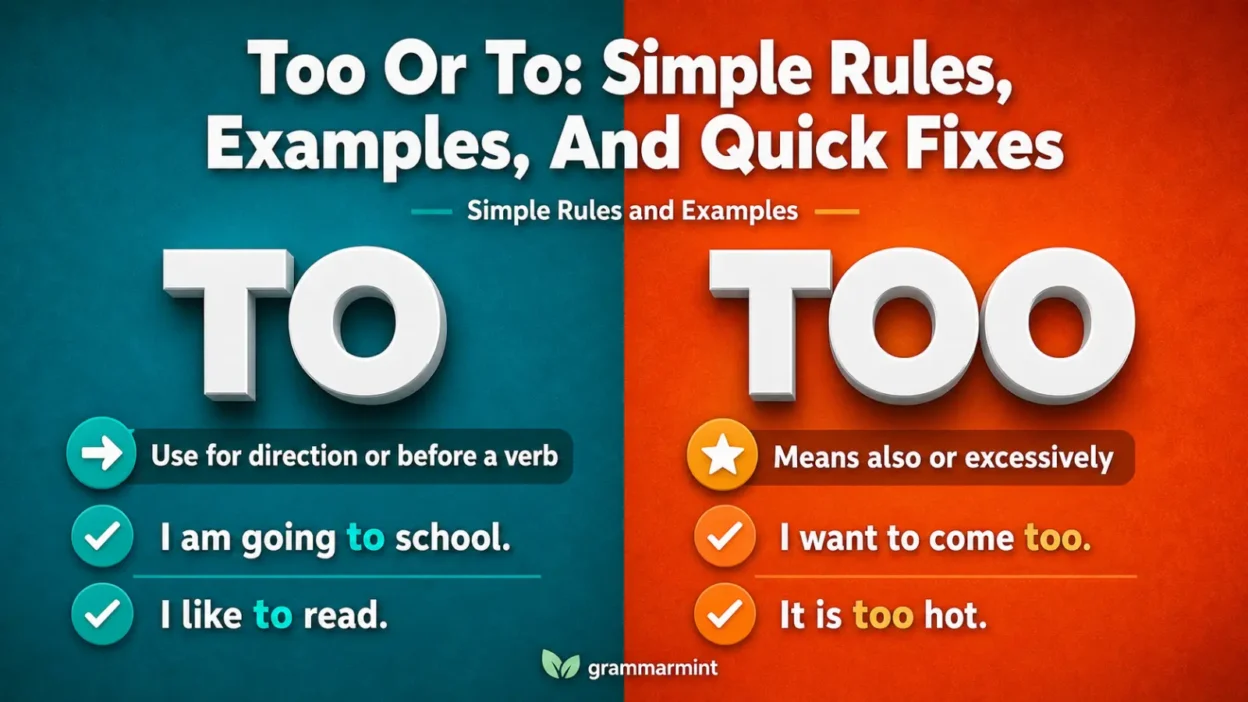
If you’ve ever paused while texting, emailing, or writing homework, this guide will help you choose Too or To too-or-to with confidence. These small words can change a sentence fast, especially in messages, school essays, work emails, social captions, and everyday chats. You’ll learn the simple difference, see clear examples, and fix common mistakes without memorizing hard rules.
The key is meaning. One word points toward something or helps form a verb. The other adds “also” or shows that something is more than enough. Once you spot that clue, the choice gets much easier.
Quick Answer
Too or to depends on meaning: use “to” for direction, purpose, or before a verb, and use “too” when you mean “also” or “more than enough.”
TL;DR
• Use “to” before many action verbs.
• Use “to” for places and direction.
• Use “too” when it means “also.”
• Use “too” for excess or intensity.
• “Too much” is correct, not “to much.”
• Try replacing “too” with “also.”
Too Or To Meaning
“To” and “too” sound the same, so they’re easy to mix up. However, they do different jobs in a sentence. Think of them as homophones with one simple grammar rule: choose the correct word by meaning.
• “To” often points toward a place.
• “To” can show a goal.
• “To” appears before many verbs.
• “Too” can mean “also.”
• “Too” can mean “over the limit.”
• “Too” often adds extra meaning.
• “To” has one “o” for movement.
• “Too” has two “o’s” for extra.
• “Too” can strengthen an adjective.
• “To” connects ideas inside sentences.
• “Too” often sits near the end.
• Meaning decides the spelling every time.
To Vs. Too
The difference is not about sound. Instead, it’s about the job each word does. “To” is usually a preposition, while “too” is usually an adverb that changes the sentence meaning.
• Use “to” in “go to school.”
• Use “too” in “I’m going too.”
• “To” can show where.
• “Too” can show addition.
• “To” can show why.
• “Too” can show excess.
• “To” comes before base verbs.
• “Too” comes before descriptive words.
• “To” fits “toward” in many cases.
• “Too” fits “also” in many cases.
• “To” helps build longer verb phrases.
• “Too” adds a second idea.
To And Too In Sentences
A sentence usually tells you which spelling fits. First, ask what the word means there. Then use word choice, context clues, and clear writing to guide the answer.
• “I want to eat” needs “to.”
• “I want pizza too” needs “too.”
• “She walked to class” shows direction.
• “She studied too” shows addition.
• “It’s too cold” shows excess.
• “They need to leave” starts an action.
• “Give it to Maya” shows receiver.
• “Maya wants one too” adds Maya.
• “Too” can change an adjective.
• “To” can connect a noun.
• Read the whole sentence first.
• Replace “too” with “also” when unsure.
To Vs. Too Examples
Examples make the rule easier to feel. Notice how each choice changes the sentence’s job. These sample sentences include correct examples and wrong examples you can compare quickly.
• Correct: “I need to call Mom.”
• Wrong: “I need too call Mom.”
• Correct: “I’m coming too.”
• Wrong: “I’m coming to.”
• Correct: “This box is too heavy.”
• Wrong: “This box is to heavy.”
• Correct: “We drove to Boston.”
• Wrong: “We drove too Boston.”
• Correct: “She wants to learn.”
• Wrong: “She wants too learn.”
• Correct: “He felt too tired.”
• Wrong: “He felt to tired.”
When To Use To
Use “to” when the sentence points somewhere, gives something, or introduces an action. In many cases, it shows direction, a destination, or an infinitive verb.
• Use “to” before a place.
• Use “to” before a person receiving something.
• Use “to” before a base verb.
• Use “to” after “want.”
• Use “to” after “need.”
• Use “to” after “plan.”
• Use “to” after “try.”
• Use “to” after “hope.”
• Use “to” for “from Monday to Friday.”
• Use “to” for “five to six.”
• Use “to” for purpose.
• Use “to” when “toward” nearly fits.
When To Use Too
Use “too” when you mean “also” or when something crosses a limit. Therefore, “too” handles also, excessively, and in addition meanings.
• Use “too” for “I agree.”
• Use “too” for “same here.”
• Use “too” after added people.
• Use “too” after added things.
• Use “too” before adjectives.
• Use “too” before adverbs.
• Use “too” in “too fast.”
• Use “too” in “too small.”
• Use “too” in “too loudly.”
• Use “too” in “too late.”
• Use “too” when “also” works.
• Use “too” when “overly” works.
Too Meaning Also
When “too” means “also,” it adds someone or something to the idea. It often sounds friendly and natural in conversation. In this use, as well, agreement, and end position matter.
• “I like it too” means agreement.
• “She came too” adds another person.
• “Bring your jacket too” adds an item.
• “We should invite Sam too” adds Sam.
• “That works for me too” agrees.
• “I miss them too” shares feeling.
• “He plays guitar too” adds skill.
• “They want dessert too” adds desire.
• “Too” often closes the sentence.
• “Too” sounds casual and warm.
• “Also” can replace “too” sometimes.
• “As well” can replace “too” too.
Too Meaning Excessively
When “too” shows excess, it means the amount or degree is a problem. Usually, it comes before a describing word. In this pattern, it means more than enough, often with too much or a too adjective phrase.
• “Too hot” means hotter than wanted.
• “Too loud” means louder than acceptable.
• “Too slow” means slower than needed.
• “Too expensive” means beyond budget.
• “Too early” means earlier than useful.
• “Too quickly” means faster than safe.
• “Too far” means beyond comfort.
• “Too bright” means hard to see.
• “Too risky” means not worth it.
• “Too crowded” means packed beyond comfort.
• “Too tired” means energy is low.
• “Too hard” means harder than reasonable.
Too Much Or To Much
“Too much” is the correct phrase. It describes an amount that is higher than needed. Use it before an uncountable noun, after a verb, or when talking about quantity and excess amount.
• Write “too much noise.”
• Write “too much sugar.”
• Write “too much homework.”
• Write “too much pressure.”
• Write “too much information.”
• Write “too much coffee.”
• Write “too much rain.”
• Write “too much time.”
• “To much” is not correct.
• “Too much” can stand alone.
• “This costs too much” works.
• “You worry too much” works.
Too Much, Too Many, And Too Little
Use the right phrase for the thing you’re counting. The noun matters. Choose “too many” with count nouns, “too much” with uncountable nouns, and “too little” with small amounts or weak degree words.
• Use “too many” with plural items.
• Use “too much” with mass ideas.
• Use “too little” for not enough.
• Say “too many emails.”
• Say “too much stress.”
• Say “too little sleep.”
• Say “too many tabs.”
• Say “too much traffic.”
• Say “too little help.”
• Say “too many mistakes.”
• Say “too much noise.”
• Say “too little time.”
Me Too Or Me To
“Me too” is the correct casual reply. It means you share the same feeling, action, or opinion. This short reply is common for a shared feeling, especially in texting grammar.
• Correct: “Me too.”
• Wrong: “Me to.”
• Use it after “I’m hungry.”
• Use it after “I loved it.”
• Use it after “I’m excited.”
• Use it after “I miss you.”
• Use it after “I agree.”
• Use it after “I want one.”
• “Me too” means “I do too.”
• “Me too” sounds natural.
• “Me to” looks unfinished.
• “Me too” works in captions.
Comma Before Too
A comma before “too” is often optional. Use one when you want a clear pause or extra stress. The choice depends on optional comma, emphasis, and the natural pause in your sentence.
• “I want one too” is fine.
• “I want one, too” is fine.
• The comma adds a pause.
• No comma feels smoother.
• Use commas for extra stress.
• Skip commas in quick notes.
• Read the sentence aloud.
• Add commas if meaning feels clearer.
• “He, too, agreed” sounds formal.
• “We were there too” sounds natural.
• Consistency helps polished writing.
• Clarity matters more than habit.
Many writers also confuse phrases like “do to” and “due to,” especially when discussing reasons or causes. Learn the correct difference in this detailed guide: do to or due to
To, Too, And Two Difference
“To,” “too,” and “two” are three different words with the same sound. Because they sound alike, spelling must follow meaning. “Two” is the number two, while the others share the same sound but have different spelling.
• “To” can show direction.
• “Too” can mean also.
• “Two” means 2.
• “I have two dogs” counts.
• “I went to work” moves.
• “I went too” adds agreement.
• “Two” is never a connector.
• “To” is never a number.
• “Too” is never a destination.
• All three sound identical.
• Meaning separates all three.
• Check the word’s job first.
Also Vs. Too
“Also” and “too” can both mean “in addition,” but they sit in different places. “Also” often sounds better in formal writing, while word placement makes “too” feel closer to as well.
• “Also” often comes before verbs.
• “Too” often comes after clauses.
• “She also sings” sounds neat.
• “She sings too” sounds casual.
• “Also” fits reports well.
• “Too” fits conversation well.
• “As well” sounds slightly softer.
• “Too” can sound warmer.
• “Also” can start a sentence.
• “Too” rarely starts one naturally.
• Both can add information.
• Choose the smoother rhythm.
Many writers also confuse phrases like “too bad” and “to bad.” If you’re unsure which one is correct, read this detailed guide on too bad or to bad
Too Late, Too Soon, And Fixed Phrases
Some phrases are so common that you can learn them as chunks. These patterns use “too” because they show excess or timing beyond what works. A fixed phrase often carries a time meaning in natural English.
• “Too late” means past the useful time.
• “Too soon” means earlier than wise.
• “Too bad” shows mild regret.
• “Too good” means unusually good.
• “Too close” means near a limit.
• “Too far” means past comfort.
• “Too little” means not enough.
• “Too long” means beyond patience.
• “Too often” means overly frequent.
• “Too easy” can sound suspicious.
• “Too true” agrees strongly.
• “Too busy” means no room.
To Vs. Too Worksheet And Quiz
Practice is the fastest way to lock in the rule. First, read the sentence’s meaning. Then answer these practice questions, check the answer key, and repeat the quick test when you write.
• I want ___ sleep early.
• This soup is ___ salty.
• She is coming with us ___.
• We drove ___ the airport.
• He talks ___ quickly.
• Give this note ___ Dad.
• I need ___ study tonight.
• There are ___ many boxes.
• My sister wants one ___.
• It is ___ cold outside.
• Answers: to, too, too, to, too.
• Answers: to, to, too, too, too.
Still confused about quantity expressions? Learn the difference between to many or too many with simple examples and grammar rules.
FAQs
What Is The Difference Between To And Too?
“To” usually shows direction, purpose, relationship, or comes before a base verb. “Too” means “also” or shows that something is more than enough.
When Should I Use Too?
Use “too” when you can replace it with “also” or “overly.” For example, “I want one too” means “I want one also,” while “too heavy” means overly heavy.
Can Too Mean Also?
Yes, “too” can mean “also.” It often appears near the end of a sentence, as in “I’m going too.”
Can Too Appear At The End Of A Sentence?
Yes, “too” often appears at the end when it means “also.” For example, “She liked the movie too” is correct and natural.
Is Too Much Correct Grammar?
Yes, “too much” is correct. Use it for an amount that is more than wanted, needed, or useful.
Why Do People Confuse To And Too?
People confuse them because they sound exactly alike and look almost the same. However, their meanings are different, so the sentence’s purpose decides the spelling.
Do You Need A Comma Before Too?
Usually, no comma is required before “too.” Still, you can add one when you want a stronger pause or extra emphasis.
Conclusion
Choosing Too or To too-or-to gets easier once you ask one question: does the word mean direction, a verb link, “also,” or “more than enough”? Use “to” for movement, purpose, and verbs. Use “too” for addition and excess.