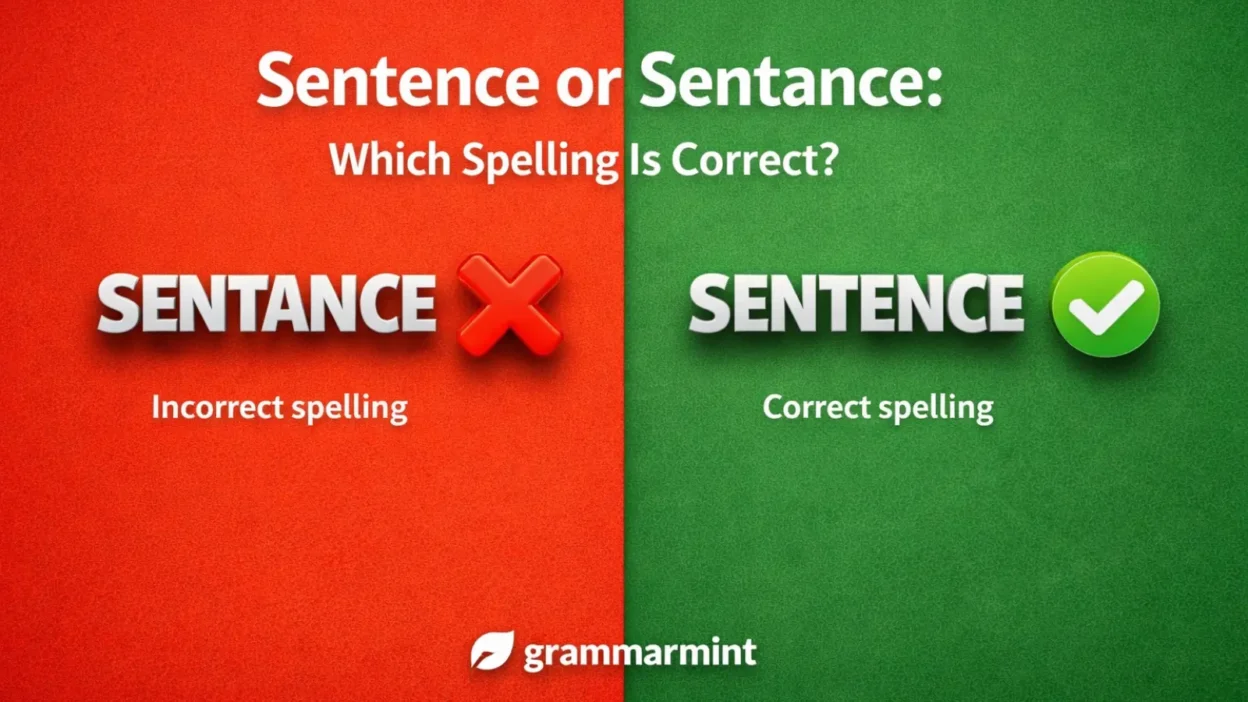
Many people hesitate when typing the word sentence. Is it spelled sentence or sentance?
This common spelling confusion appears in school assignments, blog posts, text messages, social media posts, and workplace emails. The two spellings look very similar, and their endings can sound alike in everyday speech. However, only one is correct.
If you are unsure whether to write sentence or sentance, this guide will give you a clear answer, explain why the mistake happens, and show you how to remember the correct spelling.
Quick Answer
The correct spelling is sentence.
Sentance is an incorrect spelling and is considered a common misspelling of sentence. In standard English, you should always use sentence, whether you are writing casually or formally.
- Sentence → Correct
- Sentance → Incorrect
There is no difference between American and British English in this case. Both varieties use sentence.
What Does Sentence Mean?
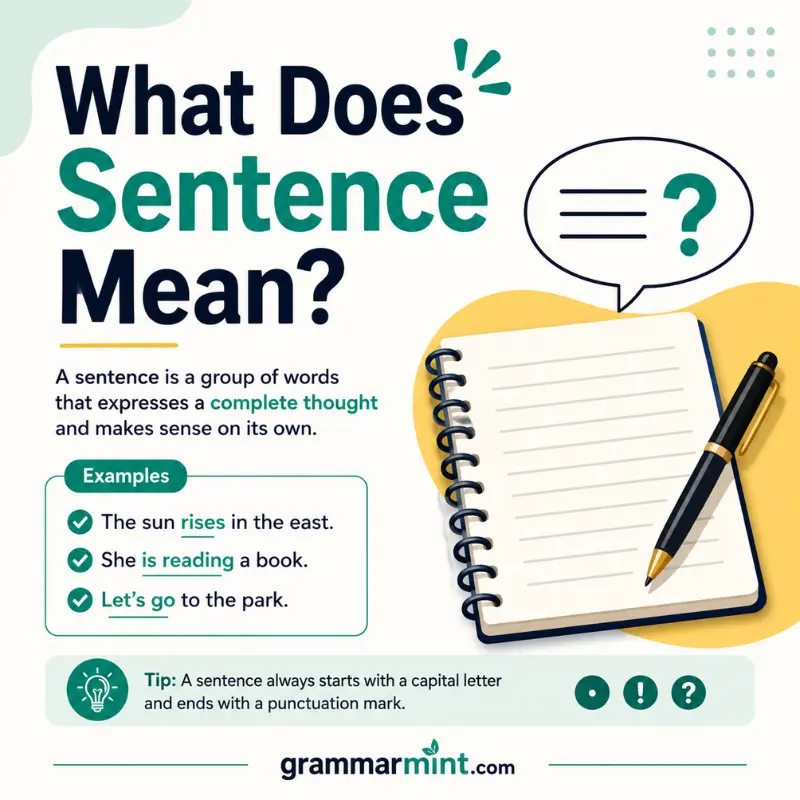
The word sentence has several related meanings in English.
In grammar, a sentence is a group of words that expresses a complete thought. For example:
She finished her homework.
The word can also refer to a judgment given by a court:
The judge gave him a five-year sentence.
So, depending on the context, sentence can refer to either a grammatical unit or a legal punishment.
Why Do People Spell Sentence as Sentance?
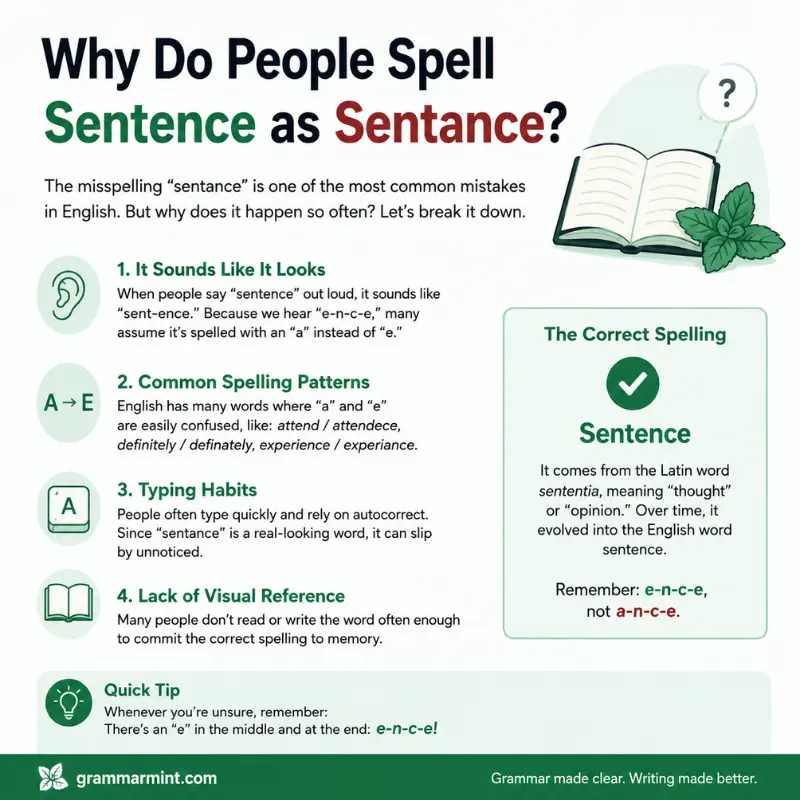
The most common reason is pronunciation.
The endings -ence and -ance can sound very similar in spoken English. Because English contains many familiar words ending in -ance, such as distance, balance, and chance, some writers assume that sentence should follow the same pattern.
However, English spelling does not always follow a predictable pattern.
The correct spelling is:
sentence
Not:
sentance
A useful way to remember it is to focus on the e before the final nce:
s-e-n-t-e-n-c-e
Sentence vs. Sentance: Key Differences
| Word | Correct? | Meaning |
|---|---|---|
| Sentence | Yes | A grammatical statement or a legal judgment |
| Sentance | No | Common misspelling of sentence |
The important point is simple: sentence is the only standard spelling.
Is Sentance a Real Word?
No. Sentance is not a standard English word.
If you see sentance in a text, article, email, or social media post, it is almost certainly a spelling mistake. It is not an alternative spelling, dialect form, or regional variation.
For correct English writing, replace sentance with sentence.
British English vs. American English
There is no British vs. American spelling difference for this word.
Both American English and British English spell it:
sentence
So, whether you are writing for readers in the United States, the United Kingdom, Canada, Australia, or elsewhere, sentence is the correct choice.
How to Remember the Correct Spelling
One simple memory trick is:
“I sent a sentence.”
Notice that both sent and sentence contain the letter e in the important position.
You can also break the word into parts:
sent + ence = sentence
Another helpful approach is to remember that the word contains -ence, not -ance.
Sentence → -ence
Sentance → -ance ❌
When in doubt, think: sentence has an E.
Common Sentence Spelling Mistakes
Here are some common mistakes and their corrections:
- ❌ Please write one sentance.
- ✅ Please write one sentence.
- ❌ This sentance is too long.
- ✅ This sentence is too long.
- ❌ Can you correct my sentance?
- ✅ Can you correct my sentence?
- ❌ The last sentance explains the main idea.
- ✅ The last sentence explains the main idea.
Sentence in Everyday Writing
The word sentence is used in many different situations.
In School
Please write a complete sentence.
In a Text Message
Can you check this sentence for me?
On Social Media
That last sentence really hit hard.
In a Work Email
Please revise the final sentence of the report.
In Academic Writing
The opening sentence introduces the main argument.
In every example, sentence is the correct spelling.
Sentence in Legal Writing
The word sentence also has an important legal meaning.
For example:
The court handed down a ten-year sentence.
Here, sentence refers to the punishment imposed on someone who has been convicted of a crime.
This meaning is completely different from the grammatical meaning, but the spelling remains the same.
Sentence vs. Sentance: Which One Should You Use?
The answer is straightforward: always use sentence.
| Situation | Correct Choice | Example |
| School assignment | Sentence | Write a complete sentence. |
| Text message | Sentence | Check this sentence. |
| Social media | Sentence | That sentence is funny. |
| Work email | Sentence | Please revise the sentence. |
| Academic paper | Sentence | The sentence supports the argument. |
| Legal document | Sentence | The court issued a sentence. |
There is no situation in standard English where sentance should replace sentence.
How to Avoid the Sentance Mistake
A few simple habits can help you avoid this spelling error:
- Remember the -ence ending.
The correct spelling is sentence, not sentance. - Use the memory trick “I sent a sentence.”
This can help you remember the correct vowel. - Read your writing before submitting it.
A quick proofreading check can catch simple spelling errors. - Pay attention to spell-check warnings.
Most modern writing tools will flag sentance as an error. - Do not rely only on pronunciation.
Similar sounds do not always mean similar spellings.
Examples of Sentence in a Sentence
Here are some natural examples:
- I wrote a short sentence about my weekend.
- This sentence needs a comma.
- Please read the first sentence carefully.
- Her final sentence summarized the entire argument.
- Can you make this sentence clearer?
- The teacher asked us to write five sentences.
- The judge announced the defendant’s sentence.
These examples show how commonly the word sentence appears in everyday English.
Sentence: Commonly Confused With Other Words
The spelling of sentence can be confusing because English has many words with similar endings.
For example:
- distance
- balance
- importance
- difference
- experience
- sentence
Some use -ance, while others use -ence. Because there is no simple rule that always tells you which ending to use, learning the spelling of individual words is important.
For sentence, remember:
SENTENCE = correct
SENTANCE = incorrect
Is “Sentance” Ever Correct?
No. In standard English, sentance is not an accepted spelling of sentence.
If you encounter it online or in someone’s writing, treat it as a spelling error rather than a different version of the word.
FAQs
Is it sentence or sentance?
Sentence is correct. Sentance is a misspelling.
Is sentance a word?
No. Sentance is not a standard English word. It is a common spelling mistake for sentence.
Why do people spell sentence incorrectly?
The -ence and -ance endings can sound similar, especially in fast speech. This can cause writers to choose the wrong ending.
Is sentance a British spelling?
No. British English also uses sentence. There is no regional spelling difference.
Is sentence correct in American English?
Yes. Sentence is the standard spelling in American English.
What does sentence mean in grammar?
A sentence is a group of words that expresses a complete thought. It typically contains a subject and a verb and ends with punctuation such as a period, question mark, or exclamation point.
How do you use sentence in a sentence?
Here is a simple example:
Write one clear sentence about your favorite hobby.
Mini Quiz
Test yourself:
- Which spelling is correct: sentance or sentence?
- Is sentance accepted as a standard American English spelling?
- Is sentance a British English variant?
- Which ending does sentence use: -ance or -ence?
Answer Key
- Sentence
- No
- No
- -ence
Conclusion
When deciding between sentence and sentance, the answer is simple: sentence is always correct.
Sentance is a common misspelling caused by the similar sounds of -ence and -ance. It is not a British or American variation, and there is no special context where it becomes correct.
Whenever you write this word, remember:
Sentence = correct ✅
Sentance = incorrect ❌
If you keep the -ence spelling in mind, you can avoid this common mistake in school assignments, emails, articles, social media posts, and everyday writing.