People often pause at disc or disk and wonder which is right. You see both in tech terms, medical writing, and everyday language. One shows up in “hard disk,” while the other appears in “compact disc.”
That mix can feel random. It is not. The choice usually depends on context, not preference. In the United States, certain fields favor one spelling over the other.
This guide explains the clear rule, the history behind both forms, and how to choose confidently. You’ll also see real examples from texting, work emails, and medical terms.
Quick Answer
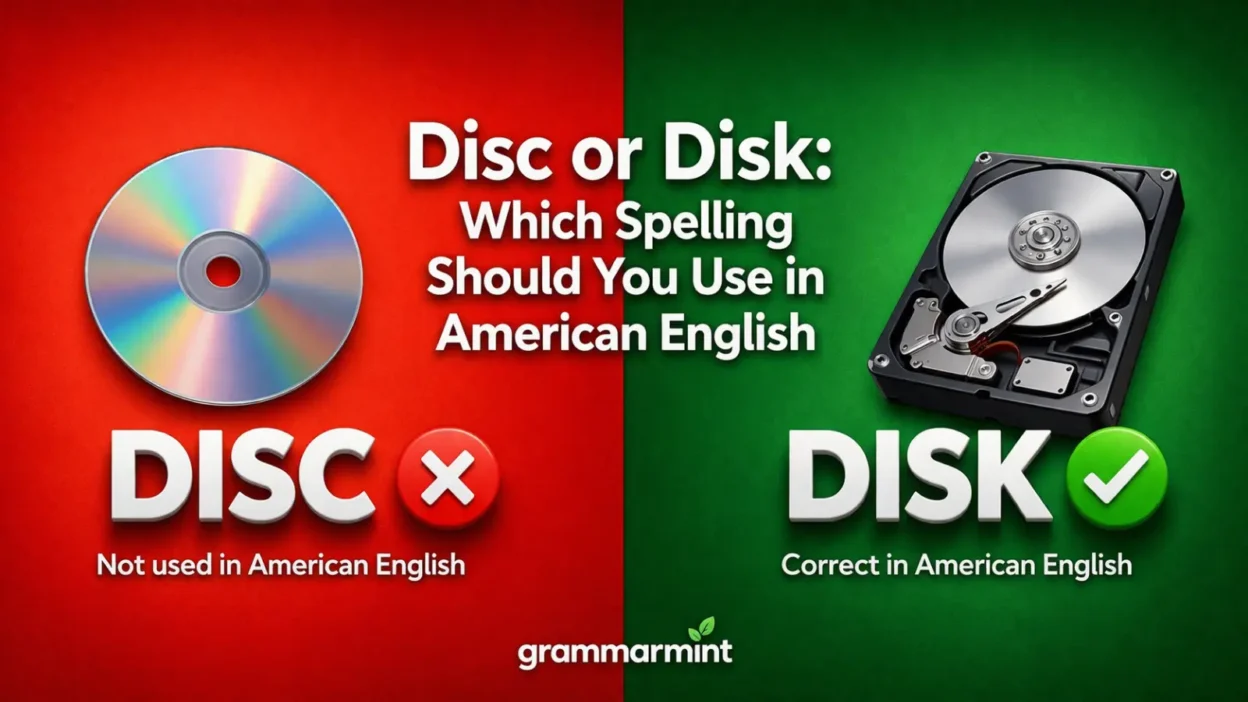
Both disc and disk are correct in American English.
In the US, disk is more common in computing and general use. Disc is usually used for optical media, like CDs and DVDs, and in some medical terms.
Key Differences at a Glance
| Feature | Disc | Disk |
| Common in US tech? | Rare | Yes |
| Used for CDs/DVDs? | Yes | No |
| Medical term (spine)? | Often | Also accepted in US |
| General round object? | Less common | More common |
| Spelling tradition | Older/Latin-based | Simplified US form |
Origin and Why Two Forms Exist
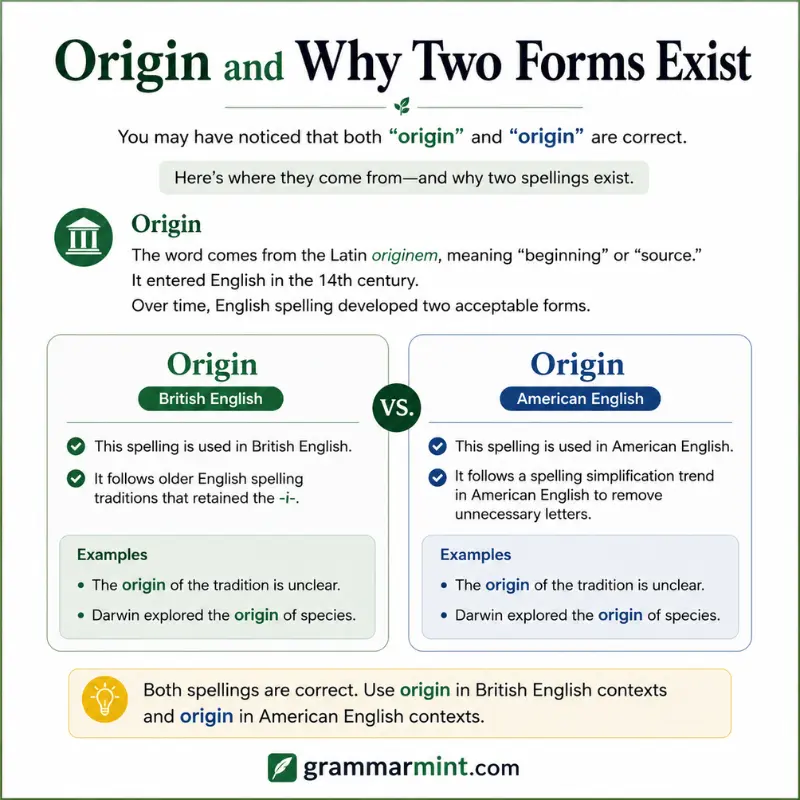
Both words come from the same root, linked to a flat, round object. Over time, English developed two spellings.
Disk became the standard American spelling for many general and technical uses. Disc stayed common in certain fixed phrases, especially compact disc and disc brake.
The difference is not about meaning. It is about convention. Specific industries settled on one form and kept it.
Disc vs. Disk: What Is the Main Difference?
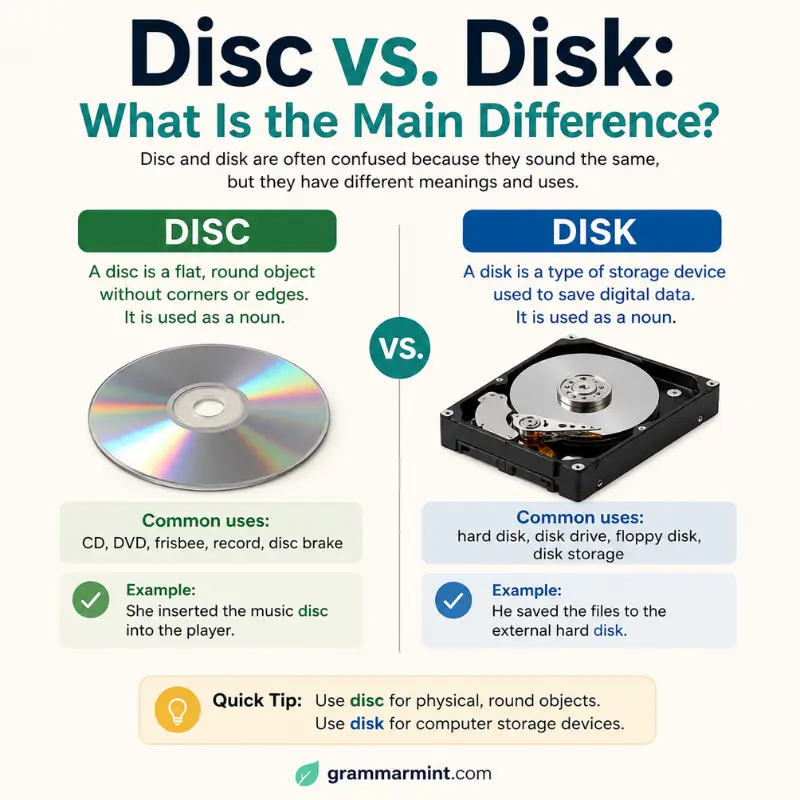
The main difference between disc and disk is not their basic meaning. Both words describe something that is flat, round, or circular. The difference comes from established usage and terminology.
In American English, disk is generally preferred when talking about computers, storage, and other general uses. For example, people commonly say hard disk, disk drive, and floppy disk.
Disc, on the other hand, appears in several established expressions. The most familiar examples are compact disc, disc brake, and spinal disc.
This means you should not simply choose one spelling and use it everywhere. The correct choice often depends on the specific word or industry.
For example:
- The computer has a new hard disk.
- She bought a music disc.
- The mechanic replaced the disc brake.
- The doctor examined the damaged spinal disc.
The easiest approach is to learn the common combinations rather than trying to create a universal rule.
British vs American English
Many people think disc is British and disk is American. That idea is only partly true.
In British English, disc is more common overall. In American English, disk dominates in computing and general use. Still, Americans use disc in fixed terms like compact disc.
So this is not a strict US vs UK split. It is more about field and tradition.
How to Remember When to Use Disc or Disk
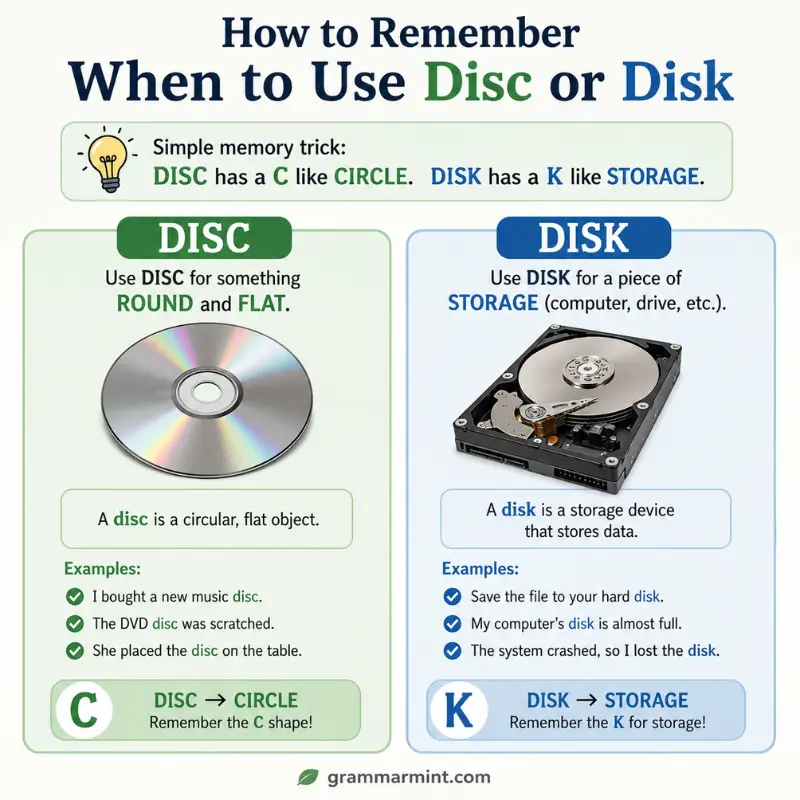
One simple way to remember the difference is to associate disk with computers and disc with CDs and DVDs.
Think of these common expressions:
- hard disk
- disk drive
- disk space
- floppy disk
- compact disc
- optical disc
- disc brake
- spinal disc
This memory trick works well for everyday American English, although it is not a perfect rule.
The word disk is strongly associated with digital storage. If you are discussing a computer’s storage system, disk is usually the safer choice.
The word disc is often retained in terms that became established before or outside modern computer terminology. This is why compact disc remains standard even though the object is also round and flat.
When you are unsure, look at the complete expression rather than the individual word. English often has fixed technical terms that cannot be changed simply because another spelling seems logical.
Which One Should You Use?
For computing and everyday US writing, choose disk.
• hard disk
• disk drive
• floppy disk
For optical media and certain fixed phrases, use disc.
• compact disc
• disc brake
In medical writing, US sources accept both spinal disc and spinal disk. Many healthcare providers prefer disc. Check your style guide if writing professionally.
In formal or academic contexts, follow the standard term used in that field. Do not switch back and forth in the same document.
Disc and Disk in Technology
Technology is one of the clearest areas where American English usually favors disk.
Common computing expressions include:
- hard disk
- hard disk drive
- disk drive
- disk space
- disk storage
- floppy disk
- startup disk
- disk partition
- disk image
- disk failure
For example:
The computer is running out of disk space.
The technician replaced the damaged hard disk.
The operating system is installed on the startup disk.
Although disc may sometimes appear in older technical material, disk is the standard spelling in most modern American computing contexts.
There is one important exception: optical disc is commonly spelled with disc. This category includes CDs, DVDs, and similar optical media.
Therefore, a useful distinction is:
Computer storage → disk
Optical media → disc
This distinction explains why you may see both spellings in the same technology article. A computer may have a hard disk that reads information from a compact disc.
Common Mistakes
Writers often make a few predictable errors when choosing between disc and disk. Here are the most common ones and their quick fixes:
Replacing “disc brake” with “disk brake.”
Keep “disc brake” because it is the standard automotive term.
Writing “hard disc drive.”
The standard American English term is “hard disk drive.”
Using “compact disk” for a CD.
The established spelling is “compact disc.”
Mixing “disc” and “disk” throughout a technology article.
For computing terminology, use “disk” consistently in expressions such as hard disk and disk drive.
Assuming “disc” is always British English.
American English also uses “disc” in established terms such as compact disc, disc brake, and spinal disc.
Changing the spelling in the middle of a report.
Select the conventional spelling for your context and use it consistently throughout the document.
Disc and Disk in Medicine
Medical terminology is another area where the two spellings can overlap.
In American medical writing, spinal disc is very common. Doctors and medical sources may refer to a herniated disc, slipped disc, or bulging disc.
Examples include:
- herniated disc
- slipped disc
- spinal disc
- damaged disc
- bulging disc
- degenerative disc disease
The spelling disk can also appear in American medical terminology. You may encounter forms such as spinal disk or herniated disk.
This variation does not necessarily indicate a difference in meaning. In many cases, both spellings refer to the same anatomical structure.
However, professional medical writers should follow the terminology used by their organization, publication, or style guide. Consistency is especially important in medical and academic writing.
For general readers, spinal disc is a familiar and widely recognized form.
Disc or Disk in Automotive Terms
Automotive English provides another important example of why context matters.
The standard term is disc brake, not usually disk brake, in American English.
A disc brake uses a flat metal disc, also called a rotor, that rotates with the wheel. Brake pads press against the disc to slow or stop the vehicle.
Common expressions include:
- disc brake
- disc brake system
- brake disc
- ventilated disc
- rear disc brakes
- front disc brakes
For example:
The mechanic inspected the front disc brakes.
You may occasionally see disk brake, particularly in older material or in contexts influenced by different terminology, but disc brake is the established form in modern automotive English.
This is a good example of why spelling should be based on the conventional term rather than the general American preference for disk.
Why Some Words Always Use “Disc”
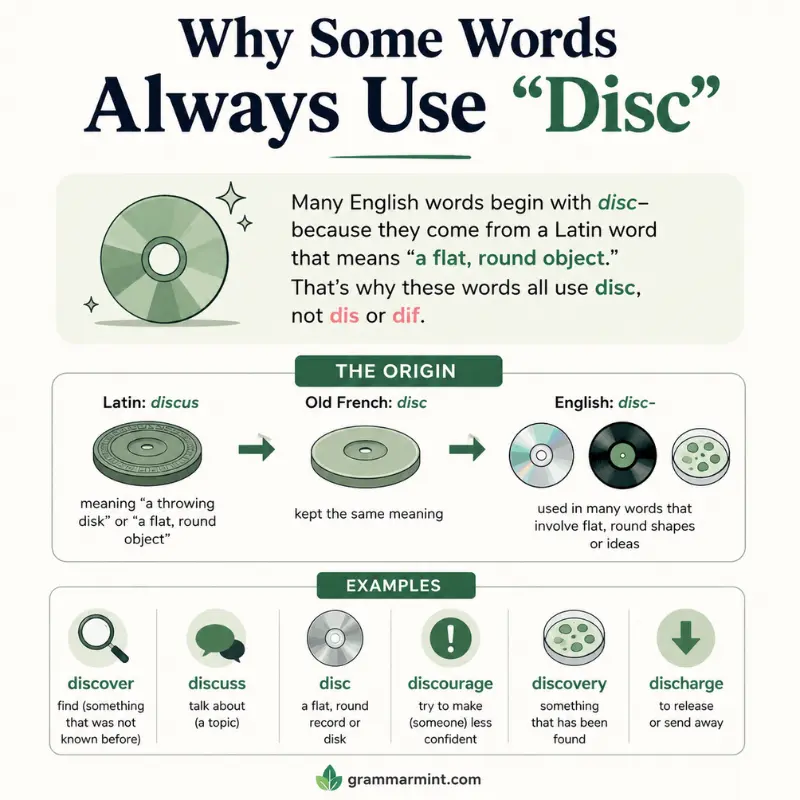
Certain expressions have become fixed with disc because that spelling became established in the terminology.
The most familiar example is compact disc. When CDs became popular, the name was standardized as compact disc, and that spelling became part of everyday English.
Other common expressions include:
- compact disc
- optical disc
- disc brake
- brake disc
- spinal disc
- slipped disc
Changing these expressions to disk can make the writing look unusual or technically incorrect, even though the basic object is still circular.
This is similar to many other English spelling conventions. A word may have a general spelling preference, but certain established phrases preserve a particular form.
Everyday Examples
Informal text:
“I need a new hard disk for my laptop.”
Social media post:
“Found my old compact disc collection in the attic!”
Medical context:
“The MRI showed a herniated disc.”
Workplace email:
“The backup disk failed last night.”
More professional rewrite:
“The primary hard disk experienced a failure during the overnight backup process.”
Why Some Words Always Use “Disk”
The spelling disk became strongly associated with American computing.
As computers developed, disk became the established spelling in terms related to digital storage and computer hardware.
Examples include:
- hard disk
- disk drive
- disk storage
- disk space
- disk partition
- floppy disk
- virtual disk
These terms are so well established that replacing disk with disc can make the phrase sound outdated or nonstandard in American technical writing.
For example, hard disk drive is much more familiar to American readers than hard disc drive.
The important point is that this is a matter of convention. English speakers understand both forms, but professional terminology favors the established spelling.
Usage/Trends
In US search data, “hard disk” appears far more often than “hard disc.” Technology brands and manuals also favor disk.
However, “compact disc” remains the accepted spelling for CDs. Medical sources often use disc when referring to the spine.
Overall, usage depends on the industry. The pattern has been stable for years.
Comparison Table
| Context | Best Choice | Why |
| Hard drive storage | Disk | Standard US tech term |
| CD or DVD | Disc | Fixed phrase tradition |
| Floppy storage | Disk | Established computing usage |
| Car brakes | Disc | Standard automotive term |
| Spinal injury (US) | Disc (often) | Common medical usage |
| General round object | Disk | More common US form |
FAQs
Is it disc or disk in American English?
Both are correct. Disk is more common overall in the US, especially in computing. Disc appears in fixed terms like compact disc.
Why are CDs called discs, not disks?
The term “compact disc” was standardized with that spelling. The phrase became fixed, so the spelling stayed.
Is it hard disk or hard disc?
In American English, it is hard disk. Tech manuals and brands use that form.
Is it slipped disk or slipped disc?
In the US, both appear. Many medical sources prefer disc, but disk is also accepted.
Are disc and disk interchangeable?
Not always. In casual writing, they may overlap. In technical terms, you should follow the established spelling.
Mini Quiz
- You installed a new hard ____ in your computer.
- She played music from a compact ____.
- The mechanic checked the brake ____.
- The MRI showed a damaged spinal ____.
Answer Key:
- disk
- disc
- disc
- disc (disk also accepted in US medical writing)
Conclusion
Disc or Disk comes down to context, not correctness.
In American English, disk leads in computing and general use. Disc remains standard in certain fixed phrases and medical terms.
Choose based on field and audience. Stay consistent. When in doubt, follow the term used by experts in that area.