You may see lowkey in texts, captions, comments, and everyday conversations. Someone might say, “I lowkey miss school.” Another person may describe a birthday dinner as low-key.
People use the term when they want to sound relaxed, private, or less intense. Yet the same spelling does not fit every sentence. In edited writing, the hyphenated form is often clearer. In casual messages, the one-word slang form feels natural.
The word can express two related ideas. It may describe something quiet and understated. In slang, it can soften a feeling, opinion, or desire.
Knowing the difference helps you understand the speaker’s real tone. It also helps you choose the right spelling for each setting. This guide covers meaning, pronunciation, grammar, examples, related terms, and common mistakes.
Quick Answer
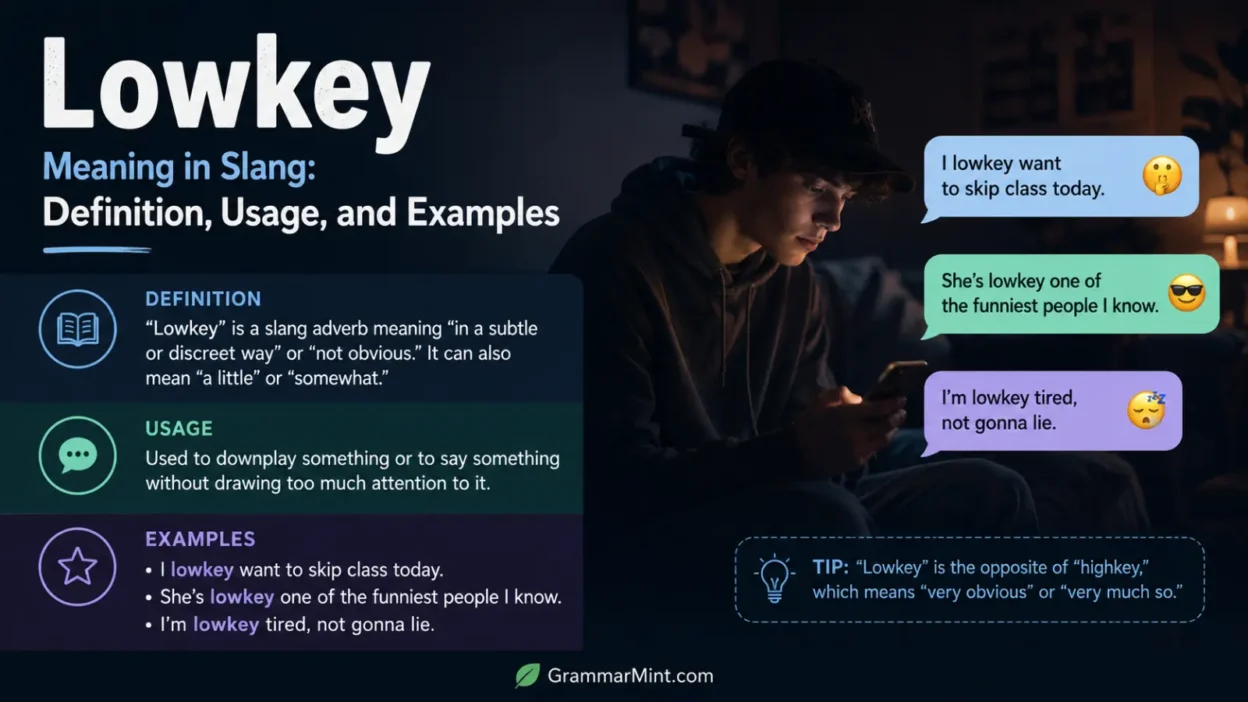
The lowkey meaning is usually “somewhat,” “secretly,” or “without making a big deal about it.”
As an adjective, low-key means quiet, restrained, or not designed to attract attention.
TL;DR
• Lowkey often means somewhat or secretly.
• It can make an opinion sound less intense.
• Low-key describes something quiet or understated.
• Lowkey is common in texts and casual speech.
• Low-key is safer in edited writing.
• Context shows which meaning fits.
What Lowkey Means in Plain English
In plain English, lowkey signals low intensity or limited attention. The speaker does not present the idea as loud, dramatic, or fully public.
Consider “I lowkey want pizza.” The speaker wants pizza but expresses that desire casually. The feeling may be mild, private, or stronger than the speaker admits.
The adjective low-key has a more traditional meaning. A low-key event is simple, calm, and not flashy.
A low-key person may seem private, relaxed, or modest. Such a person usually avoids drawing unnecessary attention.
Lowkey Meaning in Slang, Texts, and Social Posts
In slang, lowkey often works like “kind of” or “somewhat.” It reduces the force of the statement that follows.
“I’m lowkey nervous” may mean “I’m somewhat nervous.” However, the speaker could be more nervous than they openly admit.
Lowkey can also mean “secretly” or “quietly.” For example, “She lowkey wants the job” suggests an unannounced desire.
Online, people sometimes place lowkey before a strong word. This creates a playful contrast.
“I’m lowkey obsessed” often expresses real enthusiasm. The speaker simply presents that enthusiasm in a casual way.
The meaning stays similar across text messages, comments, and social captions. However, the exact tone depends on the whole message.
Pronunciation, Spelling, and Part of Speech
Pronounce lowkey as “LOH-kee.” Both parts are clear. The second part sounds like the word key.
The spelling depends on the sentence role and level of formality.
• Low-key is safest as an adjective: “We planned a low-key dinner.”
• Lowkey is common as a slang adverb: “I lowkey love this song.”
• Low key appears informally: “Let’s keep it low key.”
Low-key commonly functions as an adjective. It describes a person, event, action, style, or response.
Adjective: “They chose a low-key wedding.”
Lowkey or low-key can also function as an informal adverb. It changes the strength or manner of another expression.
Adverb: “I lowkey enjoyed the class.”
Some dictionaries also record a rare verb use. It means making something less noticeable or intense. Most speakers rarely use that form.
How to Use Lowkey in a Sentence
Place lowkey before the word or idea it softens. It often appears before a verb, adjective, or complete opinion.
Before a verb
• “I lowkey want to stay home.”
• “They lowkey forgot about the meeting.”
• “We lowkey need another day.”
• “She lowkey hopes he calls.”
Before an adjective
• “That movie was lowkey funny.”
• “The test was lowkey difficult.”
• “This restaurant is lowkey expensive.”
• “His answer was lowkey rude.”
At the start of a comment
• “Lowkey, this is the best coffee here.”
• “Lowkey, I think we should leave early.”
• “Lowkey, that plan could work.”
• “Lowkey, I miss our old apartment.”
Use low-key before a noun when it describes that noun. Examples include “a low-key party” and “a low-key response.”
You can also place it after a linking verb. For example, “The celebration was low-key” sounds natural and clear.
Common Contexts and Natural Examples
Lowkey appears most often in relaxed conversations. Its exact meaning changes with the situation and the speaker’s tone.
Feelings
• “I lowkey miss my old neighborhood.”
• “He is lowkey worried about tomorrow.”
• “I’m lowkey excited for Monday.”
• “She lowkey feels left out.”
These examples often express emotions without making them sound dramatic.
Opinions
• “That sandwich was lowkey amazing.”
• “I lowkey think the first design looks better.”
• “The ending was lowkey disappointing.”
• “This might lowkey be their best song.”
Here, the word makes an opinion sound casual or less forceful.
Desires
• “We lowkey want to take a road trip.”
• “She lowkey hopes they invite her.”
• “I lowkey want another slice.”
• “They lowkey want to cancel the plan.”
The desire may be mild. It may also be real but not openly announced.
Relationships
• “They are keeping their relationship low-key.”
• “I lowkey like him, but I have said nothing.”
• “She lowkey misses her former roommate.”
• “They had a low-key first date.”
In relationship talk, lowkey can signal privacy, uncertainty, or emotional caution.
Events and personal style
• “We had a low-key graduation dinner.”
• “Her outfit was simple and low-key.”
• “They want a low-key weekend at home.”
• “The announcement felt surprisingly low-key.”
In these examples, the adjective means simple, calm, or understated.
How Lowkey Changes Tone
Lowkey makes a statement feel casual, restrained, or less exposed. It lets speakers share feelings without sounding overly serious.
Sometimes it protects the speaker from embarrassment. “I lowkey like this show” sounds safer than “I love this show.”
The speaker can admit interest while keeping some emotional distance. This use is especially common with personal opinions and uncertain feelings.
The word can also add humor. Someone may say “lowkey terrified” when the fear is already obvious.
That mismatch creates a playful, understated effect. The statement sounds deliberately calmer than the real situation.
Lowkey may also soften criticism. “That comment was lowkey rude” sounds less direct than “That comment was rude.”
However, the criticism still remains. The softer wording does not remove its negative meaning.
Voice, context, and punctuation reveal the intended sense. Lowkey may mean slightly, secretly, casually, or jokingly.
Related Terms, Synonyms, and Antonyms
No single replacement fits every use of lowkey. Choose a substitute based on the intended meaning.
For the slang adverb, close alternatives include:
• Somewhat — shows a limited degree
• Kind of — gives an informal, mild meaning
• Slightly — expresses a small amount
• Secretly — shows that a feeling is private
• Quietly — suggests limited public attention
• Subtly — suggests something is not obvious
For the adjective, useful alternatives include:
• Understated
• Restrained
• Subdued
• Simple
• Modest
• Unflashy
• Relaxed
Possible opposites include openly, obviously, strongly, loudly, flashy, and high-profile.
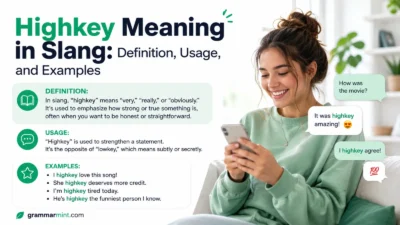
Highkey is the common slang contrast. It usually adds emphasis instead of reducing it.
| Context | Best Choice | Why |
|---|---|---|
| Mild feeling | Somewhat or kind of | Shows limited intensity |
| Private desire | Secretly | Shows the feeling is not public |
| Quiet event | Low-key or understated | Describes a calm, simple style |
| Strong open feeling | Highkey or definitely | Adds clear emphasis |
Compare these examples:
• “I lowkey like the idea” sounds cautious or mild.
• “I highkey love the idea” sounds open and enthusiastic.
• “We planned a low-key event” describes the event itself.
• “I secretly support the idea” focuses on privacy.
When Not to Use Lowkey
Avoid lowkey in formal reports, academic papers, contracts, and official messages. Its slang meaning may sound vague or too casual.
Choose a precise expression instead. Write “somewhat concerned,” “privately interested,” or “deliberately understated.”
These choices state the intended meaning more clearly. They also fit professional and formal settings better.
Avoid lowkey when safety or urgency matters. “I’m lowkey having trouble breathing” may hide the seriousness.
Direct language is better during emergencies. State the problem clearly and seek immediate assistance.
Be careful when describing another person. Calling someone low-key may mean calm, private, modest, or relaxed.
However, listeners could think the person hides feelings or avoids social attention. Add context when the intended meaning is unclear.
The term may also sound forced when used too often. Natural slang depends on the speaker, setting, and relationship.
Origin and Modern Development
Low-key first appeared as a term connected with art and photography. It described images with dark tones and limited contrast.
The word later gained a broader sense. It came to describe something restrained, understated, or low in intensity.
That established meaning appears in phrases like “a low-key event.” It also appears in expressions such as “a low-key response.”
The newer slang use developed from the same idea of reduced emphasis. Speakers began using it as an adverb.
In that role, lowkey can mean somewhat, subtly, or secretly. Recorded online examples of this use appeared by the late 2000s.
Its spelling also became more flexible in casual writing. Lowkey is now common in chats, captions, and conversational posts.
Low-key remains the clearest choice in edited prose. The open form, low key, also appears in relaxed writing.
The term was not created recently from nothing. Modern slang extended a much older expression into a new grammatical role.
Common Mistakes and Quick Fixes
Mistake: Treating lowkey as meaning only “secretly”
Correction: It can also mean somewhat, mildly, subtly, or without emphasis.
“I’m lowkey tired” often means “I’m somewhat tired.” It does not always suggest secrecy.
Mistake: Assuming it always weakens a feeling
Correction: Lowkey may hide or play down a strong feeling.
“I lowkey love this song” can show real enthusiasm. The casual tone does not always mean weak interest.
Mistake: Using lowkey in every setting
Correction: Reserve the slang form for casual speech, texts, and social conversations.
Choose more precise wording in professional, academic, or official communication.
Mistake: Writing “a lowkey meeting” in edited copy
Correction: Write “a low-key meeting” when the term appears before a noun.
The hyphen clearly joins both words into one adjective.
Mistake: Confusing lowkey with low-profile
Correction: Low-profile mainly describes limited public attention or visibility.
Lowkey has broader emotional, conversational, and stylistic meanings.
Mistake: Thinking highkey always means public
Correction: Highkey usually adds strong emphasis. It does not always describe public knowledge.
“I highkey want pizza” means the desire is strong and openly expressed.
Mini Quiz
1. What does lowkey most likely mean here?
“I lowkey want dessert.”
A. Never
B. Somewhat or secretly
C. Very loudly
2. Which spelling best fits edited writing?
A. A low-key celebration
B. A lowkey celebration
C. A low key-celebration
3. Which sentence uses the slang adverb?
A. We held a low-key meeting.
B. I lowkey enjoyed the meeting.
C. The key was low.
4. Which word is a common slang contrast?
A. Highkey
B. Quietly
C. Slowly
Answer key: 1-B, 2-A, 3-B, 4-A.
FAQs
What does lowkey mean in slang?
Lowkey usually means somewhat, secretly, or without strong emphasis. It helps someone express an opinion or feeling casually.
The exact sense depends on the surrounding sentence. A mild statement may still hide a strong emotion.
What does lowkey mean in a text message?
In a text, lowkey often softens what follows. “I lowkey miss you” expresses a feeling without making it sound dramatic.
It may mean the feeling is mild. It could also mean the sender feels shy about admitting it.
Does lowkey mean secretly?
It can mean secretly, especially when someone hides a desire or opinion. For example, “He lowkey wants the promotion” suggests private interest.
However, it can also mean slightly or kind of. Context determines the better interpretation.
Is lowkey positive or negative?
Lowkey is usually neutral by itself. The surrounding words give the sentence its positive or negative meaning.
“Lowkey amazing” is positive. “Lowkey annoying” is negative.
Is lowkey one word or hyphenated?
Lowkey is common in slang and casual digital writing. It often functions as an informal adverb.
Low-key is safer for an adjective in edited writing. For example, write “a low-key celebration.”
What is the difference between lowkey and highkey?
Lowkey reduces emphasis or suggests privacy. It can mean somewhat, secretly, or quietly.
Highkey adds emphasis. It often means openly, strongly, completely, or definitely.
Can low-key describe a person?
Yes. A low-key person is often calm, private, modest, or not attention-seeking.
The description is usually neutral or positive. Still, context may suggest that the person is reserved or emotionally private.
Conclusion
The lowkey meaning depends on context. It usually signals restraint, privacy, or reduced emphasis.
Use lowkey in casual conversation. Choose low-key when writing a polished adjective.
Notice how people use the term in real conversations. Its intended tone will soon become easy to recognize.