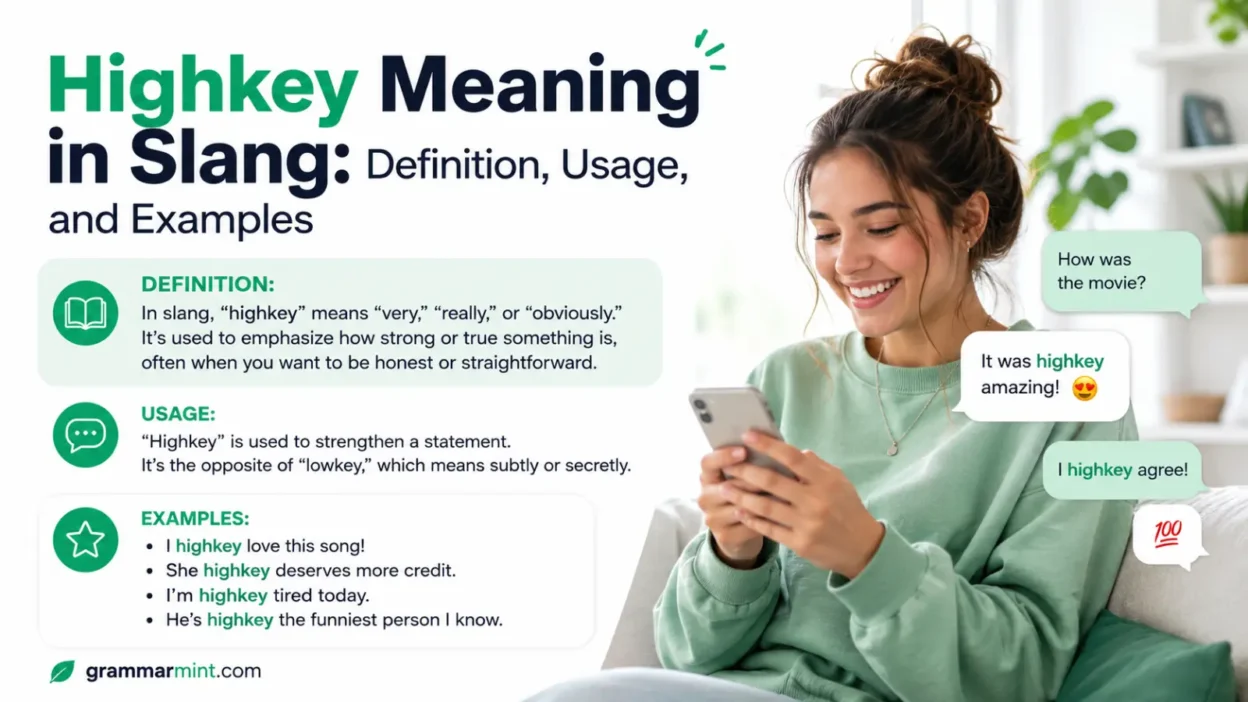
People often see highkey in texts, comments, captions, and group chats. For example, someone may write, “I highkey love this song.” In that sentence, the word adds strong and open emphasis.
Because highkey is slang, its literal parts can confuse new readers. It does not usually refer to height, music, or a physical key. Instead, it often means really, openly, clearly, or intensely.
The word can strengthen a feeling, opinion, desire, or reaction. It may sound playful, honest, dramatic, or humorous. Therefore, understanding the surrounding context is important.
This guide explains the highkey meaning in plain English. It also covers pronunciation, grammar, spelling, examples, tone, origin, and common mistakes. By the end, you will know when the term sounds natural.
Quick Answer
Highkey means really, openly, clearly, or intensely in informal slang. Usually, it strengthens a feeling, desire, reaction, or opinion.
TL;DR
• Highkey adds strong and open emphasis.
• It usually works as an informal adverb.
• The word can describe positive or negative feelings.
• Common spellings include highkey, high-key, and high key.
• However, it does not suit most formal writing.
What Does Highkey Mean in Slang, Texting, and Social Media?
In modern slang, highkey works as an intensifier. An intensifier makes another word or statement stronger. Therefore, highkey often communicates honesty, intensity, or open emotion.
For example, “I highkey miss summer” means “I really miss summer.” The speaker is not hiding the feeling. In fact, the wording makes the emotion clear.
In texting, the term can make a simple message more expressive. It often appears in chats, captions, comments, memes, and casual posts. Although the platform may change, the basic meaning stays similar.
The word itself is neither positive nor negative. Instead, the surrounding words create the emotional tone.
• “I’m highkey proud of you” is positive.
• “That was highkey rude” is negative.
• “I highkey forgot” is a direct admission.
• “This is highkey surprising” shows a strong reaction.
Sometimes, highkey also adds playful exaggeration. A person may say, “I highkey need a vacation,” after one tiring afternoon. In that case, context shows whether the comment is serious or humorous.
Pronunciation, Spelling, and Part of Speech
Highkey is pronounced HIGH-kee. The stress falls on the first part. In other words, it sounds like high and key spoken together.
You may see three common spellings:
• highkey
• high-key
• high key
All three forms appear in informal writing. However, highkey is especially common in texts and social posts. Meanwhile, high-key is a clear dictionary-style spelling.
In slang, highkey mainly works as an adverb. It can modify a verb, adjective, noun phrase, or complete statement.
• Verb: “I highkey want tacos.”
• Adjective: “That episode was highkey emotional.”
• Noun phrase: “This is highkey a great idea.”
• Statement: “Highkey, I should apologize.”
In the last example, the term comments on the whole statement. As a result, it has a meaning close to honestly or seriously.
Highkey is not usually a noun or verb in this slang sense. For that reason, a person does not normally “highkey” something. The word simply adds force to another idea.
How to Use Highkey in a Sentence
Place highkey near the word or idea you want to strengthen. Most often, it appears before a verb or adjective. However, it can also introduce a complete statement.
Before a verb, highkey stresses an action, wish, or feeling.
• “I highkey love this restaurant.”
• “She highkey carried the whole project.”
• “We highkey need more time.”
Before an adjective, the term increases the strength of the description.
• “That jacket is highkey perfect.”
• “The final scene was highkey sad.”
• “I’m highkey nervous about tomorrow.”
Highkey can also appear before a noun phrase.
• “That is highkey a compliment.”
• “This could be highkey a problem.”
• “He is highkey the funniest person here.”
At the start of a statement, add a comma for easier reading.
• “Highkey, I expected a better ending.”
• “High-key, we should leave before traffic starts.”
This opening position sounds conversational and slightly dramatic. Often, it introduces an honest opinion or confession.
A short reply may contain highkey alone. For instance, someone may answer “Highkey” to show strong agreement. Still, that use depends on the earlier message.
Common Contexts and Examples
Highkey works best when speakers want noticeable emphasis. In particular, it is common with feelings, opinions, reactions, and desires.
Excitement
“I’m highkey excited for the concert.”
Here, the speaker feels openly and strongly excited. Rather than downplaying the emotion, the sentence highlights it.
Attraction or Affection
“I highkey like her.”
Usually, this means the speaker truly likes her. The feeling may also be stronger than a casual interest.
Food and Cravings
“I highkey want pizza tonight.”
In this example, the speaker has a strong craving. The tone remains casual and direct.
Stress or Frustration
“I’m highkey stressed about the deadline.”
The stress feels real and noticeable. Therefore, the speaker is not pretending everything is fine.
Opinions
“That movie was highkey better than the first one.”
The speaker strongly believes the second movie was better. Depending on the context, the wording may sound confident or playful.
Admissions
“I highkey forgot your birthday.”
Here, highkey makes the admission direct. At the same time, it may add humor to an awkward confession.
Praise
“She is highkey talented.”
This sentence gives strong and open praise. Compared with “She is talented,” it sounds more expressive.
Criticism
“That comment was highkey unnecessary.”
The speaker strongly disapproves. However, the criticism comes from unnecessary, not from highkey itself.
Highkey and Lowkey: The Difference
Highkey and lowkey often work as informal opposites. Even so, their meanings are not perfectly balanced in every sentence.
Lowkey can mean secretly, somewhat, quietly, or without much emphasis. By contrast, highkey usually means openly, strongly, or with clear emphasis.
| Context | Best Choice | Why |
|---|---|---|
| Strong, open feeling | Highkey | The speaker wants noticeable emphasis. |
| Private or softened feeling | Lowkey | The speaker reduces or hides the intensity. |
| Formal or neutral message | Really or clearly | Standard wording fits the setting better. |
Compare these examples:
“I lowkey want to leave” sounds hesitant or understated. Perhaps the person does not want to announce the feeling.
“I highkey want to leave” sounds strong and open. Therefore, the person is making the desire clear.
Sometimes, people combine both words for humor. “I’m lowkey highkey worried” suggests mixed levels of openness and intensity. Although the phrase is not logically exact, it works as playful slang.
Tone, Formality, and When Not to Use It
Highkey is casual slang. Therefore, it suits conversations with friends, relaxed messages, captions, comments, and informal dialogue.
The word is not offensive by itself. Still, the full sentence may sound kind, rude, serious, or sarcastic. For that reason, tone depends on the surrounding words.
Highkey can make a message feel youthful, expressive, or dramatic. It may also sound ironic when the situation is not serious. However, some readers may find it unfamiliar.
Avoid highkey in most formal settings. For example, school essays, legal notices, business reports, and applications usually need standard wording.
Informal: “I highkey disagree with that plan.”
Formal: “I strongly disagree with that plan.”
Informal: “The results were highkey surprising.”
Formal: “The results were highly surprising.”
When speaking to an unfamiliar audience, slang may reduce clarity. Instead, choose really, strongly, openly, clearly, or genuinely.
Origin and the Older Technical Meaning
The slang use of highkey grew as an expressive counterpart to lowkey. It is commonly linked to African American English and hip-hop culture. However, slang history can be difficult to trace with complete certainty.
Digital use became more visible during the 2010s. As online conversations expanded, the term reached wider age groups and communities. Even so, its cultural background should not be ignored.
High-key also has an older technical meaning. In photography, painting, and film, it describes bright tones and low contrast. As a result, a high-key image often has soft shadows and a light appearance.
That technical sense differs from the slang meaning. Fortunately, context usually makes the intended meaning clear.
• “The portrait uses high-key lighting” refers to visual style.
• “I’m highkey obsessed with the portrait” uses slang emphasis.
The modern slang meaning likely developed through contrast with lowkey. Still, no simple history explains every stage of its spread.
Synonyms, Antonyms, and Related Terms
No single synonym replaces highkey in every sentence. Instead, the best choice depends on intensity, openness, or honesty.
Close alternatives include:
• Really: general emphasis
• Seriously: strong sincerity
• Genuinely: honest feeling
• Openly: no attempt to hide something
• Intensely: strong degree or emotion
• Definitely: firm certainty
• Clearly: obvious or noticeable
Lowkey is the closest slang opposite. Other possible contrasts include quietly, subtly, secretly, mildly, and somewhat. However, those choices do not fit every context.
Several expressions have related functions but different meanings.
• For real stresses sincerity or agreement.
• No cap means the speaker is not lying.
• Honestly introduces a sincere view or admission.
• Literally may add emphasis, although its exact meaning differs.
Before replacing highkey, read the whole sentence. Then, decide whether the speaker stresses honesty, openness, or intensity.
Common Mistakes and Quick Fixes
Mistake 1: Assuming Highkey Is Always Positive
Incorrect idea: Highkey always shows excitement or praise.
Quick fix: Check the following word. For example, “highkey annoyed” is negative, while “highkey thrilled” is positive.
Mistake 2: Treating It as Formal Vocabulary
Unnatural formal sentence: “The committee highkey supports the proposal.”
Quick fix: Write, “The committee strongly supports the proposal.”
Mistake 3: Confusing Slang With Photography
“The photo is high-key” may describe bright lighting. Therefore, it does not necessarily mean the photo is extremely good.
Quick fix: Use the surrounding topic to identify the correct sense.
Mistake 4: Placing It Too Far From the Main Idea
Unclear: “I want to visit Chicago next year highkey.”
Clearer: “I highkey want to visit Chicago next year.”
Mistake 5: Using It in Every Sentence
Too much slang can weaken its effect. Instead, use highkey only when strong emphasis adds something useful.
Mistake 6: Assuming Every Spelling Has a Different Meaning
Highkey, high-key, and high key can share the same slang meaning. Usually, the writer’s style and platform affect the spelling.
Mini Quiz
Choose the best answer for each question.
1. “I highkey love this song” most nearly means what?
A. I secretly dislike this song.
B. I really love this song.
C. I barely noticed this song.
2. Which sentence fits a formal report?
A. The change was highkey useful.
B. The change was extremely useful.
3. What part of speech is highkey usually in slang?
A. Adverb
B. Noun
C. Pronoun
4. Which sentence uses the technical meaning?
A. The studio created a high-key portrait.
B. I highkey want a new camera.
5. Can highkey introduce a negative feeling?
A. Yes
B. No
Answer Key
- B
- B
- A
- A
- A
FAQs
What Does Highkey Mean in Slang?
In slang, highkey means really, openly, clearly, or intensely. It adds strong emphasis to a feeling, opinion, desire, or reaction.
What Does Highkey Mean in a Text Message?
In a text, the term shows that the sender feels something strongly. For example, “I highkey miss you” means “I really miss you.”
What Does Highkey Mean on TikTok?
On TikTok, highkey usually works as an informal intensifier. Creators often use it in captions, comments, reactions, and spoken posts.
Is Highkey the Opposite of Lowkey?
In many cases, yes. Highkey is open and intense, while lowkey is softer, private, or restrained.
Is Highkey Positive or Negative?
By itself, highkey is neutral. For instance, “highkey amazing” is positive, but “highkey irritating” is negative.
Can Highkey Be a Compliment?
Yes, it can strengthen praise. “You are highkey talented” means the speaker strongly and openly recognizes your talent.
Is Highkey One Word or Two?
Both highkey and high key appear in casual writing. In addition, the hyphenated form high-key is common and widely recognized.
Conclusion
The highkey meaning centers on strong, open, and informal emphasis. Therefore, use it when really feels too plain in casual conversation.
Before using it, check the audience and setting. Then, choose standard wording when clarity or formality matters more.