

If you have ever paused mid-sentence over sneaked or snuck, you are not alone. Both forms are widely used, and you can find them in books, conversations, blogs, newspapers, and everyday messages. Because both sound natural to many English speakers, choosing the right one can sometimes feel confusing.
The good news is simple: both sneaked and snuck are correct past tense forms of the verb sneak.
However, there are some differences in usage, regional preference, and tone that are worth understanding. In particular, snuck is very common in American English, while sneaked remains a standard form and is also widely used. Neither form should automatically be treated as wrong.
This guide explains the difference between sneaked and snuck, how each form is used, which one sounds more natural in different situations, and how to choose the best option for your writing.
Quick Answer
Both sneaked and snuck are correct past tense forms of sneak.
- Sneaked is the regular past tense form, created by adding -ed.
- Snuck is an irregular past tense form.
- Snuck is especially common in American English and often sounds natural in everyday conversation.
- Sneaked is also standard and can work well in formal, edited, or neutral writing.
- Neither form is simply “right” while the other is “wrong.”
For example:
He sneaked out of the house before anyone noticed.
He snuck out of the house before anyone noticed.
Both sentences are grammatically correct and have the same basic meaning.
The best choice depends largely on your audience, region, and preferred style.
Sneaked vs. Snuck at a Glance
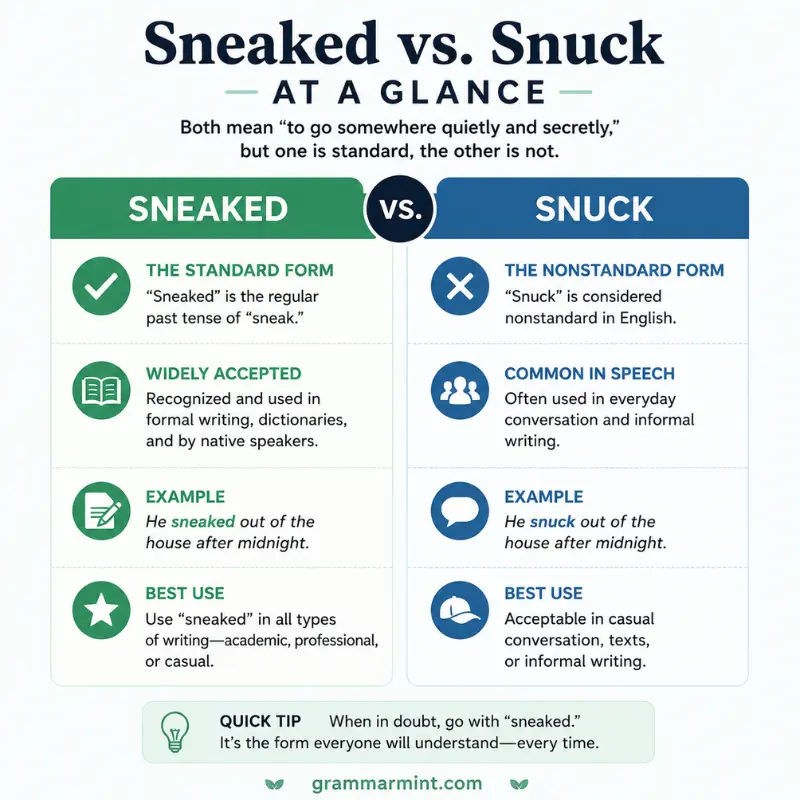
| Feature | Sneaked | Snuck |
|---|---|---|
| Base verb | Sneak | Sneak |
| Past tense | Sneaked | Snuck |
| Type | Regular form | Irregular form |
| Standard English | Yes | Yes |
| Common in American English | Yes | Very common |
| Conversational tone | Natural | Often very natural |
| Formal writing | Appropriate | Also possible, depending on style |
| Meaning | Same | Same |
The most important point is that the two forms have the same basic meaning. The difference is primarily related to usage and style rather than meaning.
What Does Sneak Mean?
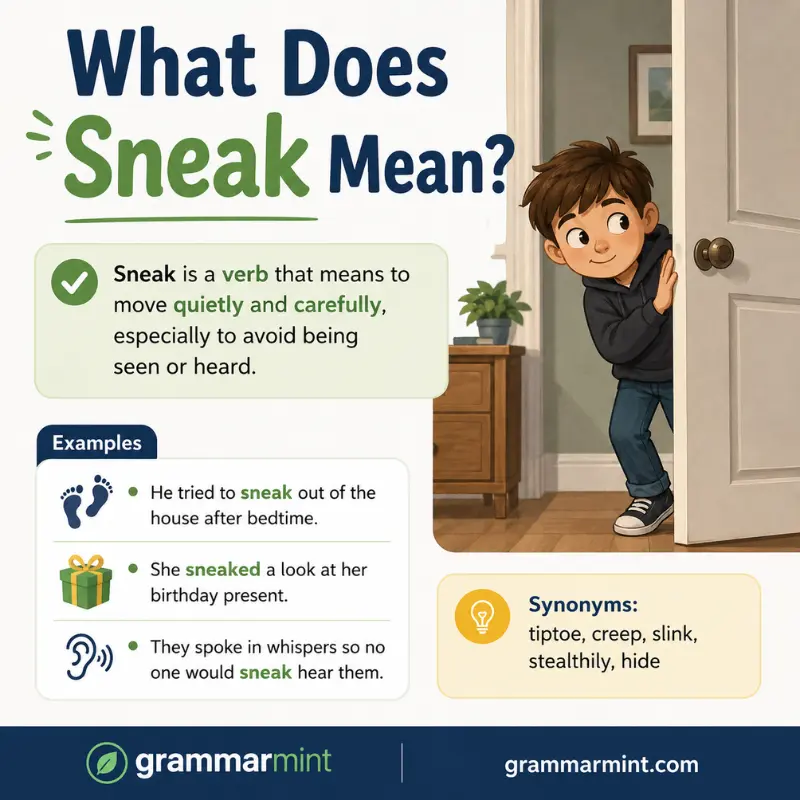
Before comparing the past tense forms, it helps to understand the verb sneak.
To sneak means to move, enter, leave, or do something quietly or secretly so that other people do not notice.
For example:
- The cat sneaked into the bedroom.
- The children snuck downstairs after bedtime.
- She sneaked a quick look at the answer.
- He snuck out without saying goodbye.
The verb can describe physical movement, but it can also describe doing something secretly.
For instance:
I sneaked a piece of chocolate from the kitchen.
Here, the person is not necessarily moving secretly. Instead, the action of taking the chocolate is done quietly or without permission.
Why Are There Two Past Tense Forms?
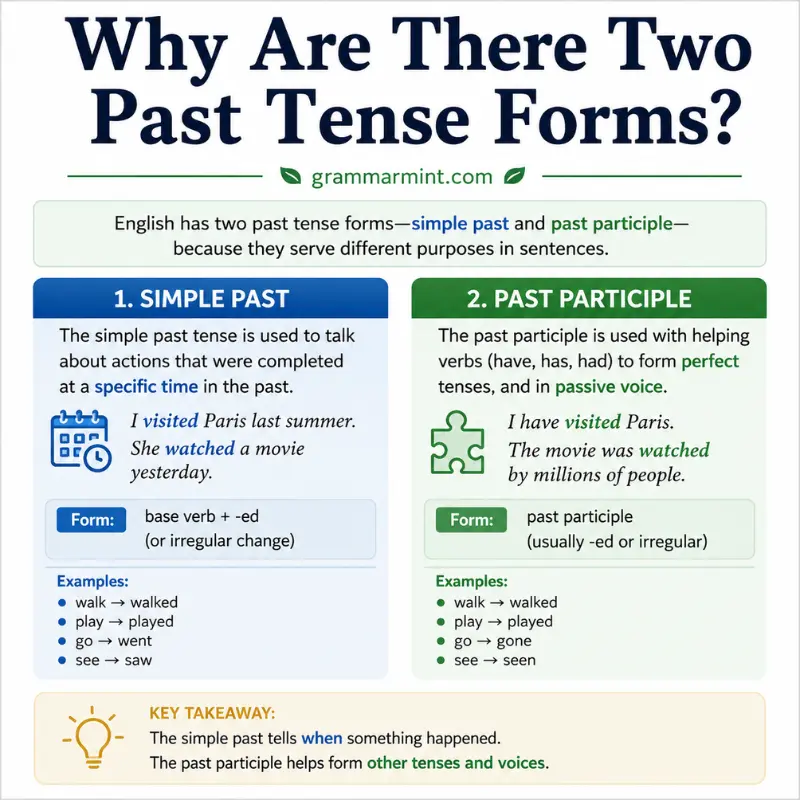
English has many verbs with more than one accepted past tense form. Some verbs follow the regular -ed pattern, while others have developed irregular forms over time.
The traditional past tense of sneak is sneaked. It follows the same basic pattern as verbs such as:
- walk → walked
- talk → talked
- jump → jumped
- sneak → sneaked
However, snuck developed as an irregular form. It resembles the pattern found in verbs such as:
- stick → stuck
- strike → struck
- sting → stung
Over time, speakers began using snuck more widely. Eventually, the form became established enough to be recognized by major dictionaries.
As a result, modern English has two accepted past tense forms:
sneak → sneaked
and
sneak → snuck
This is an example of how English changes naturally over time. A word does not have to follow the oldest pattern forever. When a new form becomes widely established, it can become part of standard usage.
Is Snuck a Real Word?
Yes. Snuck is a real and standard English word.
Some people were taught that sneaked is the only correct past tense of sneak. That explains why snuck can sometimes look unusual or incorrect to certain readers. However, modern English dictionaries recognize snuck as a legitimate past tense and past participle of sneak.
Therefore, writing:
She snuck out of the room.
is not a grammatical mistake.
Likewise:
She sneaked out of the room.
is also correct.
The difference is not one of correctness. Instead, it is mainly a matter of usage and style.
Is Sneaked a Proper Word?
Yes. Sneaked is also completely correct.
It is the regular past tense of sneak and has been used for a long time.
For example:
The journalist sneaked into the building to investigate the story.
The dog sneaked into the kitchen while everyone was outside.
He sneaked a glance at his phone during the meeting.
There is no need to avoid sneaked simply because snuck is common in modern American English.
In fact, some writers prefer sneaked because it follows the familiar regular -ed pattern.
Sneaked vs. Snuck in American English
In American English, snuck is particularly common, especially in everyday conversation.
You might naturally hear:
I snuck out early.
She snuck into the room.
He snuck a cookie before dinner.
They snuck away before the meeting ended.
These sentences sound completely normal to many American English speakers.
At the same time, sneaked is still used in American English.
For example:
The reporter sneaked into the event unnoticed.
The children sneaked downstairs after their parents went to bed.
Therefore, it would be inaccurate to say that Americans use only snuck.
A better way to describe the difference is that snuck is especially familiar and common in American usage, while sneaked remains a standard alternative.
Sneaked vs. Snuck in British English
British English also uses both forms, although usage patterns can differ from those in American English.
Sneaked has traditionally been well established in British English, while snuck is also found and has become familiar to many speakers.
For that reason, it is better not to create a strict rule such as:
Americans say snuck, but British people say sneaked.
Real-world English is more flexible than that.
Regional preferences can influence which form sounds more natural, but both forms can be encountered in different varieties of English.
Which Form Sounds More Natural?
For many American English speakers, snuck sounds especially natural in casual conversation.
Consider:
I snuck out of work early.
This sounds relaxed and conversational.
Now compare:
I sneaked out of work early.
This is also correct, but some speakers may find it slightly less conversational.
However, that does not mean sneaked is always formal or that snuck is always informal. The surrounding sentence and the writer’s style also matter.
For example, a published article can easily contain:
The company snuck the announcement into a Friday afternoon update.
There is nothing grammatically wrong with that sentence.
Likewise, a formal report might use:
The unauthorized visitor sneaked through the security entrance.
The key is to choose the form that fits the overall voice of your writing.
When Should You Use Sneaked?
Use sneaked when you prefer the regular past tense form or when it fits the style of your writing.
It can be a useful choice in:
- formal or edited writing
- academic writing
- business documents
- professional reports
- explanatory articles
- situations where you want a more traditional-sounding form
For example:
The researcher sneaked a brief look at the notes before the presentation.
The employee sneaked out of the office before the meeting ended.
The children sneaked downstairs after everyone had gone to sleep.
That said, you should not think of sneaked as the only appropriate choice for formal writing. Snuck can also appear in polished writing, particularly when the writer wants a natural or conversational voice.
When Should You Use Snuck?
Snuck is a good choice when you want language that sounds natural and conversational, particularly in American English.
It works well in:
- everyday conversation
- text messages
- casual emails
- dialogue
- social media posts
- personal writing
- informal storytelling
For example:
I snuck into the kitchen for a midnight snack.
She snuck out of bed after everyone was asleep.
He snuck into the movie theater just before the doors closed.
They snuck away before anyone could stop them.
Because snuck is so common in modern American English, there is usually no reason to avoid it in ordinary writing.
Does Sneaked Mean Something Different From Snuck?
No. In most contexts, sneaked and snuck have the same meaning.
Compare:
She sneaked out of the house.
and:
She snuck out of the house.
Both mean that she left quietly or secretly.
Similarly:
He sneaked a look at the document.
and:
He snuck a look at the document.
Both describe looking at something secretly or discreetly.
The main difference is the form of the past tense, not the meaning.
Common Mistakes With Sneaked and Snuck
Mistake 1: Saying Snuck Is Always Wrong
Some people believe that because sneak traditionally follows the regular -ed pattern, snuck must be incorrect.
Correction: Snuck is a recognized standard form.
Mistake 2: Saying Sneaked Is Old-Fashioned
Sneaked is still a valid and widely used form.
Correction: You can use sneaked without worrying that it is grammatically outdated.
Mistake 3: Treating Snuck as Slang
Snuck may sound casual to some speakers, but it is not simply slang.
Correction: Snuck is a standard dictionary-listed form.
Mistake 4: Assuming One Form Is Always Better
There is no universal rule requiring writers to use sneaked or snuck.
Correction: Consider your audience, variety of English, and overall writing style.
Mistake 5: Changing Forms Without a Reason
If you are writing a long article, repeatedly switching between forms can make the style feel inconsistent.
Correction: Either form can work, but consistency may make your writing feel more polished.
Everyday Examples of Sneaked and Snuck
Here are several examples showing how both forms work naturally.
Casual Conversation
I snuck out before the party got too crowded.
Personal Story
When I was younger, I sneaked into the kitchen to look for cookies.
Text Message
I snuck home early because I was tired.
Children’s Story
The little fox snuck through the forest while the animals slept.
Professional Writing
The employee sneaked into the restricted area without authorization.
News-Style Writing
The group snuck into the building shortly before midnight.
Personal Blog
We sneaked away from the crowded beach and found a quiet café.
Each sentence is grammatically understandable and uses an accepted form of the verb.
Sneaked or Snuck in Formal Writing
One common question is whether sneaked is always better for formal writing.
The answer is more nuanced.
If your goal is a traditional or neutral style, sneaked may feel like the safer stylistic choice for some audiences. It follows the regular past-tense pattern and may sound more restrained.
However, snuck is not automatically inappropriate in formal writing.
For example:
The organization snuck the policy change into the final version of the document.
That sentence can be perfectly acceptable in a polished article, especially if the writer wants to sound direct and natural.
Therefore, instead of thinking:
formal = sneaked
and
informal = snuck
it is better to think of the distinction as a general tendency rather than a strict grammatical rule.
Sneaked or Snuck in Academic Writing
Academic writing usually benefits from consistency, precision, and an appropriate tone.
If your professor, institution, publication, or style guide has a preference, follow it. Otherwise, either form can be grammatically correct.
For example:
The participant sneaked a brief glance at the screen.
or:
The participant snuck a brief glance at the screen.
Both are grammatically possible. However, depending on the discipline and the overall tone of the paper, one may sound more natural than the other.
When writing academically, the larger issue is usually clarity and consistency, not whether you selected sneaked or snuck.
Comparison Table
| Context | Possible Choice | Reason |
| Casual conversation | Snuck | Very natural in American English |
| Text messages | Snuck | Fits a conversational voice |
| Dialogue | Snuck | Often sounds lively and natural |
| Children’s stories | Snuck | Common in informal storytelling |
| Personal blog | Either | Depends on the writer’s voice |
| Academic writing | Either | Follow the required style if specified |
| Business writing | Either | Choose the form that fits the tone |
| News writing | Either | Both are standard |
| Edited prose | Either | Style and regional preference matter |
Sneak, Sneaked, and Snuck: Verb Forms
Understanding the basic forms can make the difference easier to remember.
Present Tense
I sneak into the room.
Third-Person Singular
She sneaks into the room.
Past Tense
She sneaked into the room.
or
She snuck into the room.
Past Participle
The same two forms can also be used as past participles.
He has sneaked into the building.
or
He has snuck into the building.
This means that sneaked and snuck are not just alternative past tense forms; they can also function as past participles.
Helpful Memory Trick
If you frequently forget which form is correct, remember this simple rule:
Sneaked = regular
Snuck = irregular
The regular form simply adds -ed:
sneak → sneaked
The irregular form changes more significantly:
sneak → snuck
You do not need to memorize a complicated rule because both forms are accepted.
Instead, remember that the choice is mainly about usage and style.
Which One Is More Common?
The answer depends on the variety of English and the type of writing.
In American English, snuck is highly familiar and frequently used, particularly in speech and informal writing. Sneaked remains established and continues to appear in edited and general writing.
Because English usage changes over time, the popularity of a particular form can also vary between generations, regions, and contexts.
Therefore, it is better to avoid saying that one form has completely replaced the other.
The two forms continue to coexist.
Can You Use Both in the Same Article?
Yes, but consistency is often preferable.
For example, imagine an article that uses:
He snuck outside.
Later, it says:
She sneaked into the room.
There is no grammatical error in using both forms. However, if there is no particular reason for switching, a consistent choice can make the article feel more polished.
For instance, you could choose snuck throughout a conversational article or sneaked throughout a more traditional piece.
The important thing is not to treat consistency as a strict grammar rule. It is simply a useful style practice.
FAQs
Is snuck a proper word?
Yes. Snuck is a standard English word and an accepted past tense and past participle of sneak.
Which is correct: sneaked or snuck?
Both are correct. Sneaked is the regular past tense form, while snuck is an irregular form.
Is snuck grammatically correct?
Yes. Snuck is grammatically correct when used as the past tense or past participle of sneak.
Is sneaked grammatically correct?
Yes. Sneaked is also grammatically correct and remains widely used.
Is snuck informal?
Snuck often sounds conversational, particularly in American English, but it is not merely slang. It is a standard dictionary-listed form.
Is sneaked more formal than snuck?
Sneaked can sound more traditional or neutral to some speakers, while snuck often sounds more conversational. However, this is a stylistic tendency, not a strict grammar rule.
Do British people say snuck?
Yes. Snuck is also used in British English, although sneaked has traditionally been well established there.
Do Americans say sneaked?
Yes. Americans use both sneaked and snuck. Snuck is particularly common in everyday American English.
Can I use snuck in an academic paper?
Yes, provided it fits your institution’s style requirements and the overall tone of the paper. If a particular instructor or style guide prefers sneaked, follow that preference.
Is sneaked outdated?
No. Sneaked is still a standard and widely accepted form of the verb sneak.
Is snuck slang?
No. Although it can sound casual, snuck is not simply slang. It is an established standard form.
What is the past tense of sneak?
The past tense can be sneaked or snuck.
For example:
She sneaked into the room.
or:
She snuck into the room.
What is the past participle of sneak?
The past participle can also be sneaked or snuck.
For example:
He has sneaked out.
or:
He has snuck out.
Mini Quiz
Choose sneaked, snuck, or either form where appropriate.
- He ___ into the theater after the movie started.
- She ___ out quietly to avoid waking the baby.
- The children ___ downstairs after their parents went to bed.
- Which two forms can be used as the past tense of sneak?
- Is snuck grammatically correct?
- Is sneaked still a standard English form?
- In American English, which form often sounds especially natural in casual conversation?
Answer Key
- Sneaked or snuck
- Sneaked or snuck
- Sneaked or snuck
- Sneaked and snuck
- Yes
- Yes
- Snuck
Conclusion
Choosing between sneaked and snuck does not need to be confusing. Both forms are correct, and both are used in modern English.
Sneaked is the regular past tense of sneak and has a long history of standard usage. Snuck is an irregular form that became widely established over time and is especially common in American English.
If you are writing casually or speaking in everyday American English, snuck will often sound natural:
I snuck out before everyone noticed.
If you prefer the regular form, sneaked is perfectly acceptable:
I sneaked out before everyone noticed.
The most useful rule is therefore simple: choose the form that fits your audience, region, and writing style.
You do not need to treat snuck as incorrect, and you do not need to avoid sneaked simply because snuck is popular. Both forms have a legitimate place in modern English.
When in doubt, remember:
Sneaked = regular and standard.
Snuck = irregular and standard.
Both can mean the same thing. The difference is mainly one of usage, style, and regional preference—not correctness.

[…] American English, whoa is the standard […]