If you’ve ever stopped mid-sentence and wondered whether to write either or neither, you’re not alone. These small words look similar, but they do very different jobs. In everyday English, they often appear with choice, negative form, correlative conjunctions, sentence patterns, agreement rules, and short replies. This guide explains the difference in plain American English, shows where each word belongs, and gives you examples you can copy with confidence. Core rules here match dictionary and writing-center guidance: either usually points to one of two options, while neither means not one and not the other.
Quick Answer
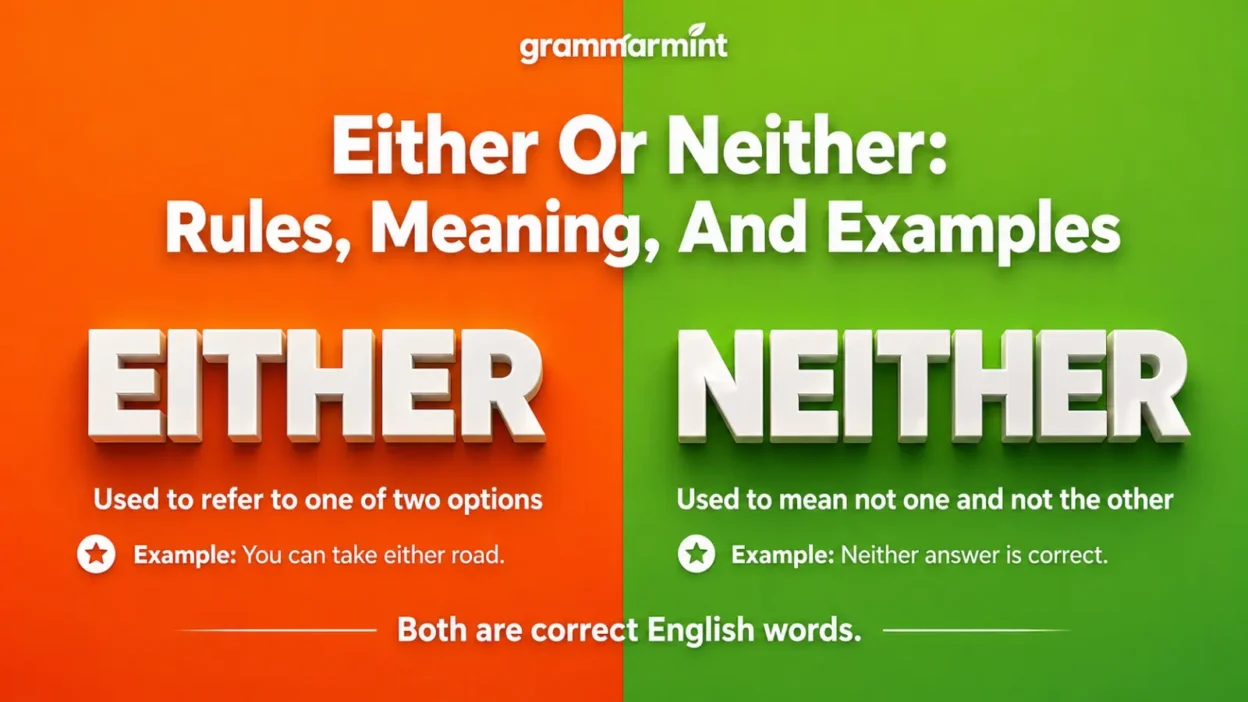
Either or neither depends on whether your sentence is positive or negative. Use either for one of two choices, and use neither when both of two choices are not true, not wanted, or not possible. In paired forms, write either…or for alternatives and neither…nor for two negative alternatives.
TL;DR
• Either means one of two
• Neither means not one of two
• Use either…or for choices
• Use neither…nor for negatives
• Usually keep verbs singular
• Match forms on both sides
Either Vs. Neither
The shortest difference is this: either opens a choice, but neither closes both choices. So, one is positive, and the other is negative. That basic contrast is consistent across major grammar references.
• Meaning changes the whole sentence
• Either leaves one option open
• Neither rejects both options
• Either sounds positive or neutral
• Neither makes the idea negative
• Both words usually involve two things
• Either can suggest flexibility
• Neither can show total refusal
• Either often pairs with or
• Neither often pairs with nor
• Either can stand alone
• Neither can stand alone
What Either Means
Use either when one of two people, things, or choices works. It can act as a determiner, pronoun, or part of a correlative pair. In all of those roles, it still points to one option out of two.
• One of two is the core idea
• Either answer is acceptable
• Either route gets us there
• Either of us can drive
• You can choose either seat
• Either side looks fine
• Either plan could succeed
• Either key opens the door
• Either child may read first
• Either option fits the budget
• I can meet on either day
• Either seems reasonable here
What Neither Means
Use neither when both of two options are ruled out. As a negative word, it means “not either.” It also appears as a determiner or pronoun and often joins nor in paired structures.
• Not one of two is key
• Neither answer is correct
• Neither road feels safe
• Neither of us was ready
• Neither candidate impressed voters
• Neither shoe fits properly
• Neither movie sounds interesting
• Neither child wanted juice
• Neither plan solved the problem
• Neither side backed down
• Neither message reached me
• Neither reason feels convincing
Either…Or And Neither…Nor
These pairs are called correlative conjunctions because they work together. Either…or presents alternatives, while neither…nor links two negative alternatives. Major grammar guides also stress that both sides should match in structure.
• Correlative conjunctions work in pairs
• Alternatives should stay balanced
• Pairing matters for clarity
• Either tea or coffee is fine
• Either call me or text me
• Either today or tomorrow works
• Neither rain nor wind stopped us
• Neither Amy nor Jake agreed
• Neither slow nor steady describes him
• Either laughing or crying followed
• Neither singing nor dancing helped
• Either to leave or stay
Either Of And Neither Of
This pattern often confuses writers because the noun after of looks plural. Still, grammar references generally treat either and neither as singular in these structures, especially in careful writing.
• Of-phrase often hides the subject
• Use a plural noun after of
• Keep a singular verb in formal writing
• Either of the books is useful
• Neither of the chairs matches
• Either of them can help
• Neither of us knows him
• Either of those sounds better
• Neither of the teams was ready
• Either of my sisters cooks
• Neither of the phones works
• Either of these choices fits
Singular Or Plural?
This is the trickiest part for many learners. On its own, either and neither are usually singular. With either…or and neither…nor, the verb often follows the nearest subject when the two parts differ in number. University writing centers teach that pattern clearly.
• Subject-verb agreement matters here
• Watch the nearest subject carefully
• Prefer singular in formal writing
• Either choice is acceptable
• Neither option seems likely
• Either the teacher or students are coming
• Either the students or teacher is coming
• Neither the lights nor the lamp works
• Neither the lamp nor lights work
• Either of them is available
• Neither of them is missing
• Informal speech sometimes goes plural
Parallel Structure Made Simple
When you use either/or or neither/nor, both sides should match. That means noun with noun, verb with verb, phrase with phrase, or clause with clause. Matching form makes sentences smoother and easier to read.
• Parallel structure keeps parts balanced
• Use matching form on both sides
• Better clarity comes from symmetry
• Either a manager or an assistant
• Neither running nor swimming appealed
• Either in May or in June
• Neither at home nor at work
• Either she apologizes or leaves
• Neither polite nor patient described him
• Either to study or to rest
• Neither before dinner nor after
• Either by bus or by train
Sentence Examples You Can Copy
Examples make these words easier to remember. The patterns below are short, natural, and close to the uses shown in dictionaries and grammar guides.
• Sentence patterns help memory stick
• Good model sentences show placement
• Real usage feels easier then
• Either movie would make me happy
• Neither sandwich looks fresh today
• We can leave either now or later
• Neither Mark nor Elena answered
• Either of the buses is fine
• Neither of those jackets fits
• I don’t want either option
• She liked neither color choice
• Either parent can sign here
• Neither player finished strong
Neither Do I, Nor Do I, And I Don’t Either
These replies show agreement with a negative statement. In standard English, neither do I and I don’t either are common, while nor do I is more formal. Me neither is very common in speech, but me either is widely treated as nonstandard in careful writing.
• Agreement replies follow negative statements
• Informal English allows shorter responses
• Negative response patterns vary by tone
• “I’m not tired.” “Neither am I.”
• “She can’t go.” “I can’t either.”
• “We didn’t win.” “Nor did they.”
• “He doesn’t smoke.” “Neither do I.”
• “I’m not hungry.” “Me neither.”
• “They weren’t late.” “We weren’t either.”
• Formal writing prefers full structures
• Casual speech drops extra words
• Avoid “me either” in formal prose
Either, Neither, And Both
Learners often confuse this trio because all three refer to two things. A simple memory trick helps: both means the two together, either means one of the two, and neither means not one of the two.
• Both includes the whole pair
• Two choices frame either clearly
• Comparison helps learners remember
• Both shirts are clean
• Either shirt is fine
• Neither shirt is dry
• Both kids can join
• Either kid can lead
• Neither kid felt ready
• Both roads are open
• Either road works tonight
• Neither road looks safe
Common Mistakes To Fix Fast
Most errors happen because writers mix positive and negative patterns or forget agreement rules. A few fast edits can fix nearly every problem.
• Common errors are easy to spot
• Avoid double negatives with neither
• Check word choice before editing
• Wrong: either…nor in one pair
• Wrong: neither…or in one pair
• Wrong: neither of them are
• Better: neither of them is
• Wrong: either of the students are
• Better: either of the students is
• Wrong: me either in essays
• Better: I don’t either
• Better: neither do I
Commas And Punctuation
In most sentences, do not place a comma between the paired words and the items they connect. Grammar guides note that these pairs should stay intact unless another rule creates a comma for a separate reason, such as an interrupting clause.
• Comma rules stay simple here
• Keep punctuation light and clean
• Protect the paired words together
• No comma in simple pairings
• Write: either red or blue
• Write: neither soup nor salad
• Don’t split the pair needlessly
• Commas follow normal clause rules
• Interruptions may require commas separately
• Lists need fresh sentence planning
• Read aloud to test flow
• Cleaner punctuation improves readability
More Than Two Items
Traditionally, either and neither are strongest with two options. Still, some modern usage sources note that they also appear with longer series. In careful writing, many editors still prefer any or none when more than two items are involved, especially if clarity matters most.
• Three or more needs extra care
• Choose the formal preference when unsure
• A long series can sound crowded
• Traditional grammar favors two options
• Modern usage sometimes expands beyond two
• None works well for many negatives
• Any works well for many choices
• Repeat nor in longer negative series
• Revise awkward chains for clarity
• Formal edits often simplify choices
• Shorter sentences usually sound better
• Clarity matters more than tradition alone
Practice Patterns
Quick practice helps these forms stick. Try finishing each pattern aloud, then check whether your sentence stays positive or negative and whether both sides match. That simple habit catches many mistakes early.
• Practice builds faster recall
• Use mini drills every day
• A quick self-check prevents errors
• Either ___ or ___ will work
• Neither ___ nor ___ was ready
• Either of the ___ is fine
• Neither of the ___ was open
• “I don’t.” “___ do I.”
• “She can’t.” “I can’t ___.”
• Both sides should match form
• Keep the main subject in mind
• Read the sentence twice
Quick Tips For Formal Writing
Formal writing usually prefers the clearest, most balanced version of a sentence. That means careful agreement, matched structure, and avoiding casual replies that sound fine in speech but weak on the page.
• Formal tone favors clean structure
• Watch academic writing for precision
• Keep clean grammar over trendy speech
• Prefer singular after either alone
• Prefer singular after neither alone
• Match nouns with nouns
• Match verbs with verbs
• Avoid vague half-finished pairings
• Replace awkward chains with direct wording
• Keep examples short and clear
• Choose standard replies in essays
• Proofread agreement last
Everyday English Shortcuts
Everyday speech is more flexible than formal writing. People often shorten replies, relax agreement in conversation, and choose whichever version sounds natural in the moment. Still, knowing the standard form helps you switch styles when needed.
• Spoken English bends rules sometimes
• Natural phrasing changes by context
• Everyday use can sound looser
• “Me neither” sounds very common
• “Neither do I” sounds tidier
• “I don’t either” sounds natural
• Friends often skip extra words
• Speech tolerates rougher agreement
• Writing needs stronger consistency
• Tone decides the best choice
• Simpler sentences reduce hesitation
• Practice makes both forms easier
FAQs
What is the difference between either and neither?
Either means one of two choices, while neither means not one and not the other. So, if one option stays open, use either; if both are rejected, use neither.
Is it “either is” or “either are”?
In standard grammar, either is usually singular, so either is is the safer choice. In speech, plural agreement sometimes appears, but careful writing usually keeps it singular unless a mixed either/or subject makes the verb follow the nearer noun.
Is it “neither is” or “neither are”?
Standard usage usually prefers neither is because neither is singular. However, real usage sometimes shifts to plural in speech, especially in phrases like neither of them are, even though many formal guides still favor the singular.
Can you use neither with more than two things?
You may see neither used with longer series, and some modern sources accept that. Even so, many editors still prefer none for more than two items because it sounds clearer and less awkward in formal writing.
How do you use either…or and neither…nor correctly?
Use either…or to present two alternatives and neither…nor to connect two negative alternatives. Keep the grammar balanced on both sides, and when the two subjects differ in number, let the verb agree with the nearer subject.
Is “me either” correct?
In careful standard English, me either is generally treated as nonstandard after a negative statement. Safer choices are me neither in casual speech, neither do I in standard style, or I don’t either in everyday conversation.
Conclusion
Once you know the core contrast, either or neither becomes much easier to use. Think “one of two” for either and “not one of two” for neither, then check your pairing and verb agreement before you finish the sentence.