If you’ve ever paused over discrete or discreet, you’re not alone. These two words sound the same, look almost the same, and mean very different things. In simple terms, discrete refers to things that are separate or distinct, while discreet describes someone or something careful, private, or unobtrusive. This guide breaks down the meanings, common sentence patterns, memory tricks, related forms, and easy examples so you can choose the right spelling with confidence.
Quick Answer
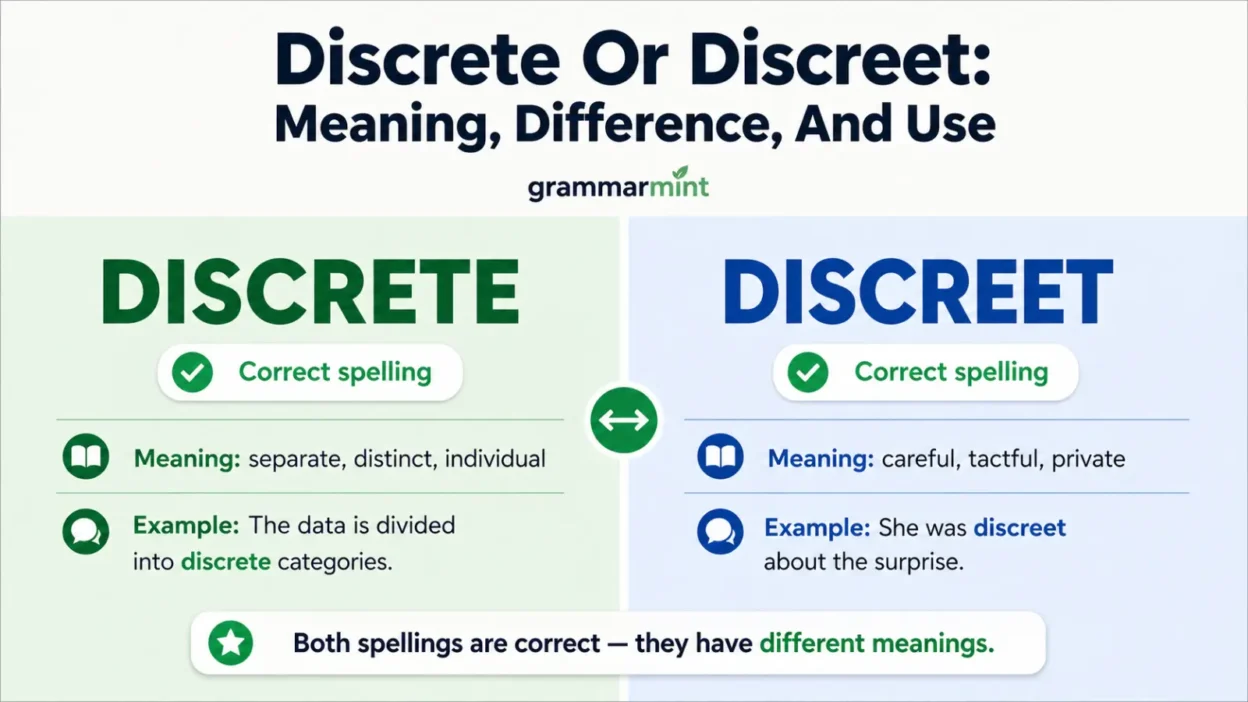
Discrete or discreet depends on your meaning. Use discrete when something is separate, distinct, or made of individual parts. Use discreet when someone acts carefully, tactfully, or privately.
TL;DR
• Discrete means separate or distinct
• Discreet means careful or private
• They sound the same in speech
• Discrete often appears in math
• Discreet often describes behavior
• Test the meaning, not the sound
Discrete Vs Discreet At A Glance
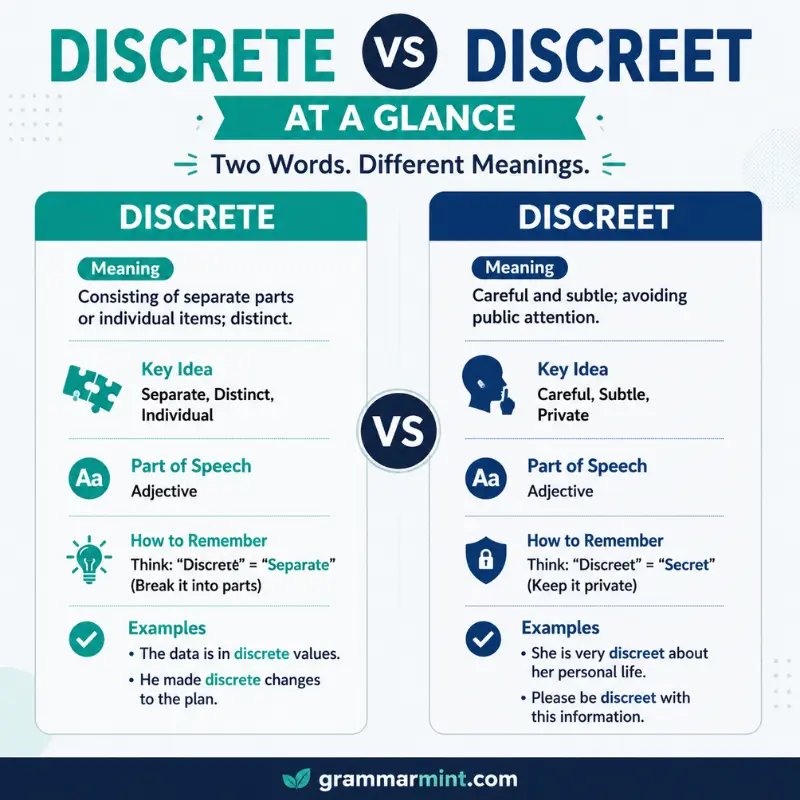
These words are easy to mix up because they’re pronounced alike. Still, their meanings move in two different directions.
Use this quick comparison when you need a fast answer.
• Discrete means separate from other parts
• Discreet means careful with private matters
• Both words are homophones in English
• One is about parts, one about behavior
• Discrete fits data, steps, stages, categories
• Discreet fits people, actions, conversations, design
• Discrete often appears in formal writing
• Discreet often appears in social situations
• Discrete can contrast with continuous
• Discreet can suggest tact and restraint
• The spelling difference changes the meaning
• You can’t swap them freely
What Discrete Means
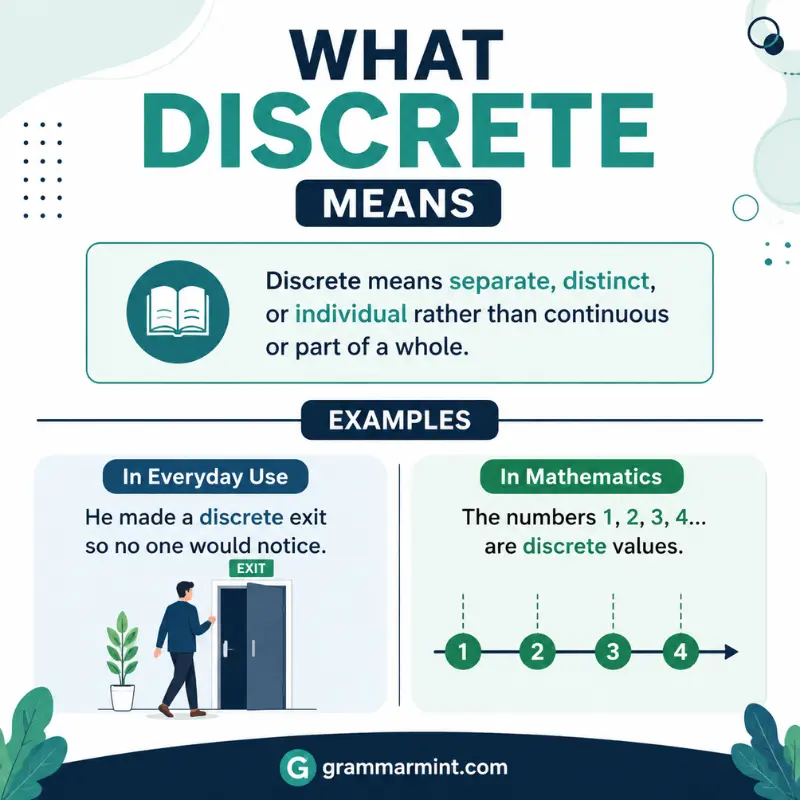
The word discrete points to separation. It usually describes things that are individually distinct or not blended together.
Because of that, it often appears in academic, technical, and structured writing.
• Distinct parts that stay clearly separate
• Independent units within a larger system
• Separate categories in a list
• Individual stages in a process
• Unconnected events over time
• Countable values in math
• Noncontinuous patterns in data
• Divided sections in a document
• Standalone items in a collection
• Different elements with clear boundaries
• Formal or specialist usage is common
• Often replaced by “separate” in plain speech
What Discreet Means
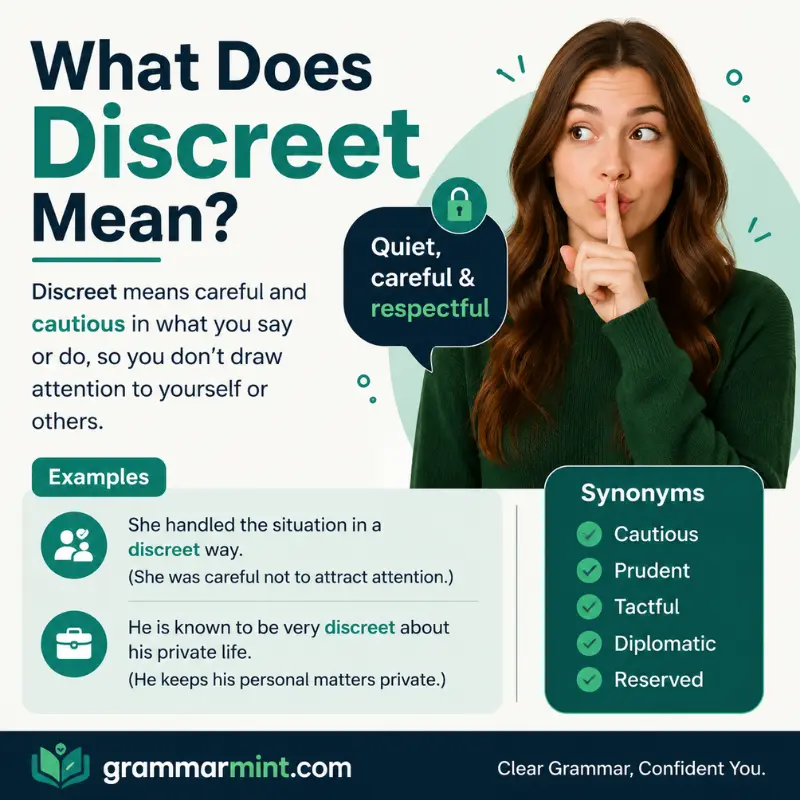
The word discreet is about judgment and restraint. It describes behavior that avoids attention, embarrassment, or unnecessary disclosure.
So, it often appears when privacy, tact, or subtle handling matters.
• Private handling of sensitive information
• Tactful behavior in awkward situations
• Quiet actions that avoid notice
• Careful speech around personal topics
• Subtle design that doesn’t stand out
• Restrained comments in public settings
• Respectful silence when needed
• Thoughtful handling of confidential details
• Polite behavior that avoids embarrassment
• Unobtrusive style or appearance
• Cautious judgment before speaking
• Professional discretion in delicate matters
Pronunciation And Why These Words Get Mixed Up
In speech, these two words sound the same. That’s one big reason writers confuse them.
Because sound won’t help you, spelling and meaning have to do the work.
• They share the same pronunciation
• They are classic homophones
• Hearing them won’t reveal the spelling
• Context decides which word fits
• Similar letter order adds confusion
• Both end with the same sound
• Writers often rely on memory instead
• Spellcheck may miss a wrong choice
• Meaning is your best guide
• Sentence role stays adjective in both
• Fast typing causes many mix-ups
• Proofreading helps catch context errors
The Fastest Memory Tricks
A good memory trick can save time, especially when both spellings feel possible. The best one connects spelling to meaning.
That way, you remember the word by visual pattern, not by guesswork.
• In discre t e, the e’s are separated
• So discrete matches separate things
• In discreet, the e’s stay together
• So discreet fits kept-together secrets
• Think “private and neat” for discreet
• Think “separate pieces” for discrete
• Test with the word “distinct”
• Test with the word “careful”
• If “private” fits, choose discreet
• If “individual parts” fits, choose discrete
• Sound won’t help, meaning will
• Use the letter pattern as a clue
When To Use Discrete In Real Writing
Use discrete when you’re talking about things that are separate, countable, or clearly divided from one another.
This meaning is common in structured explanations, reports, science, and math.
• For stages in a long process
• For categories in survey results
• For units in a technical system
• For sections in a complex plan
• For events treated one by one
• For items counted individually
• For values in statistics
• For parts with firm boundaries
• For steps handled separately
• For data that isn’t continuous
• For grouped but distinct components
• For formal writing about structure
When To Use Discreet In Real Writing
Use discreet when you mean careful, tactful, or intentionally unobtrusive. It often applies to people, choices, and behavior.
It also works for things like design, service, or gestures that stay low-key.
• For good judgment in sensitive moments
• For confidential handling of private news
• For subtle customer service
• For quiet questions about a problem
• For polite handling of embarrassment
• For restrained comments at work
• For modest design choices
• For private conversations in public
• For careful public behavior
• For low-profile personal decisions
• For tact around family matters
• For respectful silence when needed
Discrete In Everyday Sentences
Examples make this difference easier to hold onto. Here, discrete shows separation, not privacy.
Read each bullet as a natural sentence pattern you can reuse.
• The report breaks into discrete sections
• We tracked three discrete stages
• The plan has discrete goals
• Each file stayed in a discrete folder
• The course covers discrete topics weekly
• Their roles remained discrete throughout
• The chart shows discrete values
• The museum has discrete exhibit rooms
• The project moved through discrete phases
• The recipe has discrete steps
• Those events felt discrete, not connected
• The toolkit includes discrete components
Discreet In Everyday Sentences
Now compare that with discreet. These examples involve privacy, tact, restraint, or subtle action.
Notice how the word often describes a person, gesture, service, or response.
• She made a discreet phone call
• He asked a discreet question
• They kept a discreet distance
• Her necklace was small and discreet
• The staff stayed discreet all evening
• We need a discreet way forward
• He gave a discreet nod
• She handled the issue discreetly
• The hotel offers discreet service
• They made discreet inquiries first
• His answer was calm and discreet
• Please be discreet about the surprise
Why Discrete Appears In Math And Data
Many learners first meet discrete in school. That makes sense, because the word is widely used for countable values and separate units.
In those settings, it often contrasts with continuous.
• A discrete variable has countable values
• Data points can be listed separately
• Finite values fit discrete models
• Whole numbers often count as discrete
• Survey choices can be discrete
• Steps in an algorithm may be discrete
• Discrete math studies separate structures
• Categories differ from flowing measurements
• Counts differ from continuous ranges
• Binary choices are often discrete
• Separate outcomes suit probability models
• Tables often present discrete results
Discreetly Vs Discretely
These adverbs cause another layer of confusion. They sound alike, but they follow the same meaning split as the adjectives.
So the safest move is to match each adverb to its base word first.
• Discreetly means privately or tactfully
• Discretely means separately or distinctly
• She spoke discreetly near the door
• The parts were arranged discretely
• Use discreetly for secretive action
• Use discretely for separated treatment
• Both are real English words
• Both are easy to mistype
• Spellcheck may not flag either
• Meaning should guide your choice
• Link discreetly to discreet
• Link discretely to discrete
Synonyms And Nearby Words
Synonyms can help, but only if you choose them by meaning. Some words overlap, while others only partly match.
That’s why a quick substitute test is useful before you decide.
• Discrete can mean separate
• Discrete can mean distinct
• Discrete can mean individual
• Discrete can mean detached
• Discreet can mean prudent
• Discreet can mean tactful
• Discreet can mean subtle
• Discreet can mean cautious
• “Distinct” often helps test discrete
• “Private” often helps test discreet
• “Independent” can fit discrete
• “Judicious” can fit discreet
Opposites And Easy Contrasts
Sometimes the easiest way to learn a word is through its opposite. That contrast sharpens the meaning fast.
Here, the two words part ways clearly.
• Discrete often contrasts with continuous
• Discrete can oppose connected
• Discrete can oppose merged
• Discrete can oppose blended
• Discreet often contrasts with indiscreet
• Discreet can oppose careless speech
• Discreet can oppose attention-seeking behavior
• Continuous data isn’t discrete
• Loud behavior isn’t discreet
• Oversharing isn’t discreet either
• Boundless flow isn’t discrete
• Public exposure defeats discreet intent
Word Family You Should Know
Related words help the meanings stick. Once you know the word family, it becomes easier to choose the right form.
That’s especially helpful when you meet nouns and adverbs in reading.
• Discretion relates to careful judgment
• Discreet leads to discreetly
• Discreet leads to discreetness
• Indiscreet is the common opposite
• Discrete leads to discretely
• Discrete leads to discreteness
• Discrete links to discrete mathematics
• Discretion often implies secrecy
• Discreteness implies separateness
• Discreetness is about restraint
• Word families keep meanings aligned
• Shared roots don’t mean same meaning
Common Mistakes And Quick Fixes
Most mistakes happen because the writer hears the word, guesses the spelling, and moves on. Since both spellings are valid, that error can slip through.
A simple check can fix it quickly before you publish or send.
• Don’t choose by sound alone
• Don’t assume spellcheck caught it
• Replace with “separate” first
• Replace with “careful” next
• If “separate” fits, use discrete
• If “careful” fits, use discreet
• Watch the adverbs closely
• Review technical writing for discrete
• Review personal topics for discreet
• Look for privacy clues nearby
• Look for countable parts nearby
• Proofread slowly before finalizing
A Simple Choice Checklist
When you’re stuck, use a short checklist. You don’t need to memorize every rule if you can test the meaning fast.
This method works well for school, work, and everyday writing.
• Am I describing separate parts?
• If yes, choose discrete
• Am I describing careful behavior?
• If yes, choose discreet
• Is the context technical or structured?
• That often points to discrete
• Is privacy part of the meaning?
• That usually points to discreet
• Would “distinct” fit here?
• Then discrete probably works
• Would “tactful” fit here?
• Then discreet probably works
FAQs
What is the difference between discrete and discreet?
Discrete means separate, distinct, or made of individual parts. Discreet means careful, tactful, private, or unobtrusive.
What does discreet mean?
Discreet describes someone or something that avoids embarrassment or unwanted attention, often by being careful or private. It can also mean unobtrusive in style or action.
What does discrete mean?
Discrete means individually distinct, separate, or not continuous. It often appears in technical or academic contexts, including math, statistics, and structured analysis.
Are discrete and discreet interchangeable?
No. Even though they sound the same, they are not interchangeable because they express different meanings. One refers to separation, and the other refers to careful behavior or privacy.
Is discrete used in math or technical writing?
Yes. Discrete is commonly used for things like discrete variables, discrete probability, and other countable or separate elements. That technical use is one of the clearest signals that discrete is the correct spelling.
How do you remember discrete vs discreet?
A popular trick is to notice that the two e’s in discrete are separated by the t, just like separate parts. In discreet, the e’s stay together, which can remind you of keeping things quiet or close.
Conclusion
If you remember just one thing about discrete or discreet, remember the meaning split. Use discrete for separate parts, and use discreet for careful, private, or tactful behavior. With the quick tests above, the right choice gets much easier.