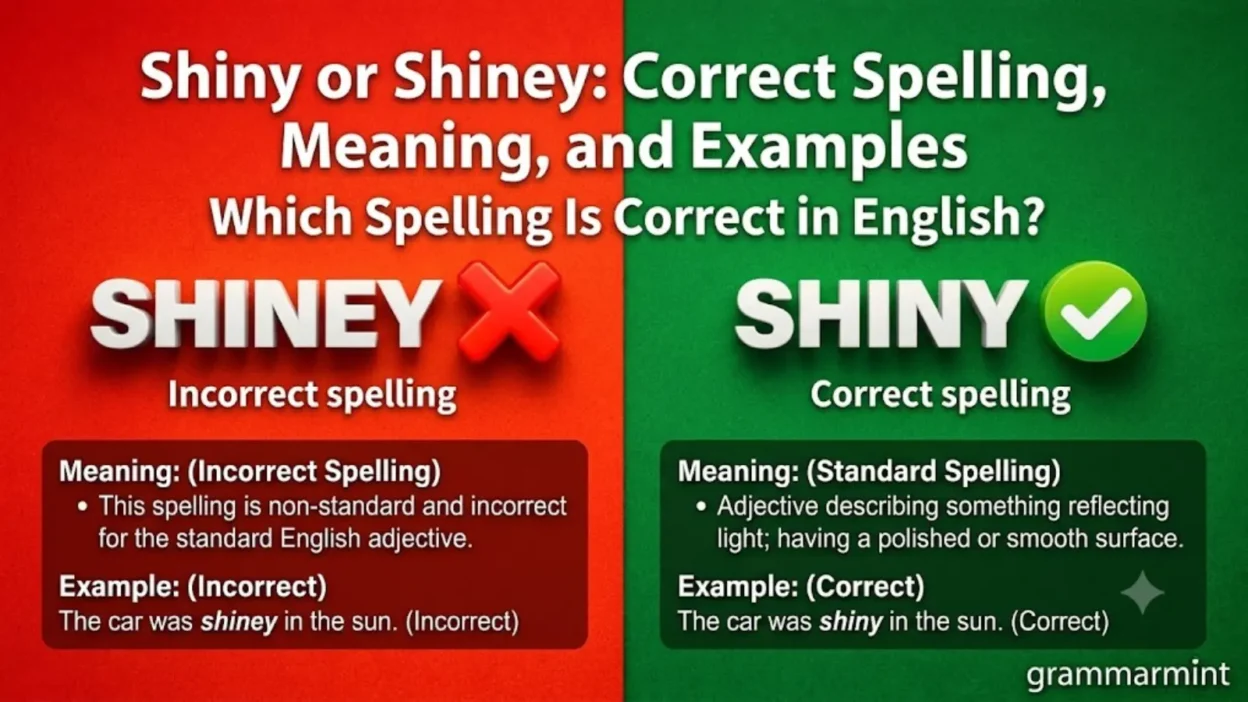
Anyone checking shiney or shiny wants a fast, clear answer they can trust. The correct word is “shiny,” an adjective used for something bright, glossy, polished, smooth, or reflective. You’ll see it in dictionaries like Merriam-Webster, Cambridge, Collins, and Dictionary.com. However, “shiney” still appears because the base word “shine” makes the extra “e” feel tempting. This guide explains the spelling, meaning, pronunciation, examples, synonyms, and common mistakes in simple American English. By the end, you’ll know exactly when to use “shiny” and why “shiney” usually needs fixing.
Quick Answer
Shiney or shiny? The correct spelling is “shiny.” “Shiney” is a common misspelling, except when used as a proper name.
TL;DR
• “Shiny” is the correct spelling.
• “Shiney” is usually incorrect.
• “Shiny” means bright or glossy.
• Drop the “e” in shine.
• Use “shiny” in formal writing.
• Remember: shine plus y becomes shiny.
Shiney Or Shiny
The correct spelling is “shiny,” not “shiney.” However, the mistake is easy to understand because “shine” ends with “e.” In standard English, “shiney” is a common misspelling.
• Use shiny for polished shoes.
• Use shiny for bright jewelry.
• Use shiny for glossy hair.
• Use shiny for reflective cars.
• Use shiny for clean floors.
• Use shiny for smooth metal.
• Use shiny for bright coins.
• Use shiny for glowing surfaces.
• Avoid shiney in school papers.
• Avoid shiney in business emails.
• Fix shiney during proofreading.
• Choose shiny every time.
Shiny Meaning
“Shiny” means bright, smooth, or glossy. It often describes something that reflects light. Also, it can describe something that feels new, attractive, or exciting.
• A shiny coin catches light.
• A shiny mirror looks clean.
• A shiny car feels polished.
• A shiny floor reflects shoes.
• A shiny necklace sparkles softly.
• A shiny screen can glare.
• A shiny idea feels exciting.
• A shiny future sounds hopeful.
• A shiny trophy looks impressive.
• A shiny button stands out.
• A shiny wrapper attracts attention.
• A shiny finish looks fresh.
Shiny Definition
A simple definition of “shiny” is having a smooth surface that looks polished. It can also mean bright, clear, or lustrous. Therefore, it works best when light or smoothness matters.
• Shiny describes visible brightness.
• Shiny often suggests cleanliness.
• Shiny can show polish.
• Shiny can describe fabric.
• Shiny can describe skin.
• Shiny can describe paint.
• Shiny can describe glass.
• Shiny can describe plastic.
• Shiny can describe metal.
• Shiny can feel positive.
• Shiny can sound playful.
• Shiny stays easy to understand.
Is Shiney A Word?
In regular writing, “shiney” is nonstandard. Still, it can appear as a proper name, brand name, username, or personal spelling. Otherwise, treat it as a typo.
• Shiney is not standard.
• Shiney may be someone’s name.
• Shiney can appear in usernames.
• Shiney may appear in brands.
• Shiney is wrong for surfaces.
• Shiney is wrong for shoes.
• Shiney is wrong for jewelry.
• Shiney is wrong for coins.
• Shiney is wrong for hair.
• Shiney looks informal and careless.
• Shiney should usually be corrected.
• Shiney differs from proper nouns.
Why Shiny Drops The E
The word “shine” ends with a silent e. When adding suffix y, English often tells you to drop the e. So, shine becomes shiny.
• Shine plus y becomes shiny.
• Do not keep the e.
• The same rule helps elsewhere.
• Ice becomes icy.
• Grease becomes greasy.
• Smoke becomes smoky.
• Scare becomes scary.
• Shade becomes shady.
• Noise becomes noisy.
• The pattern feels familiar.
• The final word stays shorter.
• The spelling looks cleaner.
How To Spell Shiny
“Shiny” has five letters: s-h-i-n-y. A quick memory trick is “shine loses e before y.” This spelling pattern helps you fix the word fast.
• Start with shine.
• Remove the final e.
• Add the letter y.
• Check for one n.
• Keep the i after h.
• End with y only.
• Never write shiney.
• Never write shinny here.
• Never write shinie.
• Say it slowly once.
• Picture a shiny coin.
• Proofread the final letter.
Shiny Pronunciation
“Shiny” sounds like SHY-nee. It has two syllables, and the stress falls on the first syllable. Therefore, it sounds simple even when spelling feels tricky.
• Say shy first.
• Add nee softly.
• Stress the first part.
• Keep the ending light.
• Avoid saying shin-ee.
• Avoid stretching the y.
• It rhymes with tiny.
• It also rhymes with whiny.
• The sound matches shiny.
• The sound can mislead spelling.
• Speech hides the missing e.
• Writing shows the rule.
Shiny Examples
Good example sentences make the word easier. They show clear context and natural wording. Also, examples help you avoid repeating the same phrase.
• Her shiny shoes looked new.
• The shiny car reflected clouds.
• He found a shiny penny.
• The shiny floor felt slippery.
• I bought shiny wrapping paper.
• The dog had shiny fur.
• Her shiny hair framed her face.
• A shiny ring caught sunlight.
• The lake looked shiny today.
• His shiny helmet stood out.
• The kitchen had shiny tiles.
• Their shiny badges looked official.
Shiny In A Sentence
“Shiny” usually appears before a noun. That sentence placement makes it a descriptive adjective. However, a strong noun pairing matters more than fancy wording.
• Place shiny before objects.
• Pair shiny with concrete nouns.
• Keep the sentence direct.
• Use shiny for visible detail.
• Avoid overloading one sentence.
• Choose nouns readers picture.
• Try shiny black shoes.
• Try shiny silver coins.
• Try shiny clean windows.
• Try shiny green leaves.
• Try shiny metal buttons.
• Let the noun carry meaning.
Shiny Synonyms
Useful synonyms include glossy, gleaming, and polished. However, each word has a slightly different feel. So, choose the word that matches the image.
• Glossy suggests a smooth finish.
• Gleaming suggests bright light.
• Polished suggests careful cleaning.
• Sparkling suggests tiny flashes.
• Lustrous sounds rich and elegant.
• Radiant feels warm and glowing.
• Bright is simple and broad.
• Reflective sounds more technical.
• Sleek suggests modern style.
• Glimmering feels soft and gentle.
• Dazzling sounds very intense.
• Shimmering suggests moving light.
Shiny Vs Glossy
“Shiny” focuses on light. “Glossy” focuses on surface finish. Still, both can describe visual shine and smooth texture.
• Shiny works for many things.
• Glossy often describes coatings.
• Shiny feels more casual.
• Glossy sounds more precise.
• Shiny shoes can be glossy.
• Glossy paper feels slick.
• Shiny metal reflects strongly.
• Glossy paint has sheen.
• Shiny jewelry sparkles brightly.
• Glossy magazines look smooth.
• Shiny can be figurative.
• Glossy is usually physical.
Shiny Vs Shining
“Shiny” is an adjective. “Shining” is often a present participle showing ongoing action. So, the best choice depends on grammar.
• A shiny star describes appearance.
• A shining star suggests action.
• Shiny shoes look polished.
• Shining shoes are giving light.
• Shiny is a fixed quality.
• Shining feels more active.
• Shiny can describe surfaces.
• Shining often describes light.
• Shiny sounds everyday.
• Shining sounds more poetic.
• Use shiny before most nouns.
• Use shining for active brightness.
Shinier Or More Shiny
The usual comparative form is shinier. However, more shiny can appear when you want extra emphasis. In most clean sentences, “shinier” sounds smoother.
• This coin is shinier.
• Her shoes look shinier today.
• That polish made it shinier.
• The newer car seems shinier.
• Shinier sounds natural and short.
• More shiny sounds less smooth.
• Use more shiny for contrast.
• Avoid more shinier together.
• Never write shineyer.
• Never write shinyer either.
• Compare only similar things.
• Keep comparisons easy.
Shiniest Spelling
The superlative form is shiniest. It means the most shiny or brightest-looking. Use it for the strongest comparison among three or more things.
• This is the shiniest ring.
• She chose the shiniest ornament.
• The shiniest car drew attention.
• His trophy looked the shiniest.
• Shiniest keeps the i.
• Shiniest drops no extra e.
• Never write shineyest.
• Never write shinyest.
• Use shiniest for extremes.
• Compare a full group.
• Add the when needed.
• Keep the spelling simple.
Shiny Objects
People often use “shiny” with concrete things. Common pairs include shiny hair, shiny shoes, and shiny coins. These phrases are clear because readers can picture them quickly.
• Shiny hair can look healthy.
• Shiny shoes can look formal.
• Shiny coins can look new.
• Shiny jewelry can sparkle.
• Shiny cars can seem expensive.
• Shiny floors can look clean.
• Shiny tiles can brighten rooms.
• Shiny leaves can follow rain.
• Shiny paint can feel fresh.
• Shiny metal can reflect faces.
• Shiny buttons can catch eyes.
• Shiny packaging can attract buyers.
Common Mistakes With Shiney
The wrong spelling often appears during fast typing. Careful proofreading catches it before readers do. Also, watch nearby confusing forms like shinny, shinie, and shineing.
• Shiney should become shiny.
• Shinie should become shiny.
• Shinny means something different.
• Shineing should become shining.
• Shinyer should become shinier.
• Shineyest should become shiniest.
• Do not trust autocorrect blindly.
• Search your draft for shiney.
• Check captions before posting.
• Check product descriptions carefully.
• Check school assignments twice.
• Check professional emails before sending.
FAQs
Is It Shiney Or Shiny?
The correct spelling is “shiny.” Use it when describing something bright, smooth, glossy, or reflective.
“Shiney” is usually a misspelling. The main exception is when it appears as a name or intentional brand spelling.
What Is The Correct Spelling: Shiny Or Shiney?
“Shiny” is the standard spelling. It is the form used in dictionaries and everyday American English.
“Shiney” looks tempting because of “shine.” However, the final “e” drops before “y.”
Why Do People Confuse Shiny And Shiney?
People confuse them because “shine” already has an “e.” So, writers may assume the adjective keeps that letter.
However, English often drops a silent final “e” before adding “y.” That is why “shine” becomes “shiny.”
Is Shiney Ever Acceptable In English Writing?
In regular sentences, “shiney” is not the accepted spelling. Use “shiny” in school, business, creative, and formal writing.
Still, “Shiney” can be acceptable as a proper name. In that case, keep the person’s chosen spelling.
What Does Shiny Mean?
“Shiny” means bright, glossy, polished, or able to reflect light. It usually describes surfaces, objects, hair, shoes, jewelry, or metal.
It can also be figurative. For example, a “shiny new idea” sounds fresh and appealing.
How Can I Remember The Correct Spelling?
Remember this simple rule: shine drops the “e” before “y.” So, shine becomes shiny.
You can also compare similar words. For example, ice becomes icy, and shade becomes shady.
What Is The Pronunciation Of Shiny?
“Shiny” is pronounced SHY-nee. It has two syllables, with stress on the first syllable.
The sound does not show the missing “e.” That is why the spelling rule matters.
Conclusion
Now the choice is simple: shiney or shiny should almost always be written as “shiny.” Use it for bright, glossy, polished, or reflective things. Next time you see “shiney,” fix it and let your writing look clean.