If you’ve ever paused while writing an email, guide, message, or school paper, Setup or set up can feel oddly tricky. The difference is simple, though: one form names an arrangement, configuration, verb phrase, noun, adjective, grammar rule, and writing choice; the other describes an action. This guide is for students, writers, editors, professionals, and everyday readers who want the right word fast. You’ll see clear examples for meetings, accounts, devices, instructions, offices, events, and casual messages. By the end, you’ll know which form fits without second-guessing.
Quick Answer
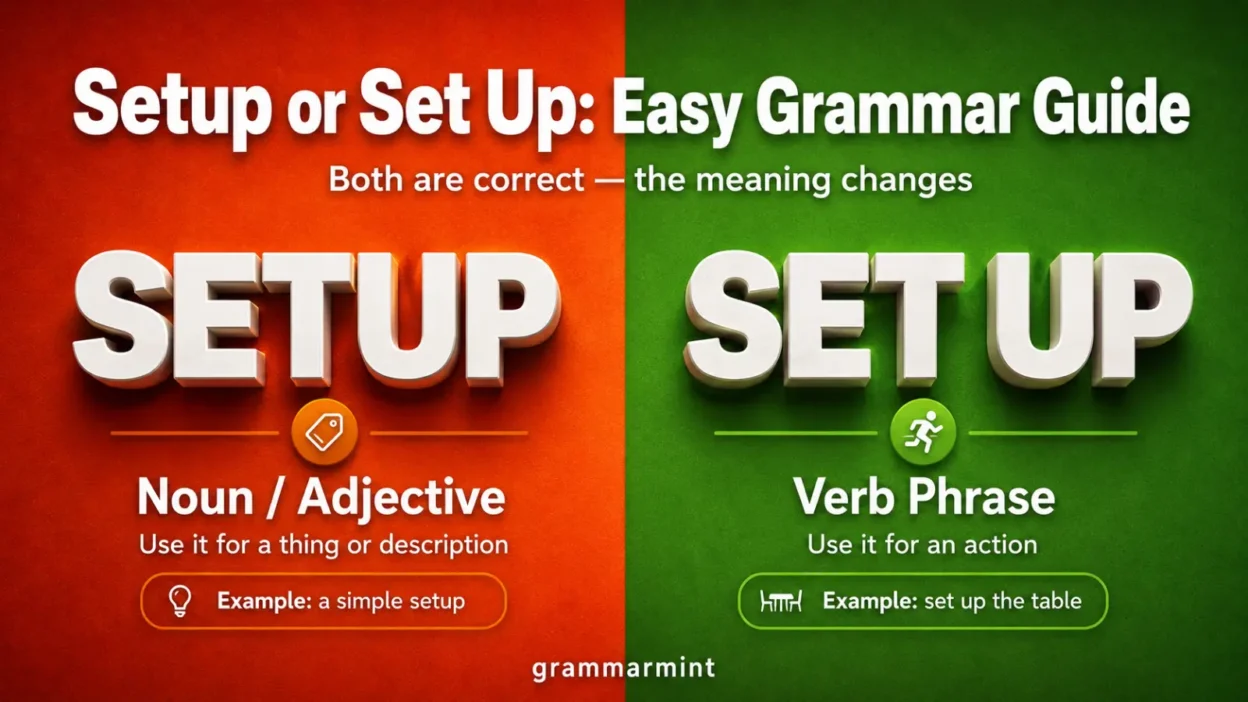
Setup or set up depends on grammar: use “setup” when you mean a thing, arrangement, or describing word; use “set up” when you mean to arrange, prepare, install, or create something.
TL;DR
• Setup names a thing or arrangement.
• Set up describes an action.
• Use setup before another noun.
• Never use setup as a verb.
• Hyphenated set-up is uncommon in U.S. writing.
• The “arrange” test usually works.
Setup or Set Up: The Simple Rule
The key is grammar, not sound. Both forms sound the same, but they do different jobs in a sentence. Use noun, verb phrase, and correct usage as your quick checkpoints.
• Use setup for a thing.
• Use set up for an action.
• Setup can describe another noun.
• Set up usually needs a doer.
• “I set up” shows action.
• “The setup” names the result.
• “Setup guide” describes a guide.
• “Set up guide” means arrange a guide.
• The space changes the job.
• Meaning depends on sentence role.
• When unsure, test with “arrange.”
• If “arrange” fits, use set up.
Setup Meaning as a Noun
“Setup” often names the finished result. It can describe how parts, people, tools, or systems are placed together. Think of arrangement, configuration, and structure as the center of this form.
• The setup looked clean and simple.
• Her desk setup saves space.
• Our camera setup needs better lighting.
• The office setup encourages teamwork.
• That gaming setup is impressive.
• His podcast setup fits small rooms.
• The kitchen setup makes cooking easier.
• Their stage setup blocked the exit.
• This payment setup feels confusing.
• The classroom setup supports group work.
• A smart setup prevents delays.
• Your current setup may need updates.
Set Up Meaning as a Verb Phrase
“Set up” shows that someone does something. It means to place, arrange, prepare, start, or make ready. So, arrange, prepare, and establish all point toward the two-word form.
• Please set up the chairs.
• We’ll set up before noon.
• She set up the projector.
• They set up a small business.
• Can you set up the printer?
• I set up my new phone.
• He set up the tent quickly.
• Let’s set up a shared folder.
• The team set up testing stations.
• Mom set up the decorations.
• Students set up their laptops.
• Volunteers set up the food table.
Setup as an Adjective
“Setup” can also describe another noun. In that role, it acts like a modifier before a thing. You’ll see it in phrases like setup instructions, setup file, and setup process.
• Read the setup guide first.
• Open the setup file carefully.
• Follow the setup steps slowly.
• The setup screen asked questions.
• A setup fee may apply.
• The setup process took minutes.
• Save your setup preferences.
• Review the setup checklist today.
• Download the setup package once.
• Check the setup menu again.
• The setup wizard seemed clear.
• Keep setup details in writing.
Set Up Examples You Can Trust
The two-word form works best when someone is doing the work. It often appears before a person, place, tool, system, or event. Watch for action, install, and organize clues.
• I’ll set up the room.
• She set up her tablet.
• We set up lunch outside.
• They set up security cameras.
• Please set up the microphone.
• Dad set up the grill.
• Teachers set up learning stations.
• He set up a savings plan.
• We set up reminders yesterday.
• She set up the display.
• Mark set up the router.
• Friends set up a surprise party.
Setup Examples in Real Sentences
The one-word form feels natural when you can point to a thing or result. It often follows words like “the,” “this,” “that,” “my,” or “your.” Use layout, system, and equipment as clues.
• The setup needs more space.
• This setup works for beginners.
• My audio setup sounds better now.
• Her bedroom setup looks cozy.
• That lighting setup feels harsh.
• Our checkout setup saves time.
• The network setup failed twice.
• Your workout setup seems practical.
• Their booth setup drew attention.
• A simple setup reduces stress.
• The whole setup felt rushed.
• His travel setup fits one bag.
Setup or Set Up in a Sentence
A sentence usually tells you which form belongs. First, find the job the phrase performs. Then check the context, sentence clue, and grammar function around it.
• “The setup is ready” names something.
• “Set up the table” gives action.
• “Setup time” describes a time block.
• “I set up time” sounds incomplete.
• “We need setup help” describes help.
• “We need to set up” shows doing.
• “Final setup” points to a result.
• “Finally set up” points to action.
• “Easy setup” describes a process.
• “Easily set up” describes doing.
• “Setup failed” names the process.
• “Set up failed” needs more context.
Set Up a Meeting or Setup a Meeting
For the action of arranging a meeting, use “set up a meeting.” “Setup meeting” can work only when “setup” describes the type of meeting. The clues are schedule, meeting room, and event prep.
• Correct: Let’s set up a meeting.
• Incorrect: Let’s setup a meeting.
• We set up interviews for Friday.
• She set up a client call.
• Please set up the conference room.
• The meeting setup took ten minutes.
• Our room setup needed extra chairs.
• Set up the slide screen early.
• They set up name tags outside.
• A poor setup delayed the meeting.
• The setup meeting covered equipment.
• Set up invites before lunch.
Set Up an Account or Setup an Account
Use “set up an account” when you create or prepare one. Use “account setup” when naming the process or describing account-related steps. Notice create account, account setup, and sign-up flow.
• Correct: Set up your account today.
• Incorrect: Setup your account today.
• Account setup takes five minutes.
• Finish the setup before logging in.
• We set up user access.
• She set up payment details.
• The setup page loaded slowly.
• Set up two-step protection.
• Their account setup felt simple.
• He set up a business profile.
• Complete setup after email confirmation.
• Set up alerts for updates.
Setup Instructions or Set Up Instructions
Use “setup instructions” when talking about the instructions themselves. Use “set up instructions” only if you mean arrange or prepare instructions. A product guide, user manual, or step-by-step page often uses “setup.”
• Read the setup instructions first.
• Setup instructions belong near the device.
• The user manual includes setup help.
• Follow each setup step carefully.
• Set up instructions for new hires.
• That means prepare the instructions.
• Setup tips should be clear.
• The product guide explains setup.
• Keep setup warnings near diagrams.
• Setup language should stay simple.
• Print setup notes for staff.
• Set up the instruction table.
Set-up With a Hyphen
“Set-up” appears in some older or non-U.S. writing. Still, American readers usually expect “setup” for the noun. Treat hyphenated form, older style, and British English as special cases.
• Use set-up only when required.
• Avoid set-up as a verb.
• “Set-up the room” is wrong.
• Some publishers still prefer set-up.
• U.S. writing favors setup.
• Older books may show set-up.
• British sources may use set-up.
• Follow your assigned style guide.
• Keep one spelling throughout.
• Don’t mix setup and set-up randomly.
• Hyphens can look dated here.
• When unsure, choose setup.
Setup vs Set-Up in American English
For a USA audience, “setup” is the safer noun and adjective. “Set-up” may still be understood, but it often feels less current. Your best signals are American English, modern spelling, and style choice.
• Write “the setup” in U.S. content.
• Write “setup guide” before nouns.
• Skip “set-up guide” unless required.
• Use “set up” for every verb.
• Modern spelling keeps setup closed.
• Business writing usually prefers setup.
• Tech writing often uses setup.
• School papers can use setup.
• Editors may remove the hyphen.
• Consistency matters more than decoration.
• The hyphen rarely adds clarity.
• U.S. readers expect the closed form.
One-Word or Two-Word Test
A quick test saves time. Replace the phrase with “arrange,” “prepare,” or “create.” If that works, choose the two-word form; otherwise, try the one-word form with a replacement test.
• “Arrange the room” becomes set up.
• “The arrange” clearly fails.
• “Prepare the device” means set up.
• “The preparation” may mean setup.
• “Create an account” means set up.
• “Account creation” may mean setup.
• “Install the printer” means set up.
• “Printer arrangement” may mean setup.
• Add “the” before setup.
• Add “to” before set up.
• “To setup” is usually wrong.
• “The set up” usually looks awkward.
Common Mistakes With Setup and Set Up
Most errors happen because both forms sound identical. However, the fix is quick once you spot the sentence job. Focus on the grammar mistake, wrong form, and quick fix.
• Wrong: I will setup chairs.
• Right: I will set up chairs.
• Wrong: The set up looks great.
• Right: The setup looks great.
• Wrong: Setup your password now.
• Right: Set up your password now.
• Wrong: Our set up process is easy.
• Right: Our setup process is easy.
• Wrong: Please set-up the tent.
• Right: Please set up the tent.
• Wrong: The event set up failed.
• Right: The event setup failed.
Setup Synonyms and Better Alternatives
Sometimes “setup” is correct but not the strongest word. Choose a clearer noun when the situation needs more detail. Useful options include arrangement, layout, and system.
• Use arrangement for planned placement.
• Use layout for physical design.
• Use system for connected parts.
• Use configuration for technical settings.
• Use structure for organized relationships.
• Use design for visual planning.
• Use plan for intended order.
• Use format for presentation style.
• Use equipment for gear only.
• Use process for repeated steps.
• Use framework for broad organization.
• Use environment for surrounding conditions.
Another common spacing question is whether to write <a href=”https://grammarmint.com/wellbeing-or-well-being/“>wellbeing or well-being</a> in American English.
Set Up Synonyms and Better Alternatives
“Set up” is clear, but another verb may fit better. Pick the word that matches the exact action. Strong choices include arrange, prepare, and organize.
• Use arrange for placement.
• Use prepare for readiness.
• Use organize for order.
• Use install for devices.
• Use create for accounts.
• Use schedule for meetings.
• Use establish for businesses.
• Use assemble for parts.
• Use build for structures.
• Use launch for new projects.
• Use start for simple beginnings.
• Use configure for settings.
A similar spacing rule appears in <a href=”https://grammarmint.com/every-day-or-everyday/“>every day or everyday</a>, where the correct form depends on its job in the sentence.
FAQs
What is the difference between setup and set up?
“Setup” is a noun or adjective. “Set up” is a verb phrase. So, use “setup” for the thing or result, and use “set up” for the action.
Is “setup” one word or two?
“Setup” is one word when it names a thing or describes another noun. “Set up” is two words when it shows an action. The space changes the grammar job.
Can I use “setup” as a verb?
No, not in standard everyday writing. Write “set up the room,” “set up the account,” or “set up the device.” “Setup the room” is the common mistake to avoid.
Can I use setup and set up interchangeably?
No, they aren’t interchangeable. They sound alike, but one names something and the other does something. The sentence decides which one is right.
When should I use the hyphenated “set-up”?
Use “set-up” only if a required style guide asks for it. For U.S. readers, “setup” is usually the better noun and adjective form. Never use “set-up” as the verb.
Why is “setup” confusing to writers?
It’s confusing because the spoken sound doesn’t change. Also, English often turns two-word actions into one-word nouns. Once you check the sentence job, the choice gets easier.
Similar spelling rules apply to location terms, such as <a href=”https://grammarmint.com/onsite-or-on-site/“>onsite or on-site</a>.
Conclusion
Setup or set up is simple once you look at the word’s job. Use “setup” for a thing or description, and use “set up” for the action. When you’re unsure, try the “arrange” test and choose the form that fits naturally.