At first glance, combatting and combating look like two equally valid spellings of the same word. In many ways, they are. Both come from the verb combat, meaning to fight against something, reduce its impact, or actively oppose it.
The confusion happens because English spelling rules are not always consistent when forming “-ing” verbs. Some verbs double the final consonant, while others do not, even when they look similar.
This is where writers pause. Should it be combatting the issue or combating the issue?
The answer is simpler than it looks, especially in modern American English writing.
Quick Answer
In standard US English, combating is the preferred and most widely accepted spelling.
Combatting is a secondary variant that exists but is rarely used in American writing today.
Both are understandable, but only one feels natural and standard in modern US usage: combating.
Why People Confuse Them

The confusion comes from a common English spelling rule: doubling the final consonant before adding “-ing.”
For example:
- run → running
- sit → sitting
- stop → stopping
Because combat ends in a consonant after a short vowel sound, many writers assume it should become combatting.
That assumption makes sense based on pattern recognition. But English does not apply this rule uniformly across all verbs.
Combat behaves differently in standard usage, which leads to the simpler form combating being preferred in American English.
Another reason for confusion is exposure. Writers often see mixed usage in older texts, international writing, or less formal content. That inconsistency makes both forms feel acceptable—even when one is clearly more standard in US writing.
Key Differences At A Glance
| Feature | Combatting | Combating |
|---|---|---|
| Spelling | Double “t” | Single “t” |
| US English Preference | Rare | Standard |
| Reading Familiarity | Lower | High |
| Writing Acceptance | Limited | Widely accepted |
| Modern Usage | Occasional | Common in all contexts |
Even though both forms exist, only one is consistently used in professional US writing.
Combating Meaning
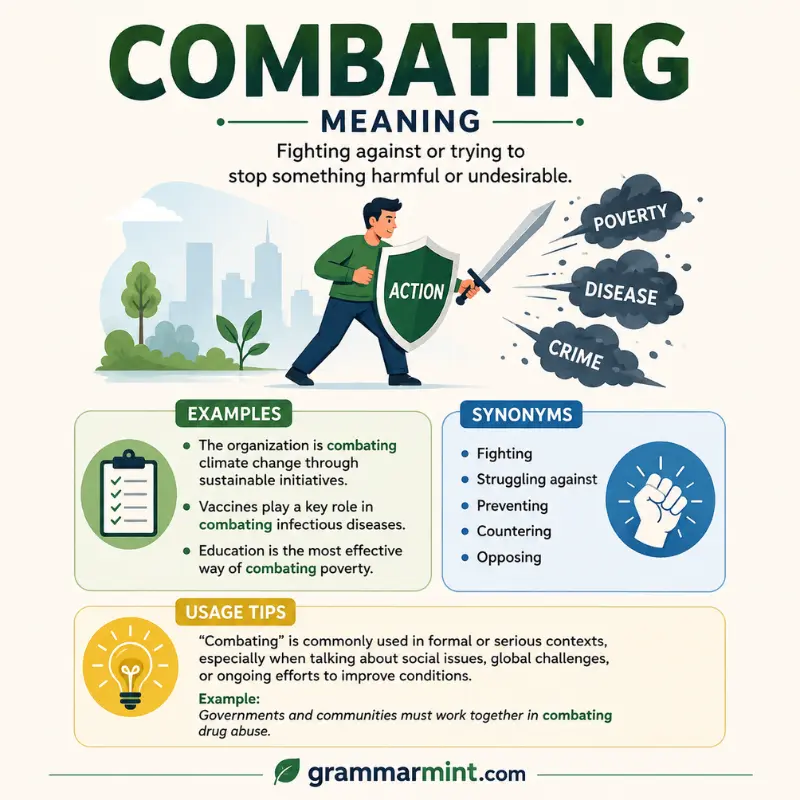
Combating means fighting against, trying to stop, or taking action to deal with a problem, danger, or harmful situation.
It is the -ing form of “combat.”
Examples:
- The government is combating climate change.
- Regular exercise can help with combating stress.
- New measures were introduced for combating crime.
- The organization is combating poverty in local communities.
Synonyms: fighting, opposing, resisting, tackling, addressing, preventing.
Combating vs. Combatting
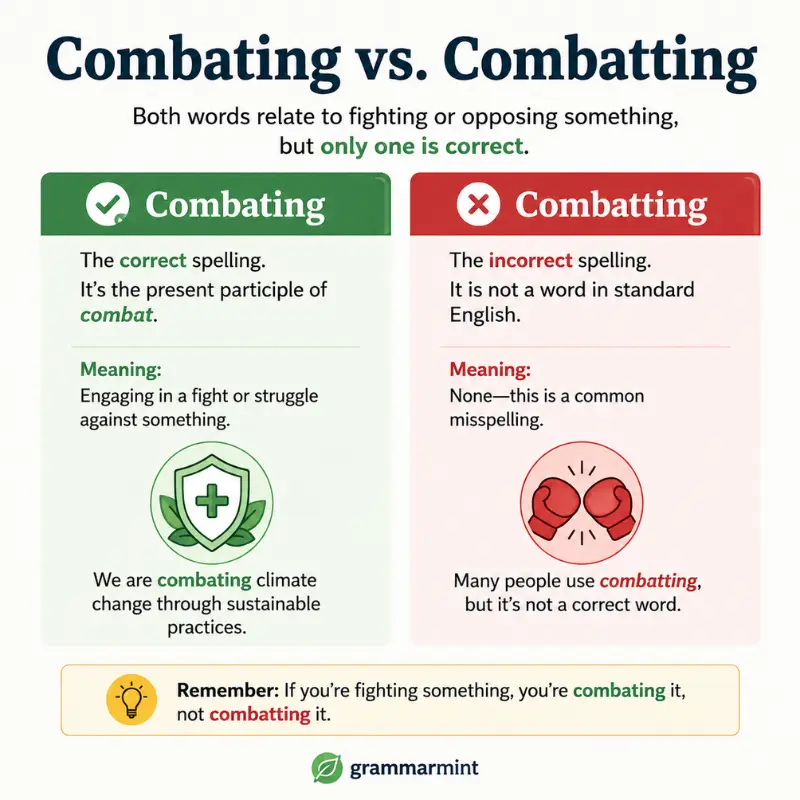
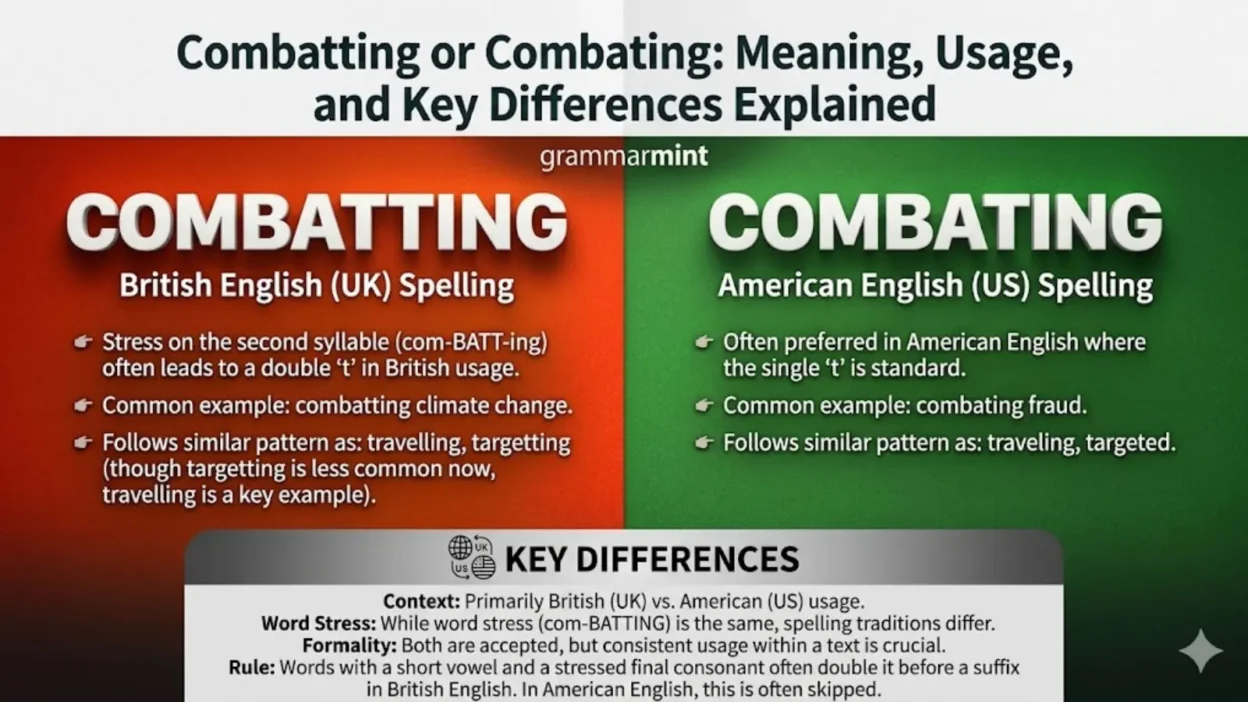
Both “combating” and “combatting” are correct spellings. The main difference is usage and regional preference.
- Combating — the more common spelling, especially in American English.
- Combatting — also correct and traditionally used more often in British English.
Examples:
- The organization is combating poverty.
- The government is combating climate change.
- New laws were introduced for combatting crime.
Best choice for American English: Combating
Simple rule: If you are writing for a U.S. audience, choose combating.
Meaning and Usage Difference
There is no difference in meaning between the two spellings.
Both combatting and combating mean:
actively working against something harmful, unwanted, or difficult
Examples include:
- combating disease
- combating crime
- combating misinformation
- combating poverty
The only real difference is spelling convention and frequency of use.
In American English:
- Combating is the default form in newspapers, academic writing, and business communication.
- Combatting is uncommon and may appear in older or non-US sources.
This means writers do not choose between two meanings—they choose between a standard form and a less common variant.
Tone, Context, and Formality
Both words carry the same tone because they are the same verb in different spellings.
However, in real-world writing, tone is influenced by familiarity.
- Combating feels natural, modern, and neutral in US English.
- Combatting can feel slightly formal in a rigid or outdated way, not because of meaning, but because of frequency.
In formal writing such as reports, articles, or academic papers in the US, combating blends in smoothly. It does not draw attention.
That is an important difference in practice: not grammar, but reader expectation.
Combating or Combatting
Both combating and combatting are correct spellings.
- Combating — more common, especially in American English.
- Combatting — also correct and used in British English.
Example:
“The organization is combating poverty.”
For a U.S.-focused article, I recommend “combating.”
Which One Should You Use?
If you are writing for American readers, the safest and clearest choice is:
👉 Use “combating.”
It works in:
- academic essays
- news writing
- professional documents
- blogs and online content
- everyday communication
Use combatting only if:
- you are following a specific editorial style that prefers it
- you are matching British or regional variation
- you are quoting a source that uses it directly
In nearly all US contexts, combating is the correct default.
When One Choice Sounds Wrong
In American English, combatting is not grammatically wrong, but it can feel out of place.
For example:
- “The team is combatting climate change.” (understandable but uncommon)
- “The team is combating climate change.” (natural US usage)
Writers often describe combatting as “heavier” or “older” in tone simply because readers are less used to seeing it.
This is not about correctness—it is about readability and expectation.
When readers see a less familiar spelling, they may pause, even if only briefly. That small pause is why most US writers avoid it.
Common Mistakes (and Quick Fixes)
Mistake 1: It’s incorrect to assume both spellings are equally standard.
Fix: In US English, the default is “combating.”
Mistake 2: Over-applying consonant doubling rules leads to errors.
Fix: Not all verbs follow the “run → running” pattern.
Mistake 3: Using both forms within the same document creates inconsistency.
Fix: Choose one form (prefer “combating”) and stay consistent throughout.
Mistake 4: A common misconception is that spelling changes the meaning.
Fix: In this case, both forms mean the same thing—only usage and regional preference differ.
- Fix: Both forms mean exactly the same thing
Everyday Examples
- The city is combating rising pollution levels.
- Scientists are combating antibiotic resistance through new research.
- Schools are combating absenteeism with new attendance programs.
- The organization is combating food insecurity in rural communities.
- Authorities are combating fraud in online transactions.
These examples reflect how the word appears in modern US writing—clear, direct, and consistent.
Dictionary-Style Word Details
Verb
- Combatting: A less common spelling variant of the verb combat in its present participle form.
- Combating: The standard present participle of combat, meaning actively opposing or fighting against something.
Both function as verbs in progressive tense constructions (e.g., “is combating”).
Noun
- Combatting: Not used as a noun in standard English.
- Combating: Not used as a noun; it only appears as a verb form.
Neither word changes category based on spelling.
Synonyms
- Combatting: closest plain alternatives — fighting, addressing, tackling, opposing
- Combating: closest plain alternatives — fighting, addressing, tackling, opposing
All synonyms apply equally because the meaning is identical.
Example Sentences
- Combatting: The agency is combatting illegal dumping in the area.
- Combating: The agency is combating illegal dumping in the area.
- Combating: The government is combating inflation with policy changes.
These show that substitution does not change meaning, only style.
Word History
Both forms come from the verb combat, meaning to fight or struggle against something.
The variation in spelling comes from English verb formation patterns, especially how “-ing” endings are applied to words ending in consonants.
Over time, usage patterns settled differently across regions, with American English favoring the simpler spelling combating.
No meaningful difference in origin or meaning exists between the two forms today.
Phrases Containing
- combating climate change
- combating corruption
- combating crime
- combating disease
- combating misinformation
- combating inequality
The same phrases can technically use combatting, but it is far less common in modern US writing.
FAQs
1. Is it “combatting” or “combating” in US English?
In American English, combating is the standard spelling. Combatting exists but is rarely used in modern US writing.
2. Do “combatting” and “combating” mean the same thing?
Yes. Both words mean actively fighting against or trying to stop something, such as a problem, disease, or issue.
3. Why does “combatting” have two T’s?
Some English verbs double the final consonant before adding “-ing” (like running or stopping). However, combat does not consistently follow that pattern in US usage, which is why combating is preferred.
4. Is “combatting” grammatically wrong?
No, it is not grammatically wrong. It is simply a less common spelling variant compared to combating, especially in American English.
5. Which spelling should I use in formal writing?
Use combating for formal writing such as essays, reports, articles, and professional documents in US English.
6. Is “combatting” British English?
It can appear in some British or international writing, but even in British English, combating is widely used and accepted.
7. Can I mix “combatting” and “combating” in the same document?
It is not recommended. Choose one spelling and stay consistent, preferably combating for US audiences.
8. Does spelling affect meaning?
No. Both words mean exactly the same thing. The difference is only in spelling preference and usage frequency.
Conclusion
The difference between combatting and combating is not about meaning or grammar. It is about usage preference.
Both are understandable, but only one is standard in American English today.
If you want your writing to feel natural, modern, and consistent for US readers, combating is the correct choice.