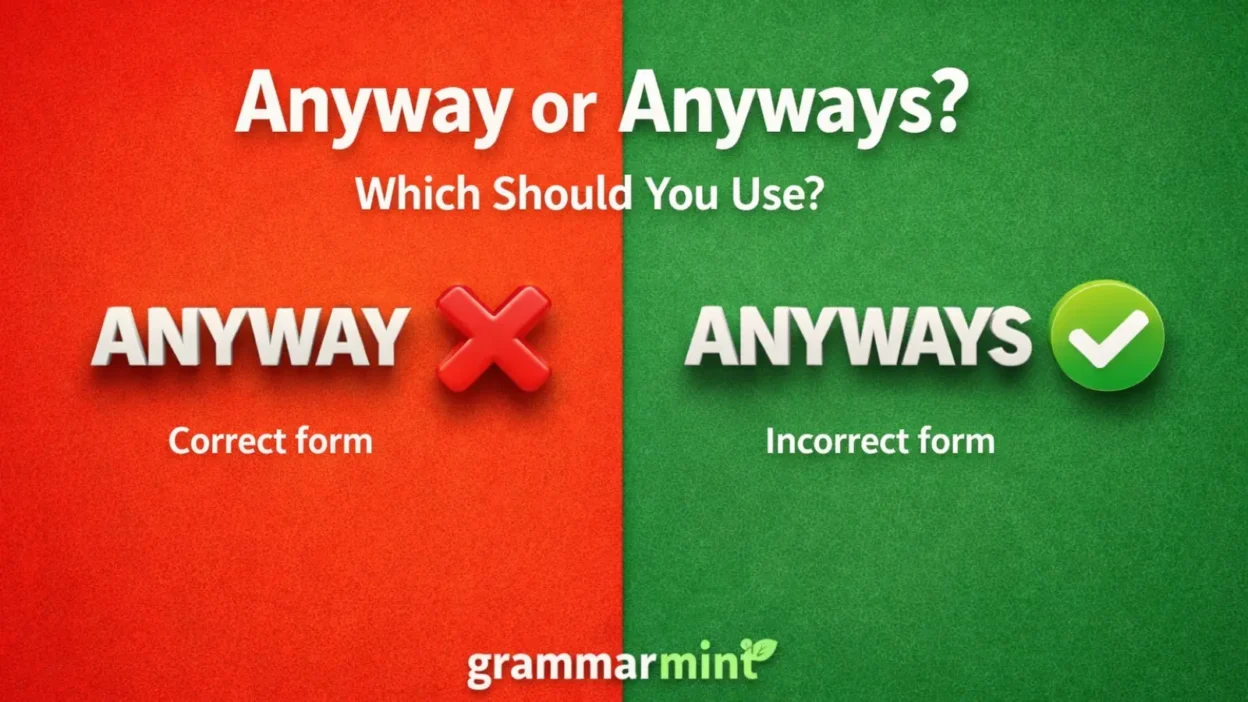
If you write emails, essays, captions, or work messages, Anyway or Anyways can feel like a tiny choice that suddenly becomes a real style problem. The confusion usually comes from how close the forms sound in speech, even though standard English, formal writing, American English, colloquial use, any way, and the discourse marker role do not all work the same way. In daily life, people hear both forms, especially in conversation and online posts. Still, readers often judge tone fast. This guide shows what each form means, where it sounds natural, and which version looks safest in school, work, and everyday writing.
Quick Answer
Anyway or anyways: use anyway in standard writing. Anyways is a casual, colloquial variant that can sound nonstandard, while any way means “in any manner” or “by any method.”
TL;DR
• Use anyway for standard writing.
• Use anyways only for casual voice.
• Use any way for method or manner.
• Starting with anyway is fine.
• Skip anyways in polished writing.
Anyway Or Anyways: The Main Difference
This is the choice most readers care about first. The meaning stays close, but the tone changes fast.
• Standard English favors anyway almost everywhere.
• Colloquial anyways sounds more relaxed and regional.
• The core tone difference matters more than meaning.
• Anyway looks cleaner in edited prose.
• Anyways feels looser in conversation.
• Both usually point toward the same idea.
• Readers expect anyway in serious writing.
• Anyways can distract careful readers.
• Anyway is the safer default choice.
• Anyways often carries a chatty flavor.
• The extra s changes style, not truth.
• When unsure, choose anyway and move on.
Is Anyways A Real Word?
A lot of people ask this because they hear it often. The short answer is yes, but that answer needs context.
• Many dictionary entries include anyways.
• It exists, but it is still nonstandard.
• Some sources tie it to dialect use.
• Being listed does not make it safest.
• Old history does not equal modern polish.
• It shows up more in speech.
• It can appear in dialogue naturally.
• It can sound casual, not careful.
• Some readers dislike it on sight.
• Others hear it as normal conversation.
• It is real, but still risky.
• Real word does not mean best choice.
Which Form Fits Formal Writing?
This is where the decision gets easy. Formal writing rewards the least distracting option.
• Use formal writing rules as your baseline.
• Choose anyway in school essays.
• Choose anyway in job applications.
• Choose anyway in reports and memos.
• Choose anyway in cover letters.
• Choose anyway in polished web copy.
• Avoid anyways in résumés.
• Avoid anyways in scholarship statements.
• Avoid anyways in legal writing.
• Avoid anyways in client documents.
• Avoid anyways in formal speeches.
• When tone matters, anyway wins fast.
Can You Start A Sentence With Anyway?
Yes, you can. In fact, that is one of its most useful jobs.
• A sentence opener with anyway is normal.
• Add a comma after anyway up front.
• It works well as a transition.
• It brings readers back on track.
• It can close a side comment.
• It can restart the main point.
• It often sounds conversational but clear.
• It works in speech and writing.
• Keep it brief at the front.
• Do not overuse it every paragraph.
• Use it when the shift feels natural.
• Opening with anyway is fully acceptable.
Anyway As A Transition Word
This use appears in everyday talk all the time. It helps conversation move without sounding stiff.
• As a discourse marker, anyway organizes thought.
• In conversation, it resets shared focus.
• A gentle topic shift often starts here.
• It can end a tangent neatly.
• It can soften a sudden pivot.
• It can return to unfinished business.
• It can signal mild impatience too.
• It can wrap up a side story.
• It often sounds warmer than “however.”
• It helps speech feel less abrupt.
• It suits casual narration well.
• It works best when the shift is real.
Anyway Meaning “Regardless”
This meaning is different from the transition use. Here, anyway means something like “despite that.”
• Use regardless as the closest quick gloss.
• It can mean in spite of that.
• It often lands in end position.
• “I was tired anyway” fits naturally.
• “We went anyway” feels direct.
• It can show stubborn follow-through.
• It can signal refusal to quit.
• It can soften disagreement a little.
• It often follows a contrast.
• It sounds common in plain speech.
• It rarely needs extra explanation.
• This use belongs to anyway, not any way.
When Anyways Sounds Natural In Casual Speech
People do say it, and many listeners barely notice. The issue is less about meaning and more about setting.
• In casual speech, anyways may sound normal.
• In text messages, many people use it.
• In dialogue, it can fit character voice.
• It can sound friendly and loose.
• It can sound regional or personal.
• It can match a playful tone.
• It can fit chats with close friends.
• It may suit relaxed storytelling.
• It may feel too casual for strangers.
• It may weaken a polished message.
• It works best when voice matters most.
• It is still not the safest default.
Anyway Vs Any Way
These forms do not do the same job. One is an adverb, while the other is a phrase.
• Any way is not the same word.
• It stays as two words for meaning.
• It often means in any manner.
• “Help any way you can” is correct.
• “Go anyway” is a different idea.
• Any way points to method.
• Anyway points to spite or transition.
• Any way can follow verbs like help.
• Anyway often follows whole clauses.
• Do not merge them by habit.
• The spacing changes the sentence logic.
• This split matters more than style.
Easy Tests To Choose The Right Form
You do not need to memorize every rule. A couple of quick checks solve most cases.
• Try a swap test with “regardless.”
• Do a quick meaning check first.
• Then read aloud for natural rhythm.
• If method is meant, use any way.
• If transition is meant, use anyway.
• If polished tone matters, avoid anyways.
• If you can say “by any method,” split it.
• If you can say “despite that,” join it.
• If it sounds chatty, check context.
• If the sentence opens a pivot, comma helps.
• If doubt remains, pick anyway.
• Simple tests beat guesswork every time.
Anyway In Emails And Work Messages
Work writing usually benefits from a calm, clean tone. Small choices can affect how polished you sound.
• In emails, anyway looks most professional.
• In the workplace, clarity beats extra personality.
• A professional tone usually avoids anyways.
• Use anyway in follow-ups.
• Use anyway in deadline notes.
• Use anyway in polite clarifications.
• Avoid anyways with new clients.
• Avoid anyways with managers.
• Avoid anyways in meeting summaries.
• Avoid anyways in formal requests.
• Anyway still sounds human and natural.
• Clean wording builds more trust fast.
Anyway In Texts, Chats, And Social Posts
Casual online writing gives you more freedom. Even then, the best choice depends on the voice you want.
• In social posts, both forms may appear.
• In group chats, anyways may feel normal.
• In DMs, tone often matters most.
• Anyway still reads cleaner online.
• Anyways can sound playful or breezy.
• Anyway can sound slightly sharper.
• Either form may pass unnoticed casually.
• Audience closeness changes what feels fine.
• Public posts invite more judgment.
• Private chats allow more looseness.
• Brand voice usually prefers anyway.
• Personal voice may tolerate anyways.
Anyway In Essays, Schoolwork, And Applications
This context calls for the safest form. Readers here expect control and consistency.
• In applications, choose the polished option.
• An academic tone does not need anyways.
• Strong polish starts with small choices.
• Use anyway only when it truly helps.
• Do not sprinkle it as filler.
• Replace weak transitions when needed.
• Keep sentence openings purposeful.
• Skip slang-like forms in essays.
• Skip anyways in thesis writing.
• Skip anyways in personal statements.
• Skip anyways in scholarship essays.
• Careful wording supports stronger credibility.
British Vs American English Check
People sometimes think this is a US-vs-UK spelling split. It is not that simple.
• American English strongly accepts anyway as standard.
• British English also uses anyway widely.
• The real usage split is formality.
• This is not like color and colour.
• Anyway works on both sides easily.
• Anyways sounds more casual than regional.
• Some American speakers say anyways often.
• That still does not make it formal.
• British readers may also understand anyways.
• Shared understanding does not equal approval.
• The safest cross-region choice is anyway.
• Treat this as register, not spelling war.
Common Mistakes With Anyway, Anyways, And Any Way
Most errors come from speed. Writers hear the sound first, then pick the wrong form.
• Common mistakes often start with fast typing.
• Watch the spelling before you send.
• Check usage against the sentence meaning.
• Wrong: “Is there anyway to leave?”
• Right: “Is there any way to leave?”
• Wrong: “Anyways, attached is my résumé.”
• Right: “Anyway, attached is my résumé.”
• Wrong: “We went any way.”
• Right: “We went anyway.”
• Wrong form often survives autocorrect habits.
• Reading once more catches many slips.
• Meaning should decide the final form.
Example Sentences For Everyday Use
Examples make the pattern stick faster. Read them out loud and the contrast becomes easier.
• Examples help the rule feel real.
• Everyday English shows the pattern best.
• Natural phrasing matters more than jargon.
• “I was busy, but I came anyway.”
• “Anyway, let’s finish this later.”
• “Can I help any way at all?”
• “She smiled anyway and walked in.”
• “Any way you choose works for me.”
• “Anyway, back to your question.”
• “We kept trying anyway.”
• “He’ll support you any way possible.”
• “Anyways, I’ll text you tonight” sounds casual.
Similar Words: Anyhow, Anyhoo, And By The Way
These words can look similar, but they do not always do the same thing. Tone and purpose still matter.
• Anyhow is a close cousin of anyway.
• Anyhoo sounds playful and extra casual.
• By the way usually introduces side information.
• Anyhow can replace anyway in many lines.
• Anyhoo rarely fits serious writing.
• By the way often adds, not returns.
• Anyway often returns to the main track.
• Anyhow may sound slightly older.
• Anyhoo sounds joking or quirky.
• By the way can feel lighter.
• These are tone choices, not strict twins.
• Pick the one matching your audience.
FAQs
Is anyways grammatically correct?
It exists, so it is not imaginary. Still, it is usually treated as casual or nonstandard in polished writing, so anyway is the safer choice.
What is the difference between anyway and any way?
Anyway is one word and usually means “regardless” or works as a transition. Any way is two words and means “in any manner” or “by any method.”
Can you use anyway at the start of a sentence?
Yes. Starting a sentence with anyway is normal, especially when you are returning to the main point. A comma after it usually makes the sentence cleaner.
Is anyway formal or informal?
Anyway works in both casual and fairly formal writing, though it still sounds conversational. It is acceptable in standard writing when it fits the sentence naturally.
Is anyways okay in text messages?
Usually, yes. In texts with friends, anyways may sound natural and relaxed, but it is still better to switch to anyway when you want a cleaner tone.
Conclusion
If you need one safe rule, choose Anyway or Anyways by context: use anyway for standard writing, save anyways for very casual voice, and use any way when you mean method or manner.