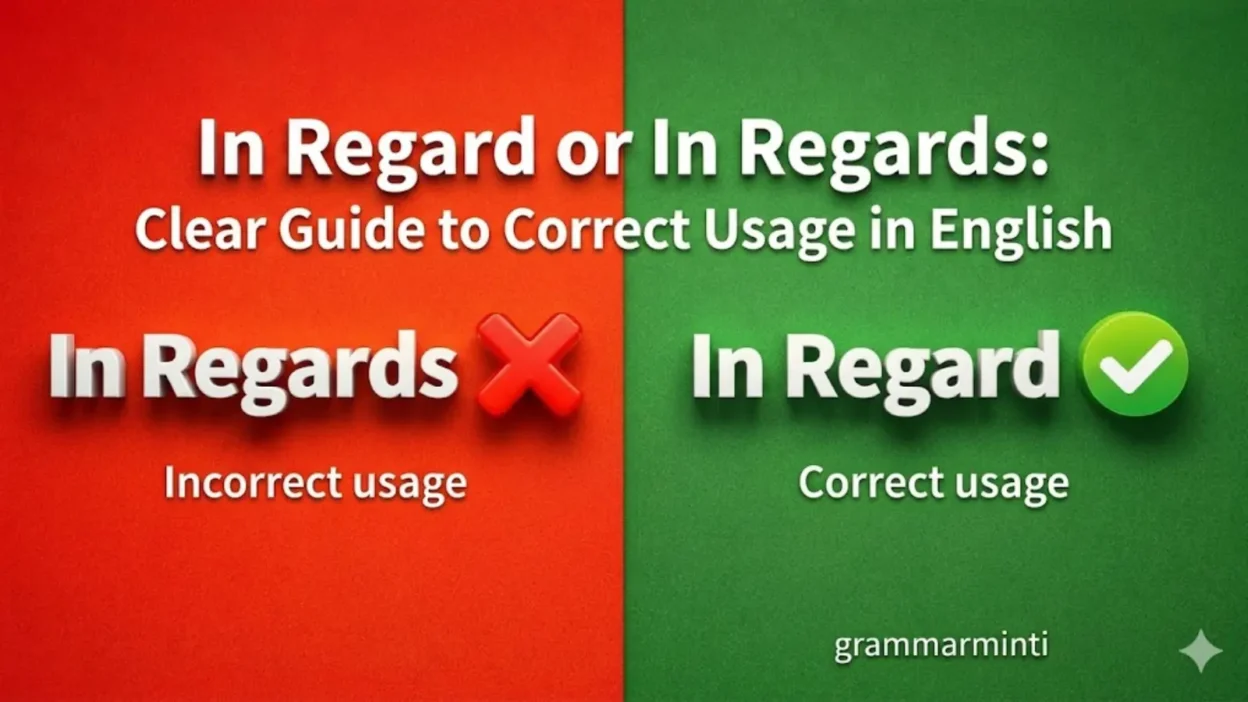
“In regard” and “in regards” look almost identical, so it’s no surprise people mix them up in everyday writing. Both appear in emails, messages, and online posts, which makes the confusion even stronger.
The real issue is that only one form fits standard English structure in formal writing. The other exists in casual usage, but it often feels less correct when strict grammar rules are applied.
Understanding the difference is not about memorizing a hard rule. It’s about seeing how the word “regard” works inside a phrase and how English treats it in formal communication.
Quick Answer
The correct standard form is “in regard to.”
“In regards” is commonly used in informal writing, but many grammar references consider it nonstandard when used in this structure.
If you want safe, clear, professional English, choose “in regard to” or the shorter “regarding.”
Why People Confuse Them
The confusion starts with everyday language habits.
Most people know the word “regards” from email sign-offs like:
- Best regards
- Kind regards
Because of that, it feels natural to say “in regards to” when talking about a topic.
But these two uses are not connected in grammar. “Regards” in email closings is a polite expression. In the phrase about a topic, “regard” works differently as a general idea of attention or reference.
Another reason for confusion is speech. In spoken English, people often say “in regards to” without thinking, and it spreads into writing.
Key Differences At A Glance
| Context | Best Choice | Why |
|---|---|---|
| Formal writing | In regard to | Standard structure |
| Business communication | In regard to | Clear and professional |
| Academic writing | In regard to | Widely accepted form |
| Casual speech | In regards to | Common but informal |
| Emails/messages | In regard to | Safer choice in writing |
Meaning and Usage Difference
“In regard to” means about, concerning, or relating to a topic.
It introduces the subject you are talking about in a structured way.
Example:
- In regard to your request, we will respond soon.
Here, “in regard to” connects the sentence to the topic “your request.”
Now compare with “in regards.” In practice, people use it the same way, but it does not follow the same standard grammatical structure in formal English.
The issue is not meaning. The issue is form.
English treats “regard” as a mass concept in this phrase, not a plural noun. That’s why “in regard to” fits better in formal grammar systems.
A simpler alternative many writers use is:
- regarding your request
- about your request
These often sound cleaner and more direct.
Tone, Context, and Formality
Tone plays a big role in choosing between these two forms.
In regard to
This sounds structured and professional. It works well in:
- Office emails
- Reports
- Academic writing
- Official statements
It gives a sense of careful wording.
In regards
This sounds more relaxed and conversational. You might see it in:
- Casual emails
- Text messages
- Informal notes
In strict writing environments, it can stand out as slightly incorrect or less polished.
The key difference is not meaning but formality level.
Which One Should You Use?
If you are unsure, always choose “in regard to.”
It is the safer option in almost every written context.
Use it when:
- Writing to a manager
- Sending a formal email
- Writing school or college work
- Preparing professional documents
Use “regarding” when you want something even simpler.
Avoid relying on “in regards to” in formal writing unless you are matching a casual tone intentionally.
When One Choice Sounds Wrong
“In regards to” can sound wrong in formal writing because it breaks expected structure.
Here’s why it feels off:
- “regard” works as a general concept
- It is not naturally plural in this phrase
- “in regard to” is the established fixed expression
So this sentence feels weak in formal English:
- ❌ We are contacting you in regards to your application.
A better version:
- ✔ We are contacting you in regard to your application.
Or even smoother:
- ✔ We are contacting you regarding your application.
In professional writing, smoother often wins.
Common Mistakes (and Quick Fixes)
Many errors come from habit rather than misunderstanding.
Mistake 1
❌ in regards to your email
✔ in regard to your email
Mistake 2
❌ we spoke in regards of the issue
✔ we spoke in regard to the issue
Mistake 3
❌ in regards with your request
✔ in regard to your request
Mistake 4
❌ using “in regards” in formal reports
✔ replace with “regarding” or “in regard to”
Quick fix rule
If you can replace the phrase with “about,” you are likely safe using “in regard to” or “regarding.”
Everyday Examples
Here’s how both forms appear in real writing:
- In regard to your order, we are processing it now.
- I have a question in regard to the schedule change.
- In regards to your message, I will reply soon.
- She called in regard to the billing issue.
- We are writing in regard to yesterday’s meeting.
- In regards to your request, updates will follow. (informal tone)
Notice how the meaning stays the same, but tone shifts depending on form.
Dictionary-Style Word Details
Verb
- In Regard: Not used as a verb in standard English
- In Regards: Not used as a verb in standard English
Both are fixed phrase structures, not action words.
Noun
- In Regard: Functions as part of the phrase “in regard to,” meaning reference or relation to a topic
- In Regards: Sometimes mistakenly treated as plural, but not standard in formal grammar use
Synonyms
- In Regard: regarding, concerning, about, with respect to, in relation to
- In Regards: same closest plain alternatives, but “regarding” is preferred in cleaner writing
Example Sentences
- In Regard: In regard to your request, we will respond today.
- In Regards: In regards to your request, we will respond today.
Both are understood, but only the first is widely accepted in formal contexts.
Word History
- In Regard: Comes from the word “regard,” meaning attention, notice, or consideration of something
- In Regards: Developed from informal spoken usage where “regards” became mistakenly extended into this phrase
Historical clarity is limited, but standard usage patterns are well established today.
Phrases Containing
- In Regard: in regard to, with regard to, in this regard
- In Regards: in regards to (informal usage), best regards (email closing, unrelated meaning)
FAQs
1. Is it correct to say “in regards to”?
“In regards to” is commonly used in informal speech and writing, but many grammar guides consider it nonstandard in formal English. “In regard to” or “regarding” is the preferred form.
2. What is the correct form: “in regard to” or “in regards to”?
The correct standard form is “in regard to.” It is widely accepted in professional, academic, and formal writing.
3. Can I use “in regards” in an email?
Yes, but it depends on tone. In casual emails, it may be fine. In professional or business emails, it is better to use “in regard to” or “regarding.”
4. Why do people say “in regards to”?
People often confuse it with email sign-offs like “best regards.” This leads to the mistaken belief that “regards” works the same way in both expressions.
5. Is “regarding” better than “in regard to”?
“Regarding” is often considered cleaner and more direct. Both are correct, but “regarding” is usually shorter and easier in modern writing.
6. What is a more formal alternative to “in regards to”?
Better formal alternatives include:
- in regard to
- regarding
- with regard to
- concerning
7. Does “in regards to” mean the same as “in regard to”?
Yes, both are understood to mean “about” or “concerning.” The difference is mainly in formality and standard usage, not meaning.
8. Which is more professional: “in regard to” or “in regards to”?
“In regard to” is more professional and widely accepted in formal writing and business communication.
Conclusion
The difference between “in regard” and “in regards” is not about meaning but about standard usage.
“In regard to” is the correct and professional form used in formal English writing. “In regards” is common in casual speech and informal messages, but it is not the preferred form in structured writing.
If you want clear, polished, and safe English, stick with “in regard to” or switch to “regarding” for even smoother communication.