
If you have ever paused while typing to wonder whether nosy or nosey is correct, you are not alone.
Both spellings appear in English, and they are pronounced the same way. That can make it difficult to know which form belongs in a text message, email, article, or formal document.
The good news is that the choice is simple for most American writers. Nosy is the standard and more common spelling in modern American English. Nosey is also recognized, but it is generally treated as a variant.
This guide explains the difference between nosy and nosey, what the word means, why two spellings exist, which one to use in American English, and how tone changes depending on context.
Quick Answer
Nosy is the preferred spelling in modern American English for someone who is excessively interested in other people’s private affairs.
Nosey is a recognized variant with the same meaning, but nosy is the safer choice for general, professional, and edited American writing.
Example:
My nosy neighbor always wants to know where everyone is going.
Nosy vs Nosey at a Glance
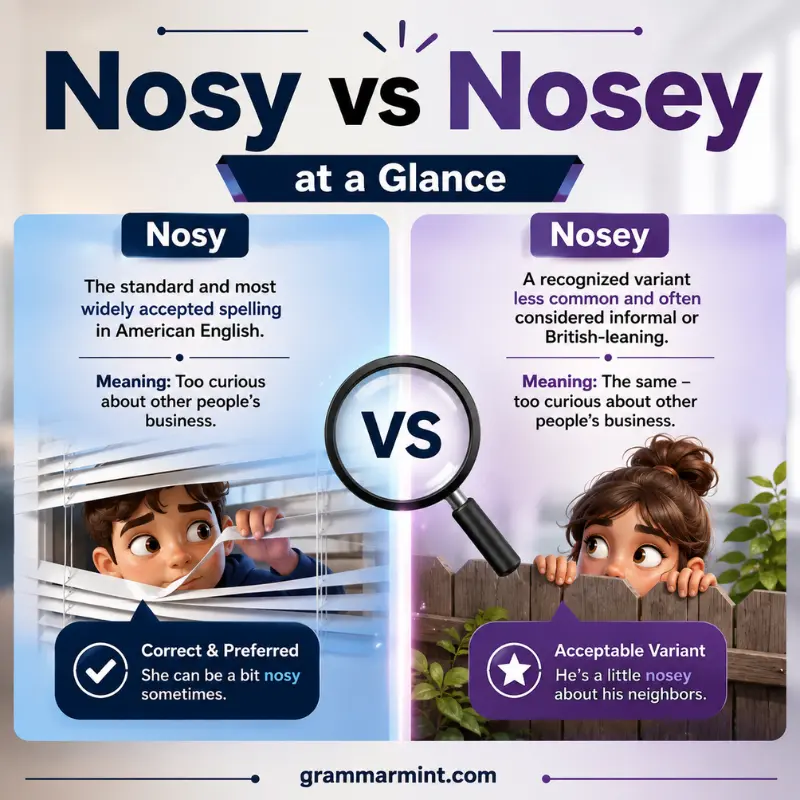
| Feature | Nosy | Nosey |
|---|---|---|
| Correct spelling? | Yes | Yes |
| Meaning | Overly curious about others’ affairs | Same |
| Preferred in US English | Yes | Less common |
| Suitable for general writing | Yes | Possible, but less standard |
| Pronunciation | Same | Same |
| Best default choice | Nosy | Variant |
The easiest rule is:
When writing for an American audience, choose nosy.
What Do Nosy and Nosey Mean?
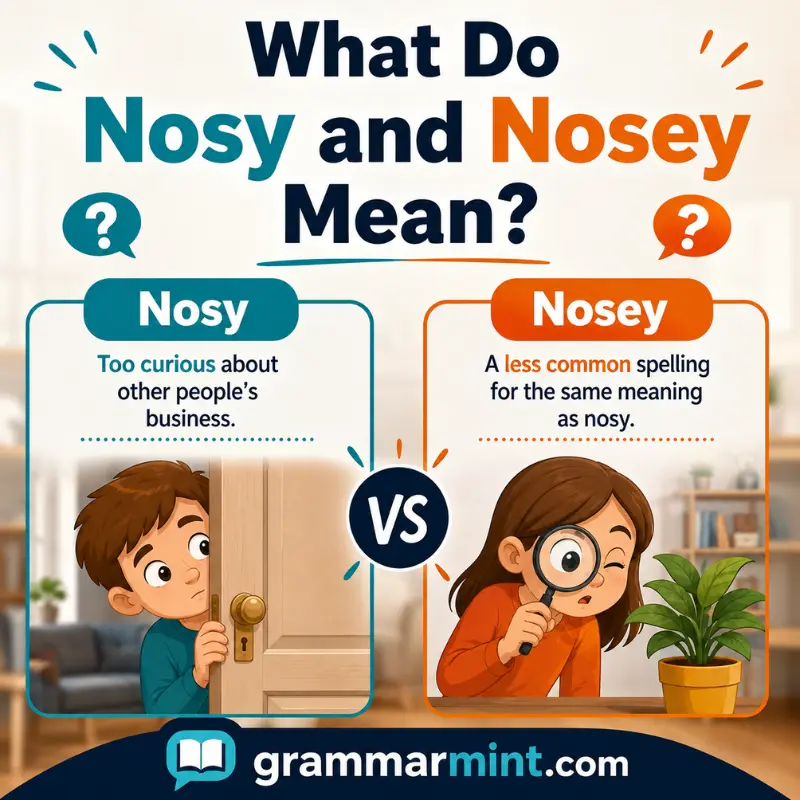
Nosy and nosey are adjectives used to describe someone who is too interested in information that does not concern them, especially private details about other people’s lives.
For example:
My nosy coworker keeps asking how much everyone earns.
The word usually has a negative or mildly critical tone. Calling someone nosy suggests that their curiosity has crossed a boundary.
It does not normally describe healthy curiosity, interest, or a desire to learn.
Is Nosy or Nosey Correct?
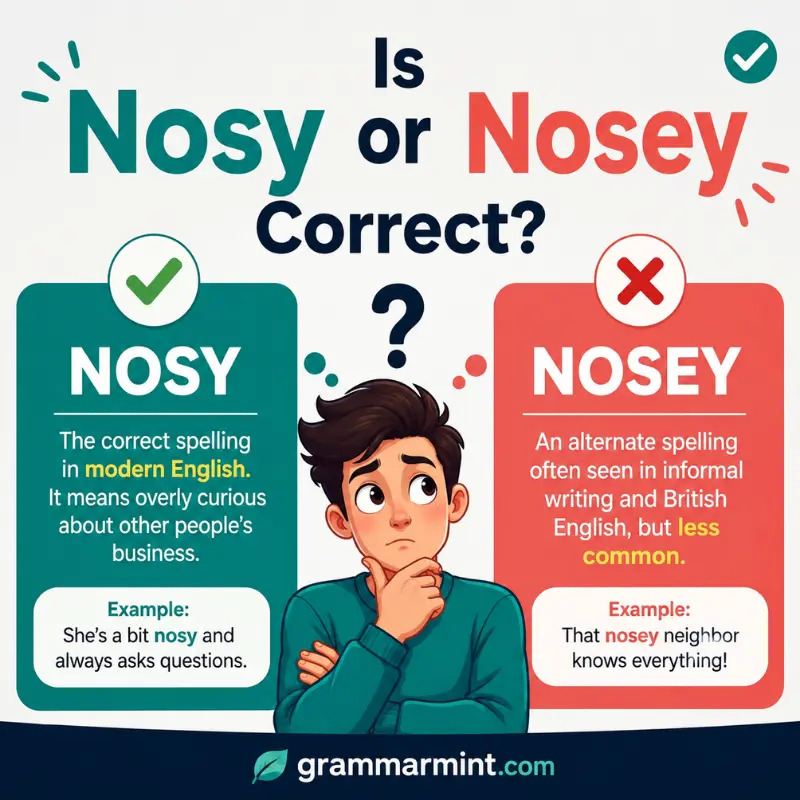
Technically, both spellings are correct.
However, they are not equally common.
Nosy is the standard spelling most American writers should use. Nosey survives as an alternative spelling and may appear in informal writing, older material, personal preferences, or publications that follow a particular style.
Therefore:
- Use nosy as your default.
- Do not automatically mark nosey as a spelling error.
- Stay consistent within the same piece of writing.
If you are writing for a US audience and have no special reason to choose the variant, nosy is the better choice.
Why Are There Two Spellings?
Both forms are connected to the noun nose.
The expression reflects the figurative idea of someone putting or sticking their nose into another person’s business.
Because the base word is spelled nose, the spelling nosey may seem logical. English spelling, however, does not always preserve every letter when words change form.
Over time, nosy became the dominant spelling, especially in American English, while nosey continued to exist as a recognized variant.
This is why both forms can be found even though one is now much more useful as the standard choice.
Nosy in American English
For American readers, nosy is the form to use in most situations.
You can use it in:
- News and magazine writing
- Blog posts
- Emails
- Fiction
- Social media
- Everyday conversation
- General business communication
For example:
Correct:
The reporter was accused of asking nosy questions about the actor’s private life.
Also recognized but less usual:
The reporter was accused of asking nosey questions about the actor’s private life.
The first version will generally look more natural to a US audience.
Nosey in British vs American English
It is sometimes claimed that nosey is simply the British spelling and nosy is the American spelling, but that distinction is too simplistic.
Both forms can appear in different varieties of English. Nosy is widely recognized and commonly used, while nosey remains an established variant.
Therefore, it is better to think of the difference as one of spelling preference and frequency, rather than a strict British-versus-American rule.
For a US-focused article, business document, or publication, nosy remains the safest default.
When Should You Use Nosy?
Use nosy whenever you mean excessively or intrusively curious.
In Everyday Conversation
Why are you being so nosy?
In Text Messages
Don’t be nosy. I’ll tell you later.
In Social Media Posts
We’re all a little nosy when celebrity drama starts trending.
In Fiction
The nosy neighbor watched from behind the curtains.
In Professional Writing
The spelling nosy is correct, although the word itself can sound informal or judgmental.
For more neutral professional language, you may sometimes prefer words such as intrusive, overly curious, or inappropriate.
For example:
The questions were unnecessarily intrusive.
This sounds more professional than:
The questions were nosy.
When Might Nosey Appear?
You may still encounter nosey in:
- Informal writing
- Older publications
- Dialogue
- Personal writing styles
- Publications that deliberately use that variant
It means exactly the same thing as nosy.
For example:
She’s always been a bit nosey about the neighbors.
The sentence is understandable and the spelling is recognized. However, American writers usually have little reason to prefer it over nosy.
Nosy vs Curious vs Inquisitive
One important usage mistake is treating nosy as a neutral synonym for curious.
The words have different connotations.
Nosy
Usually negative. It suggests unwanted interest in private matters.
He was nosy about his coworker’s divorce.
Curious
Usually neutral. It means wanting to know or learn something.
She was curious about how the machine worked.
Inquisitive
Often positive or neutral. It can describe someone who enjoys asking questions and learning.
The teacher encouraged her inquisitive students.
So, if you want to praise someone’s desire to learn, curious or inquisitive is usually better than nosy.
Grammar and Word Forms of Nosy
Nosy is primarily an adjective.
Adjective
Our nosy neighbor asks too many personal questions.
Comparative: Nosier
He became even nosier after hearing part of the conversation.
Superlative: Nosiest
She is the nosiest person in the office.
Noun: Nosiness
His nosiness made everyone uncomfortable.
Adverb: Nosily
She nosily asked what they had been discussing.
These related forms normally follow the standard spelling based on nosy.
Synonyms for Nosy
Depending on the context, possible alternatives include:
- Intrusive
- Meddlesome
- Prying
- Inquisitive
- Curious
- Interfering
- Snooping
These words are not perfectly interchangeable.
For example, curious can be positive or neutral, while prying, meddlesome, and nosy are usually negative.
Choose the word that matches the tone you want.
Common Mistakes and Quick Fixes
Mistake 1: Assuming Nosey Is Always Wrong
Incorrect assumption:
Nosey is a misspelling.
Better understanding:
Nosey is a recognized variant, but nosy is the preferred default for American English.
Mistake 2: Mixing Nosy and Nosey
Avoid switching between spellings in the same article or document.
Better:
The nosy neighbor asked another nosy question.
Not:
The nosy neighbor asked another nosey question.
Mistake 3: Thinking the Spellings Have Different Meanings
They do not.
Nosy and nosey describe the same type of intrusive curiosity.
Mistake 4: Using Nosy as a Compliment
Nosy normally carries a negative implication.
Instead of:
She’s a nosy student who loves learning.
Use:
She’s an inquisitive student who loves learning.
Mistake 5: Assuming Nosey Is Required in British English
There is no simple rule that British writers must use nosey.
Both spellings occur, so writers should follow the conventions of their publication, dictionary, or style guide.
Everyday Examples of Nosy
Here are some natural examples in modern English:
Text message:
Stop being so nosy and tell me what you want.
Family conversation:
My brother is always nosy about who I’m dating.
Workplace:
The question felt a little too nosy for a first meeting.
Social media:
Why are people so nosy about celebrities’ private relationships?
Neighborhood:
Our nosy neighbor seems to notice every delivery.
Fiction:
The nosy reporter refused to stop asking questions.
Nosy or Nosey in Formal Writing?
If you need to use the word in formal American writing, choose nosy.
However, consider whether the word itself fits the tone.
Nosy can sound conversational, subjective, or judgmental. In academic, legal, corporate, or highly formal writing, another word may communicate the idea more precisely.
Instead of:
The interviewer asked several nosy questions.
You might write:
The interviewer asked several intrusive personal questions.
The second sentence is more neutral and precise.
How to Remember Nosy vs Nosey
A simple memory trick is:
NOSY is the standard US choice — keep it short and skip the extra E.
You can also remember:
Nose + curiosity = nosy.
Although the original noun contains an e, the standard adjective is usually spelled nosy.
Comparison Table
| Context | Recommended Choice | Reason |
| American English | Nosy | Standard default |
| Business writing | Nosy | More conventional spelling |
| Formal writing | Nosy | Preferred spelling if the word is appropriate |
| Academic writing | Nosy | Correct spelling, though a more neutral term may be better |
| Text messages | Nosy | Common and natural |
| Social media | Nosy | Familiar spelling |
| Informal variant | Nosey | Recognized but less preferred |
| Fiction/dialogue | Nosy or nosey | Depends on style and character voice |
FAQs
Is Nosey Correct?
Yes. Nosey is a recognized alternative spelling of nosy. However, nosy is the better default for modern American English.
Is It Nosy or Nosey in American English?
Use nosy in American English. It is the standard and more familiar spelling for most US readers.
Do Nosy and Nosey Mean the Same Thing?
Yes. Both describe someone who is excessively interested in other people’s private affairs.
Is Nosey the British Spelling?
Not strictly. Nosey can appear in British English, but it is not accurate to treat the two spellings as a simple British-versus-American pair.
Is Nosy a Negative Word?
Usually, yes. It suggests intrusive or unwelcome curiosity. Use curious or inquisitive when you want a more neutral or positive meaning.
What Is the Plural of Nosy?
Nosy is an adjective, so it does not have a plural form. You can say nosy people, nosy neighbors, or nosy coworkers.
Is It Nosier or Noseyer?
The standard comparative form is nosier.
Example:
My sister is even nosier than my brother.
Mini Quiz
1. Which spelling is the best default in American English?
A. Nosey
B. Nosy
Answer: B. Nosy
2. Do nosey and nosy have different meanings?
A. Yes
B. No
Answer: B. No
3. Which word is better for positive curiosity?
A. Nosy
B. Inquisitive
Answer: B. Inquisitive
4. Which sentence is best for standard US English?
A. My nosey neighbor asks too many questions.
B. My nosy neighbor asks too many questions.
Answer: B.
Conclusion
When deciding between nosey or nosy, choose nosy for standard American English.
Both spellings are recognized and have the same meaning, but nosy is the more useful default for US readers and most edited writing. The word describes someone who shows excessive or intrusive curiosity about other people’s affairs.
Remember that nosy usually carries a negative tone. If you mean curiosity in a positive sense, curious or inquisitive may be a better choice.
The simplest rule is easy to remember: for American English, skip the extra e and write nosy.