Many English learners pause when choosing between unformal or informal. The confusion makes sense: if unhappy means “not happy” and unusual means “not usual,” then unformal may look like a logical way to say “not formal.”
However, English does not always build opposites with the same prefix.
For normal modern English, informal is the word you should use when describing language, clothing, meetings, conversations, behavior, or situations that are relaxed, casual, unofficial, or less formal.
The word unformal does exist in English and is listed by Merriam-Webster as an adjective meaning informal. However, it is not the usual choice in contemporary everyday or edited English. Most writers, teachers, editors, and readers expect informal, so using unformal can look unusual or mistaken even though the form has dictionary recognition.
This guide explains the difference between unformal and informal, why the two forms cause confusion, how informal works in American English, and which word sounds most natural in real situations.
Quick Answer
Informal is the normal and recommended word in modern English.
Use informal when something is casual, relaxed, unofficial, or appropriate for everyday situations:
- an informal meeting
- informal language
- an informal conversation
- informal clothing
- an informal agreement
Unformal is an existing but uncommon form meaning essentially the same thing. Because it is unusual in contemporary standard writing, it is best avoided unless you are discussing the word itself, quoting a source that uses it, or working in a context where that particular form has intentionally been chosen.
For everyday American English, the safest rule is simple:
Formal → Informal
Unformal vs Informal at a Glance
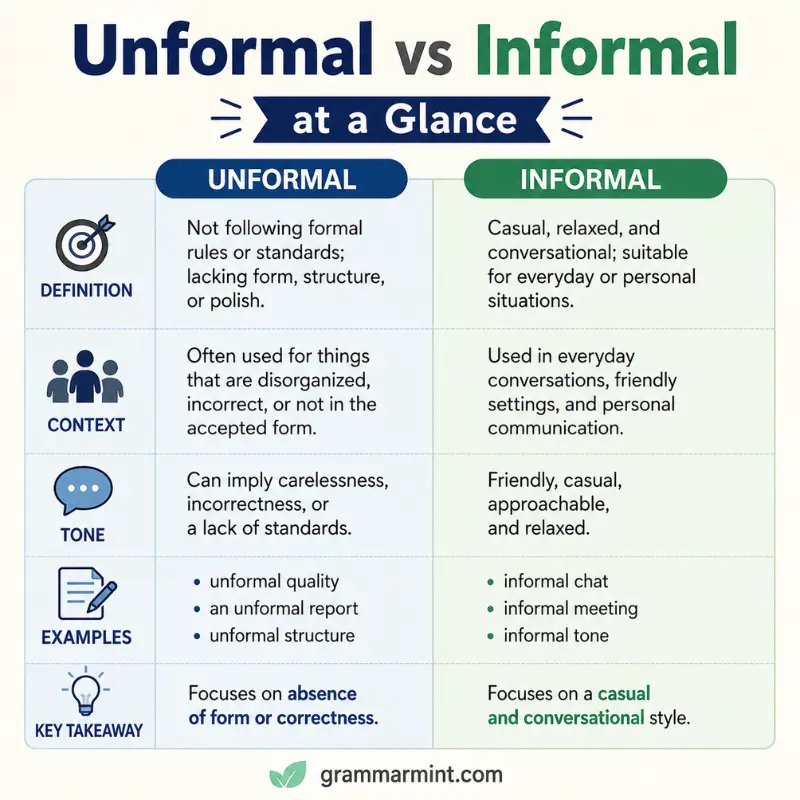
| Term | Status | Meaning | Best Use |
|---|---|---|---|
| Informal | Standard and common | Casual, relaxed, unofficial, or not formal | Everyday, academic, business, and professional English |
| Unformal | Existing but uncommon | Not formal; essentially informal | Rare usage, quotations, or discussion of the word itself |
| Formal | Standard | Official, conventional, structured, or ceremonious | Professional, academic, official, and ceremonial contexts |
The two words may communicate a similar basic idea, but they are not equally natural choices.
If you are deciding which word to put into an email, essay, article, report, text message, or conversation, choose informal.
What Does “Informal” Mean?
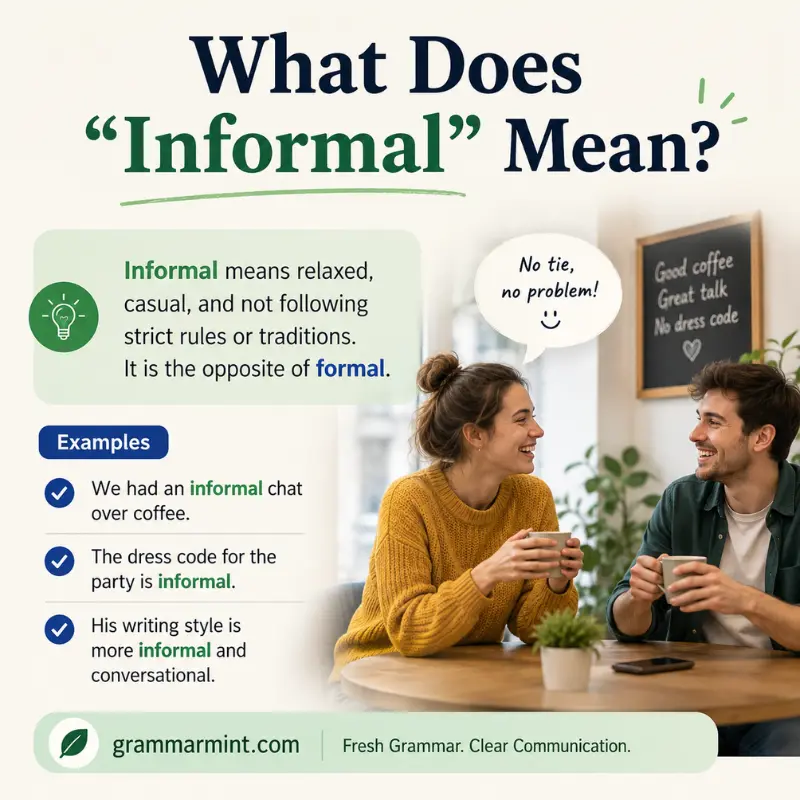
Informal is an adjective that generally describes something that lacks formality or is appropriate for ordinary, casual, or familiar situations.
Merriam-Webster includes senses related to the absence of formality and ordinary or casual use, while Cambridge uses informal for language and situations that are less formal or official.
Depending on the context, informal can mean:
- casual
- relaxed
- unofficial
- conversational
- familiar
- everyday
- less ceremonious
- less strictly structured
For example:
We had an informal meeting after lunch.
Here, informal suggests that the meeting was relaxed or less structured than a formal business meeting.
Her writing style is informal and conversational.
Here, informal describes the language and tone.
The invitation says the dress code is informal.
Here, the word indicates that highly formal clothing is not required.
Is “Unformal” a Real Word?
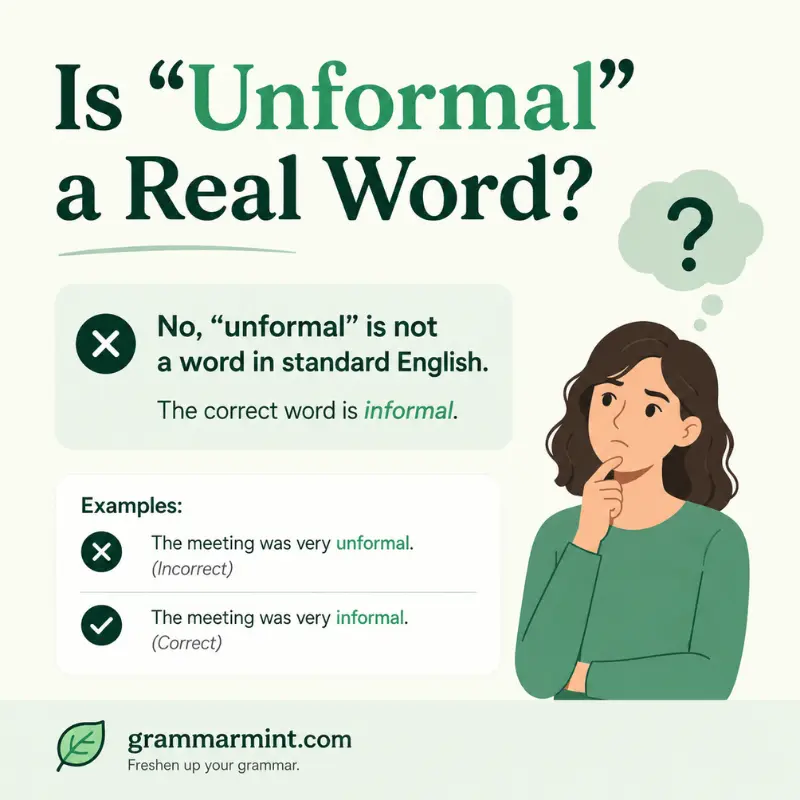
Yes, unformal is a real recorded English word.
This is an important correction because saying that unformal “does not exist” or “is not in any major dictionary” is too strong. Merriam-Webster has an entry for unformal and defines it as informal.
That does not mean, however, that unformal and informal are equally useful in modern writing.
Dictionary recognition and normal everyday usage are not exactly the same thing. Dictionaries can record rare, historical, regional, technical, or otherwise unusual forms alongside the vocabulary people use every day.
For practical purposes, informal remains the expected choice.
Compare:
Natural:
The office has an informal atmosphere.
Unusual:
The office has an unformal atmosphere.
Both may be understood, but the first sentence sounds much more natural to most modern English readers.
Therefore, instead of teaching the overly simple rule “unformal is not a word,” it is more accurate to say:
Unformal exists, but informal is the established form you should normally use.
Why Do People Write “Unformal”?
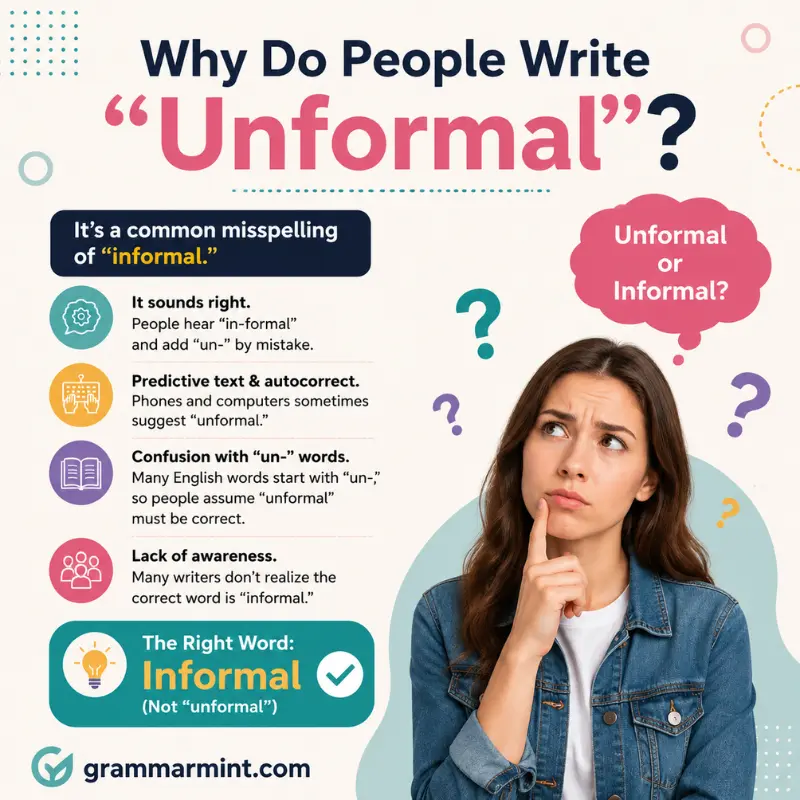
The confusion usually comes from English negative prefixes.
The prefix un- commonly creates opposites:
- happy → unhappy
- certain → uncertain
- common → uncommon
- clear → unclear
- fair → unfair
- usual → unusual
Because of this familiar pattern, a learner may naturally assume:
formal → unformal
The logic is understandable.
English, however, also uses in- and its related forms to create negative meanings:
- accurate → inaccurate
- complete → incomplete
- direct → indirect
- active → inactive
- formal → informal
English word formation developed through several historical influences, so speakers cannot always choose a prefix simply by applying one universal rule.
That is why established usage matters.
Similar-looking choices can cause confusion elsewhere in English too. For example, writers may hesitate over mistakingly or mistakenly because both forms appear logically possible at first glance. Learning the established form is often more useful than trying to invent a rule that works for every word.
Why “Informal” Is the Better Choice
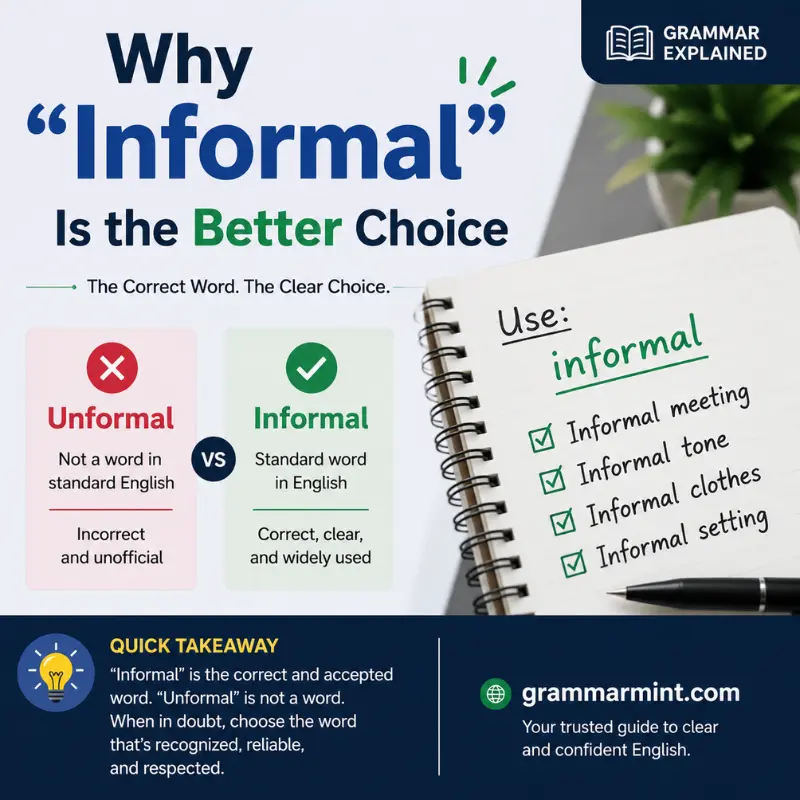
The strongest reason to choose informal is not merely that one prefix appears more logical than another. It is that informal is the conventional form readers expect.
It appears naturally in common combinations such as:
- informal conversation
- informal language
- informal meeting
- informal discussion
- informal tone
- informal agreement
- informal setting
- informal clothes
- informal gathering
- informal interview
- informal approach
- informal communication
- informal atmosphere
- informal education
Merriam-Webster gives standard examples such as an informal meeting and informal clothes, showing how broadly established the adjective is in ordinary English.
Using familiar combinations makes your writing easier to read because the reader does not have to stop and wonder whether the wording is intentional.
Formal vs Informal Language
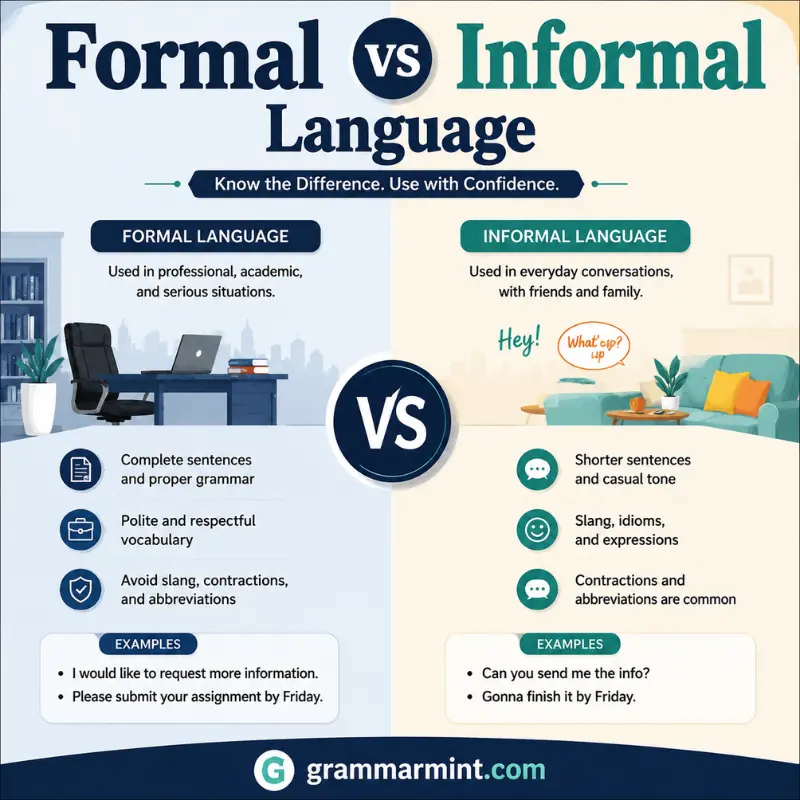
One of the most important uses of informal is in discussions of language register.
Formal language is generally more structured and is often appropriate for professional, academic, ceremonial, or official situations.
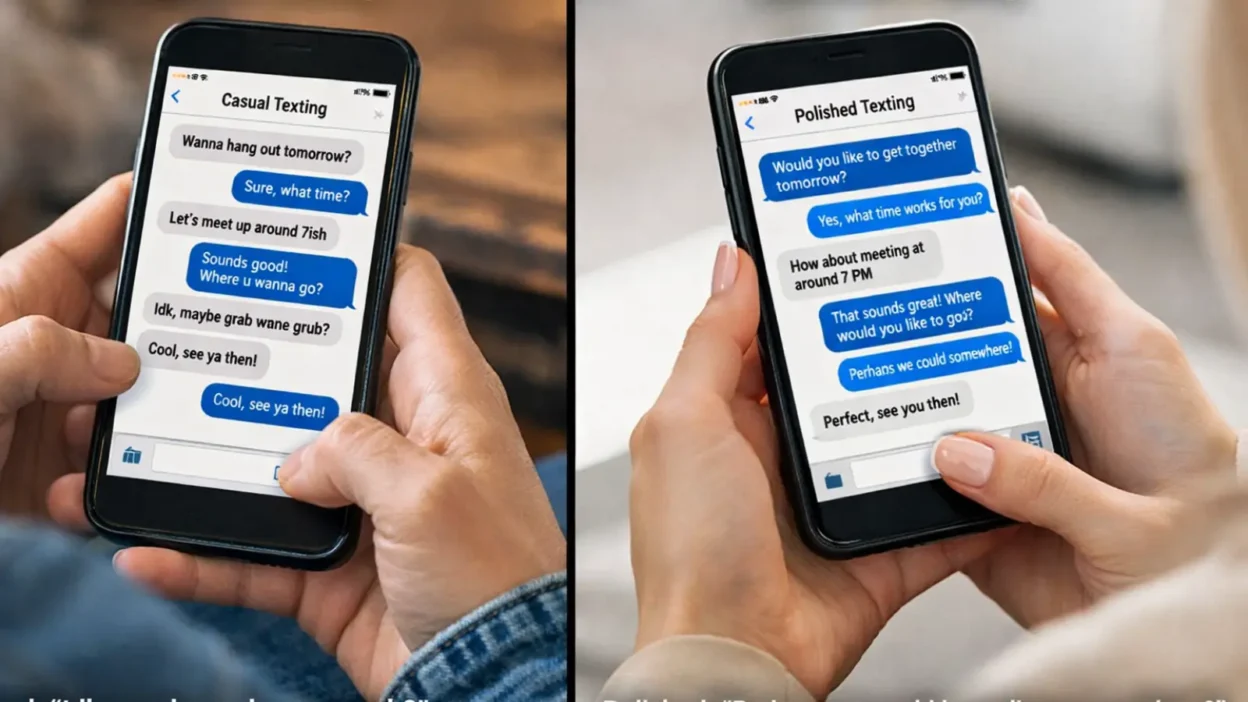
Informal language is more conversational and is common among friends, family members, coworkers in relaxed settings, and people communicating casually online.
Cambridge notes that formal language tends to be more common in writing and informal language more common in speech, while also pointing out that writing can be informal and speech can be formal depending on the situation.
Compare these examples:
Informal:
Can you send me the file when you get a chance?
More formal:
Could you please send me the file at your earliest convenience?
Another example:
Informal:
Thanks for helping me out.
More formal:
Thank you for your assistance.
Neither style is automatically better. The appropriate choice depends on your audience and purpose.
Informal Does Not Mean Incorrect
A common misunderstanding is that informal English means bad English.
It does not.
Informal language can be completely grammatical and appropriate. It simply suits a more relaxed context.
For example:
I’m gonna head home.
This is highly conversational and may be represented informally in dialogue or casual messaging.
Compare:
I’m going to head home.
This version is more neutral and suitable for a wider range of writing.
Likewise, internet vocabulary such as mutuals or slang terms such as sus may belong primarily to informal registers. If you are interested in those kinds of expressions, see what “mutuals” means on social media and the guide to “sus” meaning and usage.
The key point is that informal describes the register, not necessarily the correctness of the language.
British vs American English
For the choice between informal and unformal, American and British English do not create a major practical difference.
Informal is the normal word in both varieties.
Cambridge includes informal in both its general and American dictionary material, and Merriam-Webster treats it as an established adjective in American English.
Although unformal has a dictionary record, it should not be treated as the ordinary American equivalent while informal is supposedly British, or vice versa.
That kind of regional distinction does occur with some English words. For example, American and British spelling can differ in choices such as authorization or authorisation.
That is not the main issue here.
Whether you are writing for readers in the United States or the United Kingdom, informal is the practical default.
Which One Should You Use?
Everyday Conversation
Use informal.
Natural:
It was just an informal conversation.
Less natural:
It was just an unformal conversation.
Text Messages
If you need the adjective, informal is still the best choice.
The message sounds too informal for my boss.
However, in an ordinary text to a friend, you may simply use more conversational wording:
That sounds too casual for work.
School Assignments
Use informal when discussing language, tone, writing style, behavior, or social settings.
Correct:
The author uses an informal tone to connect with younger readers.
Avoid replacing it with unformal in an essay unless the word itself is the topic of discussion.
Workplace Emails
Use informal if it accurately describes the tone or setting.
Our first meeting will be informal.
The opening paragraph sounds too informal for a client proposal.
In some cases, another adjective may be more precise, such as casual, unofficial, conversational, or relaxed.
Professional Reports
Use informal, but only where its meaning is appropriate.
The team gathered feedback through informal discussions with employees.
This means the discussions were less structured or less official than a formal research process.
Social Media
Informal is the natural form when discussing style or tone.
I wanted the caption to sound informal and friendly.
You may encounter unformal online, but seeing a form on social media does not automatically make it the preferred form for edited writing.
Clothing and Dress Codes
Informal clothing is grammatically correct, but casual clothing or casual attire is often more natural in everyday American English.
For example:
Correct:
The event allows informal clothing.
More natural in many US contexts:
The event has a casual dress code.
Choosing the most precise expression often improves writing more than simply choosing a technically possible adjective.
Informal, Informally, and Informality
Another useful way to avoid mistakes is to learn the related word forms.
Informal — Adjective
Use informal to describe a noun.
We had an informal discussion.
Her writing style is informal.
Informally — Adverb
Use informally to describe how an action happens.
They spoke informally after the meeting.
Everyone was dressed informally.
Do not write:
Dress informal today.
In traditional grammar, informal is an adjective, while the adverb is informally.
However, an even more natural sentence may be:
Dress casually today.
Informality — Noun
Informality names the quality or condition of being informal.
The informality of the meeting helped everyone relax.
Learning the complete word family makes it easier to choose the right form in different sentence structures.
Often emphasizes the absence of formality, ceremony, official procedure, or highly structured language.
We held an informal meeting before the official presentation.
Casual
Often emphasizes relaxation, ease, or lack of seriousness or strictness.
The restaurant has a casual atmosphere.
For clothing, casual is particularly common:
casual clothes
casual attire
casual dress code
For language and register, informal is often more precise:
informal language
informal writing
informal speech
So instead of assuming every use of informal should be replaced by casual, choose the term that communicates your intended meaning most accurately.
Informal vs Unofficial
These words can also overlap, but they are not identical.
Informal may mean relaxed or lacking ceremony.
Unofficial usually means something has not been formally approved, authorized, announced, or recognized.
Compare:
We had an informal meeting.
The meeting was relaxed or less structured.
We had an unofficial meeting.
The meeting was not officially arranged or recognized.
A meeting could theoretically be both informal and official, or formal and unofficial.
That is why context matters.
What About “Nonformal”?
Another word readers sometimes encounter is nonformal.
Merriam-Webster lists nonformal with the meaning “not formal: informal.”
However, nonformal can also appear in specialized discussions where writers want to distinguish different categories rather than simply describe a relaxed style.
Education is a good example. Research and policy discussions sometimes distinguish formal, non-formal, and informal learning as separate concepts rather than treating all three terms as exact synonyms.
For ordinary conversation, however, you normally do not need nonformal as a replacement for informal.
Instead of:
We had a nonformal dinner.
Most speakers would simply say:
We had an informal dinner.
Or, even more naturally:
We had a casual dinner.
Common Mistakes and How to Fix Them
Mistake: “The meeting was unformal.”
Better:
The meeting was informal.
Mistake: “We use unformal language in this chat.”
Better:
We use informal language in this chat.
Mistake: “Your email sounds unformal.”
Better:
Your email sounds too informal.
Or, if you want greater precision:
Your email sounds too casual for a client.
Mistake: “Dress informal today.”
Better:
Dress informally today.
More natural:
Dress casually today.
Mistake: “We’ll keep the presentation unformal.”
Better:
We’ll keep the presentation informal.
Mistake: “Write in an unformal way.”
Better:
Write in an informal style.
Mistake: “This is an unformal conversation.”
Better:
This is an informal conversation.
Mistake: “The essay needs an unformal tone.”
Better:
The essay needs an informal tone.
Mistake: Assuming informal means grammatically wrong
Better understanding:
Informal language can be grammatically correct. The term refers mainly to register, tone, or level of formality.
Mistake: Assuming unformal does not exist at all
Better understanding:
The word has dictionary recognition, but informal remains the normal choice for contemporary everyday and edited English.
Everyday Examples in Real Contexts
Talking to a Friend
Natural:
The party is pretty informal, so you don’t need to dress up.
Meaning: The party is relaxed and does not require formal clothing or behavior.
Workplace
The manager scheduled an informal discussion before the official review.
Meaning: The discussion is less structured or less official than the review.
School
The teacher asked us to identify the informal expressions in the dialogue.
Meaning: The expressions belong to a conversational or less formal register.
The first draft feels too informal for a legal audience.
Meaning: The tone is too casual for the intended readers.
Social Media
I prefer an informal writing style on Instagram.
Meaning: The writer prefers a conversational, relaxed style.
Family Setting
Dinner will be informal this year.
Meaning: The gathering will be relaxed and may involve fewer ceremonial expectations.
Interview
We had an informal chat before the interview started.
Meaning: The conversation was relaxed and separate from the more structured interview.
Clothing
Business casual is less formal than traditional business attire.
This wording is often more natural than trying to describe every clothing category with informal.
Natural Sentence Examples With “Informal”
Here are additional examples you can use as models:
- We had an informal discussion after class.
- The company arranged an informal lunch for new employees.
- His writing is friendly and informal.
- You can use a more informal tone with close friends.
- The event is fairly informal, so a suit is unnecessary.
- She conducted several informal interviews before beginning the study.
- The agreement started as an informal arrangement between neighbors.
- They met in an informal setting rather than a conference room.
- The teacher explained the difference between formal and informal English.
- Our conversation became more informal once the meeting ended.
- The restaurant has a comfortable, informal atmosphere.
- He received informal feedback from his coworkers.
- The group communicates through informal channels.
- Her presentation was professional without sounding overly formal.
- The message is appropriate for an informal audience.
When “Informal” May Not Be the Best Word
Although informal is correct, good writing is not only about avoiding errors. It is also about choosing the most precise word.
Consider this sentence:
He wore informal clothes to the picnic.
It is grammatical, but a native US speaker may prefer:
He wore casual clothes to the picnic.
Likewise:
We had an informal talk about the problem.
This is natural.
But if the point is that the discussion had no official status, unofficial may communicate the meaning more clearly:
We had an unofficial discussion about the proposal.
Other possible alternatives include:
- casual
- relaxed
- conversational
- familiar
- unofficial
- unceremonious
- everyday
- colloquial
The best synonym depends on what informal means in your specific sentence.
Context | Best Choice | Why
| Context | Best Choice | Why |
| Everyday conversation | informal | Natural standard adjective |
| School assignment | informal | Expected form in edited English |
| Workplace email | informal | Clear and professional when context requires it |
| Academic discussion of register | informal | Established linguistic term |
| Text message | informal | Standard even in casual contexts |
| Social media | informal | Natural word for conversational style |
| Relaxed meeting | informal | Common collocation |
| Dress code | informal/casual | Both possible; casual is often more idiomatic |
| Official status | unofficial | More precise when approval or authority is the issue |
| Rare/historical quotation | unformal may appear | Preserve it if it is genuinely part of the source |
| Discussion of the word itself | unformal | Appropriate when explaining its existence or usage |
Easy Memory Trick
Remember this pair:
Formal ↔ Informal
Not:
Formal ↔ Unformal
You can connect it with other common in- opposites:
accurate → inaccurate
complete → incomplete
direct → indirect
formal → informal
You do not need to memorize every prefix rule at once. For this particular word, simply remember the common phrase:
formal and informal
You have probably already heard expressions such as:
formal and informal language
formal and informal meetings
formal and informal communication
That familiar pair is the one to use.
FAQs
Is “unformal” a correct English word?
Unformal has a recorded dictionary entry, so it is inaccurate to say that the word does not exist at all. Merriam-Webster lists it as an adjective meaning informal. However, informal is the conventional and recommended form for normal modern writing and speech.
Which is correct: unformal or informal?
For ordinary modern English, choose informal. It is the established word used for relaxed language, meetings, clothing, situations, and behavior. Unformal may exist, but it is unusual enough that it can distract readers.
What does informal mean?
Informal generally means not formal, less official, relaxed, casual, familiar, or appropriate for ordinary situations. The exact meaning depends on whether you are talking about speech, clothing, behavior, meetings, procedures, or another context.
Is informal the opposite of formal?
Yes. In ordinary English, informal is the standard opposite of formal in expressions such as formal language vs. informal language or a formal meeting vs. an informal meeting.
Can informal be used in formal writing?
Yes. The word informal itself is not an informal or inappropriate word. You can use it in academic, professional, and formal writing whenever it accurately describes a style, procedure, relationship, setting, or type of communication.
For example:
The researchers conducted informal interviews before designing the survey.
Does informal mean incorrect English?
No. Informal describes register or level of formality. An informal sentence can still be grammatically correct. Informal English simply tends to be more conversational and suitable for relaxed situations.
Is unformal American English?
No special American-English rule makes unformal the standard alternative to formal. In American English, informal is the normal choice.
True US–UK differences occur elsewhere in vocabulary and spelling, but this pair should normally be written formal/informal.
Should I use informal or casual?
It depends on context. Informal is especially useful for language, meetings, communication, procedures, and situations. Casual is often more natural for clothing, relaxed social settings, or an easygoing style.
What is the adverb of informal?
The adverb is informally.
Adjective: We had an informal meeting.
Adverb: We met informally after work.
What is the noun form of informal?
The related noun is informality.
The informality of the conversation made everyone comfortable.
Mini Quiz
1. Choose the more natural word:
“The meeting was ___ and relaxed.”
Answer: informal
2. Correct the sentence:
“Your report sounds too unformal for class.”
Answer:
“Your report sounds too informal for class.”
3. Choose the correct adverb:
“They spoke ___ after the presentation.”
Answer: informally
4. True or False:
“Unformal has no dictionary recognition anywhere.”
Answer: False. It has a Merriam-Webster entry, although informal is the normal choice in contemporary usage.
5. Which word is usually more natural for clothing?
“Wear ___ clothes to the picnic.”
Best answer: casual
Informal can also be grammatical, but casual clothes is often more idiomatic in everyday American English.
6. Which phrase is standard?
A. formal and unformal language
B. formal and informal language
Answer: B. formal and informal language
7. Is informal language automatically incorrect?
Answer: No. Informal language can be completely correct while simply being more conversational or relaxed.
Conclusion
When choosing between unformal or informal, use informal in normal modern English.
Informal is the established adjective for language, meetings, clothing, behavior, communication, and situations that are less formal, more relaxed, or more conversational. It works naturally in everyday conversation as well as professional, academic, and edited writing.
The important nuance is that unformal should not be described as completely nonexistent. Merriam-Webster records the word and gives informal as its meaning. Even so, dictionary existence does not make the two forms equally natural in contemporary usage.
For most writers, the rule is easy to remember:
Use “informal” as the ordinary opposite of “formal.”
If informal does not express your meaning precisely enough, consider a more specific alternative such as casual, relaxed, conversational, or unofficial.
That choice will keep your English clear, natural, and appropriate for your audience.