You may hear hypocrite during arguments, debates, or everyday conversations. It often describes someone whose actions clash with their stated values. The word can appear at school, work, home, or in public discussions.
Understanding it matters because hypocrite is a strong negative label. A simple mistake does not always make someone a hypocrite. The idea usually involves a meaningful gap between what someone expects from others and how that person actually behaves.
This guide explains what hypocrite means in clear English. You will learn its pronunciation, grammar, tone, and common uses. You will also see natural examples and related word forms. Finally, you will learn when the word may be too strong.
Quick Answer
Hypocrite meaning: a hypocrite is someone whose actions conflict with beliefs or standards they claim to follow.
The word usually carries strong disapproval. It is a regular English noun, not a slang term.
TL;DR
• A hypocrite supports one standard but behaves differently.
• Hypocrite is a countable noun.
• The word usually expresses criticism or disapproval.
• Hypocrisy names the behavior, not the person.
• One mistake does not automatically make someone a hypocrite.
What Does Hypocrite Mean?
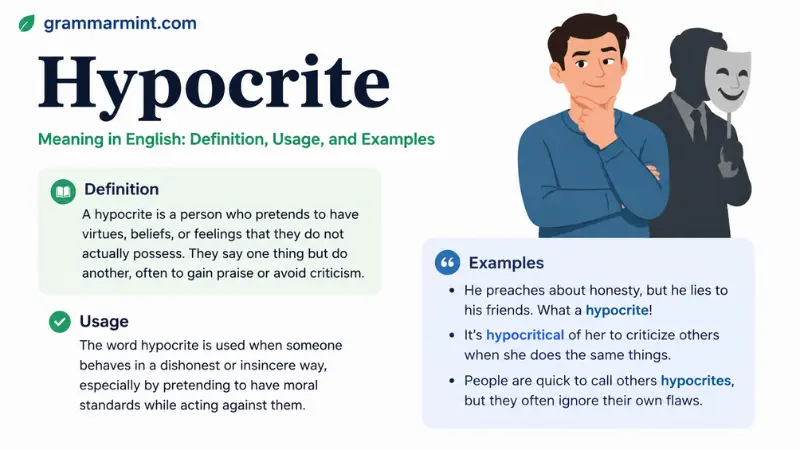
A hypocrite is a person who claims certain beliefs, values, or standards but acts against them.
A common pattern is demanding certain behavior from others while ignoring the same rule personally. Pretending to have virtues you do not truly follow can also be hypocritical.
For example, imagine someone who constantly criticizes coworkers for arriving late. That same person regularly arrives late without concern. Calling that person a hypocrite describes the clear double standard.
The idea often includes two parts:
• The person expresses a belief, value, rule, or moral standard.
• Their behavior conflicts with that stated position.
However, human behavior is not perfectly consistent. Someone can fail once without being dishonest about their values.
Suppose a health-conscious person eats one unhealthy meal. That alone does not prove hypocrisy. The person may simply have made an exception.
The label fits better when the contradiction reveals a meaningful double standard or a false appearance.
Pronunciation and Part of Speech
In American English, hypocrite is commonly pronounced HIP-uh-krit.
The stress falls on the first syllable: HIP-uh-krit.
Hypocrite is a countable noun. It refers to a person.
You can therefore use these forms:
• a hypocrite
• the hypocrite
• one hypocrite
• two hypocrites
Example:
He called his friend a hypocrite.
The plural form is hypocrites.
The word itself is not normally used as an adjective. Use hypocritical when you need an adjective.
Correct: That comment was hypocritical.
Incorrect: That was a hypocrite comment.
How Hypocrite Is Used in Everyday English
Hypocrite works in both speech and writing. However, it almost always sounds negative.
Calling someone a hypocrite questions that person’s sincerity or consistency. For that reason, the word can sound insulting during a disagreement.
Common patterns include:
• He is a hypocrite.
• She called him a hypocrite.
• They accused her of being a hypocrite.
• I would be a hypocrite if I criticized you for that.
The word often appears when someone applies one rule to others and another rule to themselves.
For example, a manager may demand punctuality but arrive late every morning. Employees might view that behavior as hypocritical.
The word also appears in discussions about moral values and personal principles. Still, the belief involved does not need to be religious or political.
Everyday rules can create the same idea.
A parent might ban phones during dinner but constantly check their own phone. A child may call that parent a hypocrite.
That statement means the parent’s behavior conflicts with the rule they are enforcing.
Examples of Hypocrite in Sentences
These examples show how the noun works naturally.
• Mark is a hypocrite because he criticizes gossip but spreads rumors himself.
• After breaking the rule she had defended, she felt like a hypocrite.
• People should not be called hypocrites simply because they make mistakes.
• His coach was called a hypocrite for ignoring his own advice.
• I would be a hypocrite if I complained about your messy desk.
• The manager seemed like a hypocrite after employees noticed the double standard.
• Her brother accused her of being hypocritical about screen time.
• During the discussion, nobody wanted to seem like a hypocrite.
These examples involve more than simple disagreement.
The key issue is a conflict between someone’s claimed standard and that person’s own behavior.
Hypocrite, Hypocrisy, and Hypocritical
These three words belong to the same word family, but their grammar is different.
| Word | Part of Speech | Meaning | Example |
|---|---|---|---|
| hypocrite | noun | a person who behaves hypocritically | He is a hypocrite. |
| hypocrisy | noun | hypocritical behavior or practice | They criticized his hypocrisy. |
| hypocritical | adjective | showing hypocrisy | His complaint sounded hypocritical. |
Choose hypocrite when you are naming the person.
The noun hypocrisy refers to the behavior, practice, or contradiction itself.
When describing a person, statement, action, or attitude, hypocritical is the correct adjective.
For example:
Calling everyone lazy while refusing to work made him look hypocritical.
Here, hypocritical describes his behavior.
You could also say:
His hypocrisy annoyed his coworkers.
Here, hypocrisy names the behavior itself.
Finally:
His coworkers thought he was a hypocrite.
Here, hypocrite refers to the person.
Synonyms, Antonyms, and Related Terms
Several words have meanings similar to hypocrite. However, few are exact replacements.
Close Synonyms
Pretender describes someone who presents a false identity, quality, or position. It is broader than hypocrite.
Phony can describe someone considered fake or insincere. It is more informal and also broader.
Deceiver describes someone who intentionally misleads others. Deception does not always involve hypocrisy.
Dissembler describes someone who hides their true motives or feelings. It is more formal and less common.
Two-faced is an informal description for someone considered insincere or deceptive. It does not always mean hypocritical.
Fraud can describe someone who falsely presents themselves. Its meaning can be much broader.
Is Liar a Synonym for Hypocrite?
Not exactly.
A liar says something that is untrue. A hypocrite behaves in a way that conflicts with claimed standards or beliefs.
A person can be both a liar and a hypocrite. However, the words do not mean the same thing.
Antonyms
English has no perfect everyday noun that serves as the exact opposite of hypocrite.
Depending on the context, you might describe the opposite kind of person as:
• sincere
• genuine
• principled
• consistent
• honest
These words describe positive qualities rather than providing one exact opposite noun.
Origin and History
The history of hypocrite goes back to Greek.
Its Greek ancestor, hypokritēs, could refer to an actor or performer. The idea was connected with playing a role.
The word later developed a figurative connection with pretending. Someone could appear to possess qualities or beliefs that were not genuine.
The term passed through Latin and French before entering English during the Middle Ages.
Older English uses often focused strongly on false religious or moral virtue. Modern English has a broader everyday meaning.
Today, the word can describe many types of conflict between claimed standards and personal actions.
The theatrical background helps explain the modern meaning.
A hypocrite can be understood figuratively as someone who presents one image while behaving differently in practice.
Common Mistakes and When Not to Use It
A common mistake is calling every inconsistent person a hypocrite.
People change their minds. They also make mistakes, forget rules, and sometimes fail to meet their own standards.
Those situations do not automatically prove hypocrisy.
Mistake: Using Hypocrite as an Adjective
Incorrect: That is a hypocrite statement.
Correct: That is a hypocritical statement.
Use hypocrite for the person and hypocritical for the description.
Mistake: Treating Hypocrite and Liar as Identical
A lie involves saying something untrue.
Hypocrisy involves a conflict between claimed beliefs, standards, or values and actual behavior.
Mistake: Using the Word for Simple Disagreement
Two people can disagree without either person being hypocritical.
A disagreement involves different opinions. Hypocrisy involves someone’s behavior conflicting with their own stated standard.
Choosing the Correct Form
| Context | Best Choice | Why |
| Naming the person | hypocrite | It is a noun for a person |
| Naming the behavior | hypocrisy | It names the behavior |
| Describing behavior | hypocritical | It functions as an adjective |
Be careful when applying the label directly to someone.
Calling a person a hypocrite can sound harsh. If you want a calmer tone, describe the specific contradiction instead.
Instead of saying, “You’re a hypocrite,” you could say:
“You ask us to follow a rule that you don’t follow yourself.”
That wording focuses on the behavior rather than attacking the person.
Mini Quiz
1. Which sentence uses hypocrite correctly?
A. That rule is very hypocrite.
B. He is a hypocrite for demanding a rule he ignores.
C. She hypocrite the entire discussion.
Answer: B.
2. Which word names the behavior?
A. hypocrite
B. hypocritical
C. hypocrisy
Answer: C.
3. Which word is an adjective?
A. hypocritical
B. hypocrite
C. hypocrisy
Answer: A.
4. Does one mistake always make someone a hypocrite?
A. Yes
B. No
Answer: B. Context and the nature of the contradiction matter.
FAQs
What Does Hypocrite Mean in Simple Words?
A hypocrite is someone who claims or expects one standard but behaves differently.
A simple explanation is: someone who does not practice what they preach.
Is Hypocrite a Bad Word?
It is not profanity or a swear word. However, it usually carries strong criticism.
Calling someone a hypocrite can therefore feel insulting or confrontational.
Is Hypocrite a Noun or Adjective?
Hypocrite is a noun. It refers to a person.
The related adjective is hypocritical. You can say, “His behavior was hypocritical.”
What Is an Example of a Hypocrite?
Imagine a student who constantly criticizes classmates for cheating.
If that student secretly cheats too, others may call the student a hypocrite.
The contradiction between the stated standard and actual behavior creates the meaning.
What Is the Difference Between Hypocrite and Hypocrisy?
A hypocrite is the person.
Hypocrisy is the behavior, practice, or quality shown by that person.
For example: “The hypocrite was criticized for his hypocrisy.”
What Is Another Word for Hypocrite?
Close alternatives include pretender, phony, deceiver, and dissembler.
However, these words have broader meanings. They do not always express the exact idea of hypocrisy.
Conclusion
A hypocrite is someone whose actions conflict with the standards or values they claim to follow.
Because the word expresses strong disapproval, use it carefully. Consider the context before applying the label to someone.