
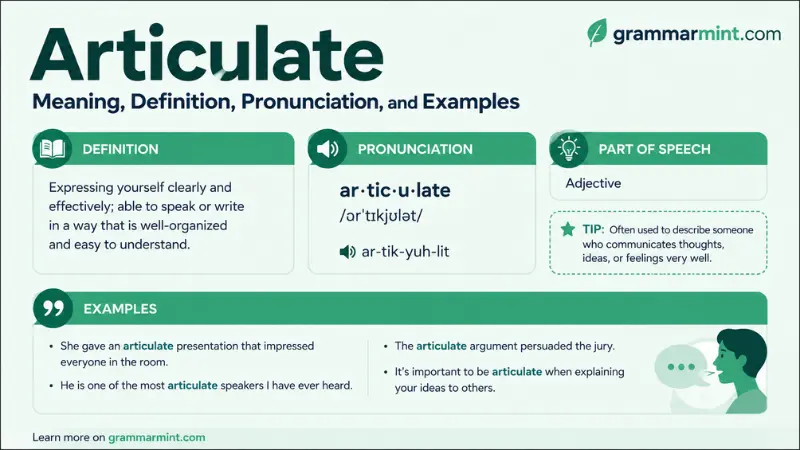
You may hear someone described as an articulate speaker. At other times, a person may say they cannot articulate their feelings.
Both uses relate to clear communication. However, the word has a different grammatical role in each sentence.
Articulate can work as an adjective or a verb. Interestingly, its pronunciation also changes between these two uses.
People often use this word in classrooms, workplaces, interviews, and presentations. In addition, it appears in everyday conversations about thoughts and feelings.
Understanding articulate can make reading and speaking easier. More importantly, it helps you describe clear and effective communication.
This guide explains the meaning, pronunciation, grammar, and common uses of articulate. Along the way, you will also see practical examples, synonyms, and common mistakes.
Quick Answer
Articulate meaning usually relates to expressing thoughts, ideas, or feelings clearly.
As an adjective, articulate describes someone who communicates well. As a verb, however, it means expressing something clearly in words.
TL;DR
• Articulate usually relates to clear expression.
• It can be an adjective or a verb.
• An articulate person communicates ideas clearly.
• As a verb, it means expressing something clearly.
• Its pronunciation changes with its grammatical role.
What Does Articulate Mean?
In plain English, articulate means clear and effective in communication.
When the word describes a person, it suggests that they express ideas well. Usually, their speech is organized and easy to understand.
The term can also describe an answer, argument, or explanation. Meanwhile, as a verb, articulate means putting thoughts or feelings clearly into words.
For example:
• Maya articulated her concerns during the meeting.
• Jordan is an articulate speaker.
• The student gave an articulate explanation.
• I struggled to articulate how I felt.
Overall, the main idea is clarity of expression.
Being articulate does not require difficult vocabulary. In fact, simple language can be very articulate when the message is clear.
Pronunciation and Part of Speech
Articulate has two common grammatical roles. Therefore, pronunciation depends on whether the word is an adjective or a verb.
Articulate as an Adjective
As an adjective, pronounce articulate roughly as:
ar-TIK-yuh-luht
In this form, the word describes someone or something that communicates clearly.
For example:
“She gave an articulate response.”
Articulate as a Verb
As a verb, pronounce articulate roughly as:
ar-TIK-yuh-layt
Here, the word describes the action of expressing something clearly.
For example:
“He articulated his concerns.”
Fortunately, the ending makes the difference easier to remember. The adjective has a softer -luht sound.
By contrast, the verb finishes with a stronger -layt sound.
How Articulate Is Used in English
Most everyday uses of articulate involve communication. Depending on the sentence, the word can relate to people, ideas, thoughts, feelings, or arguments.
| Context | Best Use | Why |
|---|---|---|
| A clear communicator | articulate adjective | Describes the person |
| Expressing an idea | articulate verb | Describes the action |
| Explaining feelings | articulate verb | Means putting feelings into words |
| Clear speech sounds | articulate verb | Means pronouncing distinctly |
Common combinations include:
• articulate speaker
• articulate response
• articulate argument
• articulate your thoughts
• articulate your feelings
• articulate a concern
• articulate a vision
• articulate a position
For instance:
“The manager articulated her vision for the new project.”
In this example, the manager explained her vision clearly.
Articulate as an Adjective
As an adjective, articulate usually describes effective communication.
An articulate person can organize ideas and express them clearly. Because of this, the word normally has a positive meaning.
For example:
“Marcus was calm and articulate during the interview.”
This sentence does not necessarily mean Marcus used advanced vocabulary. Instead, it means his ideas were easy to understand.
The adjective can also describe something a person produces. For instance, you may hear these combinations:
• an articulate argument
• an articulate presentation
• an articulate response
• an articulate explanation
Consider this sentence:
“Her answer was brief but articulate.”
Although the answer was short, it still communicated the main point clearly.
Common Mistake
Incorrect:
“She speaks very articulate.”
Correct:
“She speaks very articulately.”
Alternatively, you can say:
“She is very articulate.”
In the final example, articulate is an adjective. Articulately, on the other hand, works as an adverb.
Articulate as a Verb
As a verb, articulate means to express something clearly in words.
People often articulate thoughts, ideas, feelings, concerns, needs, or opinions. Therefore, this use appears frequently in personal, academic, and professional communication.
For example:
“I could not articulate my frustration.”
“She articulated her proposal clearly.”
“Can you articulate the main problem?”
“He struggled to articulate his thoughts.”
Compared with say, articulate sounds slightly more formal. Similarly, it often suggests careful or organized expression.
For that reason, the verb appears often in meetings, interviews, essays, and presentations.
For example:
“The candidate articulated a clear plan for improving customer service.”
Articulate can also relate to pronunciation. In this sense, a teacher may ask a student to articulate each sound carefully.
Here, the focus is on producing clear and distinct speech sounds.
Origin and History of Articulate
Articulate comes from Latin roots connected with joints and separate parts.
The Latin word articulus referred to a small joint or distinct section. Over time, that physical idea developed into meanings connected with speech.
For example, spoken language can be divided into distinct sounds. Likewise, ideas can be organized into clear verbal parts.
Later, articulate became strongly associated with clear expression. Even today, an older physical meaning survives in technical contexts.
For instance, something described as articulated may contain connected sections or joints.
In everyday English, however, articulate usually refers to communication.
Synonyms, Antonyms, and Related Words
The best synonym for articulate depends on the sentence.
Synonyms for the Adjective
• well-spoken — able to speak effectively
• expressive — able to communicate thoughts or feelings well
• clear — easy to understand
• eloquent — effective, polished, or persuasive in expression
Synonyms for the Verb
• express — communicate an idea or feeling
• state — say something clearly
• voice — express an opinion or concern
• explain — make something understandable
• enunciate — pronounce sounds or words clearly
However, these words are not perfect replacements in every situation.
For example, eloquent often suggests style, beauty, or persuasive power. Articulate, by comparison, focuses more directly on clear expression.
Antonyms
Inarticulate is the clearest opposite when discussing communication.
Someone who is inarticulate may struggle to express thoughts clearly. Depending on the context, unclear or unintelligible may also fit.
Common Mistakes and Confusions
Articulate becomes easier to use once you separate its adjective and verb meanings. Still, several common misunderstandings can cause confusion.
Articulate Does Not Mean Intelligent
Clear communication and intelligence are different qualities.
Someone may understand a difficult topic but struggle to explain it. Meanwhile, another person may explain a simple idea very clearly.
Therefore, articulate should not be treated as a direct synonym for intelligent.
Articulate Does Not Mean Using Big Words
An articulate person does not need complicated vocabulary.
In fact, simple language often communicates ideas more effectively.
Compare these examples:
Unclear:
“The situation involves numerous multifaceted complications of considerable significance.”
Clearer:
“The problem has several important causes.”
Although the second sentence is simpler, its meaning is easier to understand.
Articulate and Fluent Are Not the Same
Fluent usually refers to smooth control of a language or skill.
Articulate, however, focuses on how clearly someone expresses ideas. As a result, a fluent speaker can still give a confusing explanation.
Likewise, someone may speak slowly but still be highly articulate.
Remember the Pronunciation Difference
The adjective and verb have different endings.
Adjective:
ar-TIK-yuh-luht
Verb:
ar-TIK-yuh-layt
Once you remember the ending, choosing the correct pronunciation becomes much easier.
Mini Quiz
1. What does articulate usually mean?
A. To speak loudly
B. To express ideas clearly
C. To use difficult words
D. To speak quickly
2. Which sentence uses articulate as an adjective?
A. She articulated her concerns.
B. He could not articulate the problem.
C. She is an articulate presenter.
D. Please articulate your main point.
3. Which sentence uses articulate as a verb?
A. He is highly articulate.
B. That was an articulate answer.
C. She articulated her needs clearly.
D. They hired an articulate speaker.
4. Does articulate always mean intelligent?
A. Yes
B. No
Answer Key
- B
- C
- C
- B
FAQs
What Does Articulate Mean in Simple Words?
Articulate means expressing something clearly and effectively.
For example, it can describe a good communicator. Alternatively, it can refer to the act of putting ideas into words.
What Is an Articulate Person?
An articulate person communicates thoughts in a clear and organized way.
Importantly, they do not need complicated vocabulary. Instead, their main strength is making ideas easy to understand.
Is Articulate a Positive Word?
Yes, articulate usually has a positive meaning when describing a person.
In most cases, calling someone articulate is a compliment. It suggests strong communication skills.
What Does It Mean to Articulate Your Thoughts?
To articulate your thoughts means to express ideas clearly in words.
For instance, a teacher may ask students to articulate their opinions during a class discussion.
Can You Articulate Feelings?
Yes, feelings can be articulated.
For example, someone may find it difficult to articulate sadness, excitement, fear, or frustration. In other words, they may struggle to put those emotions into words.
Is Articulate an Adjective or a Verb?
Articulate can be both an adjective and a verb.
As an adjective, it describes clear communication. As a verb, it refers to expressing something clearly.
What Is Another Word for Articulate?
Possible adjective alternatives include well-spoken, clear, expressive, and eloquent.
For the verb, possible choices include express, state, voice, and explain. However, the best replacement depends on the sentence.
Conclusion
Understanding articulate meaning is easier when you remember one central idea: clear expression.
Use the adjective for a clear communicator. Meanwhile, use the verb when someone puts thoughts or feelings into words.