You may hear the word “obsessive” in conversations, movies, news stories, or descriptions of habits. It usually describes attention that has become unusually strong, repeated, or difficult to control.
The word is stronger than “interested,” “focused,” or “passionate.” It can describe a person, thought, habit, interest, need, or behavior. In many situations, it carries a negative or cautionary tone.
Context matters because “obsessive” also appears in mental-health discussions. However, using this word does not automatically mean someone has a medical condition.
This guide explains the obsessive meaning in plain English. You will learn its pronunciation, grammar, common uses, related words, synonyms, examples, and common mistakes.
Quick Answer
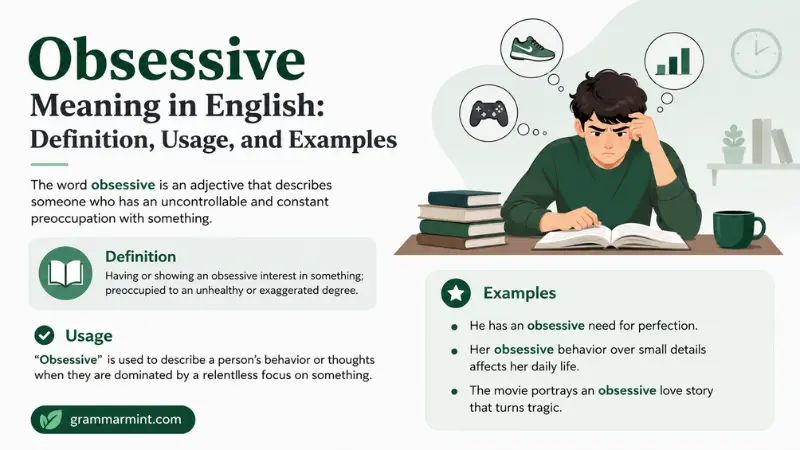
The obsessive meaning is having an excessive or persistent focus on someone or something. It often suggests attention that is unusually intense, repeated, or difficult to control.
TL;DR
• Obsessive usually means excessively focused or preoccupied.
• It is mainly used as an adjective.
• It can sometimes function as a noun.
• “Obsessive about” is a common English pattern.
• The word usually has a negative tone.
• Obsessive does not automatically mean someone has OCD.
What Does Obsessive Mean?
“Obsessive” describes a level of interest or attention that goes beyond ordinary enthusiasm.
A person may think repeatedly about the same subject. Someone may also perform the same action again and again.
For example:
• She has an obsessive interest in old movies.
• He showed obsessive concern about being late.
• Her attention to small errors became obsessive.
The word usually suggests too much attention rather than healthy interest.
Someone can love basketball without being obsessive about it. The stronger word suggests that basketball occupies an unusually large amount of attention.
“Obsessive” can describe both people and behavior.
For example:
• an obsessive fan
• obsessive checking
• obsessive thinking
• obsessive attention
• obsessive jealousy
The exact meaning depends on the situation.
Obsessive Pronunciation and Part of Speech
In American English, obsessive is pronounced:
uhb-SESS-iv
The stress falls on the second syllable: SESS.
“Obsessive” is mainly an adjective.
It can describe a person:
• She became obsessive about punctuality.
It can describe an interest:
• He developed an obsessive interest in vintage cameras.
It can describe behavior:
• His obsessive checking delayed the group.
It can also describe a need:
• She felt an obsessive need to review every detail.
“Obsessive” can sometimes be used as a noun for a person with obsessive tendencies.
For example:
• He was described as an obsessive.
However, this noun use can sound harsh or labeling. Describing the behavior is often more neutral.
How to Use Obsessive in a Sentence
One common structure is:
obsessive about + noun
This structure shows what receives the excessive attention.
Examples:
• He is obsessive about punctuality.
• She became obsessive about tracking expenses.
• They are obsessive about keeping the house spotless.
• Marcus is obsessive about checking his schedule.
Another common structure is:
obsessive + noun
Examples include:
• obsessive behavior
• obsessive thinking
• obsessive interest
• obsessive attention
• obsessive jealousy
• obsessive concern
• obsessive need
• obsessive checking
You can also use become obsessive when a normal interest grows excessive.
For example:
• His training became obsessive.
This sentence suggests that his training was once normal but later became excessive.
Obsessive Meaning in Different Contexts
The meaning stays similar across contexts, but the tone can change.
Obsessive About Work
Someone who is obsessive about work may think about it constantly.
For example:
• He became obsessive about completing every task perfectly.
This sounds stronger than saying he is hardworking.
Obsessive About a Hobby
A hobby can become obsessive when it takes too much time or attention.
For example:
• Her interest in collecting sneakers became obsessive.
This does not simply mean that she enjoys collecting sneakers.
Obsessive About Appearance
The word may describe excessive concern about appearance.
For example:
• He became obsessive about checking his clothes before leaving.
The sentence suggests more than ordinary care.
Obsessive in Relationships
In relationship contexts, “obsessive” may describe excessive focus on another person.
For example:
• His interest in the relationship became obsessive.
Depending on the situation, this could involve constant thoughts, repeated checking, or excessive jealousy.
The word should be used carefully because it can sound judgmental.
Is Obsessive Positive or Negative?
“Obsessive” usually has a negative or cautionary meaning.
It suggests that something has gone beyond ordinary interest or concentration.
Compare:
• She is focused on her work.
• She is obsessive about her work.
The first sentence sounds neutral or positive.
The second suggests that work may receive too much attention.
However, “obsessive” can occasionally sound almost complimentary.
For example:
• She has obsessive attention to detail.
The speaker may admire the result. Still, the word suggests unusually intense attention.
If you want a clearly positive word, consider:
• dedicated
• passionate
• focused
• meticulous
• committed
These words usually avoid the negative sense of excess.
Obsessive vs OCD
“Obsessive” is a normal English adjective. OCD is the abbreviation for obsessive-compulsive disorder.
They are not the same thing.
A person can have an obsessive habit without having OCD.
OCD involves persistent obsessions, compulsions, or both. These symptoms can cause distress or interfere with everyday life.
Occasionally double-checking something does not automatically indicate OCD.
For example, this casual statement can be misleading:
• I am so OCD because I organize my books.
A clearer sentence would be:
• I like keeping my books carefully organized.
Avoid using a medical term simply to describe neatness or careful habits.
Although “obsessive” and “obsessed” are closely related, they serve different purposes in a sentence.
The word obsessive usually describes a pattern, habit, quality, or type of behavior. By contrast, obsessed describes someone who is intensely focused on a specific person, activity, or subject.
• He has obsessive habits.
• She developed obsessive thoughts about the problem.
Obsessed usually describes someone who is intensely focused on something.
• He is obsessed with sneakers.
• She became obsessed with solving the puzzle.
A simple way to remember the difference is:
| Word | Common Use | Example |
|---|---|---|
| obsessive | describes behavior or tendency | He has obsessive habits. |
| obsessed | describes someone’s current focus | He is obsessed with baseball. |
Notice the common patterns:
• obsessive about something
• obsessed with something
Related Words in the Obsessive Word Family
Several related words come from the same word family.
Obsess
Obsess is a verb.
It means to occupy someone’s thoughts repeatedly.
Examples:
• Do not obsess over one small mistake.
• He tends to obsess about minor details.
Obsessed
Obsessed is usually an adjective.
It describes someone intensely preoccupied with something.
Examples:
• She is obsessed with old movies.
• He became obsessed with finding the answer.
Obsession
Obsession is a noun.
It names the intense interest or preoccupation.
Examples:
• Photography became his latest obsession.
• Her concern slowly turned into an obsession.
Obsessively
Obsessively is an adverb.
It describes how an action is performed.
Examples:
• He checked his phone obsessively.
• She revised the document obsessively.
Obsessive
Obsessive usually describes a quality, tendency, or behavior.
Example:
• She has an obsessive need to organize everything.
These words are related, but they are not interchangeable.
Synonyms for Obsessive
No synonym matches “obsessive” perfectly in every sentence.
Useful alternatives include:
• compulsive — driven by a powerful urge
• fixated — unable to shift attention easily
• preoccupied — deeply absorbed in thoughts
• intense — very strong or extreme
• driven — strongly motivated
• obsessional — closely related to obsession
Some words are softer than “obsessive.”
For example:
• dedicated
• passionate
• focused
• meticulous
Choose the word that best matches the tone.
“Passionate” sounds positive.
“Obsessive” usually suggests excess.
Antonyms for Obsessive
The best opposite depends on the sentence.
Possible antonyms include:
• casual
• moderate
• relaxed
• unconcerned
• detached
For example:
obsessive interest → casual interest
This is a natural contrast.
However, not every antonym works in every context.
For example, “relaxed interest” may sound unnatural in some sentences.
Origin of Obsessive
“Obsessive” belongs to the same word family as “obsess” and “obsession.”
Its deeper history traces back to a Latin word connected with surrounding, occupying, or besieging.
This older idea helps explain the modern meaning.
An obsession can feel as though one thought has occupied the mind.
Over time, the word family developed meanings connected with persistent thoughts and excessive preoccupation.
Today, “obsessive” is used in both everyday and psychological contexts.
Examples of Obsessive in Sentences
Here are natural examples showing different uses:
• Maya became obsessive about checking her application status.
• His obsessive focus on tiny errors slowed the project.
• She developed an obsessive interest in vintage clothing.
• His exercise routine was becoming obsessive.
• The collector had an obsessive interest in rare postcards.
• Her obsessive concern about being late affected every morning.
• The coach warned against obsessive tracking of every statistic.
• His interest was strong but never became obsessive.
• She became obsessive about keeping her desk perfectly organized.
• His obsessive attention to detail impressed the client.
• The habit started normally but gradually became obsessive.
• She worried that her social media checking was becoming obsessive.
Common Mistakes With Obsessive
Using the Wrong Preposition
Less natural:
• She is obsessive with her grades.
Better:
• She is obsessive about her grades.
Use obsessive about when naming the subject of excessive focus.
Confusing Obsessive With Passionate
“Obsessive” and “passionate” do not mean the same thing.
Compare:
• She is passionate about photography.
• She is obsessive about photography.
“Passionate” usually sounds positive.
“Obsessive” suggests that the interest may be excessive.
Using Obsessive When Focused Is Enough
Compare:
• He is focused on his fitness goals.
• He is obsessive about his fitness goals.
The second sentence is much stronger.
Use “obsessive” only when the idea of excess matters.
Confusing Obsessive and Obsessed
Incorrect or unnatural:
• He is obsessive with football.
Better:
• He is obsessive about football.
Or:
• He is obsessed with football.
Both can work, but their grammatical patterns differ.
Mini Quiz
1. Which sentence is correct?
A. She is obsessive about punctuality.
B. She obsessive about punctuality.
2. What part of speech is “obsessive” mainly?
A. Adjective
B. Conjunction
3. Which word names an intense preoccupation?
A. Obsession
B. Obsessively
4. Which phrase usually sounds more positive?
A. Passionate about music
B. Obsessive about music
5. Which sentence uses “obsessed” correctly?
A. He is obsessed with basketball.
B. He is obsessed about basketball.
Answer Key: 1-A, 2-A, 3-A, 4-A, 5-A
Frequently Asked Questions
What does obsessive mean in a person?
It means someone shows unusually strong or repeated focus on something.
The word often suggests that the focus has become excessive or difficult to control.
Is obsessive a positive or negative word?
“Obsessive” is usually negative or cautionary.
It suggests more attention or interest than seems normal or reasonable.
Can obsessive have a positive meaning?
Sometimes.
A phrase like “obsessive attention to detail” may praise extreme care. However, “meticulous” usually sounds more clearly positive.
What does obsessive mean in a relationship?
It can describe excessive focus on another person or the relationship.
It may involve persistent thoughts, repeated checking, jealousy, or difficulty maintaining balance.
What does obsessive mean in love?
It usually describes romantic attention that has become unusually intense or consuming.
Strong love alone does not automatically make someone obsessive.
What is the difference between obsessive and obsessed?
“Obsessive” usually describes a tendency, habit, or type of behavior.
“Obsessed” usually describes someone intensely focused on a specific person, subject, or activity.
For example:
• He has obsessive habits.
• He is obsessed with collecting sneakers.
Is obsessive the same as OCD?
No.
“Obsessive” is a general English word. OCD is a specific mental-health disorder involving obsessions, compulsions, or both.
Conclusion
The obsessive meaning is excessive or persistent focus on a person, idea, activity, habit, or concern.
The word is stronger than “interested” or “focused” and often carries a negative tone. Use it when the idea of unusually intense attention is important.