You may see symbolism discussed in English class, books, movies, art, religion, and everyday culture. The word describes how something familiar can represent a larger idea or feeling.
For example, a storm may suggest conflict in a story. A sunrise may represent hope or a fresh beginning. The object or event keeps its literal meaning while gaining another layer.
Understanding symbolism helps you notice ideas that writers and artists do not state directly. It can also make stories, films, and artwork easier to understand.
This guide explains the symbolism meaning in simple English. You will also learn how symbolism works, where it appears, and how to recognize it.
Quick Answer
Symbolism meaning refers to using an object, image, color, person, place, or action to represent a deeper idea or feeling. It is common in literature, art, film, religion, and everyday culture.
TL;DR
• Symbolism gives something meaning beyond its literal role.
• A symbol can represent an idea, emotion, or quality.
• Context helps determine what a symbol means.
• Symbolism is a noun and is usually uncountable.
• It is standard English, not slang.
• A symbol and symbolism are related but different.
What Does Symbolism Mean?
Symbolism is the use of symbols to represent larger ideas, emotions, qualities, or themes.
A symbol may be an object, color, animal, place, action, or person. Its deeper meaning depends on how it appears in a specific situation.
For example, a locked door may simply block an entrance. In a story, however, it could represent secrecy, fear, or exclusion.
A candle may provide light. At the same time, it may represent hope, memory, faith, or life.
The important point is that symbolism adds meaning without removing the literal meaning.
How Symbolism Works
Symbolism connects something concrete with an abstract idea.
Readers and viewers often understand that connection through context, culture, repetition, and emotion. A creator may also emphasize a symbol during important moments.
Suppose a story repeatedly shows a bird whenever a character thinks about freedom. The bird may begin to represent that character’s desire to escape.
Repeated details are often important, but repetition is not required. A single powerful image can also carry symbolic meaning.
Context matters most. Rain may represent sadness in one story but renewal in another.
Where Symbolism Appears
Symbolism is not limited to books. It appears across many forms of communication and culture.
Literature
Writers use objects, settings, characters, colors, and actions to express deeper ideas.
A road may represent a life journey. A broken mirror could suggest damaged identity or change.
Movies and Television
Filmmakers can create symbolism through lighting, costumes, objects, music, and repeated images.
Dark lighting may suggest fear or uncertainty. Bright light can suggest safety, truth, or hope.
Art
Artists often use colors, shapes, animals, plants, and objects to express ideas or emotions.
The meaning may depend on the artist’s culture, time period, and subject.
Religion
Religious traditions often use symbols to represent beliefs, values, sacred ideas, or important events.
Their meanings can be specific to a particular faith or tradition.
Everyday Culture
Flags, flowers, colors, jewelry, clothing, and gestures can carry symbolic meanings.
Even personal objects can become symbols. A family photograph might represent love, memory, or belonging.
Common Symbolism Examples
Many familiar objects have symbolic associations.
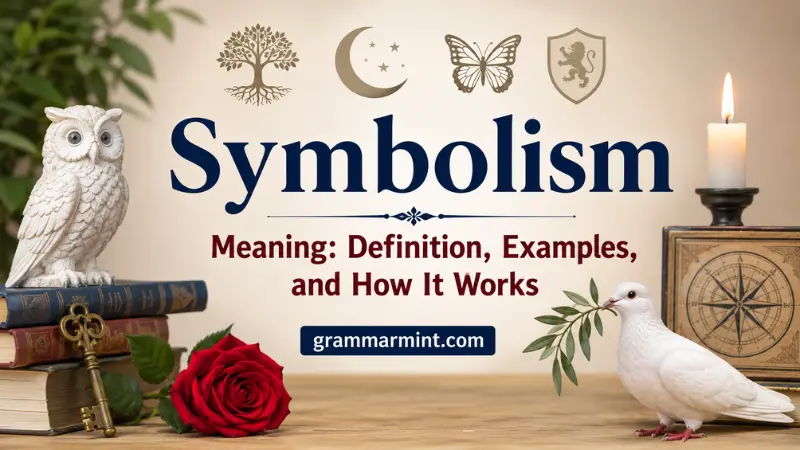
• Red rose: love, romance, or passion
• White dove: peace or hope
• Sunrise: new beginnings or hope
• Darkness: fear, mystery, or uncertainty
• Light: truth, knowledge, or hope
• Broken chain: freedom or release
• Crown: authority, power, or leadership
• Road: journey, choices, or personal growth
• Empty chair: absence, loss, or memory
• Clock: time, pressure, aging, or mortality
These meanings are common, but they are not automatic.
A red rose could represent love in one story and grief in another. Always examine the surrounding context.
Pronunciation and Part of Speech
Symbolism is pronounced:
SIM-buh-liz-um
It is a noun.
Symbolism is usually used as an uncountable noun.
Natural examples include:
• “The novel contains religious symbolism.”
• “I noticed the symbolism in the final scene.”
• “The painting is full of symbolism.”
Related words include:
• Symbol — something that represents another idea
• Symbolize — to represent something
• Symbolic — having a symbolic meaning
• Symbolically — in a symbolic way
Symbol vs. Symbolism
A symbol is the actual object, image, person, or action that represents something else.
Symbolism is the use of symbols or the deeper meaning created through them.
For example:
A dove can be a symbol of peace.
Using that dove to communicate peace is an example of symbolism.
The difference is simple: the symbol is the thing, while symbolism is how symbolic meaning works.
Symbolism vs. Metaphor
Symbolism and metaphor are related, but they are not the same.
A metaphor directly describes one thing as another to create a comparison.
For example:
“Time is a thief.”
Time is not literally a thief. The metaphor suggests that time takes things away from us.
Symbolism usually works through an object or image that represents something larger.
For example, a clock appearing throughout a story may symbolize the passing of time.
Symbolism vs. Motif
A motif is a recurring element in a story or artwork.
It might be an image, phrase, color, sound, object, or idea.
A motif can become symbolic, but repetition alone does not make something a symbol.
For example, repeated images of water may form a motif. If water consistently connects with change or renewal, it may also carry symbolic meaning.
Symbolism vs. Allegory
An allegory uses symbolic meaning across much of a story.
Characters, events, or settings may represent larger moral, political, social, or philosophical ideas.
Symbolism can be much smaller.
A single flower, color, or object can be symbolic without making the whole story an allegory.
Origin and History of Symbolism
The word symbolism has been used in English since the seventeenth century.
It comes from symbol combined with the ending -ism.
The word symbol has much older roots and developed through Greek and Latin before entering English.
There is also a historical artistic meaning of the word.
Capitalized Symbolism refers to an artistic and literary movement that became influential in Europe during the late nineteenth century.
Artists and writers connected with this movement often favored suggestion, imagination, emotion, and symbolic imagery.
This historical movement should not be confused with the everyday meaning of symbolism.
How to Identify Symbolism
Finding symbolism becomes easier when you look for clues.
Start by asking whether an object or image receives unusual attention.
Then consider whether it appears during important moments.
You can also ask:
Notice whether the detail appears more than once.
Check if it connects with a strong emotion.
See whether it supports an important theme.
Consider if its meaning changes during the story.
Watch for extra attention from the writer or creator.
Think about whether culture gives it another meaning.
Good interpretations usually have evidence behind them.
Do not assume that every detail contains a secret message.
Common Mistakes When Interpreting Symbolism
One common mistake is treating every object as symbolic.
Sometimes an object exists only because the story needs it.
Another mistake is believing that every symbol has one permanent meaning.
A snake, for example, may represent danger in one context. In another, it may suggest transformation or renewal.
Readers can also ignore cultural differences.
Colors, animals, plants, and gestures do not carry identical meanings everywhere.
The best approach is to use context first.
Does Symbolism Have Synonyms?
Symbolism does not have one perfect synonym that works in every sentence.
Depending on the context, related terms may include:
• representation
• symbolic meaning
• imagery
• figurative meaning
• signification
However, these words are not always interchangeable.
There is also no exact opposite of symbolism.
Literal meaning is often the most useful contrast.
A literal meaning describes something directly. A symbolic meaning adds another layer.
Mini Quiz
1. What does symbolism do?
A. Corrects spelling
B. Gives something a deeper representative meaning
C. Changes sentence grammar
2. Which example may show symbolism?
A. A clock simply showing 3:00
B. A repeated clock showing that time is running out
C. A dictionary defining “clock”
3. What part of speech is symbolism?
A. Noun
B. Verb
C. Adjective
4. Does every symbol have one fixed meaning?
A. Yes
B. No
Answer Key: 1-B, 2-B, 3-A, 4-B
FAQs
What is symbolism in simple terms?
Symbolism means using something to represent a deeper idea, emotion, or quality. The symbol keeps its normal meaning while gaining an additional meaning.
What is an example of symbolism?
A sunrise can symbolize hope or a new beginning. The surrounding story or situation helps determine its exact meaning.
What does symbolism mean in literature?
In literature, symbolism happens when writers use objects, characters, colors, places, or actions to suggest larger ideas. It often helps support a theme.
Why do writers use symbolism?
Writers use symbolism to communicate ideas without explaining everything directly. It can add emotion, depth, and meaning to a story.
How do you identify symbolism?
Look for important or repeated details connected to major themes or emotions. Then use context to decide what those details may represent.
What is the difference between a symbol and symbolism?
A symbol is something that represents another idea. Symbolism is the use of symbols and the deeper meaning they create.
Is symbolism a literary device?
Yes. Symbolism is commonly used as a literary device. However, it also appears in art, film, religion, culture, and everyday communication.
Conclusion
Understanding symbolism meaning helps you see how ordinary things can communicate larger ideas. Objects, colors, places, and actions may all carry deeper meanings.
Always begin with context instead of assuming a symbol has one fixed definition. This approach makes symbolism easier to recognize and interpret.