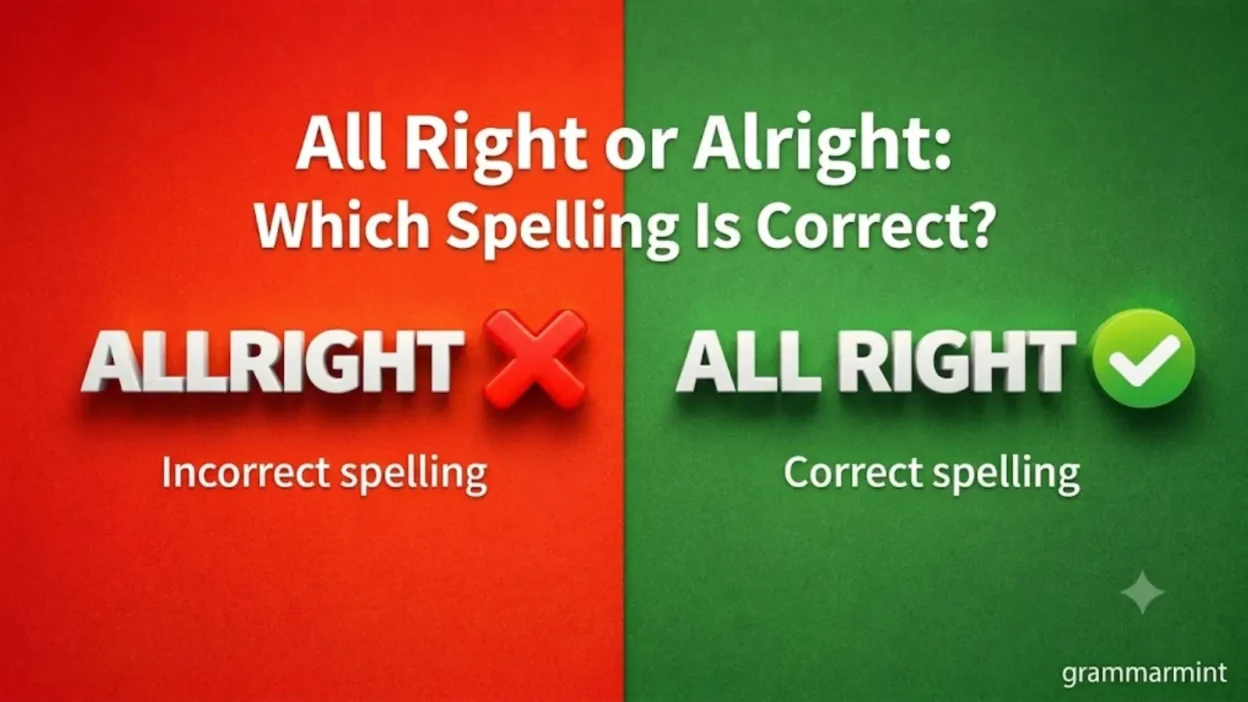
If you’ve ever paused while typing all right or alright, you’re in good company. These two forms show up in emails, texts, essays, dialogue, subtitles, dictionaries, grammar checkers, and modern writing advice. The short answer is simple, but the real choice depends on tone, audience, and context.
This guide explains the correct spelling, common usage, formal preference, informal tone, meaning, sentence examples, and easy rules. By the end, you’ll know which form to use in schoolwork, business writing, creative dialogue, casual messages, and everyday American English.
Quick Answer
All right or alright usually means “okay,” but all right is the safer standard spelling. Alright is common in casual writing, yet some teachers, editors, and style guides still prefer all right.
TL;DR
• All right is always the safest choice.
• Alright works best in casual writing.
• Both often mean okay or fine.
• Formal writing usually needs all right.
• Use all right for “all correct.”
• When unsure, choose all right.
All Right Or Alright
The simple rule is easy to remember. Use correct spelling when your writing needs to look polished. In most cases, standard form means choosing all right.
Alright is the one-word spelling, and readers understand it. However, some readers still see it as too casual.
• Use all right for school essays.
• Choose all right in business messages.
• Pick all right for formal reports.
• Use alright in relaxed texting.
• Choose alright for casual dialogue.
• Avoid alright in strict assignments.
• Use all right with cautious readers.
• Choose all right for polished writing.
• Use alright for a breezy tone.
• Pick all right when unsure.
• Keep all right in resumes.
• Use alright only with purpose.
All Right Vs Alright
All right and alright often carry the same meaning. Still, their tone feels different to many readers. That’s why context matters.
In formal writing, all right usually looks more careful. In informal writing, alright can feel natural and conversational.
• All right feels more traditional.
• Alright feels more relaxed.
• All right fits edited prose.
• Alright suits quick messages.
• All right avoids style objections.
• Alright may sound modern.
• All right works everywhere.
• Alright works in casual spaces.
• All right looks more neutral.
• Alright can sound warmer.
• All right is less risky.
• Alright is more expressive.
All Right Meaning
All right can mean okay, satisfactory, or safe. It can describe a person, a result, a plan, or a situation. Therefore, it is very flexible.
You can use all right after words like is, feel, look, seem, or sound. It also works as a reply.
• The plan sounds all right.
• She feels all right today.
• Your answer is all right.
• Everything looks all right now.
• That meal was all right.
• He drives all right.
• All right, let’s begin.
• It went all right overall.
• The room seems all right.
• Their idea sounded all right.
• I’m all right, thanks.
• The score was all right.
Alright Meaning
Alright usually means okay, fine, or acceptable. It is a casual spelling with an informal tone. Because of that, it often appears in texts, dialogue, lyrics, and social posts.
Many readers find alright acceptable in everyday writing. Still, it may feel too loose in serious work.
• Alright, I’ll call later.
• The movie was alright.
• She’s doing alright now.
• Alright, that makes sense.
• This coffee tastes alright.
• He seems alright today.
• Alright, let’s move on.
• The party went alright.
• I feel alright again.
• Alright, I understand now.
• Your draft looks alright.
• Everything turned out alright.
Is Alright A Word
Yes, alright appears as a dictionary entry in some modern references. However, labels and advice can vary. Some sources still call it nonstandard.
That means alright is real in common usage, but not always welcome. So, your safest choice still depends on the setting.
• Alright exists in modern dictionaries.
• Some references flag it carefully.
• Many readers accept alright casually.
• Some teachers still reject it.
• Editors may change it silently.
• Dialogue often keeps alright.
• Text messages commonly use alright.
• Academic papers rarely need alright.
• House style may forbid alright.
• Published writing includes both forms.
• Acceptance keeps changing slowly.
• Safe writing favors all right.
Is Alright Proper Grammar
The grammar issue is mostly about spelling and style. In standard English, all right remains the less controversial form. That makes it the better default.
A simple grammar rule helps. In edited writing, use all right unless you have a strong reason.
• Use all right in classwork.
• Use all right in applications.
• Use all right in articles.
• Use all right in instructions.
• Use all right in reports.
• Use alright in character speech.
• Use alright in casual captions.
• Use alright in friendly chats.
• Avoid alright for strict editors.
• Avoid alright in legal writing.
• Prefer all right professionally.
• Let tone guide exceptions.
All Right Or Alright In Formal Writing
Formal settings reward clarity and caution. In academic writing, all right is the better choice. It also fits a professional email without drawing attention.
Many editors follow a style guide or house preference. Therefore, all right keeps your wording clean.
• Write all right in essays.
• Use all right in cover letters.
• Choose all right in proposals.
• Keep all right in newsletters.
• Use all right in manuals.
• Pick all right for client work.
• Choose all right in policies.
• Use all right in presentations.
• Keep all right in reports.
• Avoid alright in applications.
• Avoid alright in contracts.
• Use all right for authority.
All Right Or Alright In Informal Writing
Informal writing gives you more room. In texting, alright often sounds friendly and natural. In dialogue, it can make a voice feel real.
A casual voice matters when tone is the goal. Still, all right also works casually, so you’re never trapped.
• Alright fits quick replies.
• Alright sounds natural in chats.
• Alright works in friendly comments.
• Alright can soften agreement.
• Alright suits relaxed captions.
• Alright helps character voice.
• Alright can feel conversational.
• Alright works in group texts.
• All right still works casually.
• All right feels slightly cleaner.
• Use either with friends.
• Match your usual tone.
All Right Or Alright Examples
Good example sentences make the choice easier. The best spelling depends on context. You also want natural usage, not stiff grammar.
Try reading each sentence aloud. If the setting is formal, switch to all right.
• All right, I’ll send it.
• Alright, I’ll text you.
• Your notes look all right.
• The concert was alright.
• Is everyone all right?
• She seems alright now.
• The files are all right.
• The snack tasted alright.
• All right, we agree.
• Alright, that’s enough.
• His timing was all right.
• The joke landed alright.
All Right Or Alright In A Sentence
All right and alright can act in several ways. As an adjective, they describe a condition. As an adverb, they describe how something happens.
They can also work as an interjection. That means they can stand at the start of a reply.
• As adjective: I’m all right.
• As adjective: He seems alright.
• As adverb: She sings all right.
• As adverb: They played alright.
• As reply: All right, fine.
• As reply: Alright, sure.
• After feel: I feel all right.
• After look: You look alright.
• After sound: That sounds all right.
• Before action: Alright, begin now.
• With concern: Are you all right?
• With agreement: All right, agreed.
Are You All Right Or Alright
When asking about someone’s well-being, all right is safest. It shows concern without looking too casual. That matters in serious moments.
If the tone is relaxed, alright may still work. However, for safety and reassurance, all right feels warmer and clearer.
• Are you all right?
• Is your sister all right?
• Everyone got home all right.
• I hope you’re all right.
• Please tell me you’re all right.
• Are the kids all right?
• He sounded all right yesterday.
• She looked all right after practice.
• Text me when you’re all right.
• Are we all right now?
• Your friend seems all right.
• Make sure they’re all right.
It’s All Right Or It’s Alright
It’s all right often gives permission, forgiveness, or comfort. It can calm someone after a mistake. It can also approve a small request.
It’s alright feels more casual. Still, both can sound kind when the context is gentle.
• It’s all right, don’t worry.
• It’s alright, I understand.
• It’s all right to ask.
• It’s alright to wait.
• It’s all right, try again.
• It’s alright, mistakes happen.
• It’s all right with me.
• It’s alright for now.
• It’s all right, we’re safe.
• It’s alright, keep going.
• It’s all right to rest.
• It’s alright, I forgive you.
Alright Vs Okay
Alright and okay can overlap. Both can mean okay, fine, or acceptable. Yet okay is often more neutral.
If you want the least debate, okay is useful. However, all right can sound more complete and natural.
• Okay works in most places.
• All right sounds slightly fuller.
• Alright sounds more casual.
• Okay avoids spelling debates.
• Fine can sound colder.
• Acceptable sounds more formal.
• Okay fits quick approvals.
• All right fits reassurance.
• Alright fits friendly agreement.
• Okay can feel plain.
• All right can feel warmer.
• Choose by tone first.
All Right Vs All Correct
This is where spelling can change clarity. All right can mean “okay,” but it can also mean all correct. That second meaning points to every answer or every item.
Alright does not work well for that exact meaning. So, avoid ambiguity when accuracy matters.
• The answers are all right.
• That means every answer is correct.
• The answers are alright.
• That means they are acceptable.
• All items are all right.
• All right can mean correct.
• Alright usually means okay.
• Context prevents confusion.
• Tests need careful wording.
• Grades need precise wording.
• Instructions need all right.
• Accuracy favors two words.
Alrighty Or All Righty
Alrighty is a casual variant. It has a playful tone and belongs mostly to spoken English. You’ll see it in cheerful replies and light dialogue.
All righty also appears sometimes. However, alrighty is the more familiar-looking casual form.
• Alrighty, let’s get started.
• Alrighty then, we’re done.
• Alrighty, see you soon.
• Alrighty works in jokes.
• Alrighty sounds cheerful.
• Alrighty feels informal.
• Avoid alrighty in reports.
• Avoid alrighty in essays.
• Use all righty sparingly.
• Dialogue can handle alrighty.
• Texting can handle alrighty.
• Professional writing usually cannot.
All Right Synonyms
Sometimes the best fix is a new word. Synonyms like fine, acceptable, and satisfactory can sharpen your sentence. They also help you avoid repetition.
Pick the word that matches your tone. A tiny change can make the whole sentence clearer.
• Use okay for simple approval.
• Use fine for mild approval.
• Use safe for well-being.
• Use correct for accuracy.
• Use acceptable for standards.
• Use decent for casual judgment.
• Use approved for permission.
• Use settled for agreement.
• Use fair for evaluation.
• Use sound for reliability.
• Use healthy for condition.
• Use suitable for fit.
FAQs
Is It All Right Or Alright?
All right is the safer spelling in American English. Alright is common in casual writing, but some readers still prefer the two-word form.
Is Alright A Real Word?
Yes, alright appears in some dictionaries and real-world writing. However, it may be labeled informal or nonstandard, so use it carefully.
Is Alright Proper Grammar?
Alright is widely understood, but it is not always accepted in formal settings. For strict grammar, schoolwork, and professional writing, choose all right.
Should I Use All Right In Formal Writing?
Yes, all right is the best choice for formal writing. It avoids objections and keeps your style clean.
What Does All Right Mean?
All right usually means okay, fine, safe, or satisfactory. It can describe a person, action, result, or situation.
Can Alright Be Used In Dialogue?
Yes, alright works well in dialogue when a casual voice fits. It can make speech sound natural and relaxed.
What Is The Difference Between All Right And All Correct?
All right can mean that every answer or item is correct. Alright usually means okay or acceptable, not “every one is right.”
Conclusion
All Right or Alright is easy once you know the setting. Use all right when you want the safest, most accepted spelling.
Use alright when the tone is casual, friendly, or voice-driven. When in doubt, all right is always all right.