You’ll see both “in route” and “en route” in everyday writing and conversation. They sound similar, and both seem to describe someone traveling or moving toward a destination.
That similarity is exactly why people mix them up.
But only one of them is the established, standard expression in English. The other is a casual variation that often appears in speech but does not follow standard usage rules in formal writing.
This guide breaks everything down in a simple, practical way so you always know which one to choose.
Quick Answer
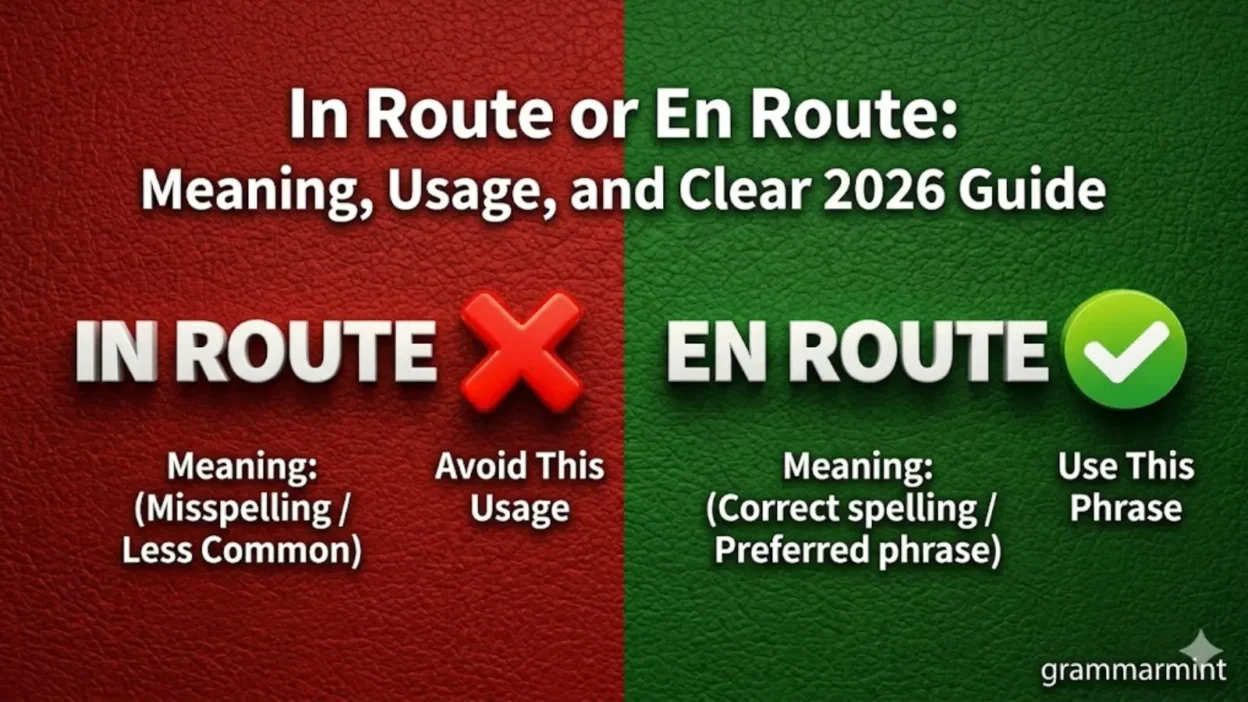
“En route” is correct and standard English.
It means “on the way to a place.”
“In route” is not standard. It appears in informal speech but is generally considered incorrect in formal writing.
If you are writing anything professional, academic, or public-facing, always use en route.
Why People Confuse Them
The confusion is very natural because both phrases feel logical in English.
People already know:
- “route” means a path or direction
- “in” often means being inside or within something
So “in route” sounds like it could mean “on the way along a route.”
But English doesn’t always build phrases in a literal way. Some expressions come from other languages or fixed historical usage patterns.
“En route” is one of those fixed expressions. It comes from French and entered English as a set phrase, not a word-by-word construction.
That’s why replacing it with “in route” feels logical—but doesn’t match standard usage.
Key Differences At A Glance
| Context | Best Choice | Why |
|---|---|---|
| Formal writing (emails, reports, school work) | En route | Standard accepted phrase |
| Navigation or travel updates | En route | Clear, widely understood |
| Casual conversation | En route | Still the correct option |
| Informal speech (some dialects) | In route | Common spoken variation but nonstandard |
Meaning and Usage Difference
En route
“En route” means:
on the way to a destination or in the process of traveling
It is treated as a fixed phrase. You don’t change its structure or grammar.
You will see it used in:
- travel updates
- shipping and delivery tracking
- professional communication
- news reports
- everyday writing
Examples of natural usage:
- The flight is en route to Chicago.
- We are en route to the conference.
- The package is en route and will arrive tomorrow.
It works like a single unit, not separate words.
In route
“In route” is an informal variation that people sometimes say when speaking casually.
It is not recognized as the standard phrase in formal English. It appears mainly when speakers try to describe travel in a more literal way, as if “in the process of being on a route.”
Examples you may hear:
- I’m in route to work.
- They’re in route to the airport.
Even though the meaning is usually understood, it is not considered correct in standard writing.
Tone, Context, and Formality
En route
- Tone: Neutral, professional
- Context: Suitable for all settings
- Form: Fixed expression
- Perception: Natural and correct
“En route” works in both speech and writing without drawing attention to itself.
In route
- Tone: Casual
- Context: Informal conversation
- Form: Nonstandard variation
- Perception: Can sound incorrect in formal settings
“In route” is mostly something you might hear in spoken language, not something you’d typically see in polished writing.
Which One Should You Use?
The simple rule is:
Use en route in all writing situations.
That includes:
- emails
- essays
- resumes
- reports
- messages to clients
- travel updates
- public posts
Avoid in route in anything formal or professional.
Even in casual writing, “en route” is still the better choice because it is short, natural, and widely understood.
When One Choice Sounds Wrong
“In route” can feel off in written English because it doesn’t match the established expression.
Here’s where it tends to stand out:
- job applications
- business communication
- academic writing
- official travel updates
- customer notifications
In these contexts, readers expect “en route.”
On the other hand, “en route” never sounds wrong in modern English. It is widely recognized across all levels of formality.
Common Mistakes (and Quick Fixes)
Many errors come from trying to translate the idea too literally.
Mistake: I am in route to the office.
Fix: I am en route to the office.
Mistake: The driver is in route now.
Fix: The driver is en route now.
Mistake: We are in route and will arrive soon.
Fix: We are en route and will arrive soon.
Mistake: Package is in route for delivery.
Fix: Package is en route for delivery.
A helpful mindset:
Don’t build the phrase word-by-word. Treat “en route” as a single fixed expression.
Everyday Examples
Here are more real-world examples to show natural usage:
- The ambulance is en route to the hospital.
- She called and said she’s en route home.
- The shipment is en route to your city.
- We’re en route to the meeting now.
- The band is en route to the concert venue.
- I’m en route and should be there in 10 minutes.
- The courier is en route with your order.
- They are currently en route to the airport terminal.
Notice how “en route” stays unchanged in every situation. That consistency is part of why it’s preferred.
Quick Comparison Table (Core Difference)
| Feature | En Route | In Route |
|---|---|---|
| Correct in formal English | Yes | No |
| Common in writing | Yes | Rare |
| Common in speech | Yes | Sometimes |
| Perceived correctness | Standard | Nonstandard |
| Meaning clarity | Clear and fixed | Understandable but informal |
Dictionary-Style Word Details
Verb
- En route: Not used as a verb in standard English. It functions as a fixed phrase.
- In route: Not used as a verb.
Both expressions do not change form like normal verbs.
Noun
- En route: Not a noun. It is a fixed expression used adverbially.
- In route: Not a noun.
Neither phrase behaves like a naming word.
Synonyms
- En route: on the way, traveling, heading to, in transit (closest plain alternatives)
- In route: on the way (informal equivalent meaning only)
These are functional substitutes, not perfect replacements in all contexts.
Example Sentences
- En route:
We are en route to the airport and will arrive shortly. - In route:
I’m in route to the store right now. (informal speech only) - En route:
The delivery is en route and tracking is active.
Word History
- En route: Originates from French, meaning “on the way.” It became part of English as a fixed phrase used in travel and movement contexts.
- In route: Developed in English speech as a logical reinterpretation of travel wording, but it is not the original established form.
The key point: “en route” entered English as a set expression, not a word-by-word construction.
Phrases Containing
- En route to:
en route to school, en route to work, en route to destination - En route home:
commonly used in everyday travel updates - En route arrival:
used in logistics or tracking contexts - In route to:
informal spoken variation only, not standard writing usage
Final Takeaway
The difference between “in route” and “en route” is simple but important.
- En route is the correct, standard expression used in writing and speech.
- In route is an informal variation that appears in casual conversation but is not standard English.
If you want clear, natural, and correct English, “en route” is always the safe and professional choice.
FAQs: In Route vs En Route
1. Is “in route” correct English?
“In route” is generally not considered standard English. It may appear in casual speech, but “en route” is the correct and widely accepted form in writing and formal communication.
2. What does “en route” mean?
“En route” means “on the way” or “traveling toward a destination.” It is used when someone or something is moving from one place to another.
3. Why do people say “in route” instead of “en route”?
People often say “in route” because it sounds logical in English. Since “route” refers to a path, speakers sometimes combine it naturally with “in,” even though the standard expression is “en route.”
4. Can I use “en route” in formal writing?
Yes. “En route” is the preferred and correct form in formal writing, including emails, reports, academic work, and professional communication.
5. Is “en route” French or English?
“En route” comes from French and literally means “on the way.” English adopted it as a fixed expression, and it is now standard in modern usage.
6. What is a simple synonym for “en route”?
Common alternatives include “on the way,” “traveling,” or “heading to.” However, “en route” is often more formal and concise.
7. Is “en route” used in American English?
Yes. “En route” is widely used in American English in both formal and everyday contexts, especially in travel updates and professional communication.
8. Can I say “I am en route” in conversation?
Yes. “I am en route” is perfectly natural in conversation and sounds clear, neutral, and correct.
9. Which one should I use: “in route” or “en route”?
Always use “en route.” It is the standard, accepted, and professional form in English.
10. Is “in route” ever acceptable?
It may be understood in informal speech, but it is not recommended for writing or professional communication.
Conclusion
Language often looks flexible, but some expressions are fixed for a reason. “En route” is one of those expressions.
Even though “in route” may feel intuitive, it does not follow standard usage in English writing. Once you recognize “en route” as a single established phrase, the confusion disappears.
From travel updates to professional communication, the correct choice stays consistent: en route is the form you can trust in every situation.