
Coarse and course sound exactly alike, so writers often mix them up. However, these two words have different meanings and grammatical roles.
The easiest rule is simple: coarse describes something rough, crude, or unrefined, while course usually refers to a path, class, meal stage, or progression.
For example, you might feel coarse sand, take a college course, eat a three-course meal, or watch a river change its course. Once you connect each spelling with its main meaning, choosing the correct word becomes much easier.
Quick Answer
Coarse is an adjective meaning rough, uneven, crude, or lacking refinement.
By contrast, course is mainly a noun. It can refer to a route, class, series, direction, meal stage, or progression. In addition, course can function as a verb meaning to move quickly or flow through something.
Examples:
- The towel felt coarse against my skin.
- She signed up for a photography course.
- After the storm, the river changed its course.
- Tears coursed down his face.
Because coarse and course sound the same, they are called homophones.
Key Differences Between Coarse and Course at a Glance
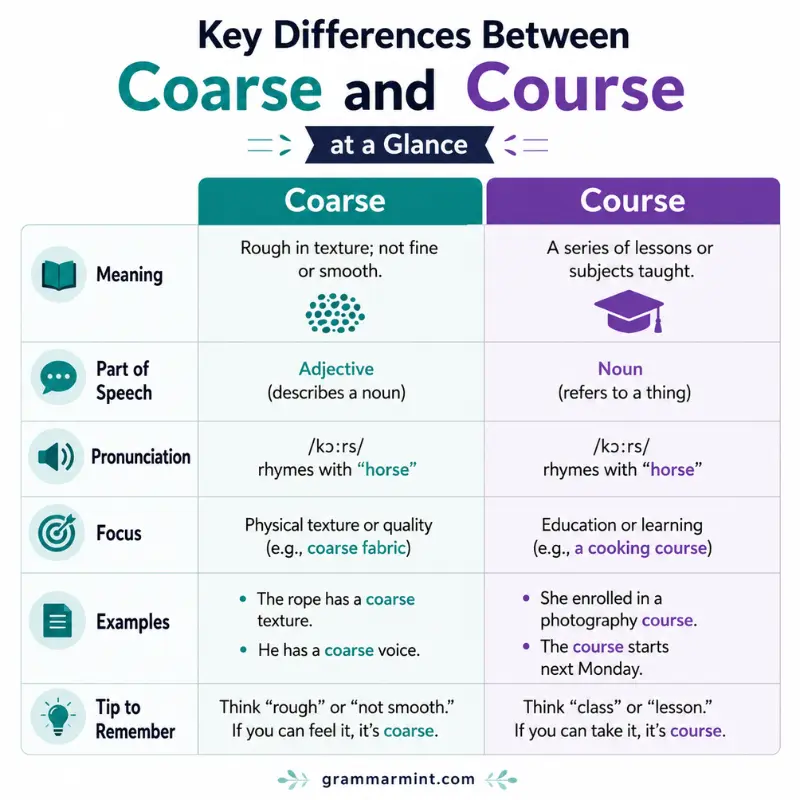
| Feature | Coarse | Course |
|---|---|---|
| Main meaning | Rough, crude, or unrefined | Path, class, series, direction, or meal stage |
| Main part of speech | Adjective | Noun; sometimes verb |
| Texture | coarse sand | Not used |
| Education | Not used | course in math |
| Meals | Not used | main course |
| Direction | Not used | change course |
| Behavior | coarse manners | Not normally used |
| Language | coarse language | Not normally used |
| Movement | Not used | blood coursed through his veins |
In short, the distinction is straightforward.
If you are describing roughness, use coarse. If you are talking about a path, class, sequence, direction, or progression, use course.
What Does Coarse Mean?
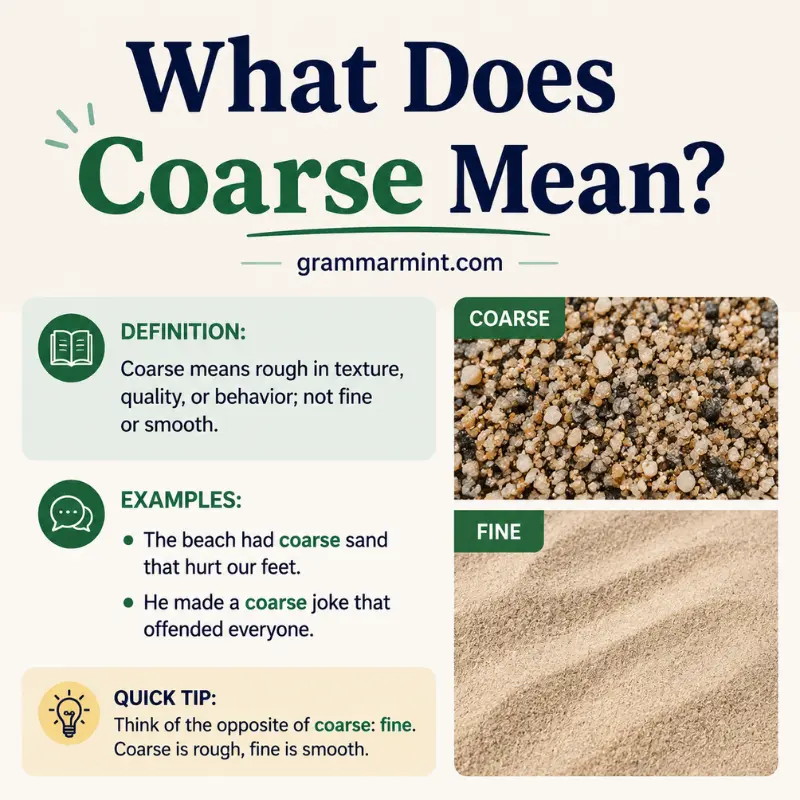
Coarse is an adjective. Generally, it describes something that is physically rough, made of larger particles, or lacking smoothness or refinement.
Coarse for Physical Texture
When something feels rough or uneven, coarse is usually the right choice.
Examples:
- The beach had coarse sand.
- This fabric feels too coarse for a baby blanket.
- He used coarse sandpaper on the wooden table.
- Thick, coarse hair covered the animal.
- The bread was made with coarse flour.
In each sentence, coarse describes a physical quality.
Coarse for Large Particles
Coarse can also describe something made of relatively large pieces or grains.
For example, common combinations include:
- coarse salt
- coarse sugar
- coarse gravel
- coarse sand
- coarse grain
- coarse-ground coffee
Consider this sentence:
“Sprinkle a little coarse salt over the potatoes before baking.”
Here, the salt has larger crystals rather than a fine texture.
Coarse for Behavior or Language
Beyond physical texture, coarse can describe behavior, jokes, manners, or language that sounds rude, crude, or unrefined.
For instance:
- His coarse language upset some guests.
- During the family show, the comedian avoided coarse jokes.
- Her manager criticized his coarse manners.
- Eventually, the conversation became increasingly coarse.
In formal writing, however, a more precise word may sometimes work better. Depending on the meaning, you could use rude, crude, vulgar, or impolite instead.
What Does Course Mean?
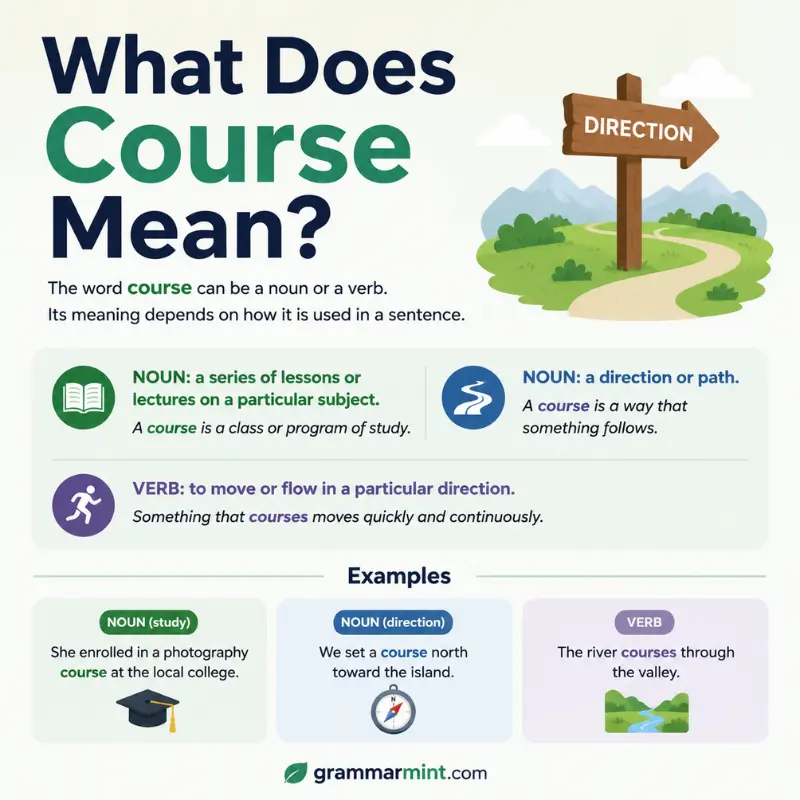
Unlike coarse, course has several common meanings. Most often, it works as a noun, although it can also function as a verb.
At first, these meanings may seem unrelated. However, many of them share the broader idea of a path, sequence, direction, or progression.
Course Meaning a Class or Series of Lessons

One common meaning of course relates to education or training.
For example:
- I am taking an English course this semester.
- She enrolled in an online photography course.
- The company offers a safety training course.
- He completed a beginner coding course.
- This biology course requires weekly lab work.
Usually, a course includes lessons or instruction organized around one subject.
Course vs Class
In American English, course and class are closely related. Still, they are not always identical.
A course usually refers to the complete organized program of study. A class, meanwhile, may refer either to the course itself or to one particular meeting.
For example:
- “I’m taking a chemistry course this semester.”
- “My chemistry class starts at 10 a.m.”
Both sentences are natural, but the intended meaning is slightly different.
Course Meaning a Path, Route, or Direction
Another common use of course refers to a route or direction.
For instance:
- The ship changed course.
- Through the valley, the river follows a winding course.
- The pilot corrected the airplane’s course.
- Suddenly, the storm changed course.
- Despite the delay, we stayed on course.
Course also works figuratively.
For example:
“The company changed course after receiving customer feedback.”
In this case, the company did not physically move. Instead, it changed its plan or strategy.
Course Meaning the Way Events Develop
Course can also refer to the progression of events over time.
Examples include:
- The decision changed the course of history.
- We will see how events develop over the course of the week.
- The symptoms improved during the course of treatment.
- Their friendship changed over the course of several years.
Additionally, English uses the common expression run its course.
This phrase means that something continues naturally until it reaches an expected end.
Correct:
“The illness needs time to run its course.”
Incorrect:
“The illness needs time to run its coarse.”
Course Meaning Part of a Meal
A course can also mean one part of a meal that is served separately from the others.
Common examples are:
- first course
- main course
- dessert course
- three-course meal
- five-course dinner
For example:
- The main course was grilled salmon.
- We ordered a three-course meal.
- Finally, dessert arrived as the last course.
Notice that the compound adjective is three-course, not “three-coarse.”
Correct:
“We enjoyed a five-course dinner.”
Incorrect:
“We enjoyed a five-coarse dinner.”
Course as a Verb
Although course is usually a noun, it can also work as a verb.
As a verb, course can mean to move quickly, flow, or pass through something.
For example:
- Tears coursed down her cheeks.
- Blood coursed through his veins.
- Adrenaline was coursing through his body.
- Water coursed through the narrow channel.
Compared with words such as flowed or moved, coursed often sounds more vivid.
For instance, “Blood coursed through his veins” creates a stronger sense of active movement.
Coarse vs Course: Pronunciation and Grammar
In standard American English, coarse and course are pronounced the same way.
Therefore, pronunciation cannot help you choose the correct spelling. Instead, you need to look at the meaning and grammar of the sentence.
Coarse
Most commonly, coarse functions as an adjective.
Examples:
- coarse sand
- coarse hair
- coarse language
- coarse fabric
In other words, coarse normally describes a noun.
Course
By comparison, course usually functions as a noun.
Examples include:
- a golf course
- a college course
- the main course
- the river’s course
Sometimes, however, it acts as a verb.
Example:
“Tears coursed down her cheeks.”
Common Phrases With Course
Many common English expressions use course, not coarse.
Of Course
Of course means naturally, certainly, or as expected.
Example:
“Of course I can help you.”
Therefore, never write “of coarse” when you mean naturally or certainly.
In the Course of
This expression means during a particular period or process.
Example:
“We learned a lot in the course of the project.”
Over the Course of
Similarly, over the course of means during a period of time.
Example:
“Sales increased over the course of the year.”
Stay the Course
To stay the course means to continue with a plan despite difficulty.
Example:
“The team decided to stay the course rather than change its strategy.”
Set a Course
To set a course means to choose a direction or plan.
Example:
“The organization has set a course for future growth.”
Course of Action
A course of action is a plan or method for handling a situation.
Example:
“We need to decide on the best course of action.”
Run Its Course
When something runs its course, it continues until it naturally ends.
Example:
“The doctor said the infection would likely run its course.”
Common Phrases With Coarse
Although coarse appears in fewer fixed expressions, it combines naturally with many words related to texture and behavior.
For example:
- coarse hair
- coarse sand
- coarse salt
- coarse gravel
- coarse fabric
- coarse texture
- coarse language
- coarse humor
- coarse manners
- coarse grain
Usually, the noun after coarse tells you what type of roughness is being described.
Why Are Coarse and Course So Easy to Confuse?
The main reason is pronunciation. Because both words sound alike, writers may choose the wrong spelling even when they know the intended meaning.
In addition, course has many uses. It can refer to education, navigation, meals, medical treatment, time, events, sports facilities, and physical movement.
As a result, course appears in a wide range of sentences.
Instead of memorizing every possible use, ask yourself one simple question:
Am I describing roughness?
If the answer is yes, choose coarse.
Otherwise, if you are referring to a path, class, direction, sequence, meal stage, or progression, choose course.
Origin and Why Two Spellings Exist
The history of coarse and course is more complicated than assuming that the letter a makes one word an adjective.
Over time, English spelling developed gradually, while the two words developed different meanings.
Course became associated with ideas such as running, movement, direction, and progression. As a result, modern English uses it for river routes, events, classes, treatment plans, and movement through the body.
Coarse, by contrast, developed meanings related to things that are rough, crude, ordinary, or lacking refinement.
For modern writers, however, the easiest distinction remains practical:
coarse = rough
course = path or progression
Importantly, there is no general English spelling rule saying that adding an a turns a word into an adjective.
British vs American English
There is no major British-versus-American spelling difference between coarse and course.
Both varieties of English generally use coarse for rough or unrefined qualities. Likewise, both use course for classes, routes, meal stages, and progressions.
For example:
“The fabric has a coarse texture.”
“She enrolled in a language course.”
Although individual educational terms can vary between countries, the basic distinction between these two words stays the same.
An Easy Trick to Remember Coarse vs Course
A simple memory trick can make the difference easier to recall.
Coarse Has an A — Think Abrasive
The A in coarse can remind you of abrasive.
Because abrasive things are rough, this connection can help:
coArse = Abrasive = rough
For example:
- coarse sand
- coarse fabric
- coarse hair
Still, remember that this is only a memory aid, not a grammar rule.
Course Thinks About Direction
If something involves a direction, path, sequence, or organized progression, think course.
Examples include:
- golf course
- course of study
- river course
- course of treatment
- main course
- course of events
Additionally, remember the phrase “of course.” It always uses course.
Which One Should You Use?
Choose coarse when describing:
- rough textures
- large particles
- crude behavior
- rude language
- unrefined manners
- rough materials
On the other hand, choose course when discussing:
- classes
- education
- routes
- directions
- rivers
- progressions
- meal stages
- treatment periods
- plans
- events over time
- movement or flowing
General Casual Writing
In casual writing, use coarse when something is rough or crude.
Meanwhile, use course when referring to a class, path, meal, or progression.
Workplace and Academic Writing
In professional contexts, precision becomes especially important.
Correct:
“I enrolled in a data analytics course.”
“The material has a coarse texture.”
“After testing, the project changed course.”
When Describing Rude Behavior
Although coarse is correct for rude or unrefined behavior, another word may sometimes communicate your meaning more clearly.
For example, instead of:
“His behavior was coarse.”
You could write:
“His behavior was rude.”
Or:
“His comments were vulgar.”
Similarly:
“His manners were unprofessional.”
Therefore, choose the word that best matches the exact behavior you want to describe.
Common Mistakes and Quick Fixes
Mistake 1
“He took a coarse in math.”
Correct:
“He took a course in math.”
Because this sentence refers to a class, course is correct.
Mistake 2
“The course sandpaper was too rough.”
Correct:
“The coarse sandpaper was too rough.”
Here, the word describes texture, so use coarse.
Mistake 3
“She enrolled in a coarse on cooking.”
Correct:
“She enrolled in a course on cooking.”
Again, an educational program is a course.
Mistake 4
“His course manners made people uncomfortable.”
Correct:
“His coarse manners made people uncomfortable.”
Because the sentence refers to unrefined behavior, coarse is the right choice.
Mistake 5
“Let the medicine run its coarse.”
Correct:
“Let the medicine run its course.”
The fixed expression is run its course.
Mistake 6
“We enjoyed a five-coarse dinner.”
Correct:
“We enjoyed a five-course dinner.”
A stage of a meal is called a course.
Mistake 7
“Blood coarse through his veins.”
Correct:
“Blood coursed through his veins.”
In this sentence, course works as a verb.
Mistake 8
“I am taking an online design coarse.”
Correct:
“I am taking an online design course.”
Because the sentence refers to education, course is correct.
Everyday Examples of Coarse and Course
Informal Messages
“The beach sand was way too coarse to walk on barefoot.”
“Meanwhile, I’m taking a graphic design course this fall.”
Social Media
“Grinding coffee too coarse can change how your brew turns out.”
“Finally finished my online writing course!”
Parenting and School
“This sweater feels coarse, so try the softer one.”
“This summer, we’re signing you up for a swimming course.”
Workplace
“The plaster finish appears coarse and may need additional smoothing.”
“Additionally, I enrolled in the data analytics course to improve my reporting skills.”
Food
“Before roasting, add a pinch of coarse salt.”
“Later, the steak arrived as the main course.”
Travel and Navigation
“To avoid the storm, the captain changed course.”
“Through the mountains, the river follows a winding course.”
Health and Time
“Over the course of several days, the symptoms changed.”
“Eventually, the treatment followed its planned course.”
Coarse vs Course Comparison Table
| Context | Correct Word | Why |
| Rough fabric | coarse | Describes texture |
| Sandpaper | coarse | Means rough |
| Large salt crystals | coarse | Describes particle size |
| Rude language | coarse | Means crude or unrefined |
| College class | course | A planned set of lessons |
| Golf facility | course | A route or playing area |
| Meal segment | course | One part of a meal |
| Direction | course | Means path or route |
| River path | course | Describes its route |
| Events over time | course | Means progression |
| Flowing movement | course | Can function as a verb |
| “Of ___” | course | Fixed expression |
Coarse or Course in a Sentence: Side-by-Side Examples
Seeing both words in the same sentence can make the distinction even clearer.
For example:
“The coarse gravel covered the entire hiking course.”
“During the training course, she complained about his coarse language.”
“Before serving the main course, the chef sprinkled coarse salt over the vegetables.”
“Although the trail had a coarse surface, we stayed on course.”
These examples show that the two words can appear together because they perform completely different jobs.
FAQs About Coarse or Course
What is the difference between coarse and course?
Coarse is an adjective meaning rough, crude, or unrefined. Course, on the other hand, is usually a noun referring to a path, class, direction, meal stage, or progression. It can also work as a verb meaning to move or flow quickly.
How do you use coarse in a sentence?
For example, you can write, “The fabric felt coarse against her skin.” In this sentence, coarse describes the rough texture of the fabric.
Can course be a verb?
Yes. For instance, “Tears coursed down her cheeks” uses course as a verb. Here, coursed means moved or flowed quickly.
Is coarse always an adjective?
In normal modern English, coarse functions as an adjective. Therefore, it commonly describes nouns such as sand, hair, fabric, language, humor, and behavior.
Is it of course or of coarse?
The correct expression is of course.
Correct: “Of course you can come with us.”
Incorrect: “Of coarse you can come with us.”
Is it a golf course or golf coarse?
Use golf course. In this phrase, course refers to the playing area or route used for a round of golf.
Is it course sand or coarse sand?
The correct phrase is coarse sand. Because the word describes the sand’s rough or large-grained texture, coarse is the correct adjective.
Is it main course or main coarse?
Use main course. A course is one stage or part of a meal.
Mini Quiz: Coarse or Course?
1. Let the treatment run its _____.
Answer: course
2. That sandpaper is too _____.
Answer: coarse
3. I enrolled in a _____ on photography.
Answer: course
4. His _____ language offended several guests.
Answer: coarse
5. The river changed its _____.
Answer: course
6. Add some _____ sea salt.
Answer: coarse
7. We ordered a three-_____ dinner.
Answer: course
8. True or False: Coarse can mean a path or route.
Answer: False
Final Memory Rule
When deciding between coarse or course, remember this simple rule:
COARSE = ROUGH
For example:
- coarse sand
- coarse hair
- coarse fabric
- coarse language
By contrast:
COURSE = PATH, CLASS, OR PROGRESSION
Examples include:
- college course
- golf course
- river course
- main course
- course of treatment
- course of events
Therefore, if you can replace the word with rough, choose coarse.
However, if you are talking about a route, class, direction, sequence, meal stage, or progression, choose course.
Conclusion
Coarse and course sound the same, but they are not interchangeable. Coarse describes something rough, crude, or unrefined, whereas course usually refers to a path, class, direction, meal segment, or progression. In addition, course can work as a verb meaning to move or flow.
Most importantly, remember coarse = rough and course = path or progression. With that simple rule in mind, phrases such as coarse sand, college course, main course, and run its course become much easier to spell correctly.