If you’re writing an email, homework answer, caption, or message, it’s easy to pause over Patient or Patience patient-or-patience and wonder which form fits. These two words look close, sound close, and share a root, yet they do different jobs in English. One usually works as an adjective or a medical noun, while the other is a noun for calm waiting, steady restraint, and everyday usage about delays, stress, or frustration. So this guide clears up the spelling, the meaning, the grammar pattern, and the most common sentence mistakes, with plain examples you can actually use.
Quick Answer
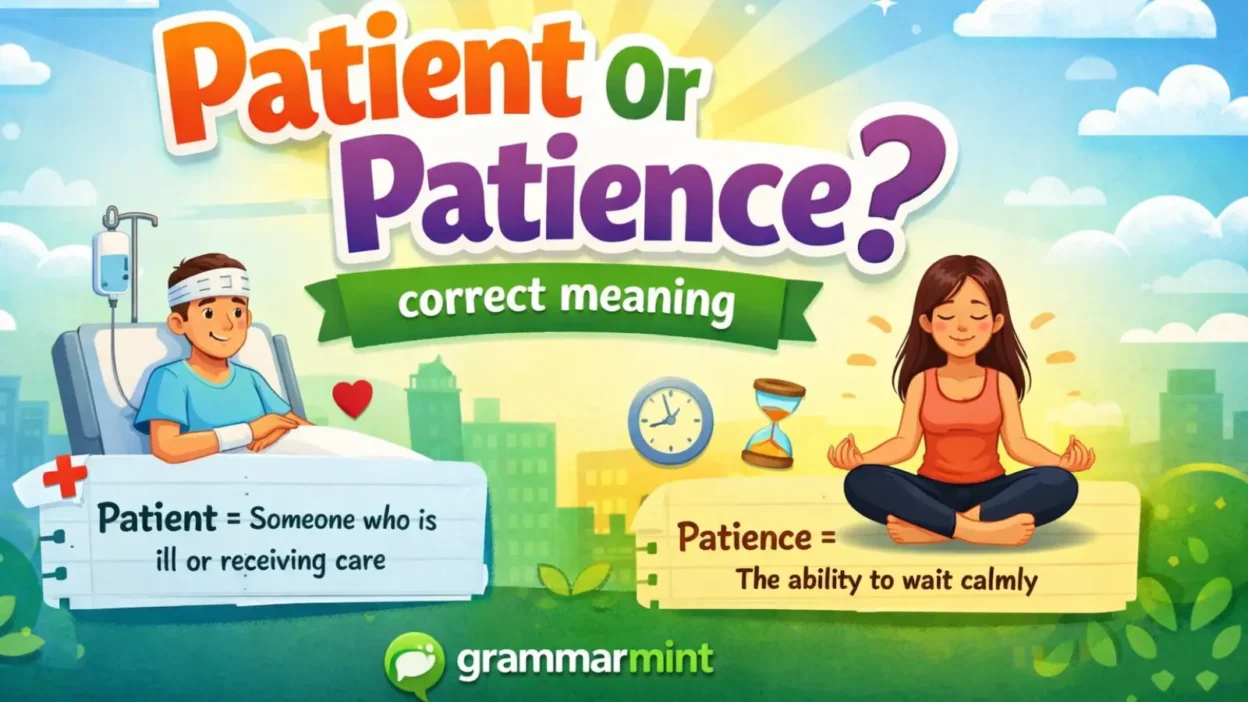
Use patient when you mean calm, tolerant, or a person receiving medical care. Use patience when you mean the quality of staying calm while waiting or dealing with problems. In normal English, people usually are patient but have patience.
TL;DR
• Patient usually describes a calm person
• Patience names the calm quality itself
• You can be patient
• You can have patience
• A patient can also mean someone treated medically
Patient Vs Patience
These words are related, but they are not interchangeable. Historically, they come from the same root about enduring or suffering, yet modern English gives them different grammar jobs.
• Patient usually acts like an adjective
• Patience works as a noun
• Patient can also mean a treated person
• Patience never names a person
• Use patient for someone calm
• Use patience for calm endurance
• “She is patient” is correct
• “She has patience” is correct
• “She is patience” is wrong
• “She has patient” is wrong
• The spelling changes the grammar
• The meaning changes with context
What Does Patient Mean?
Usually, patient means calm, tolerant, or able to wait without getting upset. It can also mean a person who receives care from a doctor, dentist, or hospital.
• Patient can describe calm behavior
• Patient can name a medical person
• It often follows linking verbs
• It can come before nouns
• “Patient teacher” sounds natural
• “Patient approach” also works
• “A patient” means one treated person
• The plural form is patients
• Tone stays neutral and standard
• Context decides the right sense
• Calm meaning is very common
• Medical meaning is also standard
What Does Patience Mean?
Patience means the quality of staying calm during delay, stress, or difficulty. It is a noun, and major dictionaries treat it as a noncount or uncountable noun in normal use.
• Patience names calm endurance
• Patience is an abstract quality
• It is usually a noncount noun
• You have patience, not “a patience”
• It often follows have or need
• It also appears after show
• “Lost patience” is a common phrase
• “Tested patience” is also common
• It fits school and work contexts
• It does not mean a person
• It cannot replace patient after be
• It suits formal and casual writing
Patient As An Adjective
As an adjective, patient describes how someone acts. So English often uses it after verbs like be, remain, seem, and stay.
• Say be patient with delays
• Say remain patient during change
• Say patient with beginners
• It describes a person’s manner
• It can describe careful work
• “Very patient” sounds natural
• “More patient” is the comparative
• “Most patient” is the superlative
• It pairs well with patiently
• Its opposite is impatient
• It fits speech and writing
• It does not name the quality
Patient As A Noun
As a noun, patient means a person receiving medical care or treatment. In this sense, it is a normal count noun, so it can take articles and a plural form.
• A patient saw the doctor
• The patient needed rest
• It is a count noun
• It takes a or the
• The plural form is patients
• It belongs in medical contexts
• Clinics use this noun daily
• Dentists also have patients
• Vets may use patient too
• It is not the calm quality
• Articles often reveal this meaning
• Context usually makes it clear
Patients Vs Patience
This is one of the biggest mix-ups because the words sound alike. Still, patients means more than one treated person, while patience means calm endurance.
• Patients means several treated people
• Patience means calm waiting
• They sound almost identical
• One is a plural noun
• One is an abstract noun
• Verb agreement also changes
• “Patients are waiting” is correct
• “Patience is fading” is correct
• Medical context suggests patients
• Delay context suggests patience
• Ts often point to people
• Ce points to the quality
Be Patient Or Have Patience
Both phrases are correct, but the grammar is different. Use be patient because patient is an adjective, and use have patience because patience is a noun.
• Be patient sounds like direct advice
• Have patience sounds slightly broader
• Both are standard English
• Choose by sentence pattern
• Be goes with adjectives
• Have goes with nouns
• “Please be patient” works well
• “You need patience” works too
• “Have patience with him” works
• They are close in meaning
• They are not grammatically identical
• Both fit everyday English
Can You Say “Be Patience”?
No. Standard English does not use be patience because patience is a noun, not an adjective. After a linking verb like be, English normally needs an adjective here.
• Be patience is not standard
• Use be patient instead
• Patience is the wrong form
• Linking verbs need adjectives here
• Signs should say “Be patient”
• Emails should use patient
• “Try to be patient” works
• “Please be patient” works
• “Stay patient” also works
• This is a common learner error
• Check the word after be
• Swap in calm to test
Can You Say “Have Patient”?
Usually, no, when you mean calm endurance. The correct form is have patience, though have a patient is correct in medical context because patient can be a count noun.
• Have patient is usually wrong
• Use have patience for calmness
• Add a for medical meaning
• “The doctor has a patient” works
• “I have patience” also works
• Quality needs the noun patience
• Article use changes everything
• Without an article, it jars
• Medical context is the exception
• Read for intended meaning
• Replace with calmness to test
• Check whether you mean person
How To Use Patient In A Sentence
Because patient has two main jobs, examples help fast. Below, some uses describe calm behavior, and others name a treated person.
• She stayed patient during the delay
• Our coach was patient with beginners
• Please be patient with the update
• He remained patient after the error
• We need a patient teacher today
• Her patient tone eased the room
• The nurse called the next patient
• One patient asked for water
• The patient saw the specialist
• They chose a patient approach
• My dad was patient while teaching
• The dentist greeted each patient warmly
How To Use Patience In A Sentence
Patience works best when you mean the quality itself. So you will often see it with verbs like have, need, show, lose, and appreciate.
• I need patience in traffic
• Teaching toddlers takes patience daily
• Thanks for your patience today
• Her patience helped everyone breathe
• The delay tested our patience
• Show some patience with yourself
• He lost patience after lunch
• Good leaders need patience too
• Their patience finally paid off
• We appreciate your patience and support
• Have patience with the process
• Practice builds patience over time
Patient, Patients, Patient’s, Or Patients’
This set causes trouble because spelling and punctuation both matter. So first choose singular or plural, then decide whether you need possession.
• patient means one treated person
• patients means more than one
• patient’s shows one person’s ownership
• patients’ shows many people’s ownership
• No apostrophe makes a plural
• Apostrophes show belonging, not number
• “Patient’s chart” means one chart owner
• “Patients’ charts” means several owners
• “Patient’s room” means one person’s room
• “Patients are waiting” needs no apostrophe
• Proofread these in medical writing
• Never confuse them with patience
Patiently, Patient, And Patience
These three words belong to the same family, but they do different jobs. Patiently is the adverb, patient is the adjective or medical noun, and patience is the noun for calm endurance.
• Patiently describes how an action happens
• Patient describes a calm person
• Patience names the calm quality
• “Waited patiently” sounds natural
• “A patient teacher” also works
• “Have patience” is correct
• Adverbs usually modify verbs
• Adjectives usually modify nouns
• Nouns name things or qualities
• These forms share one root
• Grammar decides the right pick
• Meaning becomes clearer with context
Common Mistakes With Patient And Patience
Most errors happen when writers choose the right idea but the wrong grammar form. So a quick wrong-versus-right check can fix the sentence fast.
• Mistake: She is patience. Fix: She is patient.
• Mistake: I need more patient. Fix: More patience.
• Mistake: Be patience with me. Fix: Be patient.
• Mistake: Have patient please. Fix: Have patience.
• Mistake: The patience waited. Fix: The patient waited.
• Mistake: Many patience arrived. Fix: Many patients arrived.
• Mistake: Patient’s are waiting. Fix: Patients are waiting.
• Mistake: His patients ran out. Fix: His patience ran out.
• Mistake: He spoke patience. Fix: He spoke patiently.
• Mistake: A patience needs help. Fix: A patient needs help.
• Mistake: Thanks for being patience. Fix: Being patient.
• Mistake: Patients is helpful. Fix: Patience is helpful.
How To Remember Patient Vs Patience
A small memory trick helps more than a long rule. Think about whether the sentence needs a person, a quality, or a description.
• Patient ends with t for trait
• Patience has ce for calm endurance
• A patient may see a doctor
• Patience cannot see a doctor
• After be, choose patient
• After have, choose patience
• If it’s a person, patient
• If it’s a quality, patience
• Add a or the for patient
• Don’t add a before patience
• Replace with calm or calmness
• Read the sentence aloud once
When Patient Is About Medical Care
In healthcare writing, patient is a noun first, not a personality trait. That medical meaning is fully standard in American English and appears in dictionaries across hospital, dental, and clinic contexts.
• In medicine, patient means treated person
• Hospitals use this noun constantly
• Dental offices use it too
• Nurses may call the next patient
• Charts often name the patient
• Reception desks use patients daily
• The plural form is patients
• It differs from being patient
• Doctors can be patient with patients
• One sentence can use both
• Clinical writing needs clear context
• Articles often remove confusion quickly
FAQs
What is the difference between patient and patience?
Patient usually describes someone calm, and it can also mean a person receiving medical care. Patience is the noun for calm waiting or steady restraint.
Is it correct to say be patient or have patience?
Yes. Both are correct, but the grammar changes: you be patient because patient is an adjective, and you have patience because patience is a noun.
Can patient be a noun?
Yes. In medical English, patient is a count noun that means a person receiving treatment or care. Its plural form is patients.
Is patience a noun or an adjective?
Patience is a noun. More specifically, dictionaries commonly treat it as an uncountable or noncount noun in regular use.
What is the plural of patient?
The plural of patient is patients. Use it when you mean more than one person receiving medical care.
Can I say be patience?
No. Standard English uses be patient, not be patience, because patient is the adjective form needed after be.
Conclusion
If you’re stuck on Patient or Patience patient-or-patience, use patient for a calm person or a medical noun, and use patience for the quality of calm waiting.
When in doubt, test the sentence with be patient or have patience and the right choice usually becomes obvious.