
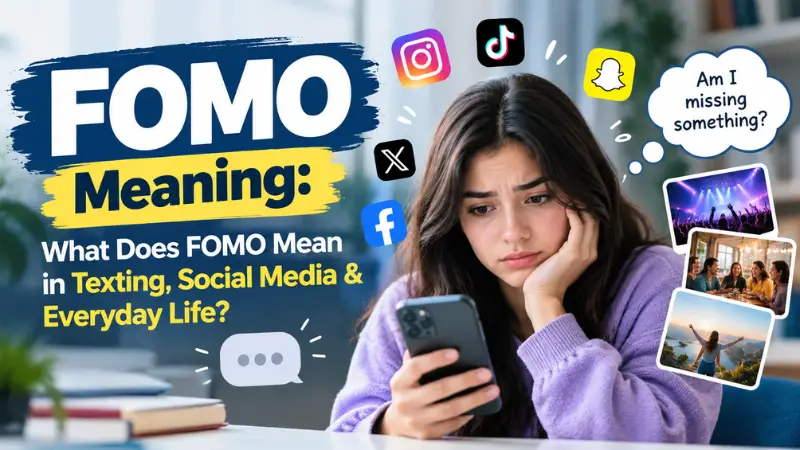
FOMO stands for “Fear of Missing Out.” It describes the feeling that other people are enjoying something exciting, important, or valuable without you. In everyday conversation, texting, and social media, someone might say “I have FOMO” when they feel left out or worry they are missing an experience.
For example, if your friends post pictures from a party you didn’t attend, you might think, “Everyone is having fun without me—I wish I had gone.” That feeling is a common example of FOMO.
The term is especially common online because social media constantly exposes people to other people’s activities, events, purchases, trips, and social experiences.
What Does FOMO Stand For?
FOMO = Fear of Missing Out.
It is an informal expression and acronym commonly used in:
- Text messages
- Social media posts
- Online conversations
- Group chats
- Casual speech
- Marketing and advertising
- Discussions about technology and social behavior
FOMO meaning in simple words
In simple terms, FOMO means worrying that you are missing something good while other people are experiencing it.
Example:
“I wasn’t going to the concert, but seeing everyone’s posts gave me FOMO.”
Here, the speaker means that seeing other people enjoy the concert made them feel like they were missing out.
What Does FOMO Mean in Texting?
In texting, FOMO is usually a quick way to say that you feel left out or don’t want to miss an experience.
For example:
Friend: “We’re all going to the beach tomorrow!”
You: “Wait, now I have FOMO 😂”
This doesn’t necessarily mean the person is seriously distressed. In casual texting, FOMO can be playful or humorous.
Common texting examples
- “Everyone is going out tonight. FOMO!”
- “I wasn’t planning to buy tickets, but now I have FOMO.”
- “Don’t make me see your vacation photos—I already have FOMO.”
- “I joined the group chat because I didn’t want FOMO.”
The exact meaning depends on context, but it generally relates to not wanting to miss an enjoyable or important experience.
What Does FOMO Mean on Social Media?
On social media, FOMO often describes the feeling people get when they see posts showing friends, influencers, celebrities, or other users participating in activities they aren’t experiencing.
For example, you might open Instagram or TikTok and see:
- Friends attending a concert
- Someone traveling to a destination
- People attending a party
- A popular event everyone seems to be discussing
- A new product that appears to be trending
- People celebrating achievements or milestones
Seeing these posts can create the impression that everyone else is having exciting experiences.
However, social media usually shows selected moments rather than someone’s entire life. A post may represent one enjoyable moment while leaving out ordinary, stressful, or difficult parts of the person’s day.
Examples of FOMO in Everyday Life
FOMO can appear in many situations.
| Situation | Example of FOMO |
|---|---|
| Party | You worry you’ll miss a memorable night if you stay home. |
| Travel | Friends go on vacation and you wish you had joined them. |
| Concert | You skip a concert and later regret missing it. |
| Shopping | A limited-time sale makes you feel pressured to buy something. |
| Social media | Seeing friends together makes you feel left out. |
| Events | Everyone discusses an event you didn’t attend. |
| Entertainment | Friends watch a popular show and you feel behind. |
| Work | You worry about missing an opportunity while others participate. |
Why Do People Experience FOMO?
FOMO can come from several different factors. It isn’t simply about wanting to attend every event.
Social comparison
People naturally compare their experiences with those of others. Social media can make this easier because users constantly see carefully selected updates from other people.
Desire to belong
Humans generally have a need for social connection. Feeling excluded from a group can make missing an event seem more significant.
Uncertainty
Sometimes you don’t know what you are missing. That uncertainty can make an opportunity seem more attractive.
For example:
“What if everyone has an amazing time and I’m the only one who stayed home?”
That thought can contribute to FOMO.
Fear of making the wrong choice
FOMO can also happen when you have several options and worry that choosing one means missing something better.
For example, you might wonder whether you should:
- Go to a friend’s birthday party
- Attend another social event
- Stay home and rest
The concern that another choice would have been better can create FOMO.
FOMO and Social Media
Social media and FOMO are frequently discussed together because platforms make it easy to see what other people are doing.
A typical cycle might look like this:
See someone’s post → Compare your experience → Feel left out → Want to participate → Take action
For some people, this may mean attending more events. For others, it could mean constantly checking notifications, stories, or updates.
Importantly, seeing other people’s highlights doesn’t provide a complete picture of their lives. Social media content is selective by nature.
FOMO vs. JOMO
A related term is JOMO, which means “Joy of Missing Out.”
FOMO focuses on the concern that you’re missing something. JOMO describes feeling comfortable or even happy about choosing not to participate.
| FOMO | JOMO |
|---|---|
| Fear of missing out | Joy of missing out |
| Focuses on what others are doing | Focuses on your own choice |
| May create pressure to participate | Can involve intentionally opting out |
| “I should probably go.” | “I’m happy staying home.” |
| Concern about being left out | Comfort with missing an activity |
Example
FOMO:
“Everyone is going to the party, so maybe I should go.”
JOMO:
“Everyone is going to the party, but I’m enjoying a quiet night at home.”
Neither term necessarily means a person will always behave one particular way. They describe different attitudes toward missing an experience.
FOMO vs. FOBO
Another related acronym is FOBO, which stands for “Fear of a Better Option.”
The two concepts are similar but not identical.
- FOMO: Fear that you are missing an experience.
- FOBO: Fear that you might choose an option when a better one could appear later.
For example, someone experiencing FOMO might attend a party because they don’t want to miss the fun.
Someone experiencing FOBO might avoid choosing a restaurant because they keep wondering whether another restaurant would be better.
How to Manage FOMO
If FOMO is affecting your decisions or making you feel constantly pressured to participate, a few practical habits may help.
1. Ask whether you actually want to participate
Before saying yes, ask yourself:
“Would I want to do this if I hadn’t seen everyone else doing it?”
This can help separate your own preferences from social pressure.
2. Limit unnecessary social media checking
Constantly checking other people’s updates can keep your attention focused on what you’re supposedly missing.
Consider setting specific times for checking social media rather than opening apps automatically.
3. Remember that online posts are selective
A social media post usually represents a particular moment. It doesn’t show everything happening behind the scenes.
4. Focus on your current experience
If you’re spending time with family, relaxing at home, working on a project, or enjoying a hobby, give that activity your attention rather than constantly comparing it with other people’s activities.
5. Make decisions based on your priorities
Not every opportunity deserves your time, money, or energy. Decide what matters to you and accept that choosing one activity often means saying no to another.
Common FOMO Phrases
Here are some natural ways people use the term:
- “I’m getting FOMO.”
- “I have serious FOMO.”
- “Don’t give me FOMO!”
- “I don’t want to miss out.”
- “Everyone’s going except me. FOMO!”
- “Seeing those pictures gave me FOMO.”
- “I went because I had FOMO.”
These expressions are generally informal and are most appropriate for casual conversations.
Related Terms to FOMO
If you’re learning internet slang and social-media vocabulary, you may also encounter these terms:
- JOMO — Joy of Missing Out
- FOBO — Fear of a Better Option
- OMO — Opportunity to Miss Out
- YOLO — You Only Live Once
- IRL — In Real Life
- FOMO-driven — Influenced by the fear of missing an opportunity or experience
- Social comparison — Comparing your life or experiences with those of other people
Is FOMO Always a Bad Thing?
Not necessarily.
FOMO is a description of a feeling, and its effect depends on the situation.
For example, feeling that you might miss an important professional opportunity could encourage you to learn more about it. On the other hand, repeatedly joining activities simply because you are afraid of being left out can make it harder to prioritize your own needs and interests.
The important distinction is between making an informed choice and feeling pressured to participate simply because other people are doing something.
FAQs
FOMO means “Fear of Missing Out.” It describes the feeling that you may be missing an enjoyable, important, or valuable experience while other people are participating.
In texting, FOMO is informal slang used to say that someone feels left out or doesn’t want to miss an activity or experience.
On Instagram, FOMO generally refers to feeling that you’re missing out after seeing other people’s posts, Stories, Reels, trips, parties, events, or experiences.
Yes. FOMO is an informal acronym and internet slang term, although it has become common enough to appear in everyday speech, media, marketing, and discussions about social behavior.
JOMO, or “Joy of Missing Out,” is commonly described as the opposite of FOMO. It refers to being comfortable with choosing not to participate in something.
If your friends attend a concert without you and their posts make you wish you had gone, that feeling is an example of FOMO.
FOMO can be associated with social comparison, the desire to belong, uncertainty about what they’re missing, and concern that another choice might have been better.
No. FOMO can occur without social media. People may experience it when friends attend parties, coworkers participate in activities, or they learn about an opportunity after deciding not to take part.
Conclusion
FOMO means “Fear of Missing Out,” and it is commonly used in texting, social media, online conversations, and everyday speech. It describes the feeling that you may be missing an enjoyable or valuable experience while other people are participating.
Understanding FOMO meaning is useful for interpreting everything from casual messages such as “I have FOMO” to discussions about social media and decision-making.
If you come across FOMO in a text, post, or conversation, remember the simple definition: FOMO = Fear of Missing Out.
SEO Meta Title
FOMO Meaning: What Does FOMO Mean?
SEO Meta Description
Learn the FOMO meaning, what FOMO stands for, how it’s used in texting and social media, examples, FOMO vs. JOMO, and related terms.
Recommended URL Slug
/fomo-meaning/


[…] Once,” and its main idea is to appreciate life and make the most of worthwhile opportunities. In texting and social media, it can be used to express excitement, spontaneity, humor, or […]