
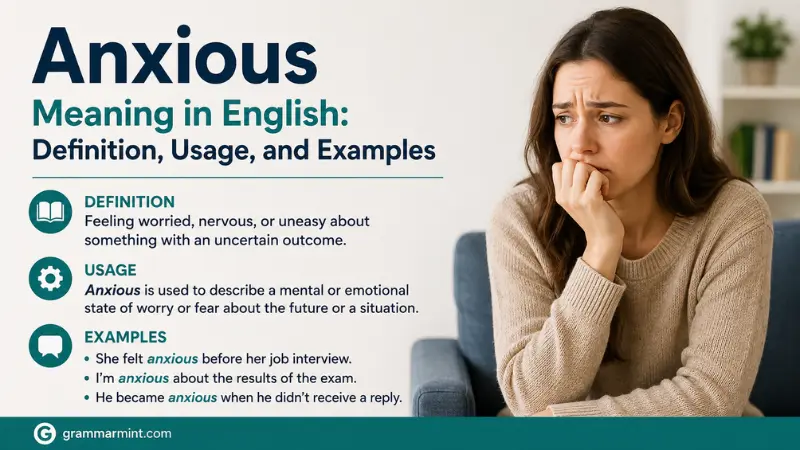
You may hear the word anxious before an exam, interview, flight, or important conversation. People often use it when they feel worried about what may happen next.
The word can describe nervous thoughts, uneasy feelings, or a stressful period. It can also describe a strong desire for something to happen.
Understanding the meaning of anxious helps you describe emotions more accurately. It also helps you avoid confusion with words such as eager, nervous, and anxiety.
This guide explains the word in simple English. You will learn its pronunciation, grammar, common patterns, examples, synonyms, antonyms, and common mistakes.
Quick Answer
Anxious meaning usually refers to feeling worried, nervous, or uneasy about something uncertain.
Anxious is an adjective. It can describe a person, feeling, expression, situation, or period of worry.
TL;DR
• Anxious usually means worried, nervous, or uneasy.
• It is an adjective.
• It often relates to uncertainty about the future.
• Anxious about usually expresses worry.
• Anxious to can express strong desire.
• Use eager for clearly positive excitement.
What Does Anxious Mean?
In simple English, anxious usually means worried or uneasy about something that may happen.
A student might feel anxious before an exam. Someone may also feel anxious while waiting for important news.
For example:
• I feel anxious about tomorrow’s interview.
• She looked anxious before the presentation.
• His parents were anxious about the storm.
• We had an anxious wait at the airport.
The word often involves uncertainty. The person does not know what will happen next.
Can Anxious Also Mean Eager?
Yes. Anxious can sometimes mean strongly wanting something to happen.
For example:
• Maya was anxious to hear the results.
• The players were anxious to begin.
• He was anxious to see his family again.
However, this use can sound unclear.
If the feeling is completely positive, eager is often the better choice.
For example:
Clearer: I am eager to start my vacation.
This sounds more positive than:
Possible: I am anxious to start my vacation.
The second sentence may suggest excitement mixed with nervousness.
Does Anxious Always Mean Something Serious?
No. People can feel anxious during normal stressful situations.
You may feel anxious before an exam, interview, speech, or difficult conversation.
Feeling anxious sometimes does not automatically mean a person has an anxiety disorder. Everyday worry and a medical condition are not the same thing.
Pronunciation and Part of Speech
Anxious is pronounced roughly:
ANGK-shuhs
It has two syllables.
The first part sounds similar to angk. The second part sounds like shuhs.
Do not pronounce it the same way as anxiety. The two words are related, but their pronunciation differs.
What Part of Speech Is Anxious?
Anxious is an adjective.
It describes a person, feeling, expression, situation, or period.
Examples include:
• an anxious student
• an anxious parent
• an anxious expression
• an anxious moment
• an anxious wait
Related forms include:
• anxiety — noun
• anxiously — adverb
• anxiousness — noun
How to Use Anxious
Several common patterns appear with anxious. Learning these patterns makes the word easier to use correctly.
Anxious About
Use anxious about when someone feels worried about a situation, event, or possibility.
Examples:
• I am anxious about the test.
• She feels anxious about moving away.
• Marcus was anxious about his interview.
• They are anxious about the weather.
This is one of the most natural patterns in everyday English.
Anxious For
Anxious for can express a strong desire for something.
Examples:
• She was anxious for an answer.
• We were anxious for more information.
• The family was anxious for good news.
In some contexts, it can also suggest concern.
However, anxious about is usually clearer when you mean worry.
Anxious To
Use anxious to + verb when someone strongly wants to do something.
Examples:
• He was anxious to leave.
• They were anxious to learn more.
• I am anxious to hear your decision.
This pattern is correct English.
However, readers may connect anxious with worry. Use eager when you want a clearly positive meaning.
Common Contexts and Examples
Anxious appears in many everyday situations. It often describes worry, uncertainty, or nervous anticipation.
School
• Nina felt anxious before her final exam.
• The student looked anxious before his presentation.
• I always feel anxious before important tests.
Work
• I am anxious about tomorrow’s job interview.
• The team became anxious as the deadline approached.
• He looked anxious during the meeting.
Travel
• We became anxious when our flight was delayed.
• She felt anxious about traveling alone.
• He gets anxious before long flights.
Health
• His family felt anxious while waiting for the results.
• The appointment made her feel anxious.
• She became anxious before the procedure.
Relationships
• I felt anxious before having the conversation.
• He seemed anxious about meeting her parents.
• She was anxious about how he would respond.
Waiting for News
• Everyone became anxious when no update arrived.
• She checked her phone with an anxious expression.
• He waited anxiously for the call.
These examples share one main idea. Something important remains uncertain.
Anxious vs. Eager
Anxious and eager can sometimes overlap. However, their emotional tone is usually different.
Anxious often suggests worry, nervousness, or uncertainty.
Eager usually suggests positive excitement or strong interest.
| Context | Best Choice | Why |
|---|---|---|
| Worried before an exam | Anxious | Worry is the main feeling |
| Excited about vacation | Eager | The feeling is positive |
| Waiting for test results | Anxious | The result is uncertain |
| Ready to start a hobby | Eager | It shows positive interest |
| Waiting nervously for news | Anxious | Worry is involved |
Compare these examples:
I am anxious about the interview.
This means the interview is causing worry.
I am eager for the interview.
This means you are looking forward to it.
Another example:
I am anxious to hear the results.
This may suggest desire mixed with worry.
I am eager to hear the results.
This focuses more on strong interest or excitement.
Both words can be correct in some situations. Choose the word that matches the feeling you want to express.
Synonyms and Antonyms
The best synonym for anxious depends on the context.
Synonyms for the Worried Meaning
Worried — concerned about a problem.
Nervous — tense before something happens.
Uneasy — uncomfortable or uncertain.
Apprehensive — worried about something that may happen.
Concerned — troubled about a situation.
Tense — unable to relax.
Examples:
• She was nervous before the interview.
• He felt uneasy about the decision.
• Her parents were concerned about the delay.
These words are similar, but they are not always exact replacements.
Synonyms for the Strong-Desire Meaning
Possible choices include:
• eager
• keen
• impatient
• enthusiastic
Eager is usually the clearest choice for positive anticipation.
Antonyms of Anxious
Useful opposites for the worried meaning include:
• calm
• relaxed
• confident
• composed
• comfortable
Example:
Anxious: She felt anxious before the speech.
Opposite: She felt calm before the speech.
Origin and Related Forms
The word anxious comes through Latin roots connected with worry, distress, and uneasiness.
Its modern English meaning still carries that connection.
Several common English words belong to the same word family.
Anxiety
Anxiety is a noun.
Examples:
• She felt anxiety before the interview.
• His anxiety increased while he waited.
Anxious
Anxious is an adjective.
Examples:
• She felt anxious before the interview.
• He became anxious while waiting.
Anxiously
Anxiously is an adverb.
Examples:
• She waited anxiously for the call.
• He looked anxiously toward the door.
Knowing these forms helps you choose the correct word in a sentence.
Common Mistakes
Mistake: Using Anxiety Instead of Anxious
Incorrect: I am anxiety about tomorrow.
Correct: I am anxious about tomorrow.
Anxious is an adjective, so it can follow am.
You can also use the noun anxiety differently.
Correct: I feel anxiety about tomorrow’s interview.
Mistake: Using the Wrong Verb Pattern
Incorrect: I am anxious for see you.
Correct: I am anxious to see you.
Use anxious to + base verb.
Mistake: Using Anxious for Simple Happiness
Less clear: I am anxious to go on vacation.
Clearer: I am eager to go on vacation.
Use eager when the feeling is purely positive.
Mistake: Adding “Of” After About
Incorrect: She is anxious about of the exam.
Correct: She is anxious about the exam.
Do not add of after anxious about.
Mistake: Confusing Anxious and Nervous
These words are close, but they are not always identical.
Nervous often describes tension before a specific event.
Anxious can describe broader worry about an uncertain situation.
For example:
• I am nervous before giving speeches.
• I am anxious about what the results may show.
Mini Quiz
Choose the best answer.
1. What does anxious usually mean?
A. Hungry
B. Worried or uneasy
C. Angry
2. Which sentence is correct?
A. I am anxiety about the interview.
B. I am anxious about the interview.
3. Which word is clearer for positive excitement?
A. Eager
B. Anxious
4. What part of speech is anxious?
A. Noun
B. Verb
C. Adjective
Answer Key
- B — Worried or uneasy
- B — I am anxious about the interview.
- A — Eager
- C — Adjective
FAQs
What Does Anxious Mean in Simple Words?
Anxious usually means worried, nervous, or uneasy.
The feeling often appears when you are unsure about what will happen next.
Does Anxious Mean Worried or Nervous?
It can mean both.
Anxious often describes worry mixed with nervous anticipation.
Can Anxious Mean Excited?
Yes, in some contexts.
It can describe a strong desire for something to happen. However, eager is usually clearer for positive excitement.
What Is an Anxious Person?
An anxious person is someone who feels worried, nervous, or uneasy.
The phrase may describe a temporary feeling. It does not automatically describe a medical condition.
Is Anxious a Positive or Negative Word?
Its most common meaning has a negative or uneasy tone.
It usually suggests worry, nervousness, or uncertainty.
What Is the Difference Between Anxious and Anxiety?
Anxious is an adjective.
Anxiety is a noun.
You can say:
• I feel anxious.
• I feel anxiety about the situation.
What Is the Opposite of Anxious?
Common opposites include calm, relaxed, confident, and composed.
The best opposite depends on the sentence.
Conclusion
Understanding anxious meaning is easy when you connect the word with worry, nervousness, and uncertainty.
Use anxious when someone feels uneasy about what may happen. Use eager for clear, positive excitement.
Practice common patterns such as anxious about and anxious to to use the word naturally.