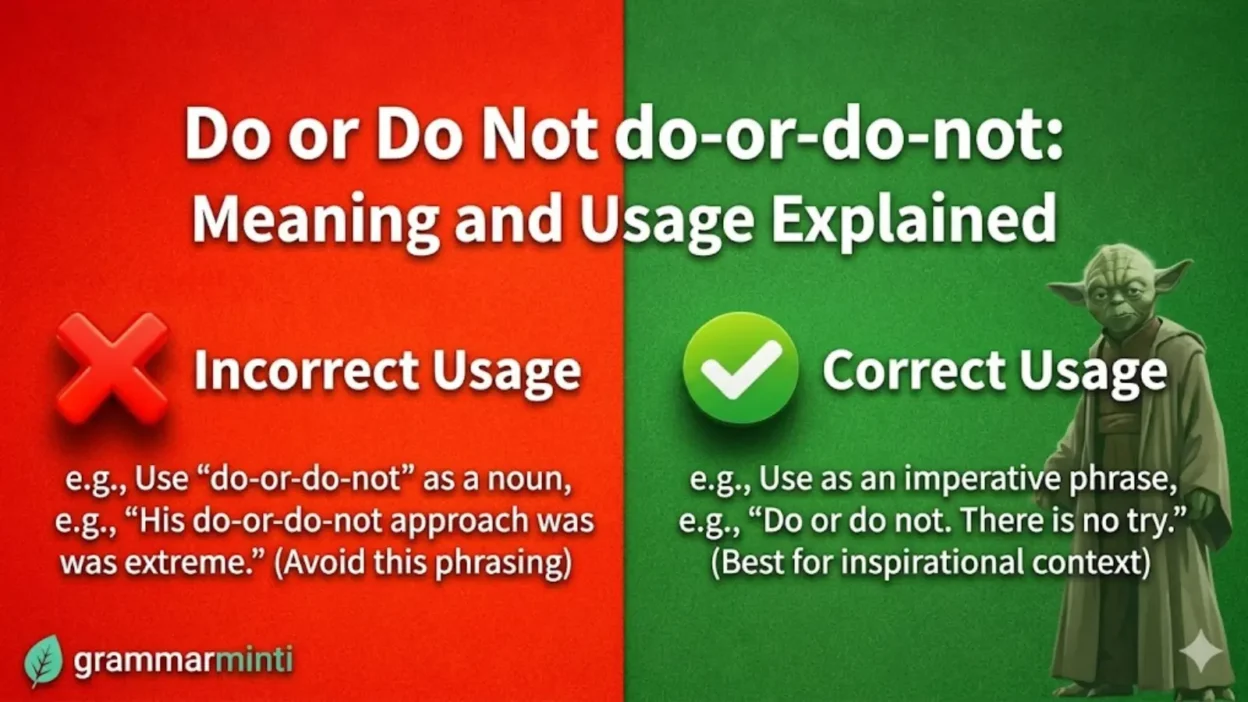
The difference between Do or Do Not do-or-do-not looks small, but it changes the meaning of a sentence in a big way. Both forms come from the same base verb “do,” yet they are used in completely different situations.
In everyday English, this choice affects how strong, polite, or strict a sentence sounds. You might use one in friendly advice and the other in rules, warnings, or instructions. Understanding this difference helps you avoid confusion and speak more naturally in both casual and formal situations.
Quick Answer
“Do” is used to encourage or ask for an action.
“Do not” is used to stop, prevent, or forbid an action.
Both are correct forms, but they are not interchangeable because they carry opposite meanings in a sentence.
Why People Confuse Them
Many English learners confuse these two because they share the same root word: do.
Another reason is that English often shortens “do not” into don’t, especially in spoken language. This makes the negative form feel less obvious when writing full sentences.
Also, both forms can appear in instructions, which creates overlap. For example, you might see:
- “Do finish your work.”
- “Do not forget your homework.”
They look similar in structure but send very different messages.
Finally, tone confusion plays a role. Both can sound like commands, but one is encouraging while the other is restricting. That contrast is what causes most mistakes.
Key Differences At A Glance
| Context | Best Choice | Why |
|---|---|---|
| Encouraging action | Do | Gives clear instruction to act |
| Preventing action | Do not | Blocks or restricts behavior |
| Casual speech | Do / don’t | Natural and relaxed tone |
| Formal rules | Do / do not | Clear and structured instruction |
Meaning and Usage Difference
The word do works as a command or action word. It tells someone to perform something.
The phrase do not is a negative instruction. It tells someone to avoid doing something.
Simple breakdown:
- Do = act, perform, complete, or proceed
- Do not = avoid, stop, or refuse action
Even though they come from the same verb family, they behave like opposites in real sentences.
How “Do” Works in Real Use
“Do” is flexible. It can appear in:
- Instructions: “Do your homework.”
- Encouragement: “Do try this method.”
- Questions: “Do you understand?”
It pushes action forward.
How “Do Not” Works in Real Use
“Do not” is more strict. It appears in:
- Rules: “Do not enter this area.”
- Safety warnings: “Do not touch the surface.”
- Instructions with limits: “Do not share personal information.”
It sets boundaries.
Tone, Context, and Formality
Tone is one of the biggest differences between these two forms.
“Do” Tone
“Do” feels neutral or positive. It often sounds like helpful advice or clear direction.
Examples:
- Do check your answers before submitting.
- Do take notes during the lecture.
- Do call me if you need help.
It feels supportive and constructive.
“Do not” Tone
“Do not” feels firm and serious. It often appears in safety instructions, policies, or strict guidance.
Examples:
- Do not enter the construction zone.
- Do not use your phone during the test.
- Do not leave food unattended.
It feels more authoritative and controlled.
Formal vs Informal Use
In casual conversation, people often replace “do not” with “don’t”:
- Don’t worry about it.
- Don’t forget your keys.
In formal writing, “do not” is preferred:
- Do not submit incomplete forms.
- Do not share confidential data.
Which One Should You Use?
Choosing between them depends on your purpose.
Use do when:
- You want action or participation
- You are giving helpful instructions
- You are encouraging someone
Use do not when:
- You want to stop or prevent something
- You are writing rules or warnings
- You need a serious tone
A simple way to think about it:
- If you want something done → use do
- If you want something avoided → use do not
When One Choice Sounds Wrong
Using the wrong form can confuse meaning completely.
Wrong Use of “Do”
- ❌ Do enter the restricted area
This sounds like permission, which is incorrect if entry is forbidden.
Wrong Use of “Do Not”
- ❌ Do not complete your assignment
This suggests stopping a task that is normally required.
Even small changes like this can reverse the meaning of a sentence.
Common Mistakes (and Quick Fixes)
1. Mixing positive and negative tone
Mistake: “Do not finish your work early.”
Fix: Decide if you are encouraging or restricting.
2. Overusing “don’t” in formal writing
Mistake: “Don’t submit late forms.”
Fix: Use “Do not submit late forms” in formal settings.
3. Unclear instructions
Mistake: “Do this carefully” (without context)
Fix: Add clarity: “Do check all details carefully before submitting.”
4. Weak commands in rules
Mistake: “Do be careful” in warning signs
Fix: Use “Do not enter” or “Do not touch” for stronger clarity.
Everyday Examples
Here are real-life uses you might see or hear:
- Do your best on the test.
- Do not run near the pool.
- Do call me when you arrive.
- Do not share your password with anyone.
- Do take breaks when studying.
- Do not ignore warning signs.
- Do finish your homework before dinner.
- Do not use your phone in class.
These examples show how one form encourages action while the other limits it.
Dictionary-Style Word Details
Verb
- Do: A base action verb used for performing tasks, actions, or forming questions.
- Do not: A negative verb form used to prevent or deny action.
Noun
- Do: Rarely used as a noun in modern English (informal use like “a big do” may appear).
- Do not: Not used as a noun.
Synonyms
- Do: perform, carry out, complete, execute (closest plain alternatives)
- Do not: avoid, refrain from, stop, prohibit (closest plain alternatives)
Example Sentences
- Do: “Do finish your homework before dinner.”
- Do: “Do let me know if you need help.”
- Do not: “Do not open this door.”
- Do not: “Do not forget to lock the gate.”
Word History
Both forms come from early English uses of “do,” which originally referred to performing actions or making something happen. The negative form developed as English evolved structured ways to express prohibition and rules. Exact historical details vary across sources and usage traditions.
Phrases Containing
- Do it now
- Do your best
- Do the work
- Do not disturb
- Do not enter
- Do not forget
- Don’t do that
FAQs
1. What is the main difference between “do” and “do not”?
“Do” is used to encourage or ask for an action, while “do not” is used to stop or forbid an action.
2. Can I use “do” and “do not” in the same sentence?
Yes, but they must refer to different actions. For example: “Do your homework, but do not copy answers.”
3. Is “do not” more formal than “don’t”?
Yes. “Do not” is more formal and is commonly used in rules, instructions, and written notices. “Don’t” is more casual and used in speech.
4. When should I use “do” in instructions?
Use “do” when you want to encourage action or give helpful direction, such as “Do check your work before submitting.”
5. When should I use “do not” instead of “don’t”?
Use “do not” in formal writing, official rules, warnings, or signs where clarity and seriousness are important.
6. Can “do not” sound rude?
It can sound strict or firm depending on tone, but it is not rude when used in rules, safety instructions, or formal communication.
7. Are “do” and “do not” always opposites?
In meaning, yes—they usually represent action vs restriction. However, their usage depends on sentence context.
8. Why do people prefer “don’t” in speaking?
Because “don’t” is shorter, faster, and sounds more natural in everyday conversation compared to “do not.”
9. Can I replace every “do not” with “don’t”?
Not always. In formal writing or official instructions, “do not” is preferred for clarity and seriousness.
10. Is there any situation where both are equally correct?
Yes. Both are grammatically correct, but the choice depends on tone—formal vs casual—not correctness.
Conclusion
The difference between Do or Do Not do-or-do-not is simple but important. “Do” pushes action forward, while “do not” stops or blocks action. Choosing the right form depends on whether you are encouraging behavior or restricting it.
When used correctly, these two forms make English clearer, stronger, and easier to understand in everyday communication, instructions, and writing.