“Afterward” and “afterwards” look almost identical. That extra s at the end causes plenty of confusion. You may see both forms in blog posts, novels, emails, school assignments, and social media captions.
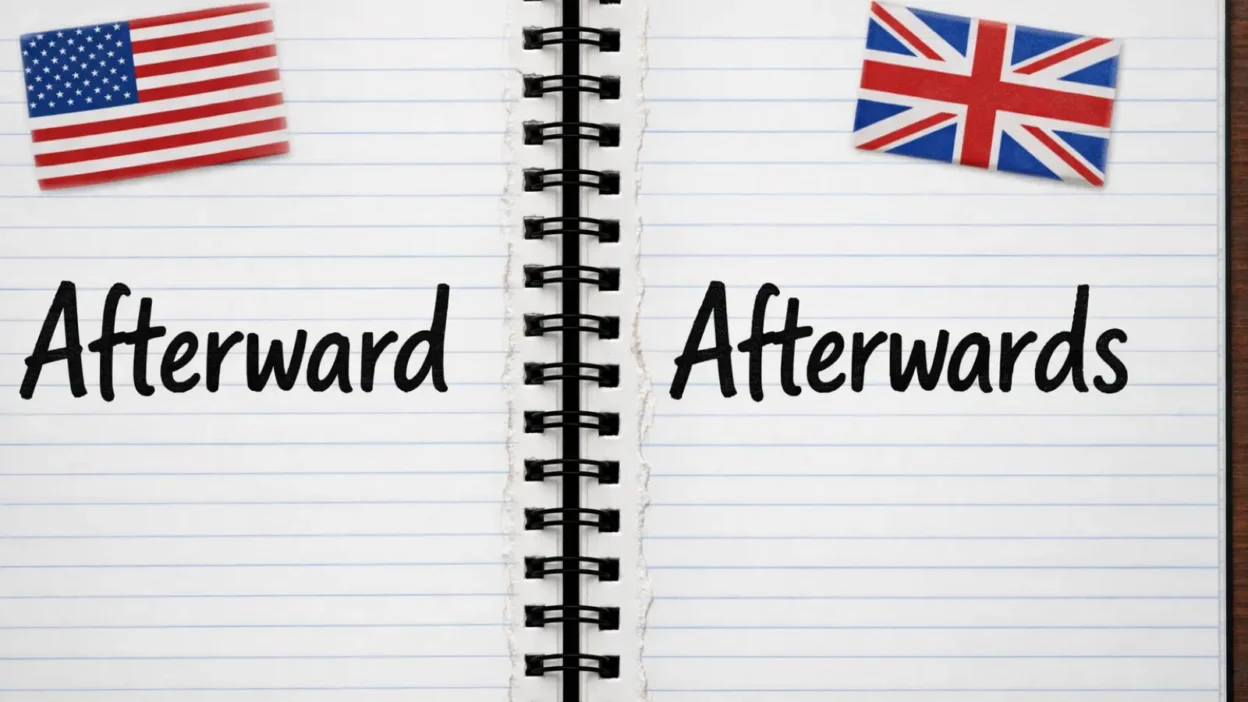
The good news is that both words are correct. The main difference comes down to regional preference. American English usually favors afterward, while British English more often uses afterwards.
This guide explains the difference between afterward and afterwards, how each word works in a sentence, which form US writers should choose, and the most common mistakes to avoid.
Quick Answer
Both afterward and afterwards are correct adverbs meaning later or at a later time.
In American English, afterward is generally the preferred and more common form. Afterwards is more strongly associated with British English, although Americans may use it too.
For US writing, afterward is usually the safest choice.
Afterward vs Afterwards: The Main Difference
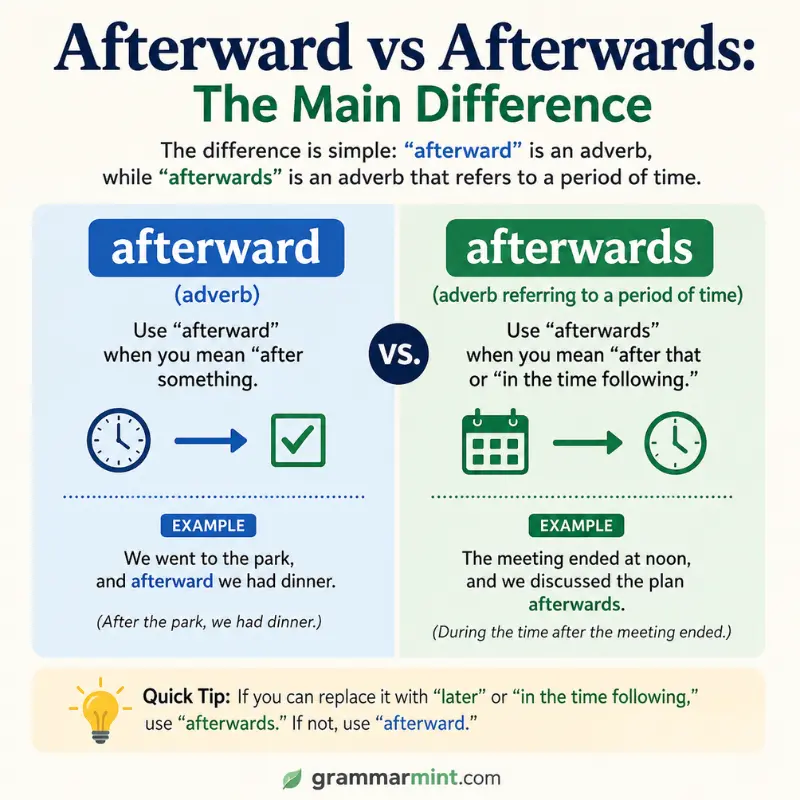
The difference between afterward and afterwards is mainly regional rather than grammatical.
- Afterward is more common in American English.
- Afterwards is more common in British English.
- Both have the same meaning.
- Both function as adverbs.
- Neither form is grammatically incorrect.
Consider these sentences:
US preference:
We went out for dinner afterward.
Common British preference:
We went out for dinner afterwards.
The meaning does not change.
Key Differences at a Glance
| Feature | Afterward | Afterwards |
|---|---|---|
| Meaning | Later; at a later time | Later; at a later time |
| Word type | Adverb | Adverb |
| US English | More common | Less common |
| British English | Used | More common |
| Formal writing | Correct | Correct |
| Meaning difference | None | None |
What Does “Afterward” Mean?
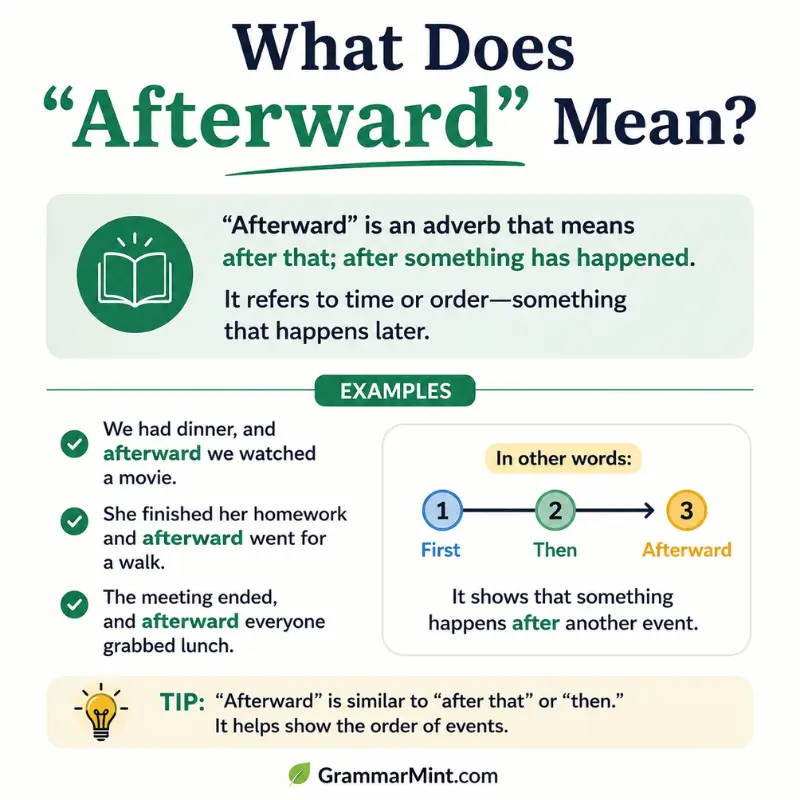
Afterward is an adverb that means later, following an event, or at a later point in time.
For example:
We finished dinner and went for a walk afterward.
Here, afterward tells us when the walk happened. It occurred after dinner.
Other examples include:
- She called me afterward.
- We talked about the problem afterward.
- He apologized shortly afterward.
- The team celebrated afterward.
Because it describes when something happens, afterward functions as an adverb, not an adjective.
What Does “Afterwards” Mean?
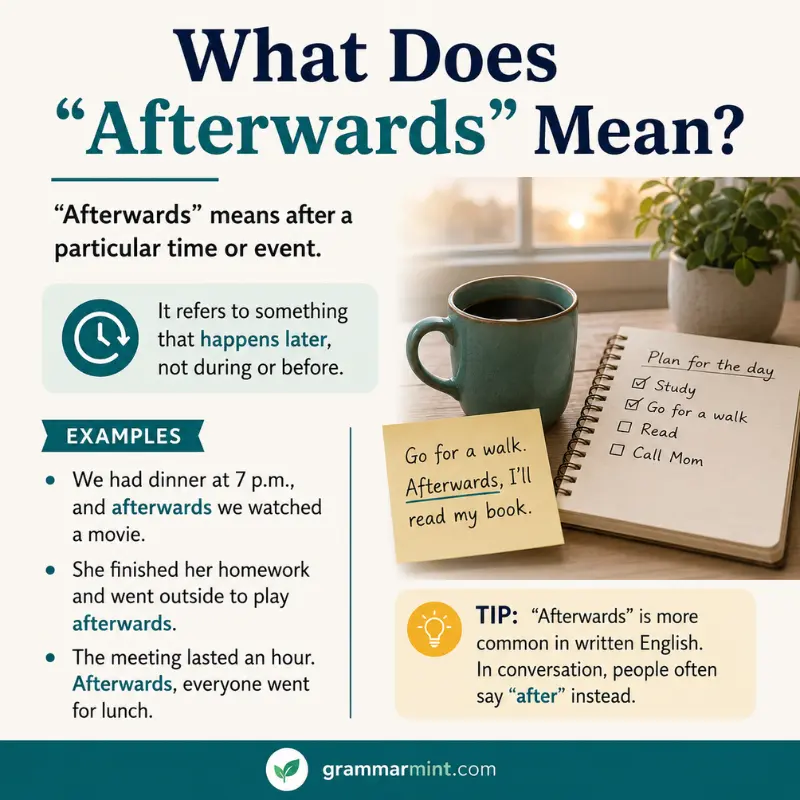
Afterwards has exactly the same meaning as afterward.
For example:
They watched a movie afterwards.
The sentence means the same thing as:
They watched a movie afterward.
The final s does not change the meaning or grammatical function. It mainly reflects a regional spelling preference.
Is It Afterward or Afterwards in American English?
For American English, afterward is usually the better choice.
You are likely to see it in:
- US school assignments
- business emails
- academic writing
- American news and publishing
- blog posts aimed at US readers
- everyday American communication
For example:
We can discuss the results afterward.
Using afterwards in the United States is not wrong. However, it may sound slightly more British to some American readers.
If your website or publication targets a US audience, using afterward consistently is a sensible editorial choice.
Is “Afterwards” British English?
Afterwards is particularly common in British English.
A British writer might naturally write:
We had lunch and went shopping afterwards.
An American writer would be more likely to write:
We had lunch and went shopping afterward.
Again, neither sentence is incorrect. The difference is primarily one of regional convention.
Are Afterward and Afterwards Interchangeable?
Yes. In most sentences, afterward and afterwards are completely interchangeable.
For example:
She called me afterward.
and
She called me afterwards.
Both sentences mean that she called at some point later.
There is no meaningful difference in tense, formality, or basic meaning.
The main reason to choose one over the other is regional style and consistency.
Is Afterward an Adverb?
Yes. Afterward is an adverb.
It describes when an action happens.
For example:
We celebrated afterward.
The verb is celebrated, and afterward tells us when the celebration happened.
The same rule applies to afterwards:
We celebrated afterwards.
Both forms function as adverbs.
Do not normally use them directly before a noun as if they were adjectives.
Where Does Afterward Go in a Sentence?
Afterward commonly appears at the end of a sentence:
We talked afterward.
It can also appear earlier when the sentence structure calls for it:
Afterward, we went home.
You may also see it modified by another word:
Shortly afterward, the meeting ended.
Soon afterward, the rain stopped.
The same positioning works with afterwards.
Afterward vs After: What’s the Difference?
Afterward and after are related, but they do not always work the same way.
Afterward usually stands alone as an adverb:
We ate dinner and went home afterward.
After can function as a preposition and is often followed by a noun or noun phrase:
We went home after dinner.
Compare:
We talked afterward.
We talked after the meeting.
Use afterward when you mean “later” without naming the event directly after the word.
Use after when you want to specify what something followed.
Afterward vs Later
Afterward and later can sometimes express similar ideas, but they are not always identical.
Afterward usually connects an action to something that happened before it:
We finished the meeting and had lunch afterward.
Later simply refers to a future or subsequent time:
We can discuss it later.
“Later” does not always require a clearly stated previous event.
In casual writing, later may sometimes sound simpler. However, afterward is useful when you want to emphasize that one action followed another.
Origin and Why Two Forms Exist
Afterward and afterwards developed from the same linguistic pattern.
English contains several directional adverbs with both -ward and -wards forms. Similar variation appears in pairs such as:
- toward / towards
- backward / backwards
- forward / forwards
Modern American English generally favors some forms without the final s, while British English often uses the -wards versions more freely.
The difference between afterward and afterwards therefore reflects regional usage rather than a difference in meaning.
British vs American English
The clearest distinction is regional.
In American English:
afterward is generally preferred.
In British English:
afterwards is generally more common.
For an international audience, either form can be understood easily. However, choosing one regional style and using it consistently makes your writing feel more polished.
If the rest of your article uses American spelling such as color, favor, and center, afterward is the natural match.
Which One Should You Use?
If you are writing for an American audience, choose afterward.
For example:
We will review the proposal and discuss the results afterward.
If you are writing for a British audience, afterwards may feel more natural:
We will review the proposal and discuss the results afterwards.
For international content, either form is acceptable. The key is consistency.
Avoid switching randomly between the two forms in the same article or document unless you are intentionally discussing their differences.
Is Afterward Formal or Informal?
Afterward works in both formal and informal English.
Informal:
Let’s get coffee afterward.
Professional:
The committee will review the proposal and provide feedback afterward.
Academic:
Participants completed a questionnaire immediately afterward.
You do not need to replace afterward simply because a sentence is formal.
In some contexts, alternatives such as subsequently, later, or following that may fit the tone, but they are not automatically better.
Common Mistakes With Afterward and Afterwards
Thinking “Afterwards” Is Incorrect in American English
Incorrect assumption:
Afterwards is always wrong in the US.
Better rule:
Both forms are correct, but afterward is generally preferred in American English.
Mixing Both Forms Without a Reason
Avoid writing:
We ate dinner afterward. We went shopping afterwards.
For polished writing, choose one regional style and use it consistently.
Writing “After Wards”
Incorrect:
We talked after wards.
Correct:
We talked afterward.
Afterward and afterwards are each written as one word.
Treating Afterward as an Adjective
Afterward normally functions as an adverb.
Correct:
We spoke afterward.
Instead of trying to place it directly before a noun, rewrite the sentence so it describes when an action happened.
Adding a Comma Automatically
A comma is not always required before or after afterward.
Correct:
We went home afterward.
Also correct:
Afterward, we went home.
Comma placement depends on the structure of the sentence, not on the word itself.
Everyday Examples of Afterward
Text Message
Let’s grab coffee afterward.
Social Media Caption
We went hiking and got pizza afterward.
School
Finish the assignment and check your answers afterward.
Parenting
Finish your homework. You can watch TV afterward.
Workplace
We will review the proposal and discuss feedback afterward.
Travel
We visited the museum and walked around downtown afterward.
Professional Writing
The participants completed the survey immediately afterward.
Afterward or Afterwards in Different Contexts
| Context | Recommended Form | Why |
| US business email | Afterward | Matches common American usage |
| UK blog post | Afterwards | Matches common British usage |
| US academic paper | Afterward | Natural American form |
| US text message | Afterward | Common in everyday US English |
| International website | Either | Both are understood |
| British school essay | Afterwards | Common British preference |
| American blog | Afterward | Fits US editorial style |
Easy Trick to Remember the Difference
If you are writing in American English, remember:
American English usually chooses “afterward” without the final s.
Think:
US = afterward
For British English, you will often encounter:
UK = afterwards
This is a preference rule rather than a strict grammar rule, but it is useful when choosing the most natural form for your audience.
FAQs
Is it afterward or afterwards in the US?
In American English, afterward is generally more common and is usually the preferred form. Afterwards is still grammatically correct but is more strongly associated with British English.
Which is correct, afterward or afterwards?
Both are correct. They have the same meaning and grammatical function. The main difference is regional preference.
Is afterwards British English?
Afterwards is commonly associated with British English and is generally more frequent there. American English usually favors afterward.
Do Americans say afterwards?
Yes. Americans may use afterwards, and the word is easily understood. However, afterward is generally the more typical American form.
Is afterward formal or informal?
Afterward works in both formal and informal writing. It can appear naturally in conversations, school assignments, academic writing, and professional communication.
Are afterward and afterwards interchangeable?
Yes. They can normally replace each other without changing the meaning of a sentence. Regional preference is the main difference.
Is afterward one word or two?
Afterward is one word. Writing “after ward” or “after wards” is incorrect when you mean “later.”
Mini Quiz
- We went to dinner and saw a movie _____.
- Which form is generally preferred in US English?
- Is after wards correct?
- Are afterward and afterwards different in meaning?
- Which form is more common in British English?
Answer Key
- afterward in standard US usage
- afterward
- No. It should be one word.
- No. They have the same meaning.
- afterwards
Conclusion
When choosing between afterward or afterwards, both forms are grammatically correct and mean the same thing: later or at a subsequent time.
The main difference is regional. Afterward is generally preferred in American English, while afterwards is more common in British English.
For a US audience, use afterward as your default. Most importantly, choose the form that matches your audience and use it consistently throughout your writing.