
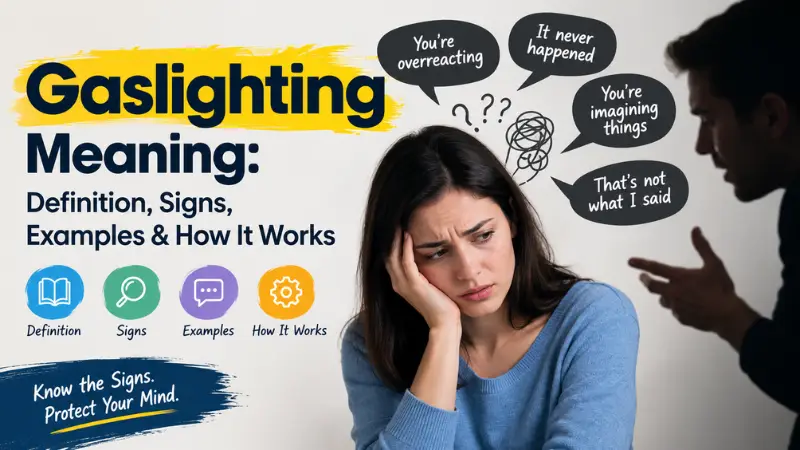
Gaslighting is a form of psychological manipulation in which someone repeatedly tries to make another person question their own memory, perception, feelings, or understanding of events. The goal or effect can be to create uncertainty and make the person doubt themselves.
For example, if someone clearly says something hurtful and later repeatedly insists, “I never said that—you’re imagining things,” despite evidence or a consistent memory of what happened, that may be a gaslighting behavior.
The term is often used casually online, but genuine gaslighting generally involves a pattern of behavior, not simply one disagreement, lie, or misunderstanding.
What Does Gaslighting Mean?
The gaslighting meaning refers to a pattern of manipulation that causes a person to question their own perception of reality.
Gaslighting can involve denying events, rewriting conversations, dismissing legitimate concerns, shifting blame, or confidently presenting false versions of what happened. Over time, the targeted person may begin to wonder whether their memory or judgment can be trusted.
Simple definition of gaslighting
Gaslighting is repeated psychological manipulation that causes someone to doubt their own memory, perception, feelings, or understanding of reality.
The word is commonly associated with emotionally abusive relationships, but similar behavior can occur in families, friendships, workplaces, and other social situations.
Where Did the Term “Gaslighting” Come From?
The term gaslighting comes from the 1938 stage play Gas Light by British playwright Patrick Hamilton. It was later adapted into films, including the 1944 movie Gaslight.
In the story, a husband manipulates his wife into questioning her perception of reality. Among the deceptive behaviors portrayed is his denial of changes in the home’s gas lighting, even though she notices them.
The story helped give rise to the modern expression “gaslighting.”
Today, the term is used more broadly to describe certain patterns of psychological manipulation.
How Does Gaslighting Work?
Gaslighting typically works gradually rather than through one isolated statement.
A person may repeatedly:
- Deny something that happened
- Contradict another person’s recollection
- Minimize legitimate feelings
- Change the subject when confronted
- Blame the other person for their own behavior
- Claim the other person is “too sensitive”
- Present misleading information with confidence
- Insist that the other person is confused or irrational
After repeated experiences, someone may start relying less on their own judgment and more heavily on the manipulator’s version of events.
Example
Imagine two partners have an argument. One partner insults the other.
Later, the person who made the insult says:
“I never insulted you. You always make things up.”
If this becomes a repeated pattern in which the person’s recollection is consistently denied and their concerns are dismissed, it could be gaslighting.
A single disagreement about exactly what was said, however, does not automatically mean gaslighting.
Common Gaslighting Examples
Gaslighting can take different forms depending on the relationship and situation.
1. Denying something that happened
Someone may insist an event never occurred even when another person remembers it clearly.
Example:
“You’re making that conversation up. It never happened.”
2. Minimizing someone’s feelings
A person may dismiss another person’s emotional response rather than addressing the underlying issue.
Example:
“You’re being way too sensitive. It wasn’t a big deal.”
3. Rewriting conversations
Someone may repeatedly change their account of what was said or done.
Example:
“I didn’t say that. What I actually said was completely different.”
4. Shifting blame
Instead of acknowledging their behavior, the person may make the other person responsible for it.
Example:
“I only yelled because you made me angry.”
5. Attacking someone’s memory
A person may repeatedly suggest that another person’s memory cannot be trusted.
Example:
“Your memory is terrible. You never remember anything correctly.”
6. Calling someone irrational
A legitimate concern may be dismissed by attacking the person’s mental state or judgment.
Example:
“That’s ridiculous. You’re imagining problems again.”
Common Gaslighting Phrases
Some phrases can appear in gaslighting situations, although a phrase by itself does not prove someone is gaslighting you.
| Phrase | What it may be doing |
|---|---|
| “That never happened.” | Denying an event |
| “You’re imagining things.” | Undermining perception |
| “You’re too sensitive.” | Dismissing feelings |
| “You’re remembering it wrong.” | Challenging memory |
| “You’re overreacting.” | Minimizing a concern |
| “Everyone agrees you’re the problem.” | Creating self-doubt |
| “I only did that because of you.” | Shifting responsibility |
| “You always make everything up.” | Attacking credibility |
The important factor is the overall pattern and context, rather than whether someone uses one of these expressions.
Signs You May Be Experiencing Gaslighting
One possible sign is that you increasingly distrust your own recollection or judgment because another person repeatedly challenges it.
You might notice that you:
- Constantly question whether you remembered something correctly
- Apologize even when you don’t believe you did anything wrong
- Frequently second-guess your decisions
- Feel confused after ordinary conversations
- Avoid bringing up legitimate concerns
- Feel responsible for another person’s harmful behavior
- Need other people to confirm what happened
- Feel like you are “walking on eggshells”
- Regularly hear that your feelings are unreasonable
- Have difficulty trusting your own judgment
These signs can also occur for other reasons, so they should not be treated as a diagnosis of gaslighting by themselves.
Gaslighting vs. Normal Disagreement
Not every argument or difference in memory is gaslighting.
People can genuinely remember the same event differently. They can misunderstand one another, make mistakes, become defensive, or disagree about what happened.
The key difference is often pattern, intent, and response to evidence or clarification.
| Situation | What it may look like |
|---|---|
| Normal disagreement | Two people remember an event differently |
| Honest mistake | Someone later recognizes they were mistaken |
| Lying | Someone knowingly provides false information |
| Manipulation | Someone uses behavior to influence another person |
| Gaslighting | A repeated pattern undermines someone’s confidence in their own perception or memory |
Intent can be difficult to determine from the outside. Someone does not necessarily have to consciously think, “I am gaslighting this person,” for their behavior to have a gaslighting effect.
Gaslighting vs. Manipulation
Manipulation is a broad term for influencing another person’s behavior, emotions, or decisions through potentially deceptive or unfair methods.
Gaslighting is more specific. It involves undermining someone’s confidence in their own perception, memory, judgment, or understanding of reality.
In other words:
Gaslighting can be a form of manipulation, but not all manipulation is gaslighting.
Can Gaslighting Happen in Romantic Relationships?
Yes. Gaslighting is frequently discussed in the context of romantic relationships.
For example, a partner may repeatedly deny hurtful behavior, dismiss concerns, change their account of important events, or make the other person feel responsible for their own mistreatment.
However, relationship conflict alone does not necessarily mean gaslighting.
A healthier disagreement allows both people to express their perspectives, acknowledge mistakes, and discuss what happened without systematically undermining the other person’s ability to trust their own judgment.
Can Gaslighting Happen at Work
Gaslighting-like behavior can also occur in professional environments.
Examples might include repeatedly denying instructions that were previously given, falsely claiming that a documented conversation never happened, or consistently portraying an employee’s legitimate concerns as imaginary or irrational.
Practical tip
If you are dealing with confusing workplace interactions, keeping objective records can help.
Depending on your workplace policies and applicable laws, you may keep:
- Emails
- Messages
- Meeting notes
- Project instructions
- Dates and timelines
- Relevant documents
Keep records factual rather than using them to escalate a conflict unnecessarily.
What Should You Do If Someone Is Gaslighting You?
If you believe you’re experiencing a repeated pattern of gaslighting, focus first on protecting your clarity, boundaries, and well-being.
1. Write down important events
Record what happened, when it happened, and what was said while the details are fresh.
For workplace situations, preserve relevant communications according to company policies.
2. Look for patterns
Ask yourself:
- Does this happen repeatedly?
- Are my concerns consistently dismissed?
- Does the person’s story repeatedly change?
- Am I being blamed for their behavior?
- Do I increasingly doubt my own memory?
Looking at the broader pattern can be more useful than analyzing one argument.
3. Check your understanding with trusted people
Talking with a trusted friend, family member, counselor, or other qualified professional can provide another perspective.
The goal isn’t necessarily to get someone to “take your side.” It is to help you assess the situation more objectively.
4. Set clear boundaries
You can calmly state what behavior you will and will not accept.
For example:
“I remember the conversation differently, and I’m not comfortable continuing this discussion while my experience is being dismissed.”
5. Avoid endless arguments about reality
If someone repeatedly refuses to acknowledge obvious facts, arguing about every detail may not resolve the underlying problem.
Sometimes the more useful question is not “How do I convince this person?” but “What do I need to do to protect my well-being?”
6. Seek professional support when appropriate
A licensed mental health professional can help you understand relationship patterns, establish boundaries, and decide what steps may be appropriate.
If you feel unsafe or fear that confronting someone could lead to harm, prioritize safety and seek appropriate local support rather than confronting the person alone.
How to Respond to Gaslighting
There is no single response that works in every situation, but these approaches can help:
Stay focused on specific facts:
“I remember the conversation differently.”
Avoid unnecessary escalation:
“I don’t want to argue about this right now.”
Set a boundary:
“I am willing to discuss the issue, but not if I’m being insulted.”
Keep important records:
Save relevant written communications when appropriate.
Trust patterns, not isolated statements:
Pay attention to repeated behavior over time.
You do not have to prove your experience to someone who refuses to engage honestly.
Is Gaslighting Emotional Abuse?
Gaslighting can be a form of emotional or psychological abuse, particularly when it occurs repeatedly in an abusive relationship and is used to control, intimidate, or undermine another person.
However, the word should be used carefully. Not every insensitive comment, disagreement, lie, or memory mistake constitutes gaslighting.
Looking at the repeated pattern, power dynamics, context, and impact provides a more accurate understanding.
Why Is Gaslighting So Confusing?
Gaslighting can be particularly confusing because it challenges a person’s confidence in their own interpretation of events.
When the same message is repeated over and over—such as “you remember everything wrong” or “you’re always overreacting”—a person may eventually begin to question themselves.
That doesn’t mean every memory doubt is evidence of gaslighting. Human memory is imperfect, and stress can also affect how people remember events.
The important question is whether another person’s repeated behavior is systematically undermining your confidence in your own perception.
Gaslighting Meaning in Simple Words
In simple terms:
Gaslighting means repeatedly making someone question their own memory, perception, feelings, or understanding of what happened.
For example, if someone repeatedly denies things they said or did and convinces you that you are simply imagining them, that may be gaslighting.
FAQs
Gaslighting is a pattern of psychological manipulation that causes someone to doubt their own memory, perception, feelings, or judgment.
One example is repeatedly denying that a conversation happened and insisting that the other person imagined it, especially when this forms part of a broader pattern of undermining their perception.
No. Lying involves intentionally giving false information. Gaslighting is more specific and involves undermining another person’s confidence in their own perception, memory, or judgment.
Not necessarily. A single statement such as “you’re overreacting” can be dismissive or insensitive, but it does not automatically constitute gaslighting. Context and repeated behavior matter.
Yes. Harmful behavior can occur without a person consciously labeling it as gaslighting. Determining someone’s internal intent can be difficult, so the pattern and effect of the behavior are also important.
Yes. Gaslighting-like behavior can occur in friendships, family relationships, romantic relationships, workplaces, and other interpersonal settings.
Look for a repeated pattern in which someone consistently denies or distorts events, dismisses your legitimate concerns, shifts blame, and causes you to increasingly distrust your own memory or judgment.
Document important events when appropriate, seek perspective from trusted people, establish boundaries, and consider speaking with a qualified professional. If you feel physically unsafe, prioritize your safety and seek appropriate help.
Final Thoughts on Gaslighting Meaning
Understanding the gaslighting meaning can help you distinguish genuine psychological manipulation from ordinary disagreements, misunderstandings, and differences in memory.
Gaslighting generally involves a repeated pattern of undermining another person’s confidence in their own perception or judgment. Recognizing the pattern is often more important than focusing on a single phrase or argument.
If you recognize these behaviors in a relationship, take your concerns seriously. Keep track of important events, talk with people you trust, establish appropriate boundaries, and seek professional support when needed.
Most importantly, you do not have to navigate persistent manipulation or an unsafe relationship alone.
SEO Meta Information
Meta Title: Gaslighting Meaning: Signs, Examples & Definition
Meta Description: Learn the gaslighting meaning, common signs, real-life examples, phrases, and how gaslighting differs from lying or normal disagreement.
URL Slug: gaslighting-meaning
Primary Keyword: gaslighting meaning


